



Automotive Climate Control Market Size, Share and Trends 2026 to 2035
Automotive Climate Control Market (By Technology: Manual/Semi-Automatic Climate Control, Automatic Climate Control, Multi-Zone Climate Control, Smart/AI-Based Climate Control; By Component: Compressor, Evaporator, Condenser, Control Panel, HVAC Housing, Sensors, Blower Motor; By Vehicle Type: Passenger Cars, Light Commercial Vehicles, Heavy Commercial Vehicles, Buses & Coaches; By Distribution Channel: OEM, Aftermarket; By Application: Temperature Control, Defrosting/Defogging, Air Filtration, Battery Thermal Management) - Global Industry Analysis, Size, Trends, Leading Companies, Regional Outlook, and Forecast 2026 to 2035
Source: https://www.precedenceresearch.com/automotive-climate-control-market
 Get a Sample
 Table Of Content


What is the Automotive Climate Control Market Size?
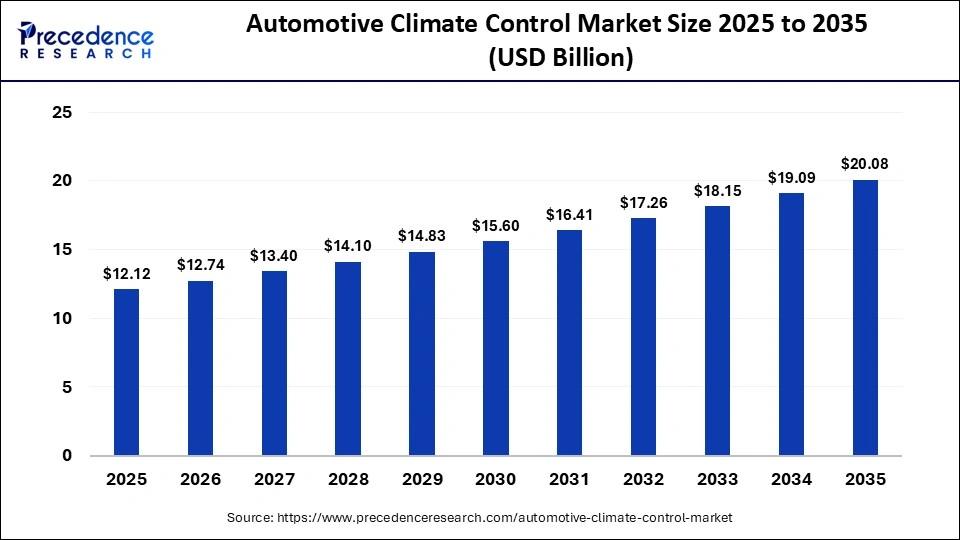
The global automotive climate control market size accounted for USD 12.12 billion in 2025 and is predicted to increase from USD 12.74 billion in 2026 to approximately USD 20.08 billion by 2035, expanding at a CAGR of 5.18% from 2026 to 2035. This market is growing due to rising demand for advanced in-car comfort systems and increasing adoption of automatic climate control in modern vehicles.
Market Highlights
- North America dominated the market, having the biggest share of 45.5% in 2025.
- Asia Pacific is expected to grow at a notable CAGR of 8.5% between 2026 and 2035.
- By technology, the automatic climate control segment contributed to the largest market share of 42.3% in 2025.
- By technology, the smart/AI-based climate control segment is growing at a CAGR of 7.2% between 2026 and 2035.
- By component, the compressor segment held the major market share of 36.5% in 2025.
- By component, the sensors segment is growing at a notable CAGR of 7.2% between 2026 and 2035.
- By vehicle type, the passenger cars segment accounted for the highest market share of 53.3% in 2025.
- By vehicle type, the electric passenger segment is expanding at a CAGR of 7.3% between 2026 and 2035.
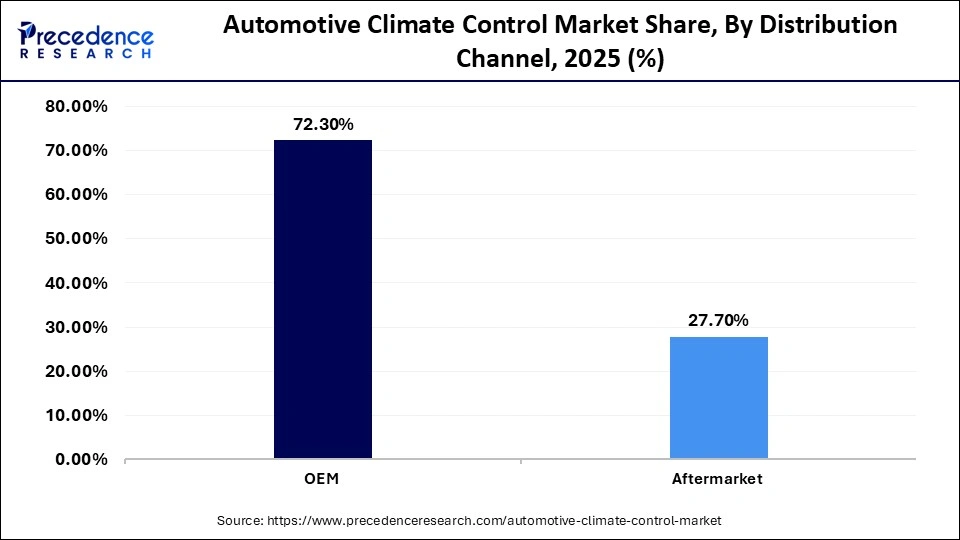
- By distribution channel, the OEM segment captured the highest market share of 72.3% in 2025.
- By distribution channel, the aftermarket segment is poised to grow at a notable CAGR of 7.5% between 2026 and 2035.
- By application, the temperature control segment contributed to largest market share of 48.5% in 2025.
- By application, the battery thermal management segment is growing at a notable CAGR of 7.6% between 2026 and 2035.
Automotive Climate Control Systems Market Overview
The automotive climate control market has been expanding steadily as buyers increasingly favor vehicles that offer improved air quality, precise temperature control, and enhanced overall cabin comfort, even within mid-range models. Automakers are integrating advanced components such as humidity sensors, cabin particulate sensors, automated air-flow regulators, and multi-zone climate control systems that adjust temperature independently for different passenger areas. These systems rely on sensor driven algorithms that monitor cabin load, sunlight intensity, and external weather conditions to maintain stable comfort levels without excessive energy use.
Demand for energy-efficient HVAC units is rising as electric-vehicle production accelerates across major automotive markets. EV manufacturers must balance climate performance with battery management requirements, which has led to the adoption of heat pumps, smart compressors, and improved refrigerant cycles that operate with lower power consumption. Cabin-air purification technologies, including activated-carbon filters and integrated HEPA systems, are also becoming standard features due to heightened consumer focus on health and air quality.
How is AI Transforming the Automotive Climate Control Market?
AI has been changing the market by creating smarter and more customized cabin environments. By utilizing sophisticated AI algorithms to monitor and evaluate the driver's behaviors, the current weather situation, and how many people are in the cabin, AI can automatically set the temperature, airflow, and humidity inside the car to ensure the highest level of comfort while conserving energy. With integration of sensors and connect systems, AI can provide real-time analysis of the air quality inside the cabin and automatically adjust the cabin's climate accordingly to ensure passenger comfort.
AI-powered climate control systems will also help electric vehicles by analyzing and optimizing the energy used to operate the climate control system to extend the battery life of the vehicle. Voice assistants and machine learning algorithms will enhance the user's ability to interact with the climate control system through natural voice commands. As automobile manufacturers continue to focus on improving the in-vehicle experience, AI-optimized climate control systems will become a key differentiator of the modern automobile platform, creating new ways to innovate and attract customers to their cars.
For Instance,
- In April 2026, Haier launched its Desert Rose AI-powered air conditioners in India, featuring AI-AtmoX technology for smart cooling, energy optimization, and automated maintenance. This includes AI Climate Control, human detection, and pre-cooling with geofencing for enhanced comfort, designed for extreme Indian summers. It delivers fast cooling, self-cleaning functions, and efficient power management.
Key Technological Shifts
- Move toward smart, sensor-based climate systems that automatically adjust temperature, airflow, and humidity based on real-time cabin and occupant conditions.
- Adoption of heat pump technology in electric vehicles to reduce energy consumption and extend driving range in cold weather.
- Integration of AI and machine learning to predict user preferences and optimize HVAC performance for efficiency and comfort.
- Use of eco-friendly refrigerants like R-1234yf and CO2 to meet global sustainability and emissions norms.
- Development of compact, lightweight HVAC components using advanced materials to improve fuel efficiency and save vehicle space.
- Connected-car climate technology, enabling remote climate pre-conditioning through smartphone apps and voice assistants.
- Advanced air-purification systems with HEPA filters, ionizers, and PM2.5 sensors to improve in-cabin air quality.
Market Trends
- Increasing adoption of smart and automatic climate control systems for better comfort and convenience.
- Growing demand for energy-efficient HVAC systems, especially in electric vehicles, improves battery range.
- Rising focuses on advanced cabin air-quality features such as air purifiers, ionizers, and high-efficiency filters.
- Expansion of multi-zone climate control in mid-range and premium cars for personalized comfort.
- Shift toward eco-friendly, low-GWP refrigerants driven by global environmental regulations.
- Development of compact, lightweight HVAC units to improve fuel efficiency and EV performance.
- Integration of connected and voice-controlled climate systems, enabling remote pre-conditioning via mobile apps.
- Increased use of heat pump technology in EVs to maintain cabin warmth with minimal energy use.
What Are the Key Factors Driving the Future Demand for Automotive Climate Control Systems?
| Future Demand | Description |
| EV Adoption | The growing production of electric and hybrid vehicles increases the need for energy-efficient, compact HVAC systems. |
| Smart & Automated Systems | Intelligent, sensor-driven climate control automatically adjusts temperature, airflow, and humidity for optimal comfort. |
| Enhanced Cabin Air Quality | Rising awareness of air pollution and health concerns drives the adoption of advanced air filters, ionizers, and purifiers. |
| Multi-Zone Customization | Consumers increasingly expect individualized climate control for different seating zones, even in mid-range cars. |
| Connected Vehicle Integration | Climate systems will integrate with mobile application and voice assistants for remote pre-conditioning and predictive adjustments. |
| Eco-Friendly & Sustainable Designs |
Use of low-GWP refrigerants, lightweight components, and sustainable materials becomes a priority. |
Automotive Climate Control Systems Market Outlook
- Industry Growth Overview: The automotive climate control market is expanding steadily because multi-zone systems, energy-efficient HVAC systems, and improved in-cabin comfort are becoming increasingly popular, especially for electric and hybrid cars. Asia Pacific, North America, and Europe are major growth-promoting regions with rising car production and widespread adoption of cutting-edge climate technologies.
- Sustainability Trends: Automotive climate control is increasingly focusing on sustainability to lessen its overall carbon footprint. Manufacturers are switching to low-GWP refrigerants like R-1234yf and CO2, creating energy-efficient HVAC systems for EVs and hybrids, and utilizing recyclable lightweight parts. While preserving cabin comforts, there is also a focus on reducing emissions from HVAC energy use.
- Startup Ecosystem: The automotive climate control startup ecosystem is expanding quickly, with many firms concentrating on advanced air quality technologies, smart climate control, and HVAC solutions tailored to electric vehicles. Predictive and customized cabin comfort systems powered by AI and IoT are being developed, and several startups are collaborating with OEM suppliers to integrate and expand their solutions worldwide.
Market Scope
| Report Coverage | Details |
| Market Size in 2025 | USD 12.12 Billion |
| Market Size in 2026 | USD 12.74 Billion |
| Market Size by 2035 | USD 20.08 Billion |
| Market Growth Rate from 2026 to 2035 | CAGR of 5.18% |
| Dominating Region | North America |
| Fastest Growing Region | Asia Pacific |
| Base Year | 2025 |
| Forecast Period | 2026 to 2035 |
| Segments Covered | Technology, Component, Vehicle Type, Distribution Channel, Application, and Region |
| Regions Covered | North America, Europe, Asia-Pacific, Latin America, and Middle East & Africa |
Segmental Insights
Technology Insights
What Made the Automatic Climate Control Segment Dominate the Automotive Climate Control Market?
Automatic Climate Control: The segment dominates the automotive climate control market with a 42.3% share because it consistently delivers energy efficiency and cabin comfort, minimizes driver effort, integrates seamlessly with vehicle electronics, and automatically maintains preset temperatures. It is widely used in mid-range and luxury passenger cars. Growing consumer preferences for comfort, convenience, and dependable climate control across a variety of driving circumstances contribute to this segment's dominance.
Smart/AI-Based Climate Control: The segment is growing rapidly, with 7.2% growth driven by the increasing adoption of intelligent, connected automobiles. By learning driver preferences, optimizing energy use, and adapting to current environmental conditions, these systems deliver individualized cabin comfort. The adoption of AI-enabled climate solutions in both passenger cars and electric vehicles is being accelerated by growing consumer demand for high-tech, energy-efficient, and customizable vehicle features.
Component Insights
Why Did the Compressor Segment Dominate the Automotive Climate Control Market?
Compressor: The segment dominated the market with a 36.5% share because it is essential for controlling cabin temperature and maintaining air-conditioning effectiveness. Compressors are crucial to all climate control systems, as they are used in conventional hybrid and electric vehicles. Ongoing technological advancements in quieter operation and energy efficiency reinforce their market dominance.
Sensors: The segment is growing rapidly, up 7.2%, due to its critical role in accurate monitoring of air quality, temperature, humidity, and particulate concentration within the vehicle cabin. These sensors act as the foundation of modern climate-control systems by providing continuous, real-time data that allows HVAC units to adjust airflow, compressor output, and filtration levels with high precision. Air-quality sensors measure CO2 levels, volatile organic compounds, and fine particulate matter to trigger automatic recirculation or activate purification modules when external pollution increases.
Vehicle Type Insights
What Made the Passenger Cars Segment Dominate the Automotive Climate Control Market?
Passenger Cars: The segment dominates the market with a 53.3% share because most climate control systems are built into both luxury and regular cars. Growing urbanization, rising disposable incomes, and consumer preferences for comfort features in mid-range and high-end vehicles all contribute to strong demand.
Electric Passenger Cars: The electric passenger car segment is growing rapidly, with 7.3% growth driven by accelerating EV adoption and the rising need for efficient thermal-management systems. Electric vehicles depend heavily on advanced climate-control technologies because cabin heating and cooling draw energy directly from the high-voltage battery. This makes thermal efficiency a critical determinant of driving range, battery longevity, and overall vehicle performance.
Distribution Channel Insights
What Made the OEM Segment Dominate the Automotive Climate Control Market?
OEM: The segment dominates the market with a 72.3% share, as most cars have standardized climate control systems installed at the factory. OEMs guarantee dependable operation, smooth system integration, and compliance with international efficiency requirements. The increasing production of feature-rich automobiles further strengthens OEM demand. Additionally, automakers are giving energy-efficient climate innovations top priority, which is fueling this market's steady expansion.
Aftermarket: The segment is growing rapidly with 7.5%, driven by the growing need to upgrade, replace, and retrofit older cars' climate systems. To increase comfort, consumers are seeking upgrades to sensors, cabin filters, and smart climate systems. Demand for aftermarket climate components is also being driven by growth in sales of used cars. Moreover, affordable installation options are encouraging adoption in developing economies.
Application Insights
Why Did the Temperature Control Segment Dominate the Automotive Climate Control Market?
Temperature Control: The segment dominated the market, accounting for 48.5% of it. Their market dominance is reinforced by their dependability, efficiency, and compatibility with both internal combustion and electric vehicles. Growing demands for comfort in hot and cold climates further boost global adoption. To enhance energy efficiency and the riding experience, automakers are improving temperature control technologies.
Battery Thermal Management: The segment is the fastest-growing application, with a 7.6% growth rate, driven by the rapid global adoption of EVs. These systems are essential to the success of electric vehicles because they guarantee battery longevity, safety, and optimal performance. Rising investments in high-performance batteries and heat-pump technologies drive the growth of this market. Battery thermal management is emerging as one of the most sought-after climate applications as global EV production rises.
Regional Insights
What is the Asia Pacific Automotive Climate Control Market Size?
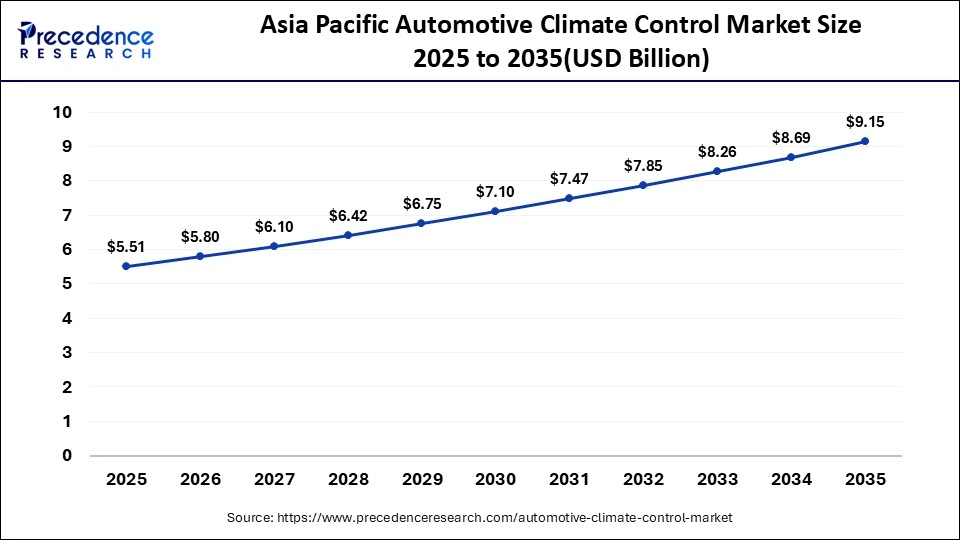
The Asia Pacific automotive climate control market size is expected to be worth USD 9.15 billion by 2035, increasing from USD 5.51 billion by 2025, growing at a CAGR of 5.20% from 2026 to 2035.
Why Did the Asia Pacific Region Dominate the Automotive Climate Control Market?
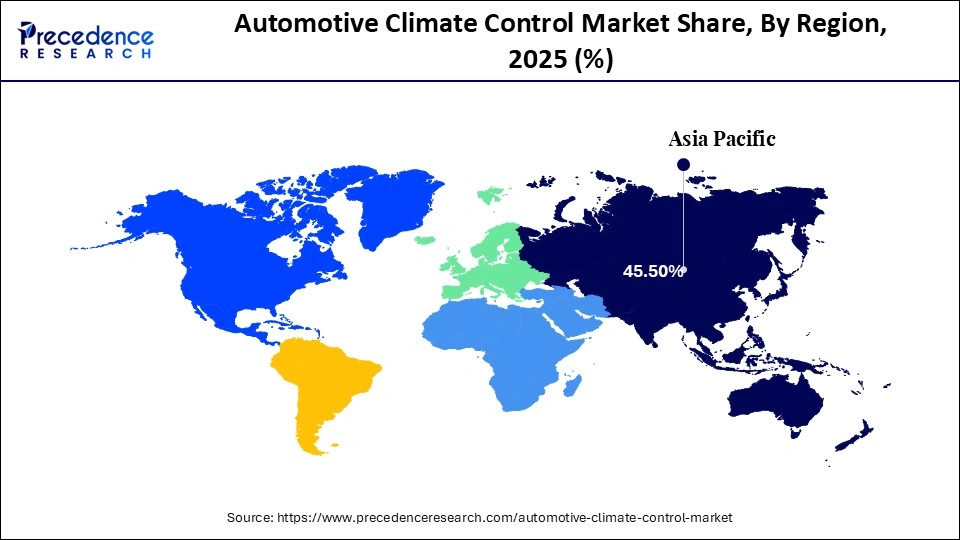
Asia Pacific dominates the market with a 45.5% share, gaining from extensive automobile production. Strong demand for cars with cutting-edge climate systems is supported by growing middle-class incomes and rapid urbanization. The region's automakers are progressively incorporating smart climate technology into mid-range vehicles. The demand for cutting-edge climate solutions is further driven by government support for EV adoption.
India's Automotive Climate Control Market Trends
The automotive climate control market in India is growing as buyers favor cars with more sophisticated interior features and increased comfort. Automatic and multi-zone climate systems are becoming more popular as demand for mid-range and high-end vehicles rises. Climate control is becoming increasingly important due to hot weather in most areas. The installation of systems in new car models is also accelerating due to increased urban mobility and rising disposable incomes.
What Is Driving North America to Become the Fastest-Growing Region in the Automotive Climate Control Market?
North America is the fastest-growing region at 8.5%, driven by rising electric-vehicle adoption, rapid technological advancements, and a strong consumer preference for high-comfort interior features. Buyers in the region increasingly favor smart, efficient, and AI-enabled climate-control systems that adapt cabin temperature, airflow, and air quality in real time based on sensor feedback. The adoption of EVs and hybrid models reinforces this demand, as thermal-management efficiency directly influences vehicle range and battery performance.
Strict emission regulations in the United States and Canada push automakers to integrate energy-efficient HVAC components, including heat pumps, variable-speed compressors, and advanced refrigerant systems designed to reduce overall power consumption. The region also shows strong demand for premium SUVs and high-end electric models, both of which rely on multi-zone climate control, cabin-air purification, and predictive thermal algorithms to differentiate user experience. These combined factors continue to accelerate market expansion and solidify North America's position as the fastest-growing region in the automotive climate-control landscape.
U.S. Automotive Climate Control Market Trends
In the U.S., the automotive climate control market is driven by high demand for luxury comfort and cutting-edge cabin technology. Customers anticipate that cars will have rapid cooling, precise temperature control, and intelligent air-purification systems. Climate systems are crucial for all kinds of vehicles due to the drastic climate differences between states. Rising sales of SUVs and high-end cars continue to strengthen demand for cutting-edge climate technologies.
What Factors Are Driving the Growth of Europe's Automotive Climate Control Market?
Europe's automotive climate-control market is expanding due to rising electric-vehicle penetration, widespread integration of advanced comfort technologies, and stringent emissions regulations that require automakers to deploy more energy-efficient thermal systems. Regulatory frameworks such as the European Union's COâ‚‚ emission standards and the transition toward low-GWP refrigerants push manufacturers to redesign HVAC units with higher thermal efficiency and lower environmental impact.
Automakers across Germany, France, the UK, and the Nordic countries are incorporating sensor-enabled multi-zone climate control, predictive temperature algorithms, and air-quality monitoring to enhance both cabin comfort and battery efficiency in EVs. The market is further strengthened by the region's strong emphasis on sustainability, premium-vehicle demand, and consumer preference for refined climate experiences in high-end models.
Germany Automotive Climate Control Market Trends
Germany remains a key contributor to Europe's climate control marketdue tof its robust automotive manufacturing base and the rapid adoption of advanced climate systems by high-end brands such as Mercedes, Audi, and BMW. Innovations like AI-based cabin comfort solutions and EV heat-pump systems are among the nation's top innovations. Demand for effective thermal management systems is further accelerated by rising EV production and sophisticated engineering capabilities.
Why Is Automotive Climate-Control Demand Rising in the Middle East and Africa?
The Middle East and Africa region is experiencing growing demand for automotive climate-control systems, driven primarily by extreme temperatures that make air conditioning an essential component across all vehicle categories. Consumers expect HVAC systems capable of rapid cooling, stable performance in high ambient heat, and durability under harsh operating conditions. Rising SUV sales, expansion of the automotive aftermarket, and increased urbanization contribute to greater adoption of upgraded climate technologies.
Governments throughout the Gulf region and parts of Africa are prioritizing transportation infrastructure development, which encourages the introduction of modern climate-control systems with higher efficiency, improved filtration, and sensor-assisted airflow management. These conditions collectively support steady regional growth.
UAE Automotive Climate Control Market Trends
UAE climate control systems are essential due to year-round high temperatures, driving strong consumer preference for vehicles with powerful cooling performance. Luxury and premium car sales are rising, pushing automakers to offer advanced multi-zone climate systems with improved filtration. Growing EV adoption and smart mobility initiatives are further increasing the demand for efficient, next-generation thermal solutions.
What Is Driving the Expansion of Latin America's Automotive Climate Control Market?
Latin America's automotive climate-control market is expanding as manufacturers upgrade HVAC systems in mid-range vehicles and consumers seek enhanced comfort features across new and existing models. Hot climates in countries such as Brazil, Mexico, and Colombia sustain consistent demand for reliable air-conditioning units with rapid cooling capability. Rising car ownership, along with increasing popularity of compact and mid-sized vehicles equipped with improved interior features, further strengthens market growth.
More affordable models now include advanced climate-control functions, such as automatic temperature regulation and improved filtration, enabled by better economic conditions and greater access to financing. These developments collectively contribute to the steady expansion of automotive climate-control adoption across the region.
Brazil Automotive Climate Control Market Trends
Brazil leads the Latin American market because of its robust vehicle manufacturing base and strong consumer preference for passenger cars with air conditioning. Because of the country's tropical climate, even low-cost cars need climate control, which encourages widespread adoption. Automakers are being forced to implement more effective cooling and thermal management systems due to growing interest in EVs and smart cabin technologies.
Top Automotive Climate Control Market Companies
- Air International Thermal Systems
- Behr Hella Thermocontrol (BHTC)
- BorgWarner Inc.
- Brose Fahrzeugteile GmbH & Co. KG
- Calsonic Kansei Corporation (Marelli)
- Continental AG
- Dana Incorporated
- DENSO Corporation
- Eberspacher Group
- Gentherm Incorporated
- Hanon Systems
- Japan Climate Systems Corporation (JCS)
- Johnson Electric Holdings Limited
- Keihin Corporation
- MAHLE GmbH
- Marelli Corporation
- Mitsubishi Heavy Industries Ltd.
- Sanden Holdings Corporation
- Subros Limited
- Valeo SA
- Webasto SE
Recent Developments
- In November 2025, Shanghai Highly Group unveiled advanced thermal management systems for EVs at the Japan Mobility Show 2025. Highly introduced new indirect heat-pump thermal-management systems for electric vehicles, combining electric compressors, high-voltage coolant heating, and electronic controls to improve cabin comfort, heating/cooling efficiency, and energy use.(Source: https://en.prnasia.com)
- In July 2025, BorgWarner announced that it had won contracts with two major global OEMs to supply its high-voltage coolant heater (HVCH) technology for plug-in hybrid electric vehicle platforms, enhancing cabin and battery heating efficiency in hybrid models.(Source: https://www.borgwarner.com)
Segments Covered in the Report
By Technology
- Manual/Semi-Automatic Climate Control
- Automatic Climate Control
- Multi-Zone Climate Control
- Smart/AI-Based Climate Control
By Component
- Compressor
- Evaporator
- Condenser
- Control Panel
- HVAC Housing
- Sensors
- Blower Motor
By Vehicle Type
- Passenger Cars
- Light Commercial Vehicles
- Heavy Commercial Vehicles
- Buses & Coaches
By Distribution Channel
- OEM
- Aftermarket
By Application
- Temperature Control
- Defrosting/Defogging
- Air Filtration
- Battery Thermal Management
By Region
- North America
- Europe
- Asia-Pacific
- Latin America
- Middle East and Africa
For inquiries regarding discounts, bulk purchases, or customization requests, please contact us at sales@precedenceresearch.com
Frequently Asked Questions





Ask For Sample
No cookie-cutter, only authentic analysis – take the 1st step to become a Precedence Research client
 Get a Sample




 sales@precedenceresearch.com
 Schedule a Meeting
