



Automotive Composites Market Revenue to Attain USD 34.25 Bn by 2035
Published: 13 Jul 2026
Author: Precedence Research



Automotive Composites Market Revenue and Trends 2026 to 2035
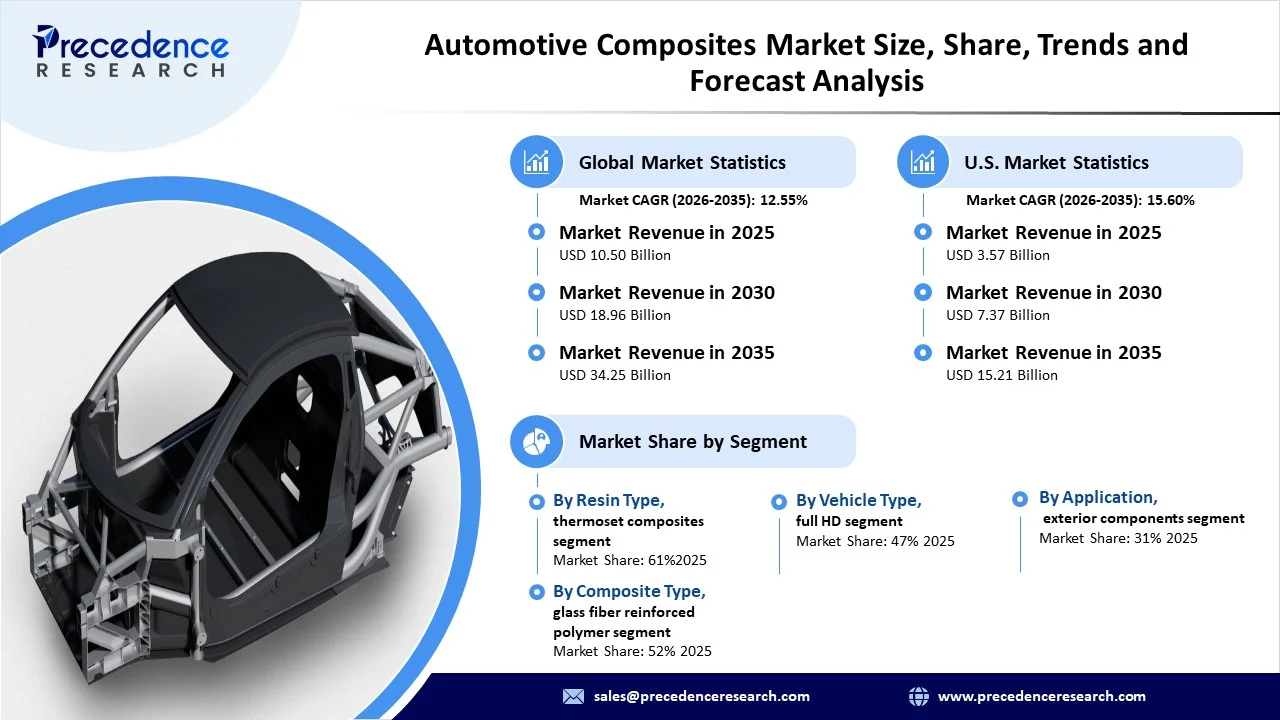
The global automotive composites market revenue was valued at USD 10.50 billion in 2025 and is expected to attain around USD 34.25 billion by 2035, growing at a CAGR of 12.55% during forecast period. The market is driven by the critical requirement of decreasing the weight of automobiles to achieve better fuel economy and range in electric vehicles, and the growing use of composite materials based on carbon fiber and glass fiber for structural and semi-structural applications.
The Material Revolution in Automobile Manufacturing
The automotive composites market includes all types of composites, including carbon fiber, glass fiber, natural fibers, and advanced polymer matrices used in the manufacture of automotive components. It involves structural components, semi-structural components, exterior body parts, interior components, and under-the-hood components. The use of composites can help save a considerable amount of weight compared to traditional metals, resulting in better fuel economy, extended electric vehicle driving range, and reduced emissions.
The market includes thermoset and thermoplastic composites and next-generation composites such as carbon fiber-reinforced thermoplastics and natural fiber composites. It encompasses the entire supply chain from raw material suppliers to compounders, part manufacturers, and tier suppliers. The key applications include body panels, chassis components, battery housing, crash management systems, interior trim, and engine components. This market has been adopted by OEMs, tier-one suppliers, and aftermarket part suppliers.
The Usage of Eco-Friendly Natural Fiber Composites
There is an increasing interest in sustainable materials within the automobile composites industry. In particular, there are advances in natural fiber composites that can be used both externally and internally. This type of material ensures considerable weight saving and reduced environmental impact when compared to conventional carbon fiber composites. In 2026, the BMW Group, together with its partners (Bcomp, SGL Carbon, among others received the JEC Composites Innovation Award in the “Automotive and Road Transportation- Parts” nomination for their “BMW M Natural Fiber Composites Project”. The project is dedicated to the industrialization of flax fiber composites for visible exterior parts of vehicles.
Introduction of Carbon Fiber Chassis in Commercial Vehicles
The structural components made of carbon fiber are being increasingly introduced in commercial vehicles, as an attempt to compensate for the weight of batteries and electric drive systems. After many years of development, the approval of the usage of carbon fiber in the chassis of vans and trucks represents an increasing level of trust placed in composites for high-volume and load-bearing applications. In 2026, Carbon Truck and Trailer GmbH (CarbonTT) received the Certification of Conformity and Compatibility of a CFRP chassis designed for the Mercedes-Benz Sprinter Van. The chassis has around 20% higher payload than a conventional steel chassis due to seven years of development, which included FEM-simulation, material qualifications, and durability tests.
Government Investment Speeds Up Production of Lightweight Composite Cylinders
Governments across the world are financing the development of advanced composite technologies within their countries for greener transportation and to decrease the kerb weight of automobiles. These ventures invest in production facilities for innovative components, which help save on the use of heavy components. In 2026, TDB (Technology Development Board), which is part of India’s Department of Science and Technology, made an agreement with NTF Energy Solutions to construct a manufacturing plant for commercially producing domestically developed type IV composite cylinders for CNG vehicles. The cylinders have the potential to provide up to 75% reduction in weight from conventional steel cylinders.
Debut of Sustainable Composite Materials in Mercedes F1 Car
At the Azerbaijan Grand Prix in 2025, the Mercedes-AMG Petronas F1 Team utilized bio-based carbon fiber composites on the rear brake duct wheel shields of their W16 car. They employed an epoxy resin named Syensqo, which consists of 30% renewable monomers sourced from biodiesel derivatives. The material showcased the capability to endure high levels of mechanical and thermal strain associated with Formula One races, along with being a more environmentally friendly alternative.
Market Segmentation Overview
- By resin type, the thermoset composites segment led the automotive composites market with a 61% share in 2025, due to their excellent mechanical properties, which include strength, fatigue resistance, and dimensional stability. This segment has been widely adopted in automotive structural and semi-structural equipment.
- By resin type, the thermoplastic composites segment is expected to expand at the highest CAGR of 14.8% during the forecast period, owing to their numerous benefits over thermoset composites, such as fast cycle time, easy recyclability, excellent damage tolerance, and the capability of being reheated and remolded. These factors resonate with the automotive industry’s needs for sustainable, economical, and mass production future goals.
- By vehicle type, the passenger cars segment dominated the market with a 47% share in 2025, due to the fact that they constitute the largest share of the world’s production of vehicles, amounting to more than 70 million units per year. Companies widely use advanced composites in passenger cars to optimize weight, which improves fuel economy and driving dynamics.
- By vehicle type, the electric vehicles (EVs) segment is expected to grow at the fastest CAGR of 18.5% from 2026 to 2035, as composite materials can help in cutting down weight significantly in this segment, as EVs come with bulky battery packs that tend to contribute a big chunk of the automobile.
- By application, the exterior components segment led the automotive composites market with a 31% share in 2025, since it involves the maximum surface area and volume of composite material, such as body panels, hood, roof, fenders, spoilers, etc., for each vehicle. The usage of composites helps optimize kerb weight, which improves fuel economy and performance. The automotive industry has decades of experience in the manufacturing process using methods such as compression molding and resin transfer molding, and is capable of producing an excellent surface finish.
- By application, the battery enclosures segment is expected to expand at the highest CAGR of 19.2% during the forecast period, owing to the high growth rate of production of electric vehicles, which is leading to a huge demand for lightweight and high-strength composites to be used in the battery enclosures of such cars. The optimization of kerb weight leads to improvements in terms of range and efficiency of the vehicle.
- By composite type, the glass fiber reinforced polymer (GFRP) segment dominated the market with a 52% share in 2025, due to the perfect balance it provides in terms of cost versus performance, giving substantial weight savings and mechanical strength for a fraction of the price of carbon fiber. This makes it economically feasible for passenger vehicle parts that require high volumes.
- By composite type, the carbon fiber reinforced polymer (CFRP) segment is expected to grow at the fastest CAGR of 16.4% from 2026 to 2035, owing to the unmatched ratio of tensile strength to weight, which makes it the most suitable composite material for use in light-weighting, including battery boxes, chassis parts, and safety systems.
- By end user, the OEMs segment led the market with an 86% share in 2025 and is expected to expand at the highest CAGR of 12.9% during the forecast period, since they are the final authority when it comes to designing and choosing materials that are used in the manufacture of vehicles. They incorporate composite materials in their production processes to meet CO2 requirements and enhance the efficiency of vehicles.
- By end user, the aftermarket segment held the second-largest market share of 14% in 2025, because it has been adopted by a huge number of existing cars fitted with composite parts such as body panels, spoilers, hoods, and bumpers, which are required to be replaced because of accidents and wear.
Regional Analysis
Asia-Pacific led the automotive composites market with a 34% share in 2025 and is expected to expand at the highest CAGR of 15.6% during the forecast period because of its status as the largest automobile manufacturing base, contributing more than 50% to the total global vehicle production. China led the market in Asia-Pacific due to its high volumes of car production, stringent government policies towards the lightweighting of vehicles, and the fact that it is the largest producer of electric cars, where composite materials play a critical role in compensating for the weight of batteries. Japan witnessed notable market growth owing to its advancements in carbon fiber technologies, the automobile industry, significant innovations in thermoplastic composites, and an automated manufacturing process.
Europe held the second-largest market share of 31% in 2025, due to its advanced automotive industry, long legacy of composite developments in optimizing kerb weight, and strict CO2 emission standards that led to the adoption of composite materials. Germany dominated the market in Europe as it is the largest automobile market in Europe, having premium brands that have extensively adopted carbon fiber composites and natural fiber composites for structural and exterior use. The UK is a significant contributor to the market owing to its dominance in the area of motorsports composites, good research and development infrastructure, as well as an increasing number of startups and small companies focused on sustainable composites and advanced manufacturing.
North America held the third-largest market share of 28% in 2025, owing to its dominance in production and supply of high-end advanced composite materials used in specialty cars, motorsports, and military applications, coupled with the development of novel manufacturing methods and environmentally sustainable composite materials. The U.S. led the market in North America because of significant manufacturing of carbon fiber and thermoplastic composites, the advanced and aggressive aerospace and defense industries that push the envelope on innovations in composite materials. Canada has witnessed notable market growth since it has an emerging composite materials research and development and manufacturing operations environment, and the tight linkages between Canadian and U.S. automobile equipment logistics.
Automotive Composites Market Coverage
| Report Attribute | Key Statistics |
| Market Revenue in 2025 | USD 10.50 Billion |
| Market Revenue by 2035 | USD 34.25 Billion |
| CAGR from 2026 to 2035 | 12.55% |
| Quantitative Units | Revenue in USD million/billion, Volume in units |
| Largest Market | Asia-Pacific |
| Base Year | 2025 |
| Regions Covered | North America, Europe, Asia-Pacific, Latin America, and the Middle East & Africa |
Top Companies in the Automotive Composites Market
Toray Industries, Teijin Limited, Mitsubishi Chemical Group, and SGL Carbon are some of the key companies that supply carbon fiber and composite material products used in the automotive sector. Hexcel Corporation, Owens Corning, Solvay, and BASF provide glass fiber reinforcements, resins, and composite material products. Magna International, ElringKlinger, POLYTEC HOLDING, and Röchling are some of the main Tier 1 suppliers that incorporate composites in automotive structures.
Segments Covered in This Report
By Fiber Type
- Glass Fiber Composites
- Carbon Fiber Composites
- Natural Fiber Composites
- Aramid Fiber Composites
- Basalt Fiber Composites
- Hybrid Fiber Composites
By Resin Type
- Thermoset Composites
- Polyester Resin
- Epoxy Resin
- Vinyl Ester Resin
- Polyurethane Resin
- Thermoplastic Composites
- Polypropylene (PP)
- Polyamide (PA)
- Polyether Ether Ketone (PEEK)
- Polycarbonate (PC)
- Polyphenylene Sulfide (PPS)
- Other Thermoplastics
By Manufacturing Process
- Compression Molding
- Injection Molding
- Resin Transfer Molding (RTM)
- Sheet Molding Compound (SMC)
- Bulk Molding Compound (BMC)
- Pultrusion
- Filament Winding
- Hand Lay-up
- Others
By Vehicle Type
- Passenger Cars
- Light Commercial Vehicles (LCVs)
- Heavy Commercial Vehicles (HCVs)
- Electric Vehicles (EVs)
- Sports Cars and Luxury Vehicles
By Application
- Exterior Components
- Bumpers
- Hoods
- Roof Panels
- Doors
- Fenders
- Tailgates
- Interior Components
- Instrument Panels
- Seat Structures
- Door Panels
- Center Consoles
- Structural Components
- Chassis
- Monocoque Structures
- Cross Members
- Powertrain Components
- Battery Enclosures
- Underbody Shields
- Leaf Springs
- Others
By Composite Type
- Fiber Reinforced Polymer (FRP)
- Carbon Fiber Reinforced Polymer (CFRP)
- Glass Fiber Reinforced Polymer (GFRP)
- Natural Fiber Reinforced Polymer (NFRP)
- Hybrid Composites
By End User
- OEMs
- Aftermarket
By Region
- North America
- Latin America
- Europe
- Asia-pacific
- Middle and East Africa
Get this report to explore global market size, share, CAGR, and trends, featuring detailed segmental analysis and an insightful competitive landscape overview @ https://www.precedenceresearch.com/sample/8545
You can place an order or ask any questions. Please feel free to contact us at sales@precedenceresearch.com |+1 804 441 9344