



Automotive Composites Market Size, Companies, Share, Vehicle Production Volume, Sales Performance, Export & Import Analysis, Technology Adoption, Competitive Positioning, and Demand Trends
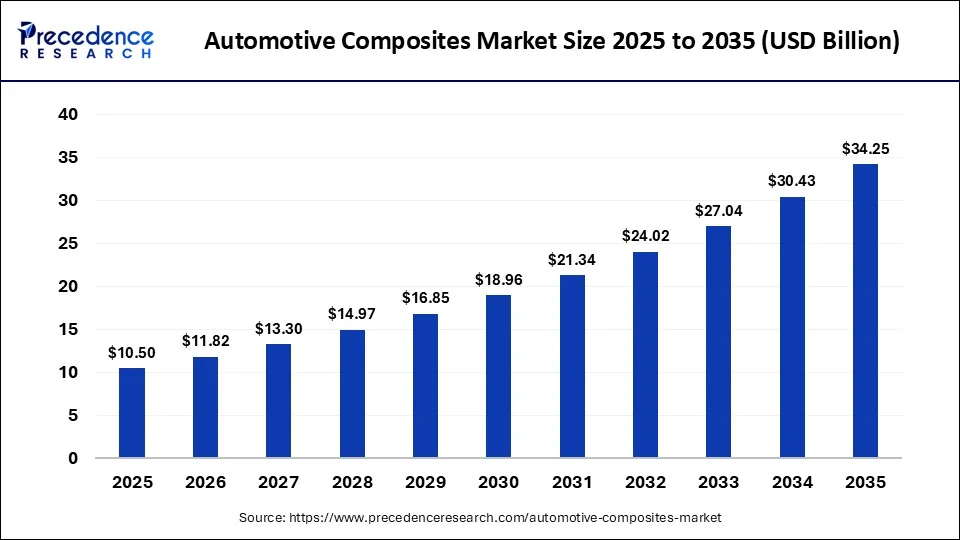
According to automotive sector expert, Laxmi Narayan notes that the automotive composites market stands at USD 11.82 billion in 2026 and is expected to reach USD 34.25 billion by 2035, growing at a CAGR of 12.55%. Leading automotive composites market companies such as Formaplex, GMS Composites, Gurit, Hexcel Corporation are driving market development across segments including fiber type, resin type, manufacturing process, vehicle type, application, composite type, end user, region.
Source: https://www.precedenceresearch.com/automotive-composites-market
 Get a Sample
 Table Of Content


Automotive Composites Market Size and Forecast 2026 to 2035
The global automotive composites market size accounted for USD 10.50 billion in 2025 and is predicted to increase from USD 11.82 billion in 2026 to approximately USD 34.25 billion by 2035, expanding at a CAGR of 12.55% from 2026 to 2035. The market growth is attributed to rising vehicle lightweighting initiatives and continuous innovations in high-performance automotive manufacturing technologies.
Key Takeaways
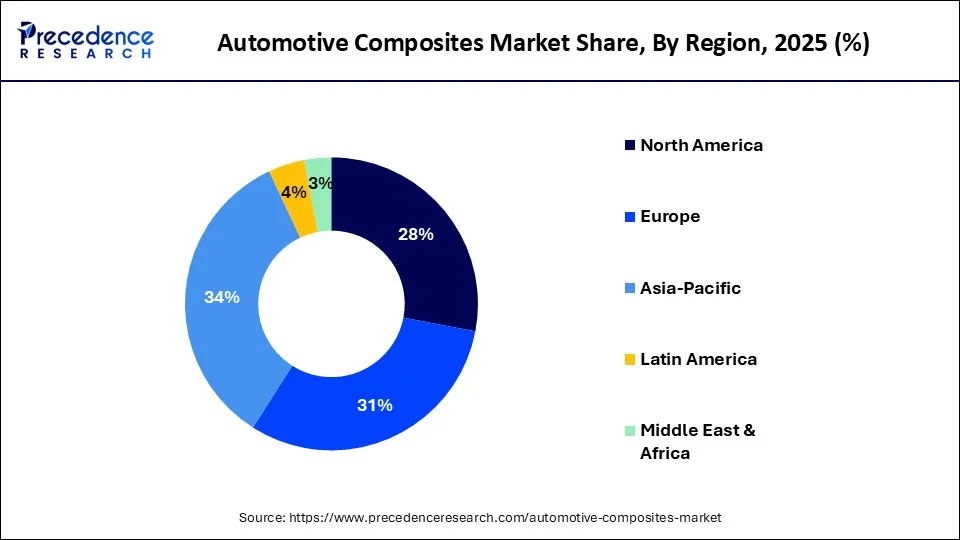
- Asia-Pacific dominated the automotive composites market with 34% of the market share in 2025 and is expected to sustain its position as a leader with a CAGR of 15.6% in the upcoming period.
- Europe held the second-largest market share of 31% in 2025.
- By resin type, the thermoset composites segment contributed the highest market share of 61% in 2025.
- By resin type, the thermoplastic composites segment is expected to grow at the fastest CAGR of 14.8% between 2026 and 2035.
- By vehicle type, the passenger cars segment held a major market share of 47% in 2025.
- By vehicle type, the electric vehicles (EVs) segment is expected to register a rapid growth of 18.5% CAGR during 2026 and 2035.
- By application, the exterior components segment contributed the automotive composites highest market share of 31% in 2025.
- By application, the battery enclosures segment is expected to grow at a strong CAGR of 19.2% over the projected period.
- By composite type, the glass fiber reinforced polymer (GFRP) segment contributed the highest market share of 52% in 2025.
- By composite type, the carbon fiber reinforced polymer (CFRP) segment is expected to grow at the fastest CAGR of 16.4% between 2026 and 2035.
- By end user, the OEMs segment contributed the highest market share of 86% in 2025 and is expected to sustain as a leader with a CAGR of 12.9% in the upcoming period.
- By end user, the aftermarket segment is expected to grow at a considerable CAGR of 10.1% between 2026 and 2035.
Market Overview
Increasing demand for lightweight, fuel-efficient, and longer-range electric vehicles continues facilitating the automotive composites manufacturing sector. Automotive composites are composed of reinforcing fibers, including carbon, glass, or natural fibers, and polymer resins. Thereby resulting in low-weight and high-strength composites.
Composites have increased structural strength, easier load handling, and corrosion resistance. They are now increasingly being utilised in automaker body panels, battery enclosures, chassis, and interior panels. Furthermore, major companies such as Toray Industries, Hexcel, Teijin, SGL Carbon, Syensqo, and BASF are progressing their efforts to make recyclable composites, boosting the market in the coming years.
Impact of Artificial Intelligence on the Automotive Composites Market
Composites shaping innovation in the automotive sector are bolstered by artificial intelligence (AI). This technology is positively impacting new materials innovation, streamlining the production of those parts. Machinery manufacturers have leveraged AI to model materials and test combinations.
It helps reduce the time for development when technology would take years and replicate the process at a lower cost. On the other hand, composite components are inspected by AI-powered computer vision systems for defects, including voids, fiber misalignment, and delamination.
Automotive Composites Market Growth Factors
- Rising Demand for Advanced Crash Protection Systems: Increasing emphasis on vehicle safety is driving composite integration in impact-resistant structural and energy-absorbing parts.
- Boosting Development of Multi-Material Vehicle Platforms: Automotive manufacturers are pushing for increased use of multi-material vehicle platforms to maximise use of the materials for optimum structural performance.
Automotive Composites Market Trends
- Expansion of Gigacasting-Compatible Composite Assemblies: Automotive suppliers are rushing to industrialize the use of recycled carbon fiber components. Improved recovery technologies are being used in different interior structures, battery systems, and semi-structural vehicle parts sectors to expand commercial applications.
- Automated Thermoplastic Composite Welding Gains Momentum: Automotive OEMs are seeing momentum growth in their investment in thermoplastic welding technologies. New, faster joining techniques are shortening assembly times and enabling increased production runs of lightweight vehicle structures.
Market Report Coverage and Key Metrics
| Report Coverage | Details |
| Market Size in 2025 | USD 10.50 Billion |
| Market Size in 2026 | USD 11.82 Billion |
| Market Size by 2035 | USD 34.25 Billion |
| Market Growth Rate from 2026 to 2035 | CAGR of 12.55% |
| Dominating Region | Asia Paicfic |
| Fastest Growing Region | Europe |
| Base Year | 2025 |
| Forecast Period | 2026 to 2035 |
| Segments Covered | Fiber Type, Resin Type, Manufacturing Process, Vehicle Type, Application, Composite Type, End User, and Region |
| Regions Covered | North America, Europe, Asia-Pacific, Latin America, and Middle East & Africa |
Market Dynamics
Drivers
Increasing Electric Vehicle Production Accelerates Composites Material Adoption
Increasing global electric vehicle production is expected to drive the market. Composite materials replace conventional steel and aluminium. They offer lightweight body structures for long range and battery efficiency. The IEA projects that the global market for electric cars was over 17 million units sold in 2024.
This drives ongoing demand for lightweight engineering materials throughout the vehicle, with a particular focus on the battery system. Furthermore, the material suppliers, including Toray Industries, Hexcel, and Teijin, are still bringing new composites for boosting market growth.
Restraint
High Carbon Fiber and Advanced Raw Material Costs
High carbon fiber and advanced reinforcement material costs are expected to hinder automotive composites market growth. The manufacturing of carbon fibre composites is a high-energy-intensive process. This involves the use of precursor materials that are not generally available, thus driving up overall costs. Furthermore, the limited recycling infrastructure for advanced composite materials is anticipated to influence market growth in the coming years.
Opportunity
Rising Investments in Sustainable Composite Technologies Advance Automotive Material Innovation
Rising investments in recyclable and sustainable composite technologies are anticipated to create immense opportunities for the market. Vehicle manufacturers are increasingly incorporating thermoplastic composites and bio-reinforcement fibres.
Material suppliers have been working to create low-carbon resin systems and fibre solutions. These are easily recycled to mitigate environmental impacts over the vehicle's lifecycle. Additionally, the increasing collaboration between automakers and material suppliers is fuelling market growth in the projected period.
Market Segmentation Analysis
Resin Type Insights
The Thermoset Composites Segment Dominated the Market with 61% of Market Share in 2025
The thermoset composites segment dominated the automotive composites market with a share of 61% in 2025, due to its high strength and thermal stability. These advantages are essential for structural body parts, battery enclosures, and underbody assemblies. Furthermore, the lightweight thermoset lines are introduced frequently for wider end-users by Hexcel, Syensqo, Huntsman Corporation, Owens Corning, and SGL Carbon, creating wider opportunities for the market in the coming years.
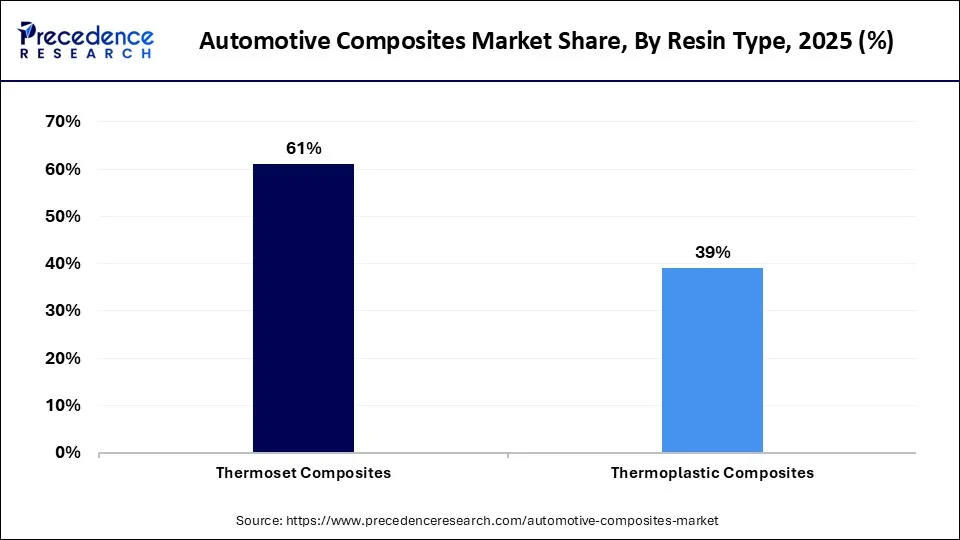
The thermoplastic composites segment held 39% of the market share in 2025 and is expected to grow at the fastest CAGR of 14.8% between 2026 and 2035, due to its recyclability and quicker manufacturing process. They are capable of fast processing and reshaping that enhances production efficiency for medium- to large-sized vehicle assembly programs. Moreover, the commercialization of innovative technologies for advanced thermoplastic composites is further driving the deployment of vehicles.
Vehicle Type Insights
The Passenger Cars Segment Dominated the Market with 47% of Market Share in 2025
The passenger cars segment dominated the automotive composites market with a share of 47% in 2025, due to the industry's focus on reducing vehicle weight without compromising safety or performance. Composite constructions enhance crash energy absorption, corrosion resistance, and overall durability in various driving scenarios.
Glass fiber and carbon fiber composites continued to be used in high-volume production of passenger vehicles. Furthermore, the growing number of passenger vehicle production is expected to fuel the market in the coming years. European Automobile Manufacturers' Association (ACEA) estimates Europe's 2024 production of passenger cars is around 10.63 million.
Automotive Composites Market Share, By Vehicle Type, 2025 (%)
| Vehicle Type | 2025 | 2035 | CAGR (%) |
| Passenger Cars | 47 | 42 | 11.20% |
| Light Commercial Vehicles (LCVs) | 16 | 15 | 11.00% |
| Heavy Commercial Vehicles (HCVs) | 10 | 9 | 10.30% |
| Electric Vehicles (EVs) | 22 | 31 | 18.50% |
| Sports Cars & Luxury Vehicles | 5 | 3 | 9.40% |
The electric vehicles (EVs) segment held 22% of the market share in 2025 and is expected to grow at the highest CAGR of 18.5% between 2026 and 2035, owing to the rapid shift towards lightweight battery-powered mobility. Engineers are focusing on greater use of composite parts to deliver greater range without growing the battery size or the car's dimensions.
The International Energy Agency (IEA) stated that electric cars accounted for 20% of new cars sold globally in 2024. This is driving up the demand for lightweight engineering composite materials in the coming years.
The light commercial vehicles (LCVs) segment held a 16% share in 2025 and is expected to register a notable growth of 11% CAGR during 2026 and 2035, driven by strong long-term composite demand in commercial manufacturers. Composite materials are used for crash protection systems, aerodynamic panels, and thermal management components.
Application Insights
The Exterior Components Segment Led the Market with 31% of Market Share in 2025
The exterior components segment led the automotive composites market with a share of 31% in 2025, as diversified body structures are going lightweight across both passenger and electric car segments. Companies are increasingly using composites to replace traditional exterior metal panels for their vehicle for good aerodynamic performance and car efficiency.
The battery enclosures segment held 11% of the market share in 2025 and is expected to grow at the highest CAGR of 19.2% between 2026 and 2035, supported by growing concerns about the protection of high-voltage battery systems and the reduction of overall vehicle weight. The use of advanced composites offers improved thermal insulation and structural integrity. Furthermore, the launch of new EV battery-specific composites is expected to fuel market growth in the coming years.
Automotive Composites Market Share, By Application, 2025 (%)
| Application | 2025 | 2035 | CAGR (%) |
| Exterior Components | 31 | 29 | 11.80% |
| Interior Components | 20 | 18 | 10.70% |
| Structural Components | 17 | 21 | 15.70% |
| Powertrain Components | 8 | 7 | 10.20% |
| Battery Enclosures | 11 | 16 | 19.20% |
| Underbody Shields | 6 | 5 | 10.90% |
| Leaf Springs | 5 | 3 | 8.30% |
| Others | 2 | 1 | 10.50% |
In July 2026, AZL Aachen in Germany launched a Joint Partner Project (JPP) called “Scaling Composite Battery Casings.” This project examines how modular and standardized plastic designs for electric vehicle enclosures can remain economically viable, even with lower production volumes.
The interior components segment held a 20% share in 2025 and is expected to register a considerable growth of 10.7% CAGR during 2026 and 2035, owing to the growing trend of modular cabin architecture and lightweight elements made from composites in new passenger vehicles. Automakers are proceeding to adopt composite instrument panels with an emphasis on comfort for the occupants.
Composite Type Insights
The Glass Fiber Reinforced Polymer (GFRP) Segment Dominated the Market with 52% of Market Share in 2025
The glass fiber reinforced polymer (GFRP) segment held the largest revenue share of 52% in the automotive composites market in 2025, as they offer extreme operating conditions over time, dimensional stability, and crash energy absorption. Industrial uptake was further bolstered by the very broad applicability to compression molding, resin transfer molding, and injection molding.
Automotive Composites Market Share, By Composite Type, 2025 (%)
| Composite Type | 2025 | 2035 | CAGR (%) |
| Glass Fiber Reinforced Polymer (GFRP) | 52 | 46 | 11.10% |
| Carbon Fiber Reinforced Polymer (CFRP) | 24 | 33 | 16.40% |
| Natural Fiber Reinforced Polymer (NFRP) | 11 | 11 | 13.40% |
| Fiber Reinforced Polymer (FRP) | 8 | 6 | 9.50% |
| Hybrid Composites | 5 | 4 | 12.90% |
The carbon fiber reinforced polymer (CFRP) segment is expected to grow at a rapid CAGR of 16.4% between 2026 and 2035, due to rising prominence of using ultra-lightweight structural components in electric, luxury and performance vehicle platforms. Carmakers are gradually incorporating CFRP to reduce weight while maintaining excellent load-bearing capacity. Furthermore, the next-generation electric platforms are driving strong long-term demand for CFRP materials while investments continue to grow in the coming years.
The natural fiber reinforced polymer (NFRP) segment held an 11% share in 2025 and is expected to register a significant growth of 13.4% CAGR during 2026 and 2035, due to accelerating commercialization of renewable composite materials. Car manufacturers incorporate NFRP solutions into car seats, package trays, and door panels. This significantly reduces the weight of material used and the environmental footprint.
End User Insights
The OEMs Segment Dominated the Market with 86% of Market Share in 2025
The OEMs segment dominated the automotive composites market with a share of 86% in 2025 and is expected to sustain as a leader with a CAGR of 12.9% in the upcoming period, as they heavily integrate advanced composites technologies in cars' design and production. Composite suppliers closely collaborate with OEM engineering teams. They are scaling up production and deployment of these composite materials in multiple vehicle platforms. The extensive use of factory-installed composite systems enabled OEMs to maintain their leadership in this industry around the world.
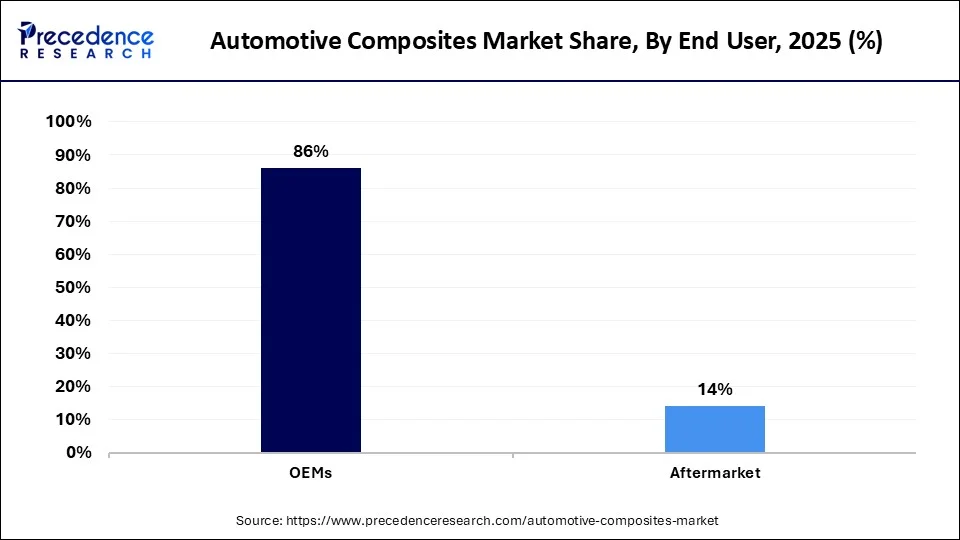
The aftermarket segment held 14% of the market share in 2025 and is expected to grow at a considerable CAGR of 10.1% in between 2026 and 2035, owing to the increasing replacement demand for lightweight components. Many performance car owners are now replacing designer items like mean green bumpers with carbon fiber components. This enhances the handling qualities of their cars without the added weight. Additionally, the constant advancement of customisation technologies and the introduction of new lightweight replacement components in the coming years.
Market Regional Analysis: North America, Europe, Asia-Pacific
Asia Pacific Automotive Composites Market Size and Growth 2026 to 2035
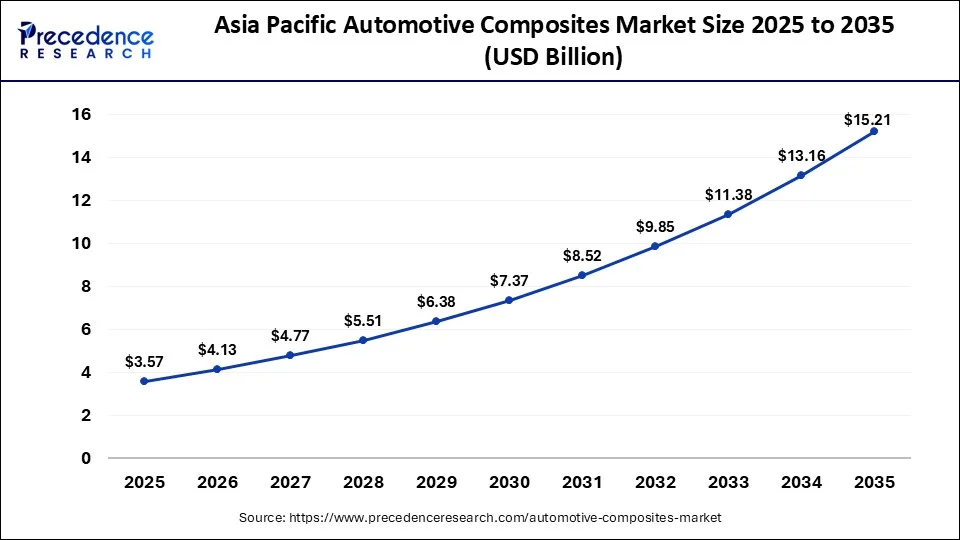
The Asia Pacific automotive composites market size was evaluated at USD 3.57 billion in 2025 and is projected to reach around USD 15.21 billion by 2035, growing at a CAGR of 15.60% from 2026 to 2035.
Which Factors Drive the Automotive Composites Market in Asia-Pacific?
Asia-Pacific held a major market share of 34% in 2025 and is expected to experience the fastest growth with a CAGR of 15.6% during the predicted timeframe. Due to the largest automotive production and export volumes recorded and significant funding investments in carbon-fiber production.
China's vehicle production and sales reached an estimated 31 million vehicles in 2024, according to the China Association of Automobile Manufacturers (CAAM). This increased the demand for high-performance composite parts. Furthermore, the home-made production of value-added composite materials supported by the government further boosts the regional market.
Japan at the Forefront of High-Performance Automotive Composite Development
Japan leads the market due to its strong and growing vehicles exportoring infrrastrure. Around 4.22 million vehicles were exported by Japan in 2024, as per the Japan Automobile Manufacturers Association (JAMA) report. They create increased the demand for high-performance composite parts in international vehicle programs.
The Europe Region Held the Second-Largest Market Share With 31% in 2025
Europe held the second-largest market share of 31% in 2025 and is estimated to grow at a strong CAGR of 11.8% over the projected period, supported by strong demand for sustainability composite technology. Novel manufacturing techniques that lower carbon emissions continue to fuel higher and higher adoption of reusable thermoplastic composites. Furthermore, the composite technology in the region continues to be propelled by high investment from top-tier vehicle makers.
- The BMW Group continued to ramp up the production plan for Neue Klasse cars with increased car light-weighting based on composite technology for 2025.
France Accelerating Sustainable Innovation in the Market
France is a major contributor to the market due to the growing manufacturing of sustainable composites. Environmentally friendly reinforcement materials are considered in vehicle manufacturing for the next mobility generations, further boosting the regional market.
How is North America Growing in the Automotive Composites Market?
North America held a 28% share of the market in 2025 and is expected to grow at a 11.4% CAGR between 2026 and 2035, driven by massive investments in EV programs and the swift commercialization of lightweight material feasibility options. Composites increasingly take the place of standard materials for any of those parts in vehicles, from batteries to body panels. Ongoing investment in regional manufacturing modernization helps sustain market demand for advanced automotive composites.
U.S. Turning Advanced Manufacturing into an Automotive Composites Advantage
In the U.S., the market is due to advanced materials research and large-scale industrial investments in EVs. Tesla scaled up production of its next-generation EVs, which demanded lightweight structural solutions, thus facilitating market Growth.
What are the Key Trends of the Automotive Composites Market in Latin America?
Latin America held 4% of the market share in 2025 and is expected to grow at a notable CAGR of 10.9% between 2026 and 2035, due to investment in export-oriented manufacturing. This continues to enhance opportunities for advanced composites suppliers in this region. Moreover, the trend of continual modernization of the automotive production factories is ongoing to support composite material demand.
Mexico Becoming the Preferred Automotive Composite Export Base
Mexico is a major player in the market, fuelled by its high export vehicle activity and growing automotive supplier chain initiatives. Lightweight parts are produced in Mexico for North American markets. They are also increasingly being exported to worldwide markets at sites provided by the car world's international manufacturers.
Will the Middle East and Africa Grow in the Automotive Composites Market?
The Middle East and Africa region held 3% of the market share in 2025 and is expected to grow at a CAGR of 10.5% between 2026 and 2035, fuelled by innovative mobility projects that have continued to increase automotive composites opportunities. The rise in investment in manufacturing equipment continues to support demand for engineered composite parts.
UAE Accelerating Automotive Composites Production in the Middle East & Africa
In the UAE, the market is boosted by advanced industrial diversification and future mobility investment projects. Emphasis on technology with excellent industrial growth is further building the UAE's reputation as an emerging region for advanced automotive composite solutions.
Automotive Composites Market Value Chain Analysis
- Raw Material Sourcing
The most common materials in carbon fiber-reinforced car production are carbon fiber, glass fiber, thermoset resin, thermoplastic polymer, additives, and specialty chemicals.
Key Players: Toray Industries, Teijin Limited, Mitsubishi Chemical Group, Owens Corning, BASF, Covestro, SGL Carbon.
- Component Manufacturing
Manufacturers convert engineered composite materials into structural and non-structural automotive components using advanced molding and fabrication technologies.
Key Players: Magna International, Röchling Automotive, POLYTEC Holding, Forvia, Plasan, ElringKlinger, Mubea.
- Vehicle Assembly and Integration
Integrating composite elements into the car platforms of automotive OEMs enhances structural performance, safety, and lightweight benefits.
Key Players: Toyota Motor Corporation, BMW Group, Mercedes-Benz Group, Volkswagen Group, Tesla, BYD, Hyundai Motor Company.
- Testing and Quality Control
Composite components undergo mechanical, thermal, crash, and durability validation to ensure compliance with global automotive standards.
Key Players: SAE International, ASTM International, Fraunhofer ICT, National Composites Centre (NCC), Oak Ridge National Laboratory (ORNL).
Market Competitive Landscape: Leading Companies and Strategies
The automotive composites market remains moderately consolidated. This presents intense competition within the market from global material suppliers and technology-driven manufacturers. TNT, Teijin Limited, Hexcel Corporation, SGL Carbon, Syensqo, Mitsubishi Chemical Group, Owens Corning, BASF, and Covestro are well-positioned in structural and lightweight applications of composites. Large suppliers' competitiveness has been influenced by strong vehicle companies' partnerships throughout the world.
Technology investments, growth, and sustainable materials development drove a speed-up in competitive activity. In 2026, Toray Industries continued developments in high-rate carbon fiber technologies for automotive large-volume production. During 2026, Syensqo propelled the innovation of recyclable composites that are suitable for next-generation battery enclosure use. Companies are increasingly integrating AI, Digital Twins, and Predictive Quality-based systems to drive innovation in this market.
Automotive Composites Market Companies
- Formaplex
- GMS Composites
- Gurit
- Hexcel Corporation
- IDI Composites International
- Johns Manville
- Mitsubishi Chemical Carbon Fiber and Composites, Inc.
- Owens Corning
- Plasan Carbon Composites
- Revchem Composites
- SGL Carbon
- Solvay
- Teijin Limited
- Toray Industries, Inc.
- TPI Composites
Recent Developments Automotive Composites Market (2025-2026)
- In July 2026, Syensqo partnered with Bucci Composites, a leader in structural composite parts, to utilize its Double Diaphragm Forming (DDF) technology. This collaboration aims to enhance automotive composite manufacturing and qualify innovative materials with key OEMs. DDF allows for a highly automated, single-step process that produces high-quality parts with reduced cycle times, simplifying logistics and optimizing capital investment.(Source: https://www.composites.media)
- In July 2026, Rane (Madras) Limited announced an acquisition of Hindustan Composites Limited's friction business for USD 39.1 million (₹370 crore), including the COMPO brake-lining brand and two Maharashtra manufacturing plants. The transaction, structured as a slump sale, encompasses all assets, liabilities, contracts, intellectual property, licenses, and employees associated with the friction unit. The deal is set to close by September 30, 2026, pending regulatory approvals.(Source: https://thebrakereport.com)
Segments Covered in the Report
By Fiber Type
- Glass Fiber Composites
- Carbon Fiber Composites
- Natural Fiber Composites
- Aramid Fiber Composites
- Basalt Fiber Composites
- Hybrid Fiber Composites
By Resin Type
- Thermoset Composites
- Polyester Resin
- Epoxy Resin
- Vinyl Ester Resin
- Polyurethane Resin
- Thermoplastic Composites
- Polypropylene (PP)
- Polyamide (PA)
- Polyether Ether Ketone (PEEK)
- Polycarbonate (PC)
- Polyphenylene Sulfide (PPS)
- Other Thermoplastics
By Manufacturing Process
- Compression Molding
- Injection Molding
- Resin Transfer Molding (RTM)
- Sheet Molding Compound (SMC)
- Bulk Molding Compound (BMC)
- Pultrusion
- Filament Winding
- Hand Lay-up
- Others
By Vehicle Type
- Passenger Cars
- Light Commercial Vehicles (LCVs)
- Heavy Commercial Vehicles (HCVs)
- Electric Vehicles (EVs)
- Sports Cars and Luxury Vehicles
By Application
- Exterior Components
- Bumpers
- Hoods
- Roof Panels
- Doors
- Fenders
- Tailgates
- Interior Components
- Instrument Panels
- Seat Structures
- Door Panels
- Center Consoles
- Structural Components
- Chassis
- Monocoque Structures
- Cross Members
- Powertrain Components
- Battery Enclosures
- Underbody Shields
- Leaf Springs
- Others
By Composite Type
- Fiber Reinforced Polymer (FRP)
- Carbon Fiber Reinforced Polymer (CFRP)
- Glass Fiber Reinforced Polymer (GFRP)
- Natural Fiber Reinforced Polymer (NFRP)
- Hybrid Composites
By End User
- OEMs
- Aftermarket
By Region
- North America
- Latin America
- Europe
- Asia-pacific
- Middle and East Africa
For inquiries regarding discounts, bulk purchases, or customization requests, please contact us at sales@precedenceresearch.com
Frequently Asked Questions





Ask For Sample
No cookie-cutter, only authentic analysis – take the 1st step to become a Precedence Research client
 Get a Sample




 sales@precedenceresearch.com
 Schedule a Meeting
