



B-Cell Maturation Antigen (BCMA) Targeted Therapies Market Revenue to Attain USD 29.81 Bn by 2035
Published: 23 Apr 2026
Author: Precedence Research



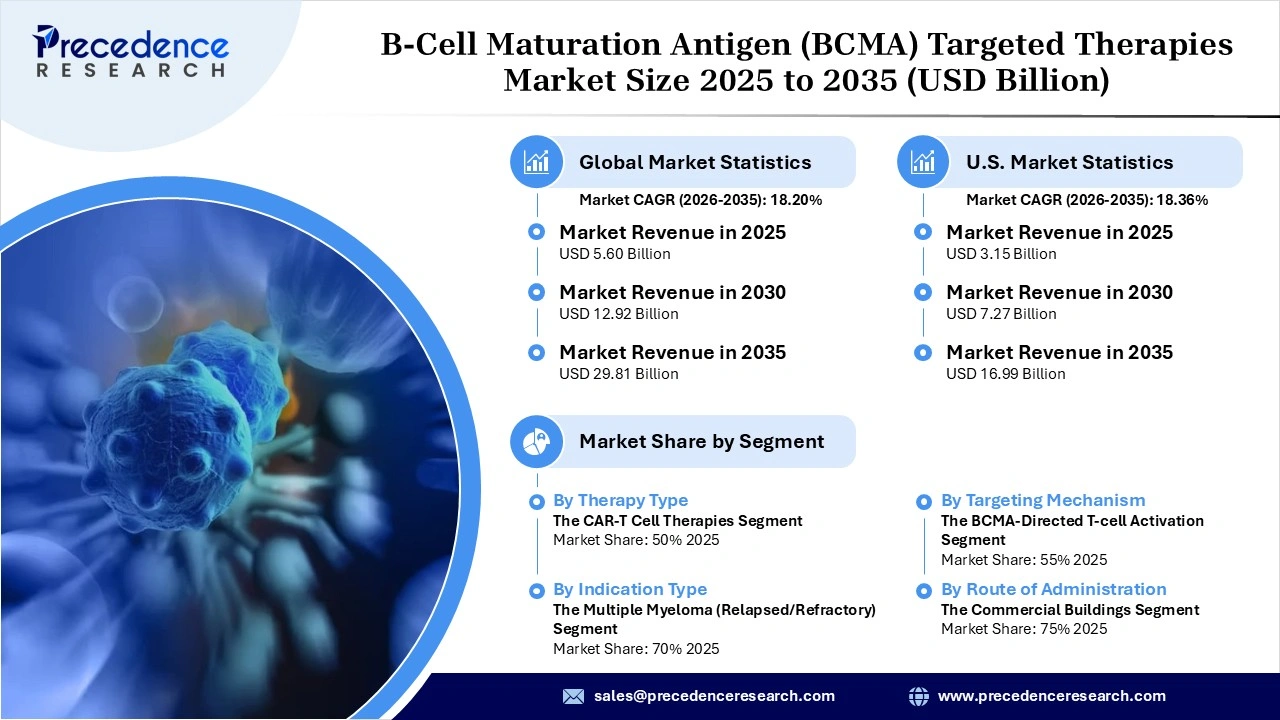
The global B-cell maturation antigen targeted therapies market revenue surpassed USD 5.60 billion in 2025 and is predicted to attain around USD 29.81 billion by 2035, growing at a CAGR of 18.20% from 2026 to 2035. The market is driven by the high expression of BCMA on malignant plasma cells and the tremendous success of immunotherapy treatments such as CAR-T cells and bispecific antibodies in the treatment of resistant multiple myeloma.
Market Overview
The B-cell maturation antigen (BCMA) targeted therapies market encompasses a set of precision oncology immunotherapies that specifically target cancerous plasma cells by engaging the BCMA receptor expressed on the surface of the cancer cells. The market includes a wide range of therapies, such as chimeric antigen receptor (CAR-T) cell therapy, BiTE (bispecific T-cell engager), and antibody drug conjugate therapies.
These therapies are facilitated by manufacturing platforms, companion diagnostics, and pipeline clinical programs. The market also extends to various lines of therapy, ranging from heavily pre-treated relapsed cases to initial stage detection. This market is influenced by continuous improvements in cellular engineering, combination treatments, and advanced medical equipment development.
What are the Major Factors Driving the Market?
Advancements in Next-Generation Immune Cell Engineering
The B-cell maturation antigen (BCMA) targeted therapies market is transitioning from the traditional one-target approach to a multi-target and pre-made immune approach, leading to higher efficiency and scalability. There have been significant advancements in the trispecific antibodies that are now capable of attaching to BCMA and CD3, allowing for better T-cell activation. This helps to decrease the probability of antigen escape. The next-generation CAR-T cells have been developed with optimized binding sites and gene-edited allogeneic cells.
- In 2026, the Innovent company’s drug IBI3003, a trispecific antibody, got FDA Fast Track Designation, showcasing the focus on a multi-antigen approach for relapsed multiple myeloma.
Fast-Paced Adoption of Bispecific Antibodies
Bispecific antibodies are being rapidly adopted in the market, resulting in better availability of novel immunotherapies for patients without requiring the complicated production process required by cell-based therapies. Bispecific antibodies have been gaining popularity in the early phase of treatment due to high efficacy levels and better safety.
- In 2026, Johnson and Johnson company’s TECVAYLI (Teclistamab) demonstrated higher rates of progression-free survival when used alongside daratumumab.
Government Policies Promoting Advanced BCMA Therapies
Government bodies and agencies are promoting the development of next-generation BCMA therapies through regulatory efforts to expedite the approval process for such technologies. The implementation of fast-track drug development programs and adaptive regulatory processes is helping to accelerate the development and introduction of such drugs in the market. Government policy support helps to enhance the clinical trial operations and manufacturing processes associated with advanced therapies.
- In 2025, the U.S. Food and Drug Administration gave fast-track approval to Linvoseltamab, a drug used for the treatment of multiple myeloma due to promising results in clinical testing.
Positive Results of LINKER-MM1 Trial Shown at ASH 2025
At ASH 2025, LINKER-MM1 trial data on Linvoseltamab (n=80) were presented, which revealed a response rate of 70% (95% CI: 59-80%) with response durability being 89% at 9 months and 72% at 12 months. Safety results showed CRS in 46% patients and neurologic toxicity in 54%, while the incidence of serious adverse reactions was comparatively low.
Market Segmentation Overview
- By Therapy Type: The CAR-T cell therapies segment led the market with a 50% share in 2025 because it has been shown to induce profound and long-lasting effects due to its targeted immune activation of BCMA-positive cancer cells. CAR-T cell therapy has a high level of efficacy in treating multiple myeloma despite its extensive pre-treatment.
- By Indication: The multiple myeloma segment dominated the B-cell maturation antigen (BCMA) targeted therapies market with a 70% share in 2025, owing to the fact that BCMA is expressed homogenously and abundantly within the malignant plasma cells, which makes it an ideal and clinically approved target. This therapy has been widely adopted because of high rates of recurrence coupled with poor efficacy when using traditional therapies.
- By Targeting Mechanism: The BCMA-directed T-cell activation segment led the market with a 55% share in 2025 because of its potential to activate and amplify the patient’s own immune system to kill tumor cells rapidly and effectively. Targeted therapies such as bispecific antibodies and chimeric antigen receptor T-cells demonstrate higher efficacy rates than other types of targeted therapies.
- By Route of Administration: The intravenous (IV) segment dominated the B-cell maturation antigen (BCMA) targeted therapies market with a 75% share in 2025, due to the need to administer BCMA targeted therapies in a controlled manner to ensure proper dosing and to monitor the patient’s health status. Furthermore, the intravenous approach of administration of drugs is preferred because it allows effective management of potential side effects, including cytokine release syndrome.
- By End-Use: The hospitals & cancer centers segment led the market with a 60% share in 2025, owing to the specialized nature of the drugs targeting BCMA. Such niche infrastructure consists of processing cells, infusion, and continuous monitoring of patients. The presence of oncologists in hospitals and cancer centers enables the management of any side effects, particularly the cytokine release syndrome.
Regional Analysis
North America led the B-cell maturation antigen (BCMA) targeted therapies market with a 45% share in 2025, owing to its efficient clinical trials landscape, adoption of cutting-edge immunotherapy approaches, and the significant presence of key biotechnology companies driving innovation. This region benefits from well-developed approval procedures and significant investments in healthcare. The U.S. led the market in North America due to its well-developed biotechnology research ecosystem, significant presence of medical research firms, and rapid adoption of innovative techniques like CAR-T and bispecific drugs. Canada is a significant contributor to the market because of significant investment in medical research and the adoption of advanced cancer treatment therapies.
Asia Pacific is expected to expand at the highest CAGR during the forecast period, owing to the rapidly developing healthcare infrastructure, increased prevalence of cancer, and increased availability of biological drugs. This region is witnessing an increase in clinical trials and manufacturing facilities, which help to reduce prices and increase the availability of novel immunotherapies. China led the market in Asia Pacific because of rapid advancement in biotechnology and an optimized regulatory approval process for cell and antibody-based therapies. Japan witnessed significant growth due to its well-developed healthcare system and widespread adoption of advanced cancer treatments.
B-Cell Maturation Antigen (BCMA) Targeted Therapies Market Coverage
| Report Attribute | Key Statistics |
| Market Revenue in 2025 | USD 5.60 Billion |
| Market Revenue by 2035 | USD 29.81 Billion |
| CAGR from 2026 to 2035 | 18.20% |
| Quantitative Units | Revenue in USD million/billion, Volume in units |
| Largest Market | North America |
| Base Year | 2025 |
| Regions Covered | North America, Europe, Asia-Pacific, Latin America, and the Middle East & Africa |
Top Companies in the B-cell Maturation Antigen (BCMA) Targeted Therapies Market
The commercial landscape for CAR-T and related immunotherapies is shaped by a combination of established pharmaceutical leaders and specialized biotech innovators. Companies such as Johnson & Johnson and Bristol Myers Squibb are key players in the market, leveraging their scale and commercialization capabilities. Moreover, GSK plc has focused on antibody-drug conjugates, including Blenrep, targeting BCMA in multiple myeloma.
Meanwhile, Pfizer Inc. and Amgen Inc. are advancing bispecific T-cell engager therapies, offering more accessible, off-the-shelf alternatives to CAR-T approaches. Large pharmaceutical firms such as Regeneron Pharmaceuticals, Inc., Sanofi S.A., and Novartis AG are investing in next-generation immunotherapies aimed at improving efficacy, safety, and scalability.
Segments Covered in the Report
By Therapy Type
- CAR-T Cell Therapies (Autologous & Allogeneic)
- Bispecific Antibodies (T-cell Engagers)
- Antibody-Drug Conjugates (ADCs)
By Indication
- Multiple Myeloma (Relapsed/Refractory)
- Earlier-line Multiple Myeloma
- Other Hematologic Malignancies (Emerging Indications)
By Targeting Mechanism
- BCMA-directed T-cell Activation
- BCMA-targeted Cytotoxic Delivery (ADC-based)
- Dual-targeting / Multi-antigen Approaches
By Route of Administration
- Intravenous (IV)
- Subcutaneous (SC)
By End-Use
- Hospitals & Cancer Centers
- Specialty Oncology Clinics
- Academic & Research Institutes
By Region
- North America
- Asia Pacific
- Europe
- South America
- MEA
Get this report to explore global market size, share, CAGR, and trends, featuring detailed segmental analysis and an insightful competitive landscape overview @ https://www.precedenceresearch.com/sample/8328
You can place an order or ask any questions. Please feel free to contact us at sales@precedenceresearch.com |+1 804 441 9344