



Ceftriaxone Sodium Market Revenue to Attain USD 4.52 Bn by 2035
Published: 19 Jun 2026
Author: Precedence Research



Ceftriaxone Sodium Market Revenue and Trends 2026 to 2035
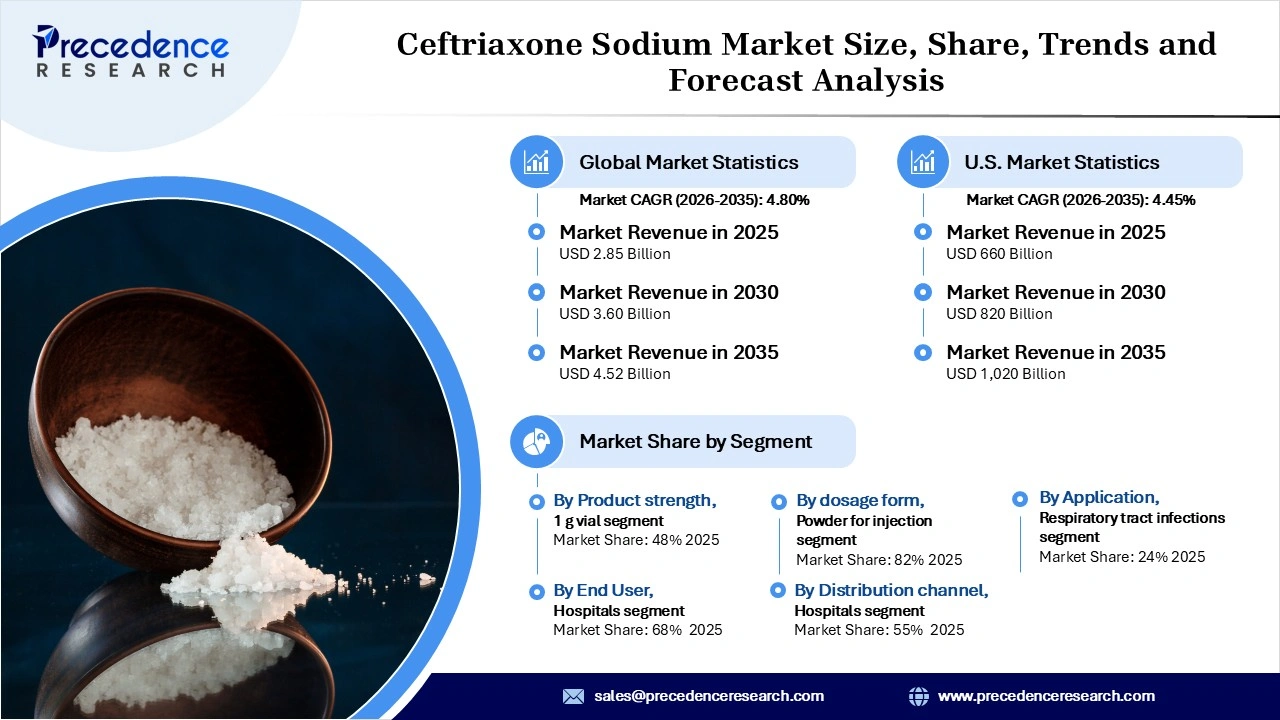
The global ceftriaxone sodium market revenue was valued at USD 2.85 billion in 2025 and is expected to attain around USD 4.52 billion by 2035, growing at a CAGR of 4.80% during forecast period. The market is driven by the extensive use of ceftriaxone sodium in the treatment of bacterial infections such as sepsis, meningitis, and pneumonia, and the increased incidence of antimicrobial resistance around the world.
The First Line of Defense: Injectable Antibiotic for Severe Infections
The ceftriaxone sodium market consists of production, distribution, and use of ceftriaxone sodium, a powerful third-generation broad-spectrum injectable antibiotic used against both Gram-positive and Gram-negative bacteria. It is primarily used for the treatment of sepsis, meningitis, pneumonia, intra-abdominal infections, and gonococcal diseases, frequently as a first line of defense in hospitals.
It is used as sterile preparations in the form of powders or frozen solutions to be administered intramuscularly or intravenously, as well as in combination with other antibiotics. The applications of this market include emergency medicine, intensive care units, preventive measures before surgeries, pediatrics, neonatology, and outpatient parenteral antimicrobial therapy. This market encompasses production of active substance, production of final medicine, and distribution to hospitals, ambulatory surgery centers, and infusion clinics.
Advanced Ceftriaxone Delivery Approaches Enhance Drug Efficacy Potential
The market is witnessing significant innovation in the area of advanced drug delivery systems for enhancing the efficacy of ceftriaxone sodium-based treatments. Advanced delivery approaches such as nanoparticulate formulation, subcutaneous injections, and antibacterial sutures have been formulated to achieve improved targeting, reduced systemic toxicity, and prolonged antibiotic delivery. In 2025, researchers at Queensland University of Technology (QUT) formulated ceftriaxone-loaded liposomes through a thin film hydration technique to treat lung infection by resistant bacteria. These nanoparticles yielded an effective fine particle fraction ranging from 47-62%, and drug release exceeded 94% after 24 hours.
Stricter Packaging Quality Rules for Generic Antibiotics
The ceftriaxone sodium market is adopting procedures to match formulations with appropriate packaging materials as a result of scientific observations of contamination from antioxidants used in rubber closures, such as BHT, entering the composition of injectable pharmaceutical preparations. Such problems increase the demand for quality control measures when producing generic antibiotics. In 2025, scientists from Damascus University (Syria) carried out the evaluation of Syrian-produced generic ceftriaxone sodium injections, which were contaminated with BHT-rubber closure antioxidant. The concentrations varied from 0.37 to 5.65 ppm.
Price Control on Drugs Enhances Access to Important Antibiotics
Government authorities in many countries are controlling the price of essential antibiotics using various measures to keep them affordable. These measures help in lowering out-of-pocket expenses for patients while also ensuring the availability of the medicines. Such measures are especially important in price-sensitive economies of developing countries. In 2025, the prices of 71 essential drugs in India were regulated by the National Pharmaceutical Pricing Authority (NPPA). The price of combinations of ceftriaxone would range from USD 6 TO USD 12 per vial, while the price of a combination comprising ceftriaxone, disodium edetate, and sulbactam powder would be USD 7.5 per vial.
Techniques Used for the Control of Antibiotic Impurities
Researchers employ analytical techniques for the detection of polymerized impurities in ceftriaxone sodium medications that may cause allergic reactions. Reversed-phase high-performance liquid chromatography (HPLC), particularly with C18 columns, is the most commonly employed method (93%), where 82% use isocratic elution while 39% use ion pair techniques. 14% of studies consider polymer impurities, and the Chinese Pharmacopeia needs gel filtration for this purpose.
Market Segmentation Overview
- By product strength, the 1 g vial segment led the ceftriaxone sodium market with 48% share in 2025, since it is the most prescribed dosage in adults, and it offers effectiveness and convenience because it is usually administered only once a day and at an affordable price. Besides, this dosage is widely used in emergencies, surgeries, and community-acquired pneumonia.
- By product strength, the 2 g vial segment is expected to expand at the highest CAGR of 5.8% during the forecast period, owing to the increasing demand for higher dosages of antibiotics to treat cases of severe hospital-acquired infections such as meningitis, endocarditis, and sepsis. Furthermore, there is increasing awareness of drug-resistant bacteria, coupled with the fact that a high dose administered once per day is essential for severe infections.
- By dosage form, the powder for injection segment dominated the market with 82% share in 2025, as ceftriaxone sodium is quite unstable in liquid form and therefore can only be supplied as sterile powder, which must be converted to liquid right before administration into the body. It gives many benefits, like a longer shelf life, easy transportation due to no requirement for refrigeration, and the ability to prepare various doses depending on patients’ specific requirements.
- By dosage form, the ready-to-use injectable formulations segment is expected to grow at the fastest CAGR of 6.8% from 2026 to 2035, due to the fact that it minimizes the contamination that might occur during the process of manual reconstitution from powder to liquid form. Premix solutions support the current market direction of standardized, ready-to-use medications that ease preparation and administration by healthcare practitioners.
- By route of administration, the intravenous (IV) segment led the ceftriaxone sodium market with 72% share in 2025 and is expected to expand at the highest CAGR of 5.1% during the forecast period, because it provides fast and efficient entry of medication into the bloodstream. Furthermore, it enables the use of large doses like 1 g and 2 g, which are widely prescribed to adults.
- By route of administration, the intramuscular (IM) segment held the second-largest market share of 28% in 2025, owing to its convenience of use as an outpatient therapy method, where the drug can be administered as an injection outside hospitals without the need for an intravenous line, especially for minor infections like uncomplicated pneumonia, gonorrhea, and skin infections. It is ideal for pediatric cases and preoperative prophylaxis.
- By application, the respiratory tract infections segment dominated the market with 24% share in 2025, due to the significant prevalence of lower respiratory infections, which need administration of intravenous antibiotics. Ceftriaxone is widely preferred for treating community-acquired pneumonia due to its wide coverage against pathogens causing these types of infections.
- By application, the surgical prophylaxis segment is expected to grow at the fastest CAGR of 6.3% from 2026 to 2035, because of the high effectiveness of ceftriaxone in preventing infections after surgeries, leading to its significant uptake as the most common single-dose antibiotic used pre-surgery.
- By end user, the hospitals segment led the ceftriaxone sodium market with 68% share in 2025, because ceftriaxone is mainly used through an intravenous administration method for serious hospital-acquired conditions such as pneumonia, sepsis, meningitis, and surgical prophylaxis. The hospital setting is the main channel due to the need for inpatient prescription and observation throughout the course of treatment.
- By end user, the ambulatory surgical centers segment is expected to expand at the highest CAGR of 5.9% during the forecast period, due to the increase in the number of outpatient surgeries, including orthopedic, urologic, and laparoscopic surgeries, which demand single-dose antibacterial medication that is easily administrable without hospital admission. This segment helps to minimize treatment costs and provides convenience to patients.
- By distribution channel, the direct tender sales segment dominated the market with 55% share in 2025, because ceftriaxone is an important antibiotic that is purchased in bulk by government hospitals and other organizations through a tender process. This segment is common in many developing nations since the government can be assured of getting low prices and a stable supply.
- By distribution channel, the online pharmacies segment is expected to grow at the fastest CAGR of 7.3% from 2026 to 2035, due to its ability to provide convenience and accessibility for patients requiring outpatient intravenous administration of antibiotic therapy. There has been an advancement of telemedicine and home healthcare facilities.
Regional Analysis
Asia-Pacific led the market with 35% share in 2025 and is expected to expand at the highest CAGR of 6.1% during the forecast period, owing to the fact that it has the largest generics market in the world and has high-volume manufacturing for both domestic and export purposes. China dominated the market in Asia-Pacific due to its massive production facilities, backed by a large domestic market that demands huge volumes of medicines because of a massive population base. India is a significant contributor to the market because of its flourishing generic drug sector, affordable manufacturing operations, and substantial exportation of ceftriaxone.
Europe held the second-largest ceftriaxone sodium market share of 25% in 2025, due to its well-developed healthcare infrastructure, high rates of antibiotic prescription in hospitals, and huge volumes of procurement of generics via health systems that favor affordable drugs. Germany led the market in Europe owing to a strong distribution network for ceftriaxone for the purpose of treating pneumonia, surgery prophylaxis, and sepsis. The UK witnessed notable market growth as the National Health Service (NHS) buys vast amounts of ceftriaxone through competitive bidding processes for hospital usage and robust antimicrobial stewardship programs that prefer targeted and cost-effective treatments.
North America held the third-largest market share of 23% in 2025, owing to its commitment towards ensuring the best quality and safety measures in the production of generic antibiotics, hence allowing only those generics that have undergone rigorous quality checks in terms of impurities. The U.S. led the market in North America due to its strong regulatory system, which demands the use of pharmacopeial testing standards, in addition to driving innovations in analytical procedures to increase the safety of injectable antibiotics. Canada is a significant contributor to the market because of its universal healthcare guidelines, which focus on evidence-based procurement and generic usage at low costs, thus making sure ceftriaxone is a viable and available first-line choice for hospitals across the country.
Ceftriaxone Sodium Market Coverage
| Report Attribute | Key Statistics |
| Market Revenue in 2025 | USD 2.85 Billion |
| Market Revenue by 2035 | USD 4.52 Billion |
| CAGR from 2026 to 2035 | 4.90% |
| Quantitative Units | Revenue in USD million/billion, Volume in units |
| Largest Market | North America |
| Base Year | 2025 |
| Regions Covered | North America, Europe, Asia-Pacific, Latin America, and the Middle East & Africa |
Top Companies in the Ceftriaxone Sodium Market
Pfizer Inc., Sandoz Group AG, Hikma Pharmaceuticals PLC, and Fresenius Kabi AG are some of the key players that provide branded and generic injectable antibiotic formulations. The NCPC Group, CSPC Pharmaceutical Group, Qilu Pharmaceutical Co., Ltd., and Shandong Luoxin Pharmaceutical Group are some of the important Chinese players with a dominant market share of API and finished dose production worldwide. United Laboratories International Holding, Aurobindo Pharma Limited, and Lupin Limited provide vertically integrated manufacturing from API to formulations in key international markets. Baxter International Inc. focuses on intravenous solutions and administration devices.
Segments Covered in This Report
By Product Strength
- 250 mg Vial
- 500 mg Vial
- 1 g Vial
- 2 g Vial
- Others
By Dosage Form
- Powder for Injection
- Premixed Injectable Solutions
- Ready-to-use Injectable Formulations
- Others
By Route of Administration
- Intravenous (IV)
- Intramuscular (IM)
By Application
- Respiratory Tract Infections
- Urinary Tract Infections
- Skin & Soft Tissue Infections
- Intra-abdominal Infections
- Bloodstream Infections (Sepsis)
- Gonorrhea Treatment
- Meningitis Treatment
- Surgical Prophylaxis
- Others
By End User
- Hospitals
- Specialty Clinics
- Ambulatory Surgical Centers (ASCs)
- Government Healthcare Facilities
- Others
By Distribution Channel
- Direct Tender Sales
- Hospital Pharmacies
- Retail Pharmacies
- Online Pharmacies
By Region
- North America
- Latin America
- Europe
- Asia-pacific
- Middle and East Africa
Get this report to explore global market size, share, CAGR, and trends, featuring detailed segmental analysis and an insightful competitive landscape overview @ https://www.precedenceresearch.com/sample/8498
You can place an order or ask any questions. Please feel free to contact us at sales@precedenceresearch.com |+1 804 441 9344