



Data Center Valves Market Revenue to Attain USD 4.04 Bn by 2035
Published: 07 May 2026
Author: Precedence Research



Data Center Valves Market Revenue and Trends 2026 to 2035
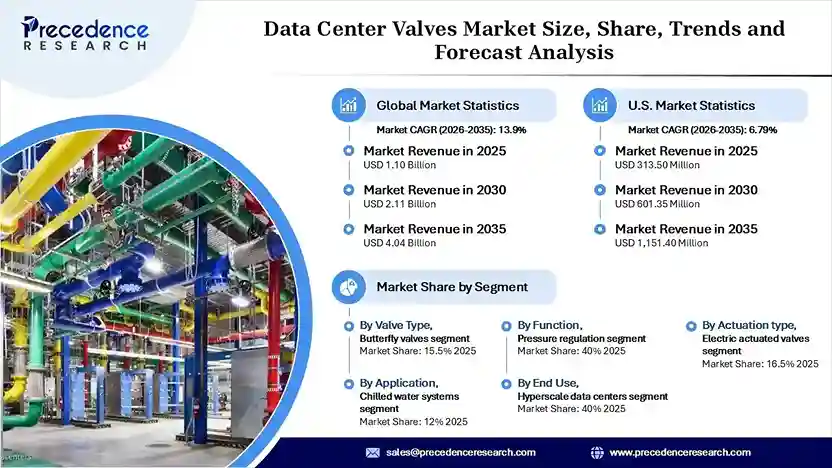
The global data center valves market revenue surpassed USD 1.10 billion in 2025 and is predicted to attain around USD 4.04 billion by 2035, growing at a CAGR of 13.90%. The data center valves market is expanding quickly as AI-heavy servers and hyperscale facilities generate more heat, making precision cooling systems no longer optional but essential.
Market at a Glance
Data center valves are mechanical and automated components designed to regulate the flow of liquids, gases, and cooling agents across data center infrastructure. They play a critical role in controlling pressure, temperature, and fluid circulation within chilled water loops, liquid cooling systems, fire suppression lines, and utility networks. With the rapid growth of high-performance computing and AI workloads, these valves are no longer viewed as simple hardware components. Instead, they have become essential for optimizing energy efficiency, maintaining operational continuity, and protecting infrastructure from thermal stress.
The data center valves market spans a wide range of facilities, including hyperscale data centers, colocation facilities, enterprise server rooms, and edge deployments. It includes both manual and automated valve systems used for cooling management, water distribution, and safety applications such as fire suppression. Increasing adoption of liquid cooling technologies and automation is creating significant growth opportunities across the market.
Market Forecast for the Data Center Valves Market
AI Workloads Driving Cooling Demand
The rise of AI-driven workloads is significantly increasing rack densities and heat generation within data centers. This shift is accelerating the adoption of liquid cooling systems, where valves play a crucial role in regulating coolant flow, pressure, and system reliability. Industry leaders such as Vertiv have highlighted how “extreme densification” and adaptive liquid cooling are reshaping data center design. As a result, demand for high-performance valves, sensors, and automated flow control systems is expected to grow substantially.
Shift Toward Smart Valves
There is a growing preference for intelligent, electronically actuated valves over traditional manual systems. Data center operators increasingly require real-time monitoring and predictive maintenance capabilities to minimize downtime and improve efficiency.
Modern smart valves are being integrated with building management systems (BMS) and data center infrastructure management (DCIM) platforms, enabling automated control and data-driven decision-making. As data centers become more software defined, even fluid control systems are evolving into intelligent, connected components.
Market Segmentation Overview
By Valve Type
The ball valves segment accounted for 25.0% of the market in 2025, driven by their durability, quick shut-off capability, and high reliability. In mission-critical environments where downtime is costly, these valves are widely preferred for cooling and utility systems.
The control valves segment is expected to grow at the fastest rate, with a CAGR of 16.5% from 2026 to 2035. This growth is supported by increasing automation and the need for real-time flow regulation in modern, software-managed data centers.
By Function
The flow control segment dominated the market with a 35.0% revenue share in 2025, as maintaining consistent coolant circulation is essential for effective thermal management. Accurate flow balancing ensures stable temperatures and reliable system performance under varying workloads.
The pressure regulation segment is projected to grow at a CAGR of 15.0%, driven by the rising adoption of high-density and liquid cooling systems. These environments require precise pressure control to protect infrastructure and maintain operational stability.
By Cooling System Type
The air-based cooling systems segment led the market with a 50.0% share in 2025, primarily due to their widespread installation and compatibility with existing infrastructure. Many facilities continue to rely on HVAC-based systems for moderate computing loads.
The liquid cooling systems segment is expected to expand rapidly, with a CAGR of 18.5%, fueled by the growth of AI, high-performance computing (HPC), and high-density server deployments. Technologies such as direct-to-chip and immersion cooling require advanced valve systems for precise fluid management.
By Actuation Type
The manual valves segment held a 40.0% market share in 2025, particularly in smaller or less complex data center environments. Their lower cost, simple design, and minimal maintenance requirements make them suitable for basic operations.
The electric actuated valves segment expected to grow at the fastest rate, with a CAGR of 16.5%, as data centers increasingly adopt automation. These valves enable remote operation, faster response times, and improved control accuracy, supporting energy efficiency and uptime optimization.
By Application
The cooling water distribution systems segment accounted for 30.0% of the market in 2025, as they form the backbone of thermal management infrastructure. Efficient water flow is essential for heat dissipation and stable equipment performance.
The liquid cooling loops segment is projected to grow at a CAGR of 17.5%, driven by the increasing adoption of advanced cooling technologies in AI and high-density computing environments. These systems rely on precise valve control for efficient coolant circulation.
By End-Use
The hyperscale data centers segment dominated the market with a 40.0% share in 2025 and are expected to maintain strong growth at a CAGR of 16.5%. Expansion of AI workloads, cloud computing, and large-scale digital infrastructure is driving demand for high-performance valve systems designed for continuous operation and scalability.
Regional Analysis
North America dominated the global data center valves market with a market share of 38.0% in 2025. The region’s dominance is driven by a strong presence of hyperscale data centers, early adoption of advanced cooling technologies, and significant investments in AI and cloud infrastructure. The U.S. remains the primary growth driver, while Canada contributes through renewable-powered data centers and expanding colocation capacity.
Asia Pacific held a market share of 28.0% in 2025 and is expected to grow at the fastest rate, with a CAGR of 16.5%. Rapid data center expansion and increasing cloud adoption are key growth drivers. China is advancing through large-scale AI and data infrastructure projects, while India is emerging as a major growth market due to hyperscale developments and accelerating enterprise digitization.
Data Center Valves Market Coverage
| Report Attribute | Key Statistics |
| Market Revenue in 2025 | USD 1.10 Billion |
| Market Revenue by 2035 | USD 4.04 Billion |
| CAGR from 2026 to 2035 | 13.90% |
| Quantitative Units | Revenue in USD million/billion, Volume in units |
| Largest Market | North America |
| Base Year | 2025 |
| Regions Covered | North America, Europe, Asia-Pacific, Latin America, and the Middle East & Africa |
Top Companies in the Data Center Valves Market
The data center valves market is supported by a group of established industrial and automation companies with decades of expertise in fluid control systems. Emerson Electric Co. and Flowserve Corporation remain central to the industry, offering a broad portfolio of valve technologies, automation solutions, and critical flow control systems that are widely used across data center infrastructure. Complementing these capabilities, Honeywell International Inc. and Schneider Electric SE provide integrated building management and control systems. Their platforms enable valves to function as part of connected, intelligent ecosystems rather than standalone mechanical components.
In addition, companies such as Parker Hannifin Corporation, Crane Company, Pentair plc, Victaulic Company, and Mueller Industries, Inc. play a significant role in supporting the broader ecosystem. Their contributions span piping infrastructure, connection systems, and specialized valve technologies designed for large-scale, high-reliability operations.
Segments Covered in the Report
By Valve Type
- Ball Valves
- Gate Valves
- Globe Valves
- Butterfly Valves
- Check Valves
- Control Valves (Automatic/Smart Valves)
By Function
- Flow Control
- Pressure Regulation
- Isolation & Shut-off
- Backflow Prevention
By Actuation Type
- Manual Valves
- Electric Actuated Valves
- Pneumatic Actuated Valves
By Application
- Cooling Water Distribution Systems
- Chilled Water Systems
- Heat Rejection Systems (Cooling Towers)
- Liquid Cooling Loops (CDU Systems)
By End-Use
- Hyperscale Data Centers
- Colocation Data Centers
- Enterprise Data Centers
- Edge Data Centers
By Region
- North America
- Latin America
- Europe
- Asia-pacific
- Middle and East Africa
Get this report to explore global market size, share, CAGR, and trends, featuring detailed segmental analysis and an insightful competitive landscape overview @ https://www.precedenceresearch.com/sample/8381
You can place an order or ask any questions, please feel free to contact us at sales@precedenceresearch.com |+1 804 441 9344