



Electric Breast Pumps Market Revenue to Attain USD 2.21 Bn by 2035
Published: 08 Jul 2026
Author: Precedence Research



Electric Breast Pumps Market Revenue and Trends 2026 to 2035
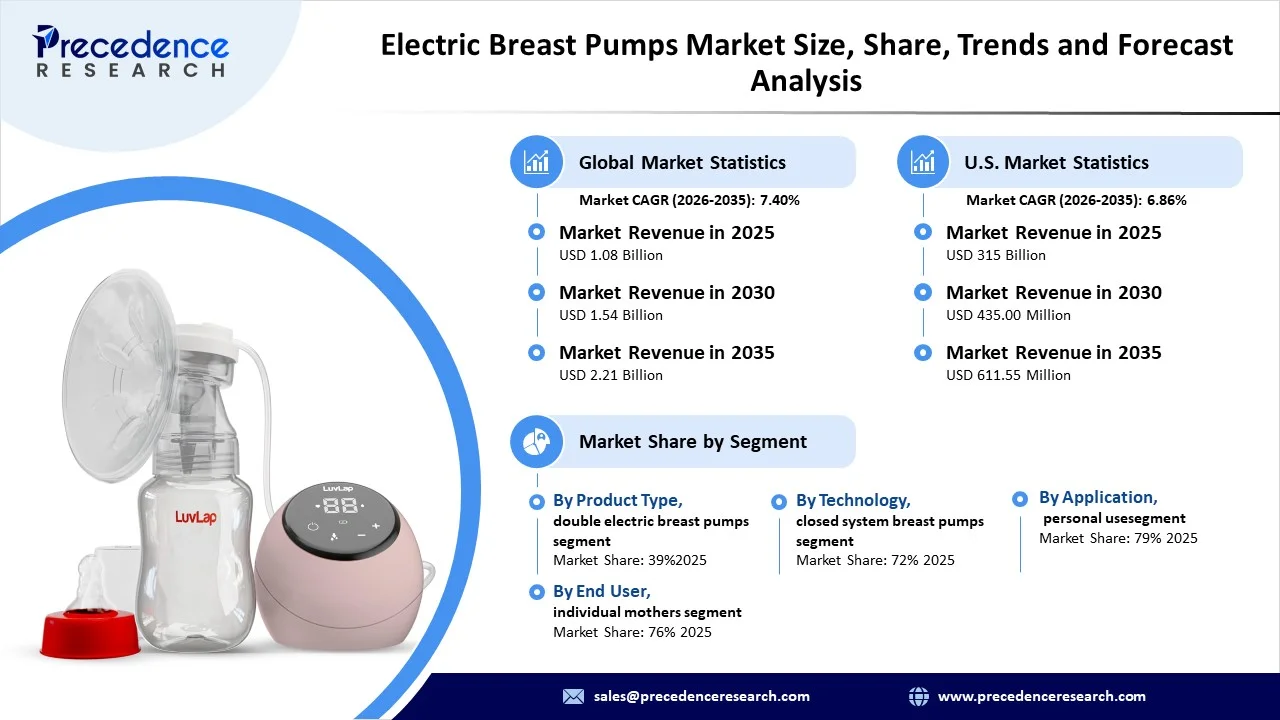
The global electric breast pumps market revenue was valued at USD 1.08 billion in 2025 and is expected to attain around USD 2.21 billion by 2035, growing at a CAGR of 7.40% during forecast period. The market is driven by the rising number of working mothers who need easy ways to breastfeed their babies, increased awareness about the advantages of breast milk, and technological innovations like wearable and smartphone-controlled pumps.
Facilitating Moms Using Modern Technologies
The electric breast pumps market consists of battery-operated and electric devices used to collect milk from the breasts of a mother, as well as accessories and replacement parts used with them. This market covers many kinds of products, from one or two electric breast pumps for home usage to hospital-level multi-pumps. The market includes both closed system pumps (with a mechanism that prevents milk from getting into the tubes) and open system pumps, as well as hands-free wearable pumps used inside nursing bras.
The basic components include the pump machinery, breast shield, valves, tubes, and collection bottles. The market also consists of smartphone integrated pumps with Bluetooth monitoring systems. Subscriptions for part replacements and milk bags have also become a part of this market. This market has been adopted by working mothers, stay-at-home mothers, and hospitals.
Biomechanical and Smart Technological Advances Fuel Pump Development
The industry is moving from desktop units towards wearable and smart-connected technologies. Recent innovations include the use of biomechanical techniques that copy the way babies suckle, smart apps for individual customization, and silent operation. Such changes are expected to allow women more comfort and convenience while pumping milk. Lansinoh introduced the NaturalWave Double Electric Breast Pump in 2026. This pump utilizes “flutter” technology designed to mimic the baby’s tongue movement. In initial studies, 79 percent of testers found an improvement in let-down as well as milk production. It provides hospital-grade suction, 12 different suction settings, three pumping modes, and vibration mode as well.
Nature-Inspired Technology Introduced Into the Market
The electric breast pumps market is witnessing increasing popularity of warming wearable pumps that imitate the baby’s nursing rhythm. Such a device stimulates oxytocin release for fast let-downs and makes the process of expressing breast milk more comfortable. Zomee introduced the Mother’s Nature W1 Warming Wearable Breast Pump. This is the first warming wearable pump that mimics the baby’s warmth and nursing rhythm. It costs USD 195, which is considerably affordable as compared to other warming wearable pumps. There are 4 nature-inspired pumping modes available in this pump: Stimulation, Expression, 2-Phase, and BioBoost power pumping mode.
Government Initiatives to Lower the Cost and Increase Accessibility
Governments across the world have passed various laws aimed at increasing the accessibility of breast pumps via tax breaks, sales tax reduction, and health insurance expansion. These measures are taken in order to decrease the costs of buying and using the breast pump and increase its availability. They have a direct effect on the demand for electric breast pumps since they make such devices cheaper and more available. In 2026, a state-level law was passed in the U.S., giving tax relief on breast pump purchases. The fiscal cost of this measure is estimated to be about USD 730,500 in lost tax revenues. The purpose of the exemption would make the use of electric breast pumps cheaper for new mothers.
Medela Introduces Motion InBra Wearable Pump in Australia
Mendela unveiled the Motion InBra wearable breast pump in Australia in 2026, with each cup weighing 250 grams and noise levels at 45 dB or less. The Motion InBra features breast shields that measure 24mm, along with 3 inserts to cater to more than 95% of nipple sizes. In recent research, 90% of users who participated in the study found the device satisfying and recommended it.
Market Segmentation Overview
- By product type, the double electric breast pumps segment led the electric breast pumps market with a 39% share in 2025, since they halve the time needed for pumping milk and boost the amount of milk produced because both sides get stimulated at once. Double electric breast pumps are a preferable choice for mothers who value efficiency and ergonomics.
- By product type, the wearable electric breast pumps segment is expected to expand at the highest CAGR of 13.5% during the forecast period, because they overcome the greatest hurdle that prevents sustained breastfeeding after maternity leave in breastfeeding moms- the necessity of the device being connected to an electrical socket and cumbersome tubing. This segment facilitates discreet and hands-free pumping in work environments.
- By technology, the closed system breast pumps segment dominated the market with a 72% share in 2025 and is expected to grow at the fastest CAGR of 8.5% from 2026 to 2035, because they provide a physical barrier that ensures that the milk does not make contact with the motor and tubes.
- By technology, the open system breast pumps held the second-largest market share of 28% in 2025, as it does not include a barrier, like a closed system, which is why it is cheaper, providing an inexpensive way for financially constrained women, infrequent users, and shorter-term breastfeeding women who don’t need hospital-grade sterility.
- By application, the personal use segment led the electric breast pumps market with a 79% share in 2025 and is expected to expand at the highest CAGR of 7.8% during the forecast period, since this is the largest part of the addressable market, with millions of individual women, ranging from first-timers to experienced mothers, buying pumps exclusively for themselves at different points in their lives.
- By application, the hospital use segment held the second-largest market share of 16% in 2025, since it fulfils an important clinical requirement by providing high-performance, clinically tested, multi-user pumps for mothers of premature babies in neonatal intensive care units (NICU), mothers who have been separated from their babies because of clinical issues, and women with low milk production.
- By end user, the individual mothers segment dominated the market with a 76% share in 2025 and is expected to grow at the fastest CAGR of 7.9% from 2026 to 2035, as it forms the largest and most varied group, consisting of millions of lactating mothers from every demographic who buy a breast pump for personal use in their homes or offices.
- By end user, the hospitals and maternity centers segment held the second-largest market share of 15% in 2025, since they offer the crucial access point for new mothers by facilitating the use of multi-user hospital-grade suction pumps for premature babies in NICUs, separated moms, and moms with low breast milk. This segment provides the best suction and expert advice on lactation, which can't be offered by personal-use pumps.
- By distribution channel, the e-commerce segment led the market with a 39% share in 2025 and is expected to expand at the highest CAGR of 10.2% during the forecast period, because it provides unique advantages of privacy and convenience for such a private purchase, enabling mothers to conduct research and compare features.
- By distribution channel, the retail pharmacies segment held the second-largest market share of 24% in 2025, since they provide a trusted and easy point of care for the new mother who needs immediate consultation from the pharmacist about buying the pump right away after being discharged from the hospital.
Regional Analysis
North America dominated the electric breast pumps market with a 39% share in 2025 because of the high employment rate among mothers, full insurance coverage (with an obligation to pay for breast pump reimbursement under the U.S. Affordable Care Act), and consumer awareness regarding the benefits of breastfeeding. The U.S. led the market in North America due to a significant working mothers’ population, strong direct-to-consumer marketing, and the significant presence of prominent breast pump manufacturers that have aggressively increased their product portfolio. Canada witnessed notable market growth owing to its state-funded healthcare system that supports breastfeeding, government maternal health programs that encourage breastfeeding, and wide retail and e-commerce distribution of conventional as well as innovative wearable pumps throughout the country.
Asia-Pacific is expected to expand at the highest CAGR of 9.2% during the forecast period, due to the surge in urban working mothers, increasing incomes and e-commerce penetration that increase the demand and availability of hands-free breast pumps suitable for today’s lifestyles. China dominated the market in Asia Pacific because of a large number of career-oriented mothers, the fast adoption of premium and smart breast pumps by millennials, and the cheap production of breast pumps within the country. India is a significant contributor to the market owing to its consistent birth rate, increasing middle class, health consciousness, large number of women entering the urban workforce, and government programs encouraging early breastfeeding.
Europe held the second-largest market share of 27% in 2025, owing to its strict national breastfeeding policies, excellent maternity leave packages and efficient healthcare infrastructure, which ensures widespread access to products such as breast pumps for maternal healthcare. Germany led the market in Europe because it is an important center of production and trade of medical devices, as the country provides universal healthcare that pays for the rental and purchase of breast pumps for new mothers. The U.K. witnessed notable market growth due to the high focus of the NHS on breastfeeding, a large number of working women, and a developed consumer market of high-quality and wearable breast pumps.
Electric Breast Pumps Market Coverage
| Report Attribute | Key Statistics |
| Market Revenue in 2025 | USD 1.08 Billion |
| Market Revenue by 2035 | USD 2.21 Billion |
| CAGR from 2026 to 2035 | 7.40% |
| Quantitative Units | Revenue in USD million/billion, Volume in units |
| Largest Market | North America |
| Base Year | 2025 |
| Regions Covered | North America, Europe, Asia-Pacific, Latin America, and the Middle East & Africa |
Top Companies in the Electric Breast Pumps Market
Medela AG, Koninklijke Philips N.V., and Ameda AG are some of the key players that manufacture electric breast pumps of various types. Spectra Baby USA, Hygeia Health, and Bailey Medical Engineering are important specialty competitors manufacturing hospital-grade and high-performance pumps. Willow Innovations, Elvie, and Momcozy are some of the main innovators in the wearable and smart breast pumps sector. Some of the mid-tier and niche competitors include Dr Trust, Angelcare USA LLC, Bellema, Rumble Tuff, and Limerick.
Segments Covered in This Report
By Product Type
- Single Electric Breast Pumps
- Double Electric Breast Pumps
- Hospital-grade Electric Breast Pumps
- Wearable Electric Breast Pumps
By Technology
- Closed System Breast Pumps
- Open System Breast Pumps
By Portability
- Corded Electric Breast Pumps
- Battery-powered Electric Breast Pumps
- Rechargeable Electric Breast Pumps
By Application
- Personal Use
- Hospital Use
- NICU (Neonatal Intensive Care Unit)
By End User
- Individual Mothers
- Hospitals & Maternity Centers
- Lactation Clinic
- Neonatal Care Centers
By Distribution Channel
- Retail Pharmacies
- Hospital Pharmacies
- Specialty Baby Stores
- E-commerce
- Direct Sales
By Price Range
- Economy
- Mid-range
- Premium
By Region
- North America
- Latin America
- Europe
- Asia-pacific
- Middle and East Africa
Get this report to explore global market size, share, CAGR, and trends, featuring detailed segmental analysis and an insightful competitive landscape overview @ https://www.precedenceresearch.com/sample/8539
You can place an order or ask any questions. Please feel free to contact us at sales@precedenceresearch.com |+1 804 441 9344