



Energy Management Software Market Revenue to Attain USD 44.31 Bn by 2035
Published: 29 Apr 2026
Author: Precedence Research



Energy Management Software Market Revenue and Trends 2026 to 2035
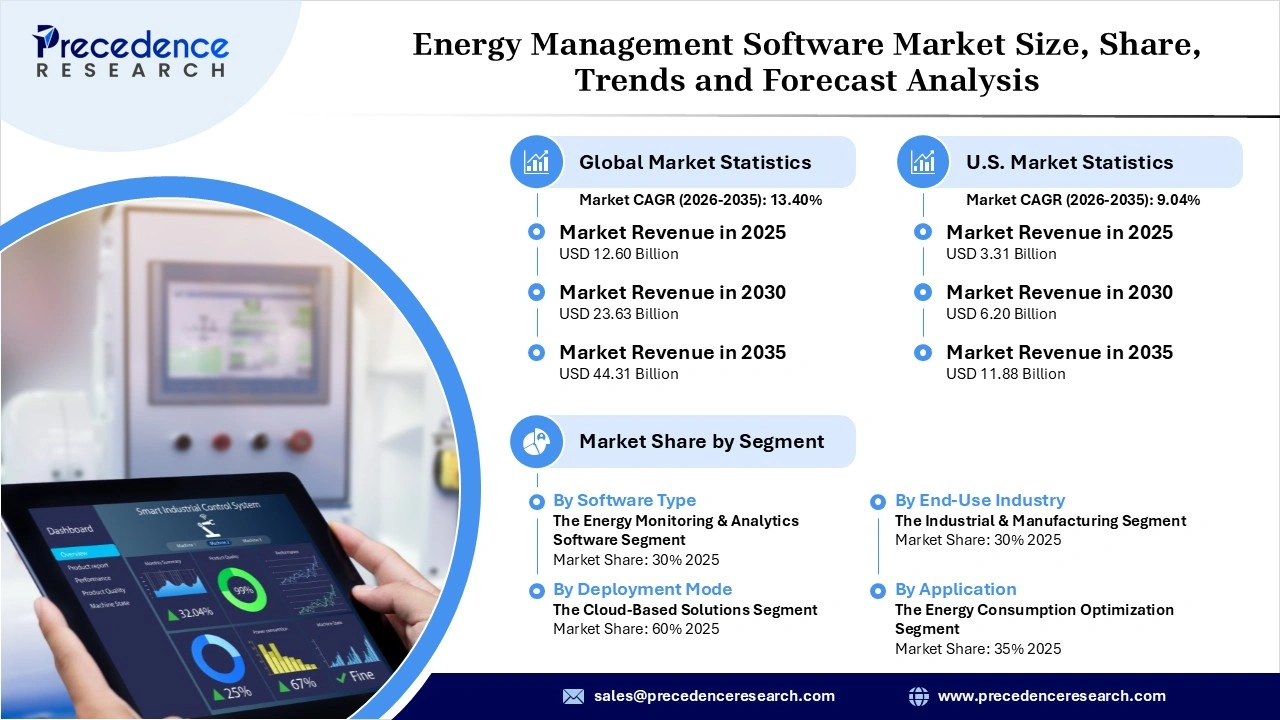
The global energy management software market revenue reached USD 12.60 billion in 2025 and is predicted to attain around USD 44.31 billion by 2035 with a CAGR of 13.40%. The market is driven by the increasing energy prices, growing emphasis on efficiency, and the rising need for companies to better manage their energy consumption.
Market Overview
The energy management software market comprises software solutions that assist organizations in monitoring, analyzing, and optimizing their energy consumption in their offices and industrial premises. The software gathers information from devices like smart meters, sensors, and connected equipment to allow users to gain insights about their energy consumption and deduce ways to address inefficiencies.
The market is driven by demand for energy consumption tracking, performance analytics, demand forecasting, cost and billing management, and even integration with buildings and industrial automation systems. Energy management software has been widely adopted in various industries and businesses, where efficiency improvement and cost savings are important considerations for long-term sustainability and compliance with regulations.
What are the Major Factors Driving the Energy Management Software Market?
- Adoption of AI and IoT Solutions for Smart Energy Monitoring: The recent advances in the market focus on incorporating AI and IoT systems that facilitate constant monitoring and automation of energy consumption. Through IoT devices like sensors and smart meters, real-time data is collected. This data is analyzed using AI systems to predict energy requirements, identify any possible faults, and optimize system efficiency. In 2025, Schneider Electric launched the next generation of its Ecostruxure platform, which is equipped with AI and can progressively analyze energy data and prevent potential problems related to power and energy before they arise.
- Adoption of Digital Twin Technology for Virtual Simulation of Energy Systems: Digital twin technology is being rapidly adopted in the market, as it facilitates companies to build virtual duplicates of their physical energy systems, such as buildings and manufacturing infrastructure. The virtual model collects real-time data from the sensors in the actual physical systems, and with the help of this data, operators can simulate the energy consumption patterns. In 2026, Siemens launched its Digital Twin Composer software that allowed businesses to experiment with their facility operations and modify their system in a virtual environment before deploying it.
- Government Initiatives to Incorporate Energy-Efficient Solutions: Governments across the world are implementing schemes that facilitate the adoption of energy management systems by providing funds, assistance, and favorable policies for efficient use of energy. These government programs assist companies in integrating the energy management system by subsidizing monitoring devices and energy-efficient technologies, which result in less energy usage and higher efficiency. In 2025, the Government of India introduced a scheme named ADEETIE (Assistance in Deploying Energy Efficient Technologies in Industries and Establishments). The government of India allocated a budget of 1000 crores to assist micro, small, and medium-scale industries in adopting energy efficiency solutions.
Grid Intelligence Surge: How Digital Infrastructure and Renewable Expansion Are Redefining Energy Software Demand
- According to the International Energy Agency, global digitalization of a smart grid should be at least twice the rate of investment it undertakes by 2030 to keep pace with net-zero objectives, which recommends high rates of software-based grid modernization between 2024 and 2026.
- By 2030, the European Union alone is projected to spend USD 548 billion on grid digitalization technologies and specifically on smart meters, automated grid management, and software platforms, and to actively deploy them during 2024-2026 as part of the European Commission Director-General for Energy initiatives.
- According to the International Renewable Energy Agency, in 2024, the total global capacity additions of power generation were almost 90%, and renewable energy, as one of the most important energy sources, is developing the necessity to provide a complex energy management program to combine such unpredictable sources of energy as the sun or wind into the grid.
- According to the International Renewable Energy Agency, it was estimated that nearly 49-50% of the total installed electricity capacity is comprised of renewable power capacity in 2025. This still demands the use of digital platforms and software systems to stabilize the grid and balance energy needs.
Market Segmentation Overview
- By Software Type: The energy monitoring & analytics software segment led the energy management software market with a 30% share in 2025. This is because of the fact that it is the key system that monitors all kinds of energy consumption information from various sources and allows businesses to detect energy wastage and make necessary improvements for efficient energy use.
- By Software Type: The carbon & sustainability management software segment is expected to expand at the highest CAGR during the forecast period, because of strict regulatory norms to manage carbon footprints, and energy management systems help companies achieve this by measuring their environmental impact and ensuring regulatory compliance.
- By Deployment Mode: The cloud-based solutions segment dominated the energy management software market with a 60% share in 2025, owing to their ability to enable companies to utilize energy management tools from remote locations, scalability to multiple locations, low initial infrastructure cost, and continuous update and integration of data in real-time.
- By Deployment Mode: The on-premise solutions segment held the second-largest market share of 25% in 2025, since a lot of prominent companies and sectors that need a lot of energy would rather rely on on-premise systems for better control over their critical energy infrastructure and flexibility.
- By End-Use Industry: The industrial & manufacturing segment led the market with a 30% share in 2025, as manufacturing companies use a significant quantity of energy in daily operations, and therefore, they are highly concerned about minimizing energy wastage, maximizing efficiency, and cutting down operational costs.
- By End-Use Industry: The commercial buildings segment held the second-largest market share of 20% in 2025, owing to the constant demand for energy for purposes like lighting, heating, and ventilation. The adoption of energy management systems helps commercial building facilities to cut down their energy consumption.
- By Application: The energy consumption optimization segment dominated the energy management software market with a 35% share in 2025, since it helps to minimize unnecessary energy consumption through the analysis of consumption trends and adjustment of systems accordingly, resulting in immediate savings for the enterprise.
- By Application: The emission & carbon footprint tracking segment is expected to grow at the fastest rate from 2026 to 2035, due to the rising need for businesses to track their harmful gas emissions to comply with strict regulatory norms, and to meet future sustainability goals like net-zero emissions.
Regional Analysis
North America led the energy management software market with a 35% share in 2025, owing to a significant presence of developed industries and intelligent infrastructure making use of energy management systems to enhance efficiency and minimize cost. The U.S. dominated the market in North America because of its robust digital ecosystem and well-developed energy management software technology, which uses smart grids and IoT. Canada is a significant contributor to the market due to its growing commitment towards sustainable construction technologies and increased government funding for energy conservation.
Asia Pacific is expected to expand at the highest CAGR of 16.5% during the forecast period, because of fast-paced industrialization and urbanization, coupled with increased energy consumption, which prompts companies to invest in advanced energy management systems. China led the market in Asia Pacific owing to its significant manufacturing capacity, active investments in smart technology infrastructure, and emphasis on energy efficiency and emissions reduction. India witnessed significant market growth due to the rapid adoption of digital technologies, growing commercial infrastructure, and smart city initiatives by the Indian government towards energy conservation.
Energy Management Software Market Coverage
| Report Attribute | Key Statistics |
| Market Revenue in 2025 | USD 12.60 Billion |
| Market Revenue by 2035 | USD 44.31 Billion |
| CAGR from 2026 to 2035 | 13.40% |
| Quantitative Units | Revenue in USD million/billion, Volume in units |
| Largest Market | North America |
| Base Year | 2025 |
| Regions Covered | North America, Europe, Asia-Pacific, Latin America, and the Middle East & Africa |
Top Companies in the Energy Management Software Market
Key players such as Schneider Electric SE, Siemens AG, Honeywell International Inc., GE Digital, ABB Ltd., Johnson Controls International plc, and Eaton Corporation plc provide comprehensive energy management software platforms that support monitoring, optimization, and control of energy usage across facilities and operations. IBM Corporation, Oracle Corporation, and SAP SE focus on enterprise-level solutions such as energy data analytics, carbon accounting, and sustainability reporting, helping large organizations track and manage environmental impact.
Meanwhile, Emerson Electric Co. and Rockwell Automation specialize in industrial energy management solutions, offering software tailored for manufacturing and process-heavy environments where efficiency and real-time monitoring are critical.
Segments Covered in the Report
By Software Type
- Energy Monitoring & Analytics Software
- Utility Bill Management Software
- Carbon & Sustainability Management Software
- Demand Response Management Software
- Distributed Energy Resource (DER) Management Software
By Deployment Mode
- Cloud-based Solutions
- On-premise Solutions
- Hybrid Solutions
By End-Use Industry
- Industrial & Manufacturing
- Commercial Buildings
- Residential Sector
- Energy & Utilities
- IT & Data Centers
- Government & Public Sector
- Healthcare
By Application
- Energy Consumption Optimization
- Emission & Carbon Footprint Tracking
- Predictive Maintenance & Energy Forecasting
- Grid & Load Management
- Cost Optimization & Billing Analytics
By Region
- North America
- Latin America
- Europe
- Asia-pacific
- Middle and East Africa
Get this report to explore global market size, share, CAGR, and trends, featuring detailed segmental analysis and an insightful competitive landscape overview @ https://www.precedenceresearch.com/sample/8351
You can place an order or ask any questions, please feel free to contact us at sales@precedenceresearch.com |+1 804 441 9344