



Energy Management Software Market Trends, Companies, Revenue / Sales Performance, Subscriber Growth, Pricing Strategies, Cloud Adoption, Infrastructure Expansion, Competitive Landscape, and Industry Outlook
Energy Management Software Market (By Software Type: Energy Monitoring & Analytics Software, Utility Bill Management Software, Carbon & Sustainability Management Software, Demand Response Management Software, Distributed Energy Resource (DER) Management Software; By Deployment Mode: Cloud-based Solutions, On-premise Solutions, Hybrid Solutions; By End-Use Industry: Industrial & Manufacturing, Commercial Buildings, Residential Sector, Energy & Utilities, IT & Data Centers, Government & Public Sector, Healthcare; By Application: Energy Consumption Optimization, Emission & Carbon Footprint Tracking, Predictive Maintenance & Energy Forecasting, Grid & Load Management, Cost Optimization & Billing Analytics) - Global Industry Analysis, Size, Trends, Leading Companies, Regional Outlook, and Forecast 2026 to 2035
Source: https://www.precedenceresearch.com/energy-management-software-market
 Get a Sample
 Table Of Content


What is the Energy Management Software Market Size in 2026?
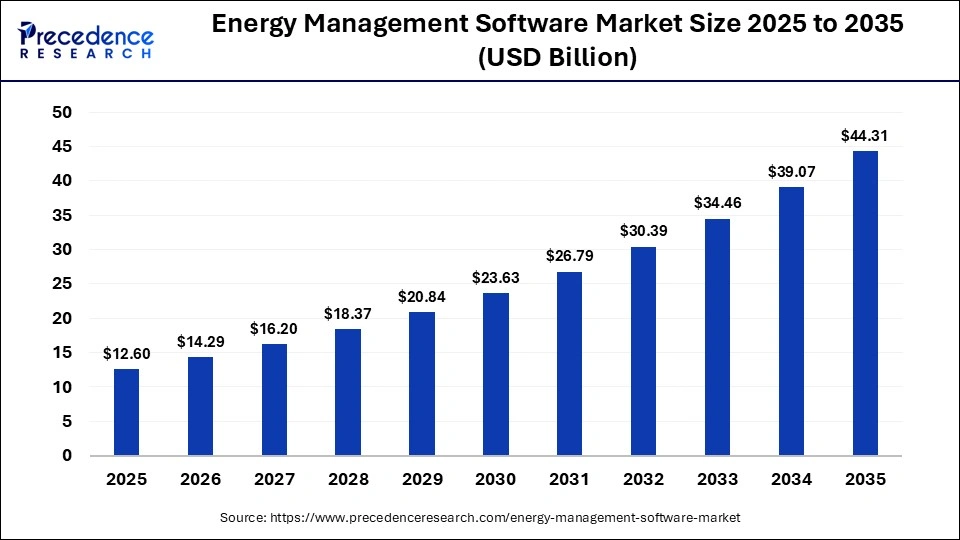
The global energy management software market size accounted for USD 12.60 billion in 2025 and is predicted to increase from USD 14.29 billion in 2026 to approximately USD 44.31 billion by 2035, expanding at a CAGR of 13.40% from 2026 to 2035. The market growth is attributed to rising energy efficiency mandates, rapid digitalization of power systems, and increasing integration of AI-driven optimization technologies across industries.
Key Takeaways
- North America dominated the energy management software market with a 35% share in 2025.
- Asia Pacific is expected to grow at the fastest CAGR of 16.5% between 2026 and 2035.
- By software type, the energy monitoring & analytics software segment held the highest market share of 30% in 2025.
- By software type, the carbon & sustainability management software segment held a 20% share of the market in 2025 and is expected to grow at a CAGR of 18.5% between 2026 and 2035.
- By deployment mode, the cloud-based solutions segment held the highest market share of 60% in 2025.
- By deployment mode, the on-premises solutions segment held the second-largest market share of 25% in 2025 and is expected to grow at a CAGR of 7.5% during the forecast period.
- By end-use industry, the industrial & manufacturing segment held a market share of 30% in 2025.
- By end-use industry, the residential sector segment is estimated to grow at the highest CAGR of 15% over the projected period.
- By application, the energy consumption optimization segment held a major market share of 35% in 2025.
- By application, the emission & carbon footprint tracking segment held a 20% share of the market in 2025 and is expected to grow at the highest CAGR of 17.5% between 2026 and 2035.
Market Overview
The energy management software market is primarily driven by rising global energy efficiency demand and rapid digitalization of infrastructure systems. Energy management software is a software solution that combines IoT, cloud, and AI analytics to measure and optimize the real-time energy use within systems.
The International Energy Agency indicates that a substantial portion of the global emissions reduction can be realized in the pathways to 2030 through energy efficiency measures. Furthermore, the decarbonization goals, increasing energy demand, and ongoing global digitalization of energy systems are driving overall market growth.
Impact of Artificial Intelligence on the Energy Management Software Market
The market is being transformed by AI, improving the efficiency of organizations in monitoring and automating the use of energy through interconnected systems. Machine learning models are used by enterprises in order to enhance their demand forecasting accuracy. This contributes to minimizing peak loads and enhancing operational planning. Moreover, enterprises use AI-based optimization solutions to minimize energy loss and enhance the performance of their processes.
Major Market Trends
- Rising Digitalization of Energy Infrastructure: Rapid digital transformation of power networks is driving the adoption of intelligent energy management software across industries.
- Growing ESG Compliance and Reporting Pressure: Rising sustainability requirements are boosting the deployment of automated energy tracking and emissions reporting software systems.
- Shift Toward AI-Driven Systems: AI-driven energy management systems (EMS) are enabling real-time, self-directed optimization of energy loads, pricing responses, and consumption patterns without human intervention. These systems continuously adjust operations based on dynamic data inputs, improving efficiency and responsiveness across energy networks.
Market Scope
| Report Coverage | Details |
| Market Size in 2025 | USD 12.60 Billion |
| Market Size in 2026 | USD 14.29 Billion |
| Market Size by 2035 | USD 44.31 Billion |
| Market Growth Rate from 2026 to 2035 | CAGR of 13.40% |
| Dominating Region | North America |
| Fastest Growing Region | Asia Pacific |
| Base Year | 2025 |
| Forecast Period | 2026 to 2035 |
| Segments Covered | Software Type, Deployment Mode, End-Use Industry, Application, and Region |
| Regions Covered | North America, Europe, Asia-Pacific, Latin America, and Middle East & Africa |
Market Dynamics
Drivers
Increasing Demand for Energy Efficiency in Enterprises
The growing focus on achieving energy efficiency in businesses is expected to drive the market by boosting the need for digital energy optimization systems across different sectors. The mandate of energy performance reporting further boosts the demand for automated monitoring systems. Furthermore, the strong focus on carbon reduction and sustainability target objectives is expected to drive mass adoption of automated energy monitoring systems.
Restraint
High Initial Implementation and Integration Costs
High implementation and integration costs are expected to limit the adoption of advanced energy optimization platforms, particularly among small and medium enterprises. Integration with existing building management and industrial control systems increases initial capital requirements and deployment complexity. Additionally, challenges in achieving seamless data integration with legacy infrastructure further hinder the widespread implementation of modern energy management solutions in industrial environments.
Opportunity
Growing Adoption of Smart Grid Technologies
Democratization of smart grid technologies is expected to create immense opportunities for the energy management software market by accelerating the digitalization of electricity distribution systems. Energy management software plays a critical role in balancing supply fluctuations from renewable sources such as solar and wind, ensuring grid stability and efficiency. Large-scale grid modernization programs led by governments and utilities are further enhancing system reliability and operational intelligence. Additionally, the rising adoption of smart buildings and interconnected infrastructure is expected to substantially increase demand for advanced energy optimization software.
Segment Insights
Software Type Insight
Energy Management Software Market Share, By Software Type, 2025-2035 (%)
| Software Type | 2025 | 2035 | CAGR (%) |
| Energy Monitoring & Analytics Software | 30.00% | 28.00% | 11.50% |
| Utility Bill Management Software | 15.00% | 13.00% | 9.00% |
| Carbon & Sustainability Management Software | 20.00% | 25.00% | 18.50% |
| Demand Response Management Software | 15.00% | 14.00% | 12.00% |
| Distributed Energy Resource (DER) Management Software | 20.00% | 20.00% | 16.00% |
The Energy Monitoring & Analytics Software Segment Dominated the Market in 2025
The energy monitoring & analytics software segment dominated the energy management software market with a share of 30% in 2025, as enterprises prioritize real-time visibility into energy consumption across operations. Companies use innovative dashboards and AI-based analytics technology to find existing inefficiencies in the industrial processes and business premises. Strong emphasis on operational optimization further drives the adoption of energy monitoring & analytics software.
The utility bill management software segment held a 15% share of the market in 2025 and is expected to grow at a 9% CAGR during the forecast period. This is mainly due to the enterprises' focus on cost control and billing accuracy. Large organizations manage complex tariff structures and multi-location energy usage through centralized billing platforms.
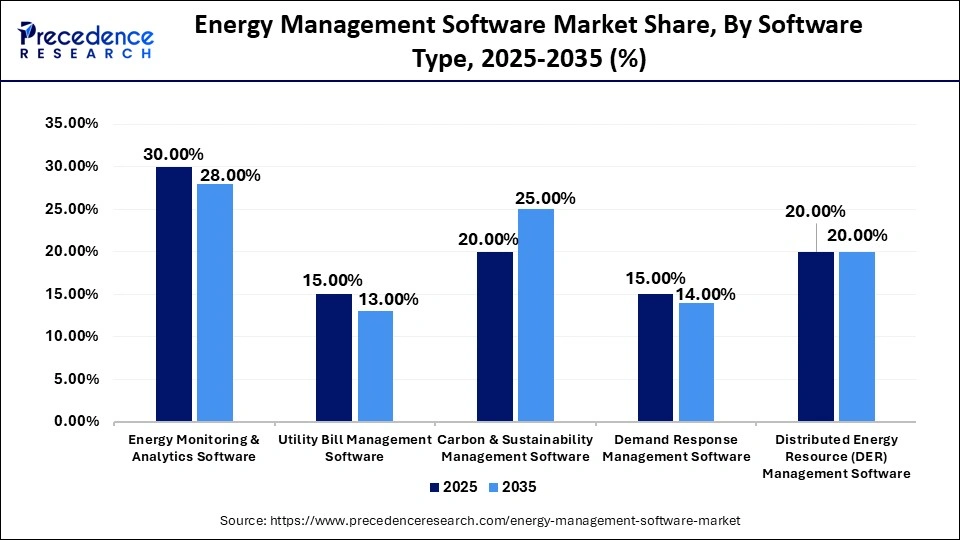
The carbon & sustainability management software segment held a 20% share of the market in 2025 and is expected to grow at the highest CAGR of 18.5% between 2026 and 2035. This is mainly driven by ESG mandates, carbon neutrality goals, and regulatory compliance requirements globally. The International Energy Agency reported that digital carbon tracking systems play a central role in achieving net-zero transition pathways. Rising regulatory enforcement continues to accelerate the demand for sustainability-focused energy software solutions.
The distributed energy resource (DER) management software segment held a 20% market share in 2025 and is estimated to grow at a strong CAGR of 16% over the projection period. This growth is driven by increasing pressure on energy grids from rising peak loads and the intermittency of renewable energy sources. Additionally, the rapid adoption of rooftop solar systems and the expansion of EV charging infrastructure are boosting demand for intelligent coordination and real-time energy balancing solutions.
Deployment Mode Insights
Energy Management Software Market Share, By Deployment Mode, 2025-2035 (%)
| Deployment Mode | 2025 | 2035 | CAGR (%) |
| Cloud-based Solutions | 60.00% | 65.00% | 18.00% |
| On-premise Solutions | 25.00% | 20.00% | 7.50% |
| Hybrid Solutions | 15.00% | 15.00% | 12.50% |
The Cloud-based Solutions Segment Held a 60% Market Share in 2025
The cloud-based solutions segment dominated the energy management software market with the largest share of 60% in 2025, as enterprises prioritize scalability and real-time energy data integration across operations. Instead of heavy hardware-based systems, organizations start to move to flexible cloud-native strategies, such as those that enable multi-site energy monitoring. Constant upgrades and AI integration offerings enhance cloud deployment leadership in the world's energy systems.
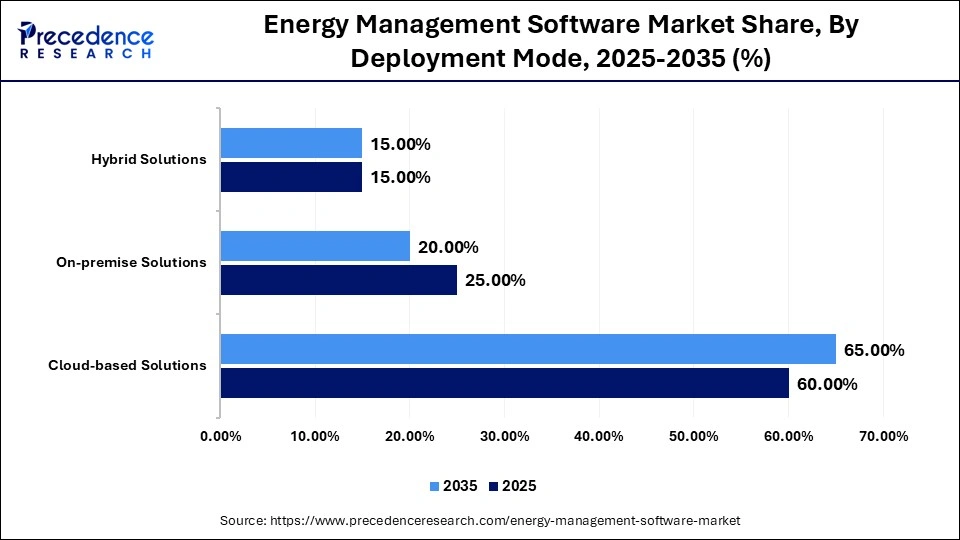
The on-premise solutions segment held the second-largest market share of 25% in 2025 and is expected to grow at a CAGR of 7.5% between 2026 and 2035. This is because these solutions are increasingly preferred by industries with critical infrastructure. The increasing need to ensure data control and operational independence is boosting the adoption of these solutions.
The hybrid solutions segment held a 15% share of the market in 2025 and is expected to grow at a 12.5% CAGR during the projection period, owing to the growing demand for balanced integration between on-premise control systems and cloud scalability. Hybrid architecture helps to achieve a gradual change to digital infrastructures without affecting legacy infrastructure.
End-Use Industry Insights
The Industrial & Manufacturing Segment Dominated the Market With a 30% Share in 2025
The industrial & manufacturing segment dominated the energy management software market by holding a share of 30% in 2025, driven by its high energy consumption and the strong need for cost optimization and efficiency improvement. Manufacturers are increasingly focusing on linking energy usage with production performance and output quality rather than solely targeting cost reduction. According to the International Energy Agency, industry accounted for around 40% of global final energy demand in 2025, making it the largest end-use sector.
The commercial buildings segment held a 20% market share in 2025 and is estimated to grow at a strong CAGR of 11.5% over the projected period. This is mainly due to the fact that commercial buildings deploy intelligent building management systems to optimize HVAC, lighting, and occupancy-based energy usage. The IEA estimates that commercial buildings contribute nearly 30% of global electricity consumption, reinforcing their importance in energy optimization efforts. Solutions such as Schneider Electric's EcoStruxure further enhance real-time energy monitoring and efficiency across multi-tenant commercial environments.
Energy Management Software Market Share, By End-Use Industry, 2025-2035 (%)
| End-Use Industry | 2025 | 2035 | |
| Industrial & Manufacturing | 30.00% | 28.00% | 12.50% |
| Commercial Buildings | 20.00% | 19.00% | 11.50% |
| Residential Sector | 10.00% | 12.00% | 15.00% |
| Energy & Utilities | 20.00% | 21.00% | 14.50% |
| IT & Data Centers | 10.00% | 11.00% | 13.50% |
| Government & Public Sector | 5.00% | 5.50% | 12.00% |
| Healthcare | 5.00% | 3.50% | 10.00% |
The residential sector segment held a 10% share of the market in 2025 and is expected to grow at the highest CAGR of 15% between 2026 and 2035. This growth is driven by utilities adopting digital platforms to manage demand-supply fluctuations across increasingly renewable-heavy grids. Rising electricity loads from electric vehicle charging are boosting the demand for forecasting and grid response strategies.
The IT & data centers segment held a 10% market share in 2025 and is expected to grow at a CAGR of 13.5% over the projected period. This is mainly due to the rising cloud computing demand and rapid expansion of digital infrastructure. The IEA reports that data center electricity consumption is increasing at an average rate of around 17%, supporting sustained adoption of energy management solutions in this sector.
The government & public sector segment held a 5% share of the market in 2025 and is expected to grow at a CAGR of 12% between 2026 and 2035, driven by smart city initiatives and infrastructure efficiency programs. Energy management platforms are increasingly being used in this sector to optimize public utilities such as lighting, transportation systems, and urban infrastructure.
The healthcare segment held a 5% market share in 2025 and is expected to grow at a 10% CAGR during the forecast period, owing to the critical requirement for uninterrupted power supply and operational reliability. Hospitals rely on energy management systems to ensure continuous power availability for life-support systems and essential medical equipment.
Application Insights
The Energy Consumption Optimization Segment Held a 35% Market Share in 2025
The energy consumption optimization segment dominated the energy management software market with a share of 35% in 2025. This leadership is driven by enterprises prioritizing operational efficiency and cost reduction through real-time energy visibility. Industrial operators are increasingly deploying granular monitoring systems that track machine- and process-level energy consumption within facilities.
The emission & carbon footprint tracking segment held a 20% market share in 2025 and is estimated to grow at a CAGR of 17.5% over the projected period. The growth os the segment is driven by ESG regulations, sustainability goals, and corporate carbon neutrality initiatives. There is a rising adoption of computer-based carbon accounting systems that measure both direct and indirect emissions across operations. These advancements are making carbon tracking possible in energy management systems.
The predictive maintenance & energy forecasting segment held a 15% share of the market in 2025 and is expected to grow at a significant CAGR of 14% between 2026 and 2035. This growth is supported by organizations transitioning toward predictive operational models. Energy platforms are increasingly used to analyze equipment performance data, enabling early detection of anomalies that could lead to system failures.
The cost optimization & billing analytics segment held a 15% market share in 2025 and is estimated to grow at a strong CAGR of 11% over the projected period. This segment is growing as organizations seek greater transparency and control over rising energy costs. The adoption of digital energy financial optimization tools is steadily increasing among enterprises, supporting segmental growth.
Regional Insights
North America Energy Management Software Market Size and Growth 2026 to 2035
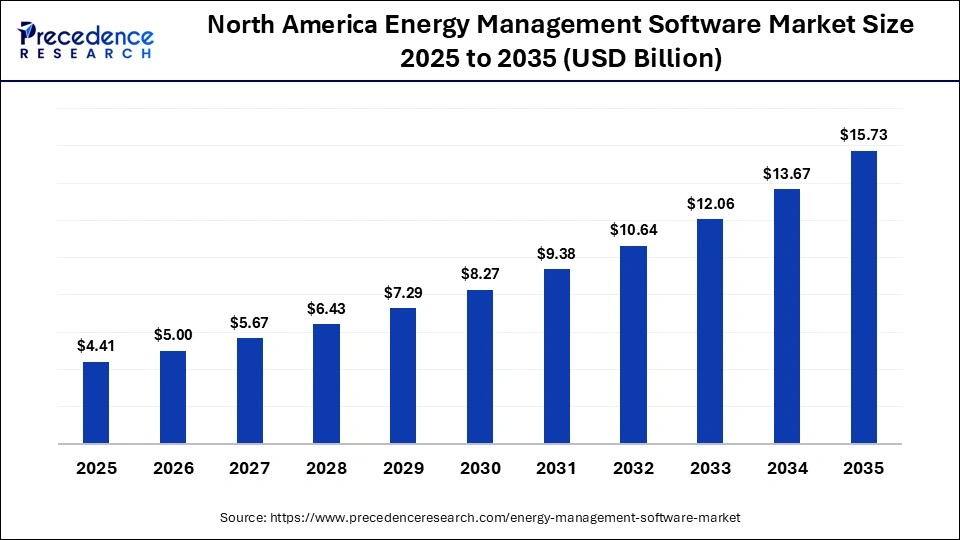
The North America energy management software market size is estimated at USD 4.41 billion in 2025 and is projected to reach approximately USD 15.73 billion by 2035, with a 13.56% CAGR from 2026 to 2035.
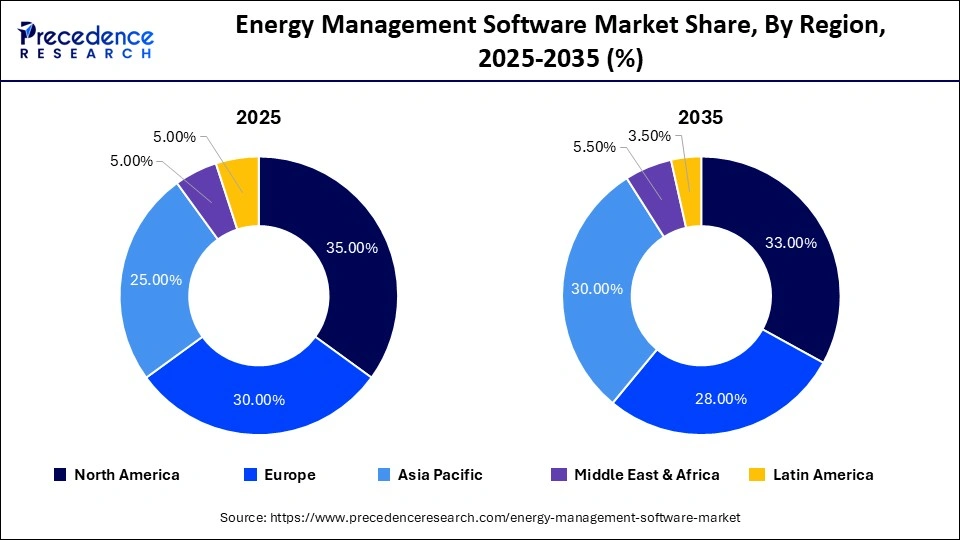
North America Dominated the Market With a 35% Share in 2025
North America led the energy management software market, capturing the largest share of 35% in 2025. This dominance is driven by widespread deployment of advanced digital energy infrastructure across industrial and commercial sectors. The region benefits from mature infrastructure readiness, with International Energy Agency (IEA) reports indicating that North America accounted for nearly one-third of global smart grid digitalization deployments in 2025. In addition, strong venture capital investment in energy technology startups continues to reinforce regional innovation leadership in energy software solutions.
U.S. Energy Management Software Market Size and Growth 2026 to 2035
The U.S. energy management software market size is calculated at USD 3.31 billion in 2025 and is expected to reach nearly USD 44.31 billion in 2035, accelerating at a strong CAGR of 9.04% between 2026 and 2035.
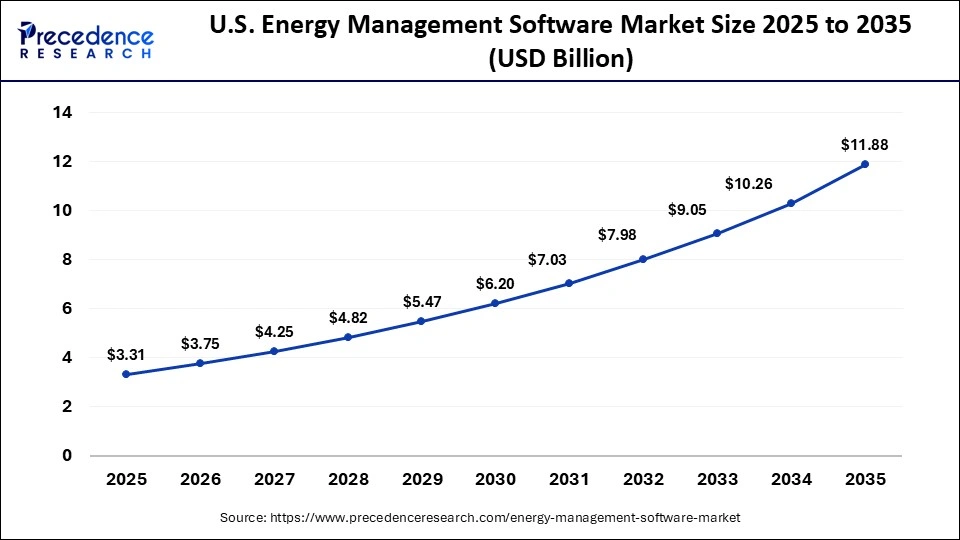
U.S. Energy Management Software Market Analysis
The U.S. leads the North American energy management software market, supported by large-scale decarbonization initiatives focused on grid digitalization and industrial emissions reduction. The rapid expansion of hyperscale data centers is further accelerating demand for advanced energy optimization tools, including predictive load balancing and real-time energy management systems.
Europe: The Second-Largest Market
Europe held the second-largest market share of 30% in 2025 and is estimated to grow at a strong CAGR of 12.5% over the projected period. This growth is primarily driven by strict carbon neutrality regulations and the accelerated digital transformation of energy systems. European enterprises are increasingly adopting energy management systems to comply with EU-mandated sustainability reporting frameworks and emissions reduction policies. Additionally, initiatives such as Carbon Trust certification schemes are encouraging faster adoption of verified emissions tracking systems, further supporting market expansion.
Germany Energy Management Software Market Analysis
Germany is a major contributor to the market within Europe, driven by its strong industrial base and the ongoing Energiewende transition. Government-backed digitalization initiatives are accelerating the adoption of energy intelligence platforms across both SMEs and large enterprises. Germany's renewable energy penetration is also a major driver, with wind and solar contributing over 50% of electricity generation at peak periods in 2025, increasing the need for advanced grid optimization and energy balancing solutions.
How is the Opportunistic Rise of Asia Pacific in the Energy Management Software Market?
Asia Pacific held a 20% share of the market in 2025 and is expected to grow at the highest CAGR of 16.5% between 2026 and 2035. The regional market growth is fueled by rapid industrialization, urban expansion, and large-scale energy infrastructure development across emerging economies. The region's strong urbanization trends are driving demand for smart building technologies and smart city energy management systems. In particular, ASEAN smart city initiatives are accelerating the adoption of cloud-based energy optimization platforms across commercial and public infrastructure.
China Energy Management Software Market Analysis
In China, the market is driven by its large industrial base and rapid modernization of smart grid infrastructure. The expansion of electric vehicle charging networks is also increasing demand for intelligent load balancing and distributed energy management systems, reinforcing China's leadership in regional adoption of energy management software.
Energy Management Software Market Companies
- ABB Ltd.
- Cisco Systems, Inc.
- Eaton Corporation plc
- Emerson Electric Co.
- Enel X S.r.l.
- General Electric (GE Digital)
- Honeywell International Inc.
- IBM Corporation
- Johnson Controls International plc
- Oracle Corporation
- Rockwell Automation, Inc.
- SAP SE
- Schneider Electric SE
- Siemens AG
- Verdigris Technologies, Inc
Recent Developments
- In April 2026, Mitsubishi Electric launched a proof-of-concept railway energy management system in Krakow, Poland, integrating the Serendie platform and energy storage systems to capture and reuse regenerative braking energy in tram operations.(Source: https://www.mitsubishielectric.com)
- In April 2026, Grid Rails introduced an enterprise-grade Virtual Power Plant platform designed to help utilities and DER operators monitor, control, and monetize distributed energy assets at scale.(Source: https://www.globenewswire.com)
- In April 2026, SymphonyAI expanded its IRIS Foundry platform with eight new industrial AI applications for energy operators, targeting emissions compliance, asset failures, and operational inefficiencies using causal AI across OT and IT systems.(Source: https://www.afp.com)
Segments Covered in the Report
By Software Type
- Energy Monitoring & Analytics Software
- Utility Bill Management Software
- Carbon & Sustainability Management Software
- Demand Response Management Software
- Distributed Energy Resource (DER) Management Software
By Deployment Mode
- Cloud-based Solutions
- On-premise Solutions
- Hybrid Solutions
By End-Use Industry
- Industrial & Manufacturing
- Commercial Buildings
- Residential Sector
- Energy & Utilities
- IT & Data Centers
- Government & Public Sector
- Healthcare
By Application
- Energy Consumption Optimization
- Emission & Carbon Footprint Tracking
- Predictive Maintenance & Energy Forecasting
- Grid & Load Management
- Cost Optimization & Billing Analytics
By Region
- North America
- Latin America
- Europe
- Asia-pacific
- Middle and East Africa
For inquiries regarding discounts, bulk purchases, or customization requests, please contact us at sales@precedenceresearch.com
Frequently Asked Questions





Ask For Sample
No cookie-cutter, only authentic analysis – take the 1st step to become a Precedence Research client
 Get a Sample




 sales@precedenceresearch.com
 Schedule a Meeting
