



Enterprise Labeling Software Market Revenue to Attain USD 7.75 Bn by 2035
Published: 11 May 2026
Author: Precedence Research



Enterprise Labeling Software Market Revenue and Trends 2026 to 2035
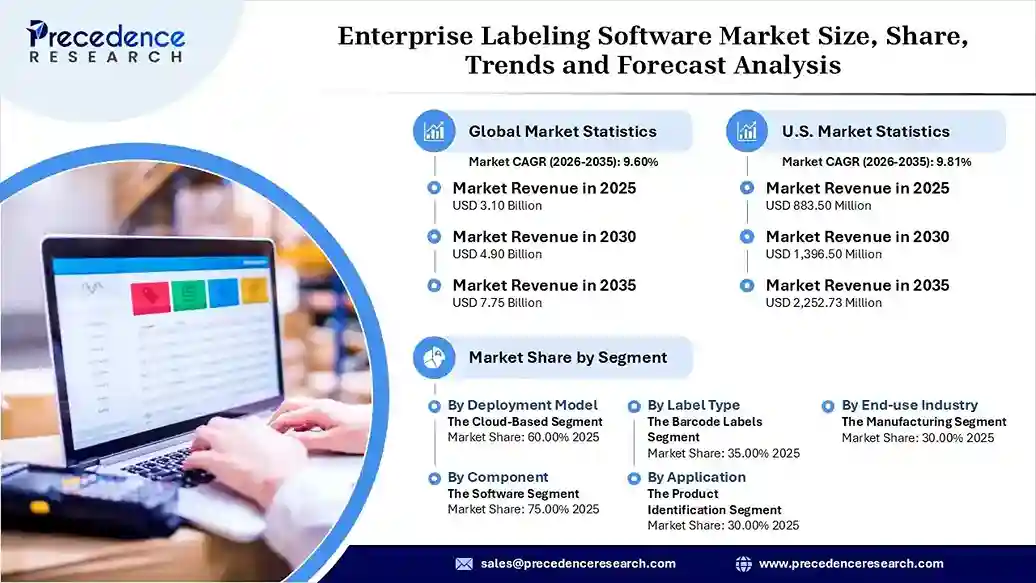
The global enterprise labeling software market revenue surpassed USD 3.10 billion in 2025 and is predicted to attain around USD 7.75 billion by 2035, growing at a CAGR of 9.60%. The market is driven by the ever-strengthening regulations concerning proper labeling of products in different sectors, and the increasing need for label automation across many plants and countries.
Market at a Glance
The enterprise labeling software market involves a range of centralized software solutions, which enable organizations to design, control, approve, and print labels. This market includes label design tools with pre-built compliance templates, workflow management to facilitate the approval process, ERP integration to access product information in real-time, and the generation of barcodes and serial numbers.
These software solutions find applications in variable data printing, regulatory label management, and global label management solutions that translate and format labels in different jurisdictions at once. This market caters to manufacturing, distribution, and logistics operations in various sectors such as food and beverage, pharmaceutical and medical devices, chemicals and hazardous materials, automotive, and electronics.
What are the Major Trends Impacting the Market?
- Hybrid Cloud-Based Labeling Solutions and Intelligent Automation: The enterprise labeling software market is swiftly embracing a new hybrid cloud architecture, which combines cloud-based label designing and management capabilities together with on-premise print capabilities. This solution provides intelligent forms that help operators make their choice between different labels and enter all necessary information without making mistakes and without requiring special technical knowledge. In 2026, Seagull Software released BarTender 12, which features a hybrid label architecture bringing together cloud-based design and collaboration capabilities with local printing. The company also unveiled an Intelligent Forms Builder to create custom forms that guarantee error-free printing of labels.
- Adoption of Cloud-Based Labeling System and MIS Automation: There is a rapid adoption of integrated workflows that involve incorporating labeling systems with manufacturing execution systems and business management systems. Label converters have been building their technical infrastructure with cloud-based labeling systems that can easily integrate with ERP systems, thus ensuring that there is no duplication of entries. It facilitates live monitoring of production activities from the machine level on the shop floor to minimize wastage and optimize decision-making processes. In 2025, Yerecic Label, a three-generation-owned label converter company catering to prominent food companies, collaborated with eProductivity Software to automate operations at its plants located in Pennsylvania and Arizona. Yerecic Label has adopted a technology platform for label converters that integrates with Microsoft Dynamics 365 Business Central, avoiding data duplication and offering real-time tracking through shipping.
- Governments Strengthening Food and Drug Labeling Regulations: Governments across the globe have introduced stringent labeling regulations for the food, pharmaceutical, and consumer products industries to adhere to consumer rights, health considerations, and logistical needs. Governments are mandating wholesalers to implement strong track-and-trace procedures and to conduct proper license verification and robust transaction documentation. In 2025, the U.S. FDA sent a warning letter to Sterling Distributors, a Florida wholesale drug distributor, for violations of the Drug Supply Chain Security Act. The company violated its license obligations under the law, distributed prescription drugs in Arkansas and Mississippi without a license, and conducted transactions with unauthorized trading partners.
Market Segmentation Overview
- By Deployment Model: The cloud-based segment led the enterprise labeling software market with 60% share in 2025 and is expected to expand at the highest CAGR during the forecast period. This is because it eliminates the need for on-premise servers as well as dedicated IT personnel and real-time sync of label designs from one location to another.
- By Deployment Model: The on-premise segment held the second-largest share of 40% in 2025, due to the fact that many large organizations in the manufacturing sector rely on traditional systems that are heavily integrated with their IT network infrastructure and adhere to stringent security protocols, thus they need on-premise systems.
- By Component: The software segment dominated the market with a 75% share in 2025, since it is the primary component involved in labeling, including design, templates, data, workflow, and printing.
- By Component: The services segment held the second-largest share of 25% in 2025, because of the large amount of professional services needed to set up enterprise labeling platforms, such as integration of the platform with the company’s ERP and MES systems.
- By Label Type: The barcode labels segment led the enterprise labeling software market with 35% share in 2025, due to the requirement of the barcode format for almost every product shipped through the channels of retail, pharma, and logistics across the world.
- By Label Type: The RFID labels segment is expected to expand at the highest CAGR during the forecast period, owing to the increasing demands placed by retail organizations and logistics companies for tagging products using RFID technology at an item level, especially since major clients such as Walmart and Target have adopted this technology.
- By Application: The product identification segment dominated the market with 30% share in 2025, because each manufactured product, whether in food packages, medicines, or chemicals, needs at least one label that contains the basic information and barcode.
- By Application: The asset tracking segment is expected to grow at the fastest rate from 2026 to 2035, driven by rising adoption of enterprise asset management systems that track the movement of various assets, including equipment, tools, IT assets, medical devices, and fleet vehicles.
- By End-Use Industry: The manufacturing segment led the market with 30% share in 2025, since all manufacturers, irrespective of the type of industry, have to label their raw materials, finished products, and transport boxes using barcodes, lot numbers, expiration dates, handling instructions, and regulatory statements.
- By End-Use Industry: The healthcare & pharmaceuticals segment is expected to expand at the highest CAGR during the forecast period because of the strict and evolving labeling regulations in this segment, such as the EU Falsified Medicines Directive, which requires the unique barcode identification of every drug package for tracking purposes.
Regional Analysis
North America led the enterprise labeling software market with a 38% share in 2025, due to the strict regulatory environment in the food, drugs, and chemicals sectors, with regulators such as the FDA, EPA, and USDA that mandate manufacturers to develop advanced labeling capabilities. U.S. dominated the market in North America due to a wide range of industrial manufacturing facilities, along with the regulatory framework such as the Food Safety Modernization Act, Drug Supply Chain Security Act, and various labeling laws at the state level.
Canada witnessed significant market growth owing to its bilingual labeling system of consumer products in English and French as mandated by the Canadian Food Inspection Agency and Health Canada. This bilingual labeling requirement adds further complications to the label production process and increases the need for a central labeling system to accommodate dual-language labels.
Asia Pacific is expected to expand at the highest CAGR during the forecast period due to fast-paced industrialization with the development of industries like food, pharmaceutical, and consumer goods, while governments have been increasingly implementing Western practices of sterilization, traceability, and labeling. China led the market in Asia Pacific since it is the leading producer of various products that are consumed domestically and exported globally, along with tightening of labeling laws by the China Food and Drug Administration. India is a notable contributor to the market because of its thriving export business in pharmaceuticals, which has compelled the local manufacturing companies to adhere to global track-and-trace measures like GS1 barcoding and sterilization.
Enterprise Labeling Software Market Coverage
| Report Attribute | Key Statistics |
| Market Revenue in 2025 | USD 3.10 Billion |
| Market Revenue by 2035 | USD 7.75 Billion |
| CAGR from 2026 to 2035 | 9.60% |
| Quantitative Units | Revenue in USD million/billion, Volume in units |
| Largest Market | North America |
| Base Year | 2025 |
| Regions Covered | North America, Europe, Asia-Pacific, Latin America, and the Middle East & Africa |
Top Companies in the Enterprise Labeling Software Market
Loftware, NiceLabel, Seagull Scientific (BarTender), TEKLYNX, Esko, PRISYM ID, and Codesoft are some of the key players that focus on designing, automating, and managing labels. Zebra Technologies, Honeywell, SATO Holdings, and Avery Dennison are hardware and printing solution providers and also provide label design and management software. Oracle, SAP, and Microsoft provide labeling solutions, typically via integrations, and native solutions.
Segments Covered in the Report
By Deployment Model
- Cloud-based
- On-premise
By Component
- Software
- Services
By Label Type
- Barcode Labels
- RFID Labels
- QR Code Labels
- Regulatory Labels
By Application
- Product Identification
- Inventory Management
- Asset Tracking
- Compliance Labeling
By Organization Size
- Large Enterprises
- Small & Medium Enterprises (SMEs)
By End-Use Industry
- Manufacturing
- Healthcare & Pharmaceuticals
- Retail & E-commerce
- Food & Beverage
- Logistics & Transportation
- Chemicals
By Region
- North America
- Latin America
- Europe
- Asia-pacific
- Middle and East Africa
Get this report to explore global market size, share, CAGR, and trends, featuring detailed segmental analysis and an insightful competitive landscape overview @ https://www.precedenceresearch.com/sample/8390
You can place an order or ask any questions, please feel free to contact us at sales@precedenceresearch.com |+1 804 441 9344