



ESG Software Market Revenue to Attain USD 31.96 Bn by 2035
Published: 20 May 2026
Author: Precedence Research



ESG Software Market Revenue and Trends 2026 to 2035
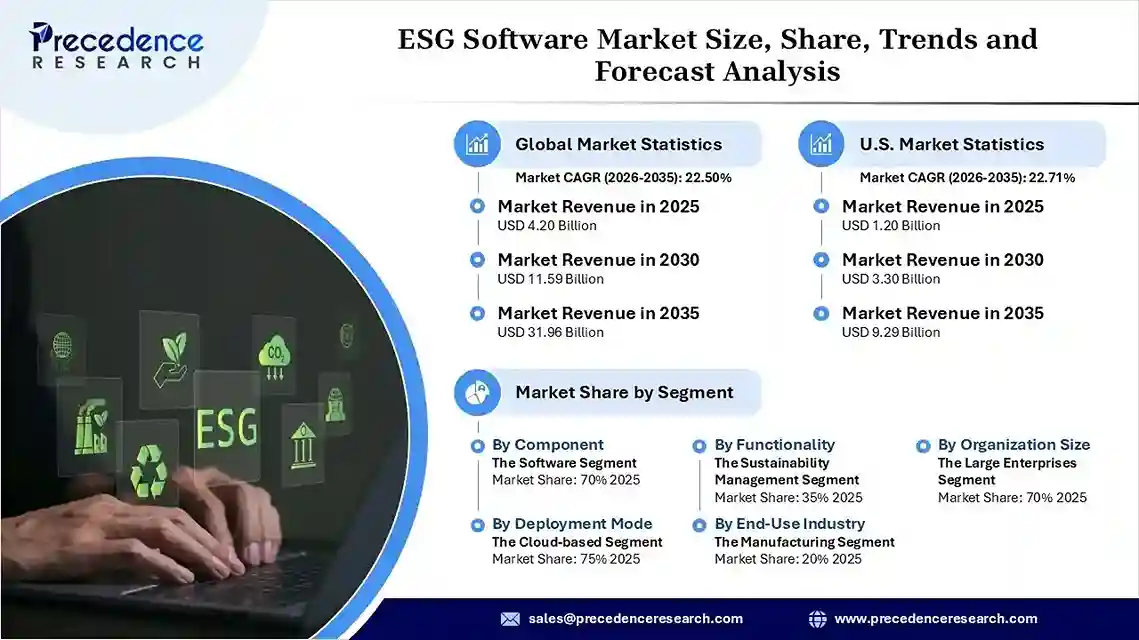
The global ESG software market revenue surpassed USD 4.20 billion in 2025 and is predicted to attain around USD 31.96 billion by 2035, growing at a CAGR of 22.50%. The market is gaining strong momentum as businesses race to replace scattered sustainability data, rising compliance pressure, and investor scrutiny with smarter platforms that turn ESG obligations into measurable business decisions.
Market at a Glance
The ESG software market comprises digital-enabled software services that enable companies to track, measure, manage, and report their environmental, social, and governance performance. The software solutions that make them are gathering information about emissions, workforce practices, supply chain ethics, and the level of compliance, and replacing confusing records with valuable information for decision-makers. Used by corporations, market participants, and regulators, the implementation of ESG software has transformed from a passive reporting solution to being closely integrated into the risk transparency and long-term value delivery strategy.
The ESG industry software sector is diverse, encompassing aspects such as carbon accounting, sustainability disclosures, governance, supplier risk assessments, diversity indicators, and regulation compliance monitoring and management. It provides solutions for so many different kinds of businesses, from financial services to manufacturing, via both cloud-based platforms and legacy systems, expanding beyond AI-driven analytics scenario modeling alongside real-time intelligence on ESG performance.
Market Forecast for the ESG Software Market
- Supply Chain ESG Data Is Driving the Market: Industry practitioners openly note that supplier data collection is one of the biggest CSRD bottlenecks, especially for manufacturers handling thousands of vendors. This creates a sharp opportunity for ESG platforms focused on supplier onboarding, traceability, questionnaires, evidence logs, and Scope 3 automation.
- Rising Demand for ESG Software in Mid-Sized Companies : Consulting professionals report that large enterprises have already begun materiality assessments, while thousands of mid-sized firms still need implementation support. That suggests the next wave of ESG software demand will come from modular, lower-cost SaaS products designed for companies without enterprise budgets.
Rising Profit Signals Higher ESG Technology Spending
- SAP's financials for Q1 2026 suggest the need for ESG software among business enterprises, with demand increasing based on cloud services, with cloud revenue up ~19% to €5.96 billion, as integration with sustainability and compliance solutions has become more popular.
- Operating profit increased to €2.74 billion, indicating enterprises are prepared to put efforts into digital governance tools by integrating them with ESG reporting.
- Projected backlog of cloud services over €21.9 billion, with a pipeline through which, indirectly or independently, ESG software is grown due to the integration of ERP-related sustainability modules.
- Total revenue was around €9.55 billion, suggesting that spending on enterprise IT continued to trend despite macroeconomic headwinds, which is a very important aspect for scaling ESG projects.
- AI-led SAP Business Suite integration is shifting ESG tools from reporting-only to predictive compliance systems inside cloud ecosystems.
- Overall, SAP’s growth signals a structural shift: ESG software is being absorbed into core cloud ERP workflows, not sold separately anymore.
Market Segmentation Overview
- By component, the software segment dominated the ESG software market with a 70% market share in 2025 and is expected to maintain its leading position with a CAGR of 23% in the coming years, due to rising demand for automated ESG tracking and reporting solutions. Enterprises increasingly rely on AI, machine learning, and big data analytics. The growing need for real-time reporting, monitoring, and compliance management is expected to fuel momentum.
- By deployment mode, the cloud-based segment dominated the market with a 75% market share in 2025 and is expected to maintain its leading position with a CAGR of 26% in the coming years, due to the benefits like less upfront costs, scalability, and operational agility. Also, firms continue to favor centralized control of ESG information and real-time reporting tools. This is particularly true for SMEs and large enterprises - both SMEs prefer SaaS models. The rising need for multi-location and global compliance tracking is strengthening adoption further.
- By functionality, the sustainability management segment dominated the market with a 35% market share in 2025 and is expected to maintain its leading position with a CAGR of 24% in the coming years, as corporations intensified efforts to reduce carbon footprints and waste generation. Rising adoption of sustainable business practices and renewable energy sources, growing corporate demand for sustainability goal tracking and reporting, are evolving stakeholder expectations.
- By end-use industry, the manufacturing segment dominated the ESG software market with a 20% market share in 2025 and is expected to maintain its leading position with a CAGR of 21.5% in the coming years, due to the rising adoption of green manufacturing technologies and the increasing need for carbon footprint reduction and waste management. Producers faced strong pressure to achieve sustainable production and supply chain management.
- By organization size, the large enterprises segment accounted for a considerable revenue share of 70% in the market in 2025, due to increased ESG budget initiatives, regulatory impetus on a global level, and the complexities associated with multinational operations that require centralized ESG tracking capabilities. There exist some early investments by these organizations in comprehensive software solutions that help to manage disclosures, but in this case, governance controls that not only maintain long-term sustainability programs but also cover regulatory compliance.
- By organization size, the small and medium enterprises segment is expected to grow at the fastest CAGR of 27% in the market between 2026 and 2035, as affordable cloud-based ESG tools become more accessible. Rising interest in cost-effective and scalable ESG management tools and growing awareness of corporate social responsibility are likely to push adoption well beyond large corporations.
Regional Analysis
North America dominated the global ESG software market with a market share of 38% in 2025, due to the demand for ESG reports on the rise, and with a strong corporate support for transparent and measurable sustainability reports, we expect North America to lead the market. Digital transformations are now being heavily invested in by companies, as there is a growing demand for data-driven ESG performance management. As for the United States, it is the nation’s largest player in the region, fueled by momentum on SEC-related climate disclosures and investment in enterprise software.
Asia-Pacific held a market share of 20% in 2025 and is expected to grow at the fastest CAGR of 25% in the market during the forecast period, due to rapid industrialization, rising awareness of environmental issues, and increasing demand for transparent governance practices. Governments and private enterprises are increasingly funding sustainability digitization. China is likely to remain a key driver, as its reforms towards green manufacturing and carbon neutrality programs continue to drive progress, but India could also see further improvements with BRSR reporting standards alongside increased ESG investments, coupled with greater demand for transparency among publicly listed firms.
ESG Software Market Coverage
| Report Attribute | Key Statistics |
| Market Revenue in 2025 | USD 4.20 Billion |
| Market Revenue by 2035 | USD 31.96 Billion |
| CAGR from 2026 to 2035 | 22.50% |
| Quantitative Units | Revenue in USD million/billion, Volume in units |
| Largest Market | North America |
| Base Year | 2025 |
| Regions Covered | North America, Europe, Asia-Pacific, Latin America, and the Middle East & Africa |
Top Companies in the ESG Software Market
SAP, Oracle, Microsoft, Salesforce, IBM, and SAS also enhance their competitive edge through ESG factors integrated throughout their existing ERP, cloud, analytics, and business intelligence tools. This encourages corporations to integrate sustainability measures into financing, purchasing, and operational processes by weaving ESG into the very fabric of their finance, procurement, and operations. Additionally, reporting capabilities, audit trail management, integration with environmental health and safety (EHS), emissions oversight, and governance processes of companies like Workiva, Enablon, Intelex Technologies, FigBytes, Wolters Kluwer, and Carbon Trust are influencing the competitive landscape as well.
Segments Covered in the Report
By Component
- Software
- Services
By Deployment Mode
- Cloud-based
- On-premise
By Functionality
- Sustainability Management
- Environmental Management
- Social Responsibility Tracking
- Governance, Risk, and Compliance (GRC)
- Reporting and Analytics
By End-use Industry
- BFSI
- IT and Telecom
- Healthcare
- Manufacturing
- Retail and E-commerce
- Energy and Utilities
- Government
By Organization Size
- Large Enterprises
- Small and Medium Enterprises
By Region
- North America
- Latin America
- Europe
- Asia-pacific
- Middle and East Africa
Get this report to explore global market size, share, CAGR, and trends, featuring detailed segmental analysis and an insightful competitive landscape overview @ https://www.precedenceresearch.com/sample/8420
You can place an order or ask any questions. Please feel free to contact us at sales@precedenceresearch.com |+1 804 441 9344