



Green Commodities Market Revenue to Attain USD 520.58 Bn by 2035
Published: 04 May 2026
Author: Precedence Research



Green Commodities Market Revenue and Trends 2026 to 2035
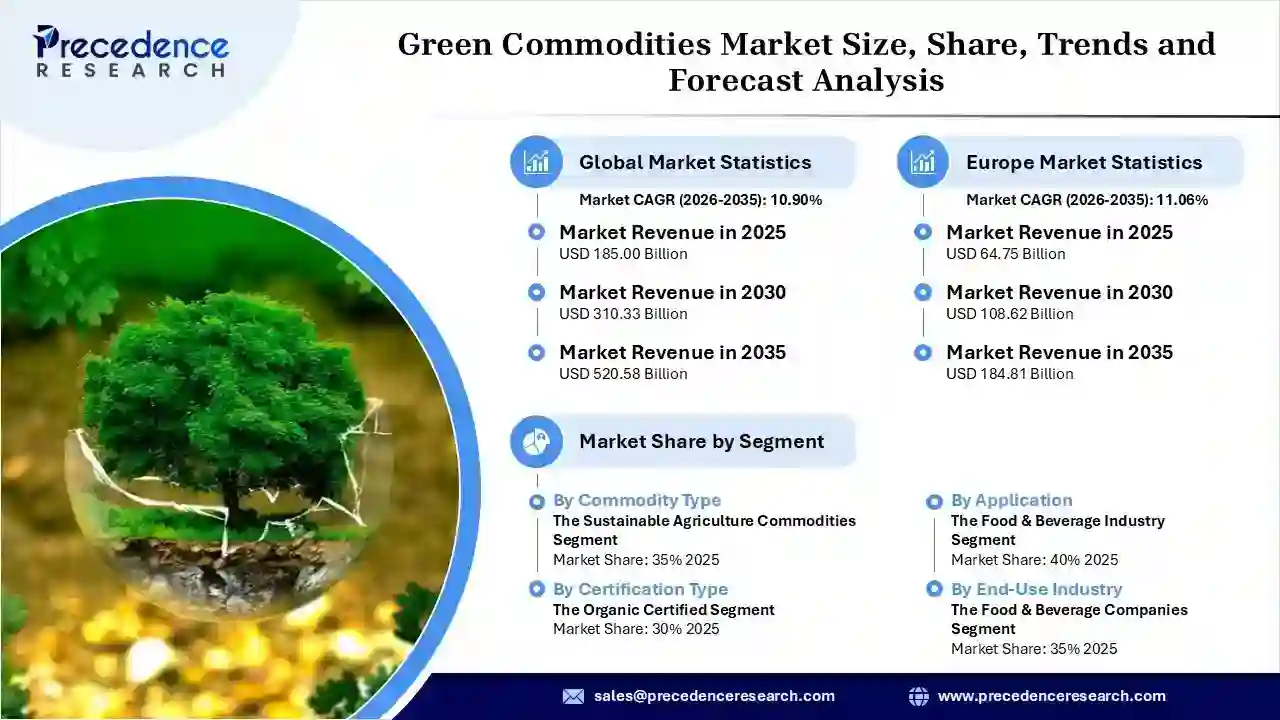
The global green commodities market revenue reached USD 185.00 billion in 2025 and is predicted to attain around USD 520.58 billion by 2035 with a CAGR of 10.90%. The green commodities market is expanding due to the rising demand for clean energy and increasing adoption of renewable sources.
Market at a Glance
The green commodities market encompasses the trading of environmentally linked products and instruments such as biofuels, green hydrogen, carbon credits, and renewable energy certificates. It operates at the intersection of physical commodity supply chains and environmental accounting systems, where value is derived not only from utility but also from reduced emissions and sustainability performance.
What distinguishes this market is the transformation of “environmental impact” into a tradable asset, enabling emissions reductions and renewable attributes to be quantified, priced, and exchanged. The ecosystem includes both compliance-driven mechanisms and voluntary initiatives, connecting producers, regulators, and investors in a framework where avoided emissions carry tangible economic value alongside physical goods.
What Drives the Green Commodities Market?
- Green Industrial Transition Driving Demand: The expansion of low-carbon industrial infrastructure is a major growth driver. More than 110 net-zero industrial plants are currently operational, while 473 additional projects are in development, representing nearly USD 700 billion in investment tied to low-carbon commodities such as green steel and clean fuels. This reflects a structural shift toward embedding sustainability directly into core industrial production.
- Rise of Digital Carbon and Analytics Platforms: Digital platforms that track emissions, feedstocks, and low-carbon fuels are becoming essential decision-making tools. These systems are enabling companies to align procurement and production with net-zero targets, effectively turning carbon data and environmental metrics into a functional layer of value creation within the green commodities ecosystem.
Investments to Support Market Growth
- Chestnut Carbon raised USD 250 million in 2025, marking the largest fundraising event in the voluntary carbon market, signaling growing investor preference for high-integrity carbon assets.
- An additional USD 90 million funding round highlights sustained investor confidence in scalable carbon commodity solutions rather than short-term speculative interest.
- Large-scale corporate agreements now cover over 7 million carbon removal credits, indicating a shift from fragmented purchases to long-term, bulk procurement strategies.
- One major initiative aims to restore approximately 60,000 acres of land and plant nearly 35 million trees, effectively converting land use into a measurable carbon offset asset class.
Market Segmentation Overview
- By commodity type, the sustainable agriculture commodities segment held a 35% share of the green commodities market in 2025 because of consistent global demand for food products that are ethically sourced. Traceability has become a core requirement in procurement strategies, with buyers increasingly prioritizing verified supply chains to reduce reputational risks and meet regulatory standards.
- By commodity type, the renewable energy commodities segment is expected to grow at the fastest CAGR of 12.5% in the market between 2026 and 2035, due to rising demand for biofuels and a broader shift toward low-carbon energy systems. As decarbonization targets intensify, these commodities are increasingly shifting from alternative inputs to essential components of energy portfolios.
- By certification type, the organic certified segment held a major market share of 30% in 2025. This is mainly due to strong consumer preference for chemical-free and organic products.
- By certification type, the rainforest alliance certified segment is expected to grow with a CAGR of 11.5% in the market between 2026 and 2035, supported by rising emphasis on biodiversity conservation and sustainable agricultural practices. Companies are increasingly adopting these certifications not only for compliance but also to demonstrate environmental responsibility across supply chains.
- By application, the food & beverage industry segment dominated the green commodities market, accounting for a share of 40% in 2025, due to consumer interest in sustainable and ethically produced food items. Brands are actively reformulating sourcing strategies to meet consumer expectations and comply with evolving labeling and sustainability regulations.
- By application, the energy & biofuel production segment is expected to expand rapidly in the market with a CAGR of 12.5%, driven by global decarbonization initiatives and the shift toward renewable energy sources. Policy incentives and emission-reduction mandates are accelerating adoption across the sector.
- By end-use industry, the food & beverages companies segment held a share of 35.0% in the green commodities market in 2025, supported by large-scale procurement of sustainable agricultural commodities. Sustainability-focused sourcing has become a baseline requirement, transforming procurement standards across the industry.
- By end-use industry, the energy & utilities segment is expected to grow at the fastest CAGR of 12.5% in the market between 2026 and 2035, driven by increasing adoption of renewable energy, carbon credits, and evolving electricity grid systems. As carbon pricing expands, utilities are becoming key participants in green commodity markets.
Regional Analysis
Europe dominated the global green commodities market with a share of 35% in 2025, driven by stringent sustainability regulations, ESG mandates, and strong consumer preference for certified products. Countries such as Germany and France have reinforced this growth through strict carbon pricing and sourcing policies, while the Netherlands remains a key trading hub for certified agricultural commodities. The UK continues to expand its voluntary carbon market and corporate-led sustainability initiatives following regulatory adjustments.
Asia Pacific held a market share of 20% in 2025 and is expected to grow at the fastest CAGR of 13.5% during the forecast period. This is mainly due to the rising environmental awareness and export-oriented agricultural transformation. Countries such as India, Vietnam, and Indonesia are aligning agricultural exports with global certification standards. Moreover, China is significantly expanding renewable energy investments, strengthening regional green commodity supply.
Green Commodities Market Coverage
| Report Attribute | Key Statistics |
| Market Revenue in 2025 | USD 185.00 Billion |
| Market Revenue by 2035 | USD 520.58 Billion |
| CAGR from 2026 to 2035 | 10.90% |
| Quantitative Units | Revenue in USD million/billion, Volume in units |
| Largest Market | Europe |
| Base Year | 2025 |
| Regions Covered | North America, Europe, Asia-Pacific, Latin America, and the Middle East & Africa |
Top Companies in the Green Commodities Market
Major agricultural traders such as Cargill, Incorporated, Archer Daniels Midland Company, Bunge Limited, and Louis Dreyfus Company are integrating sustainability into global sourcing operations. Companies like Olam Group Limited and Wilmar International Limited are strengthening traceability systems across supply chains.
Meanwhile, Nestlé S.A., Unilever PLC, and Danone S.A. are embedding sustainable sourcing as a core procurement requirement rather than a branding initiative. Similarly, Starbucks Corporation and Mars, Incorporated are aligning long-term supply contracts with verified certification standards to ensure sustainability compliance across value chains.
Segments Covered in the Report
By Commodity Type
- Sustainable Agriculture Commodities (Coffee, Cocoa, Tea, Grains)
- Sustainable Forestry Products (Timber, Pulp, Paper)
- Bio-based Raw Materials (Bioplastics Feedstock, Natural Fibers)
- Renewable Energy Commodities (Biofuels, Biomass)
- Carbon Credits & Environmental Commodities
By Certification Type
- Fair Trade Certified
- Organic Certified
- Rainforest Alliance Certified
- Forest Stewardship Council (FSC) Certified
- Others (RSPO, UTZ, etc.)
By Application
- Food & Beverage Industry
- Energy & Biofuel Production
- Textiles & Apparel
- Construction & Packaging Materials
- Carbon Trading & Offsetting
By End-Use Industry
- Food & Beverage Companies
- Energy & Utilities
- Retail & Consumer Goods
- Manufacturing & Industrial
- Government & Environmental Organizations
By Distribution Channel
- Direct Sourcing & B2B Contracts
- Commodity Exchanges & Trading Platforms
- Sustainability-focused Marketplaces
By Region
- North America
- Latin America
- Europe
- Asia-pacific
- Middle and East Africa
Get this report to explore global market size, share, CAGR, and trends, featuring detailed segmental analysis and an insightful competitive landscape overview @ https://www.precedenceresearch.com/sample/8364
You can place an order or ask any questions, please feel free to contact us at sales@precedenceresearch.com |+1 804 441 9344