



Large-Scale Active Stem Cell Clinical Trials Market Revenue to Attain USD 28.88 Bn by 2035
Published: 07 May 2026
Author: Precedence Research



Large-Scale Active Stem Cell Clinical Trials Market Revenue and Trends 2026 to 2035
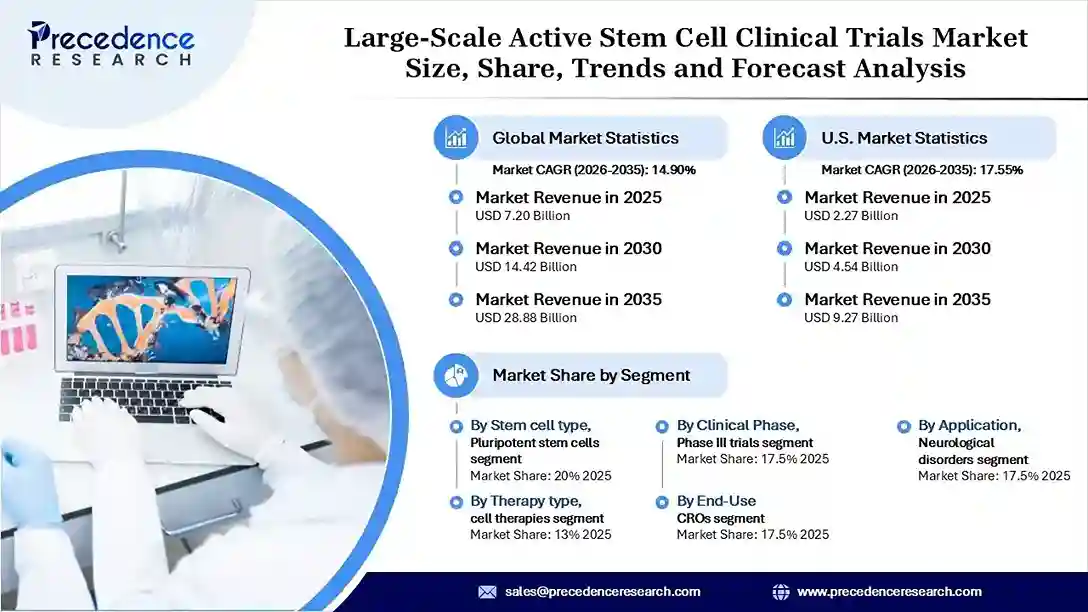
The global large-scale active stem cell clinical trials market revenue was valued at USD 7.20 billion in 2025 and is expected to attain around USD 28.88 billion by 2035, growing at a CAGR of 14.90% during forecast period. The market is driven by the increasing number of late-stage clinical trials for ailments like osteoarthritis, pediatric Crohn’s disease, Parkinson’s disease, and heart failure.
Market Overview
The large-scale active stem cell clinical trials market includes ongoing Phase 2, Phase 3, and registration-stage studies of stem cell-based therapies that are currently recruiting, underway, or completed but not yet closed. It covers trials using various stem cell types such as mesenchymal stem cells from bone marrow, adipose tissue, and umbilical cord, as well as hematopoietic stem cells for blood-related and immune disorders.
This market targets a wide range of diseases, including graft-versus-host disease, Huntington’s disease, ALS, stroke, spinal cord injury, and age-related macular degeneration. The market is primarily driven by pharmaceutical and biotechnology companies as well as academic medical centers conducting investigator-led research. Large patient-scale studies increasingly focus on allogeneic, off-the-shelf stem cell therapies designed for commercial-scale manufacturing and broader patient accessibility.
What are the Major Trends Influencing the Market?
Collaborations Between Biotech Companies and CDMOs
The large-scale active stem cell clinical trials market is majorly driven by the rising collaborations between biotechnology firms and contract development and manufacturing organizations (CDMOs) for acquiring the necessary manufacturing capabilities for Phase 3 and registration studies. Advances in autologous stem cell treatments are also creating significant manufacturing bottlenecks as programs move into late-stage trials, requiring more robust and standardized production systems. In 2025, CELLforCURE by SEQENS supported Phase 3 manufacturing of ProtheraCytes (autologous CD34+ stem cells for heart attack treatment), with technology transfer beginning in 2025 and clinical batch production planned for 2026.
Integrated Automated Manufacturing Systems and Off-the-Shelf iPSC Treatments
The market is embracing fully automated manufacturing systems designed as closed systems that allow one operator to produce several patients’ batches simultaneously using less space than that used for producing fewer batches in the previous cleanroom setting. The allogeneic off-the-shelf therapies derived from induced pluripotent stem cells (IPSCs) are being adopted, which do not involve specific harvesting of the patient’s cells. This technique makes use of universal donor cells that are manufactured commercially to ensure standardization of the treatments. In 2026, Amchepry, an allogeneic iPSC-derived dopaminergic neuron therapy for Parkinson’s disease, received conditional marketing authorization by Japan’s Ministry of Health.
Government Policies to Speed Up the Development of Stem Cell Therapies
Governments across the world have introduced regulatory reforms to facilitate the development and implementation of stem cell technologies. Some nations have put in place fast-track procedures, under which regenerative medicine therapies can be made available based on early clinical results. Many governments have introduced funding programs aimed at fostering stem cell clinical translation along with the private sector.
In 2025, the State Council of China issued Regulation No. 818 “Regulations on the Administration of Clinical Studies and Clinical Translation of New Biomedical Technologies”, coming into force on 1 May 2026. This regulation grants priority in review and approval after clinical translation for new therapies for life-threatening diseases.
99 Patients Enrolled in BioRestorative’s Phase 2 Disc Disease Study
BioResorative Therapies enrolled 99 patients for its Phase 2 clinical trial of BRTX-100 for chronic lumbar disc disease in February 2026 at 15 clinical centers located within the U.S. This study is currently the biggest FDA-approved Phase 2 cell therapy study undertaken for chronic lumbar disc disease. 40% of the total enrollment was achieved in the last six months, targeting pain reduction of more than 30% on the Oswestry Disability Index and a decrease of more than 30% on the Visual Analog Scale from baseline value at week 52.
Market Segmentation Overview
- By Stem Cell Type: The mesenchymal stem cells (MSCs) segment led the large-scale active stem cell clinical trials market with a 35% share in 2025. This is because these cells have been extensively studied and have a robust safety record and powerful immunomodulatory capabilities that allow for off-the-shelf allogeneic usage.
- By Stem Cell Type: The induced pluripotent stem cells (iPSCs) segment is expected to expand at the highest CAGR during the forecast period. This is because these cells can be sourced from adult cells, which can then be converted to any cell form, making it possible to offer patient-specific autologous treatment options.
- By Clinical Phase: The phase II trials segment dominated the market with a 40% share in 2025, due to the fact that it is a pivotal stage when promising stem cell treatments would have to prove their effectiveness on a larger population prior to costly and highly complex phase 3 trials.
- By Clinical Phase: The phase III trials segment is expected to grow at the fastest rate from 2026 to 2035, owing to the fact that more and more stem cell treatment candidates are passing the phase II stage successfully. This results in an increasing number of phase III trials, which require a greater number of participants and longer follow-up time.
- By Application: The oncology segment led the large-scale active stem cell clinical trials market with a 35% share in 2025. This is because of the long-standing use of hematopoietic stem cell transplantation in the treatment of blood cancers such as leukemia, lymphoma, and multiple myeloma as a standard treatment.
- By Application: The neurological disorders segment is expected to expand at the highest CAGR during the forecast period, due to the absence of a cure for neurological diseases like Parkinson’s disease, Huntington’s disease, amyotrophic lateral sclerosis, and Alzheimer’s disease.
- By End-Use: The pharmaceutical & biotechnology companies segment dominated the large-scale active stem cell clinical trials market with the highest share of 50% in 2025. This is because these companies are major investors in the advanced stages of clinical research and have invested billions of dollars in developing their stem cell drug candidates for regulatory approval and commercialization.
- By End-Use: The CROs segment is expected to grow at the fastest rate from 2026 to 2035, since biotechnology firms tend to hire outsourcing companies for managing clinical trials, recruiting patients, monitoring data, and submitting regulatory information as they progress with expensive and sophisticated phase II and phase III trials.
Regional Analysis
North America registered dominance in the large-scale active stem cell clinical trials market while holding a 42% share in 2025. This is because of its strong regenerative medicine ecosystem, well-defined FDA regulatory framework, and substantial venture capital funding supporting late-stage stem cell programs. The U.S. dominated the market within North America because it has advanced research facilities, numerous active Phase 2 and Phase 3 stem cell trials, and fast-track programs like the Regenerative Medicine Advanced Therapy of the FDA to bring promising therapies faster. Canada is a significant contributor to the market due to its strong government support for stem cell studies and several academic medical institutions performing investigator-initiated late-stage trials.
Asia Pacific is expected to grow at the fastest CAGR during the forecast period, driven by expanding biomanufacturing capabilities, cost-effective clinical trial operations, and increasing collaborations between local and global biotech firms. China leads the region due to its large clinical trial base, strong focus on allogeneic stem cell therapies, and growing CAR-T research pipeline. Moreover, Japan is witnessing steady growth supported by high research standards and increasing demand driven by its aging population.
Large-Scale Active Stem Cell Clinical Trials Market Coverage
| Report Attribute | Key Statistics |
| Market Revenue in 2025 | USD 7.20 Billion |
| Market Revenue by 2035 | USD 28.88 Billion |
| CAGR from 2026 to 2035 | 14.90% |
| Quantitative Units | Revenue in USD million/billion, Volume in units |
| Largest Market | North America |
| Base Year | 2025 |
| Regions Covered | North America, Europe, Asia-Pacific, Latin America, and the Middle East & Africa |
Top Companies in the Large-Scale Active Stem Cell Clinical Trials Market
Mesoblast Limited, Gamida Cell Ltd., and Athersys Inc. are key players focused on allogeneic mesenchymal stem cell (MSC) therapies for treating inflammatory, cardiovascular, and transplant-related complications. Their clinical programs primarily target immune modulation and tissue repair applications. Fate Therapeutics Inc. and Century Therapeutics Inc. are advancing iPSC-derived NK and T-cell therapies, primarily targeting oncology indications. BlueRock Therapeutics (Bayer AG) and Lineage Cell Therapeutics Inc. are leveraging pluripotent stem cell technologies to develop treatments for neurological disorders.
Vertex Pharmaceuticals Incorporated and CRISPR Therapeutics AG are focusing on gene-edited stem cell therapies, integrating CRISPR-based platforms to enhance therapeutic precision. Meanwhile, Novartis AG, Takeda Pharmaceutical Company Limited, and Stemline Therapeutics Inc. (Menarini Group) are actively developing CAR-T and other engineered stem cell-based therapies for cancer treatment.
Segments Covered in the Report
By Stem Cell Type
- Hematopoietic Stem Cells (HSCs)
- Mesenchymal Stem Cells (MSCs)
- Induced Pluripotent Stem Cells (iPSCs)
- Embryonic Stem Cells (ESCs)
By Clinical Phase
- Phase I Trials
- Phase II Trials
- Phase III Trials
By Application
- Oncology
- Cardiovascular Diseases
- Neurological Disorders
- Orthopedic & Musculoskeletal Disorders
- Autoimmune Diseases
- Others (Dermatology, Ophthalmology, etc.)
By Therapy Type
- Autologous Stem Cell Therapies
- Allogeneic Stem Cell Therapies
By Trial Design
- Single-center Trials
- Multi-center Trials (Global Trials)
By End-Use
- Pharmaceutical & Biotechnology Companies
- Academic & Research Institutes
- Contract Research Organizations (CROs)
By Region
- North America
- Latin America
- Europe
- Asia-pacific
- Middle and East Africa
Get this report to explore global market size, share, CAGR, and trends, featuring detailed segmental analysis and an insightful competitive landscape overview @ https://www.precedenceresearch.com/sample/8379
You can place an order or ask any questions, please feel free to contact us at sales@precedenceresearch.com |+1 804 441 9344