



Liquid Crystal Polymer Market Revenue to Attain USD 3.82 Bn by 2035
Published: 03 Jun 2026
Author: Precedence Research



Liquid Crystal Polymer Market Revenue and Trends 2026 to 2035
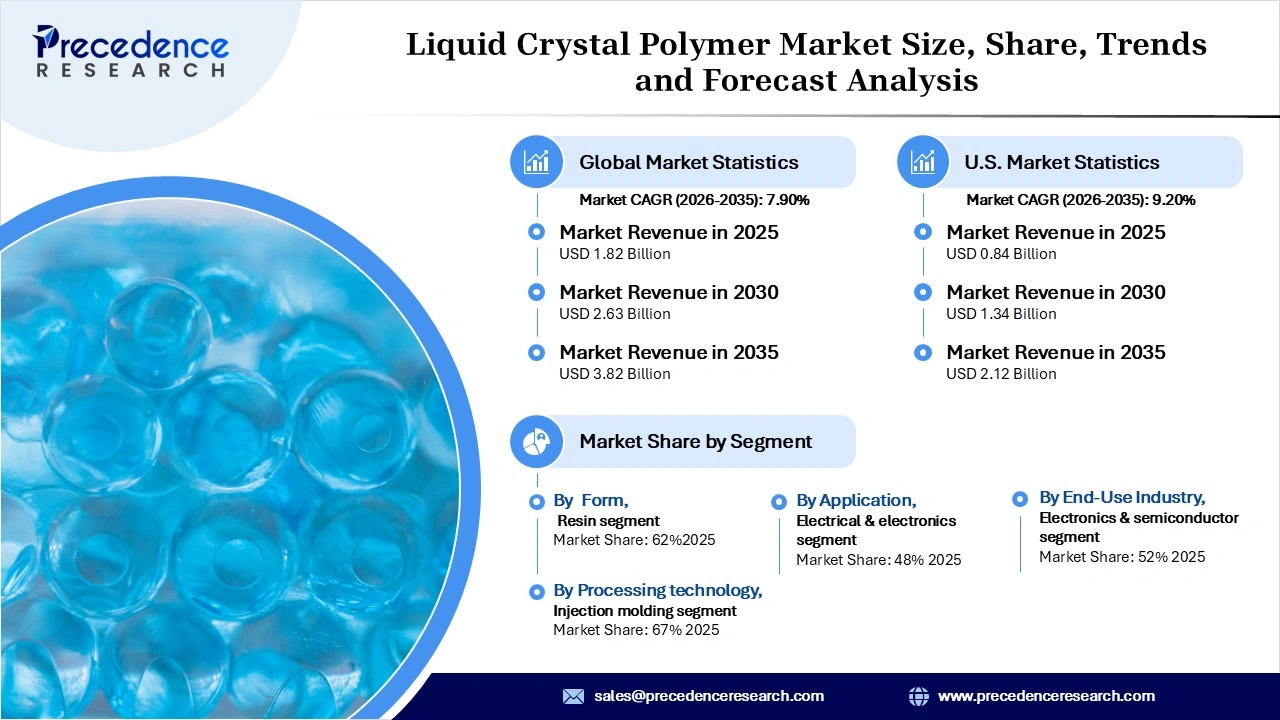
The global liquid crystal polymer market revenue was valued at USD 1.82 billion in 2025 and is expected to attain around USD 3.82 billion by 2035, growing at a CAGR of 7.90% during forecast period. The market is driven by the increasing demand for high-performance, lightweight materials in electronics, automotive components, 5G infrastructure, and miniaturized consumer devices, driven by their superior heat resistance, dimensional stability, and electrical properties.
Market Overview
The liquid crystal polymers market comprises manufacturing, blending, processing, and applications of specialty high-performance aromatic polyesters featuring liquid crystallinity and superior thermomechanical properties in the melting phase. Liquid crystal polymers possess an innovative reinforcing molecular structure offering exceptional chemical resistance, very low moisture content, and remarkable dielectric characteristics.
The market includes various grades of liquid crystal polymers (LCPs), such as injection-molding, extrusion, and film grades. Major applications involve small-size connectors, high-frequency antenna parts, autofocus voice coils of mobile devices, server sockets, and millimeter-wave products. This market has been adopted in electronics, telecommunications, automotive, healthcare, and aerospace sectors.
Exploring the Growth Potential of the Market
Reduced Transmission Loss with an Inner Cavity Structure for 6G Applications
There have been significant developments in the market with respect to a unique substrate design that consists of a hollow cavity created inside the LCP film, resulting in a reduced dielectric constant. Traditional substrates made from LCP materials face challenges when transmitting signals within the millimeter-wave range due to the increased dielectric constant. However, by making use of the internal cavity, it can attain a dielectric constant below 2.0, thus allowing for reduced transmission loss in the high-frequency range. In 2025, Murata Manufacturing released ULTICIRC, which is the first-ever LCP flexible substrate in the world consisting of an inner cavity, thus enabling a dielectric constant (Dk) of less than 2.0.
Development of Advanced Electronics Spurs LCP’s Demand
The market is adapting to cater to the needs of upcoming telecommunication technologies and miniaturized electronic products. With the increase in frequencies and component designs becoming more complicated, special types of LCP are being developed with improved flow characteristics, mechanical and thermal stability, and stable dielectric behavior. In 2025, Japanese company Polyplastics unveiled two different LCP Laperos series, namely, the TF series and the LH series. The TF series is designed to have superior flowability in thin-walled components of smartphones, and the LH series features balanced flowability and mechanical and heat stability.
Government Investment in the Development of Next-Generation Electronics
Governments across the globe are investing in research and development of advanced materials to dominate next-generation technologies such as 6G and AI. These efforts focus on breakthroughs related to LCP materials and other advanced substrates in order to enhance their supply chains. Governments have initiated programs for the development of high-frequency and semiconductor packaging. In 2025, the Executive Yuan of Taiwan allocated USD 920 million to stay ahead in the next generation of communications, including 6G. This six-year program finances research and development activities related to advanced materials that will help in next-generation communications, especially LCP materials.
- Kingfa Announces 98.94% Increase in LCP Sales in First Two Quarters of 2025
- In 2025, Kingfa Sci. & Tech declared its top-quality LCP sales posted an unprecedented increase of 98.94% on a year-on-year basis for the first half of 2025. Additionally, Kingfa is constructing an LCP synthetic resin manufacturing facility that has the capacity to produce 15,000 tons of LCP synthetic resin per year.
Market Segmentation Overview
- By type, the thermotropic liquid crystal polymer segment led the liquid crystal polymer market with 91% share in 2025 and is expected to expand at the highest CAGR of 8.1% during the forecast period. This is due to its capacity to be processed through regular melt-processing methods, like injection molding and extrusion, which are more economical than solvent-based processes employed for lyotropic LCP components.
- By type, the lyotropic liquid crystal polymer segment held the second largest market share of 9% in 2025, owing to the fact that it is capable of producing ultra-strong and high modulus fibers like the aramid fiber, despite its solvability not being as versatile as that of thermotropic LCPs.
- By form, the resin segment dominated the market with 62% share in 2025. This is because of its role as the main raw material for injection and extrusion molding processes, allowing the bulk manufacturing of highly sophisticated miniature parts such as high-frequency connectors, antenna units, and vehicle electronics.
- By form, the films segment is expected to grow at the fastest CAGR of 9.3% from 2026 to 2035, since LCP films have the unique combination of low dielectric loss, low moisture absorption, and dimensional stability, which makes them ideal for 56/6G millimeter-wave antenna modules and fast flex circuit boards.
- By application, the electrical & electronics segment led the market with 48% share in 2025 and is expected to grow at the fastest CAGR of 8.7% from 2026 to 2035, because of the very nature of LCP, which makes it ideal for use in miniaturized high-frequency components, including 5G antenna modules, fast connectors, and smartphone camera actuators.
- By application, the automotive segment held the second largest market share of 21% in 2025, owing to the fact that LCP is heat-resistant, chemical-resistant, and has thermal dimensional stability, which is required for under-hood electronics, transmissions, and ADAS sensors.
- By end-use industry, the electronics & semiconductor segment dominated the market with 52% share in 2025 and is expected to expand at the fastest CAGR of 8.8% from 2026 to 2035. This is mainly due to LCP’s unique properties, such as low-loss dielectric constant and heat resistance, which are crucial for high-frequency connectors and 5G antenna modules.
- By end-use industry, the automotive segment held the second largest market share of 19% in 2025, owing to the thermomechanical stability and dimensional accuracy of LCP materials, which are important for automotive parts like transmissions and advanced driver assistance systems.
Regional Analysis
Asia Pacific led the liquid crystal polymer market with 46% share in 2025 and is expected to expand at the highest CAGR of 9.2% during the forecast period because of a rapidly developing electronics industry, which comprises smartphones, semiconductors, and 5G infrastructure. China dominated the market in the Asia Pacific market since it is both a large consumer and producer of LCP products, and the aggressive funding for materials localization and capacity augmentation within the country. Japan witnessed notable market growth due to its reputation as an innovative producer of high-purity LCP resins and its strong presence in flexible printed circuit substrates in the automotive and electronics industries.
North America held the second largest market share of 24% in 2025, because of significant demand for high-quality LCPs from aerospace, defense, and medical device applications sectors, and the significant presence of indigenous vendors such as Solvay and Celanese. The U.S led the market in North America owing to its high-tech semiconductor packaging industry, along with various active military and aerospace programs that need LCPs due to its high thermal stability and moisture resistance. Canada is a significant contributor to the market due to the significant presence of specialized institutions conducting research and manufacturing of LCP components for telecommunications infrastructure and biomedical implants using federal funding.
Liquid Crystal Polymer Market Coverage
| Report Attribute | Key Statistics |
| Market Revenue in 2025 | USD 1.82 Billion |
| Market Revenue by 2035 | USD 3.82 Billion |
| CAGR from 2026 to 2035 | 7.90% |
| Quantitative Units | Revenue in USD million/billion, Volume in units |
| Largest Market | North America |
| Base Year | 2025 |
| Regions Covered | North America, Europe, Asia-Pacific, Latin America, and the Middle East & Africa |
Top Companies in the Liquid Crystal Polymer Market
Celanese Corporation, Sumitomo Chemical, Toray Industries, and Polyplastics Co. provide high-temperature and low-dielectric resins for 5G antennas, connectors, and automotive electronics. Solvay, SABIC, and Mitsubishi Engineering-Plastics produce LCP products designed for high-end applications in the telecommunications industry. Shanghai PRET Composites, Ueno Fine Chemicals Industry, Chang Chun Group, and Kuraray have a significant presence in Asia and provide LCP materials at a relatively lower cost than their Western counterparts.
Segments Covered in the Report
By Type
- Thermotropic Liquid Crystal Polymer
- Lyotropic Liquid Crystal Polymer
By Form
- Resin
- Fibers
- Films
- Others
By Application
- Electrical & Electronics
- Automotive
- Consumer Goods
- Industrial Components
- Medical Devices
- Others
By End-use Industry
- Electronics & Semiconductor
- Automotive
- Industrial Manufacturing
- Healthcare
- Aerospace & Defense
- Others
By Processing Technology
- Injection Molding
- Extrusion
- Blow Molding
- Compression Molding
By Region
- North America
- Latin America
- Europe
- Asia-pacific
- Middle and East Africa
Get this report to explore global market size, share, CAGR, and trends, featuring detailed segmental analysis and an insightful competitive landscape overview @ https://www.precedenceresearch.com/sample/8441
You can place an order or ask any questions. Please feel free to contact us at sales@precedenceresearch.com |+1 804 441 9344