



Liquid Crystal Polymer Market Size, Share, Trends, Companies, and Forecast 2026-2035
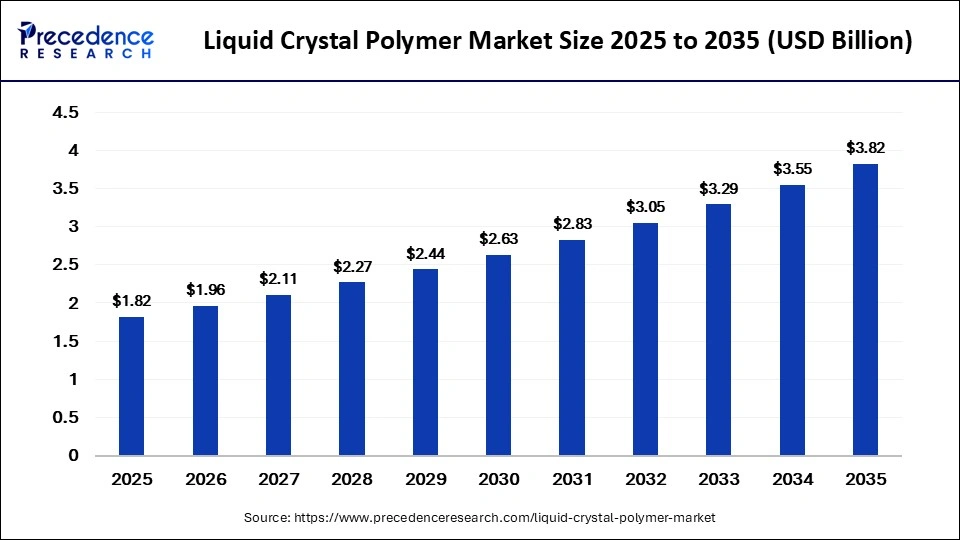
Vidyesh Swar, a Chemical and Materials Industry Expert, estimates the liquid crystal polymer market at USD 1.96 billion in 2026, with the market projected to reach USD 3.82 billion by 2035 at a CAGR of 7.90%. Major liquid crystal polymer market companies such as Celanese Corporation, Sumitomo Chemical, Toray Industries, Polyplastics Co are competing across key material and application segments, including By Type, By Form, By Application, By End-use Industry, By Processing Technology.
Source: https://www.precedenceresearch.com/liquid-crystal-polymer-market
 Get a Sample
 Table Of Content


What is the Liquid Crystal Polymer Market Size in 2026?
The global liquid crystal polymer market size is predicted to increase from USD 1.96 billion in 2026 to approximately USD 3.82 billion by 2035, expanding at a CAGR of 7.90% from 2026 to 2035. The market is driven by technological advancements in material science and the rising demand for high-performance materials in the healthcare, automotive, electronics, and aerospace industries.
Key Takeaways
- Asia Pacific led the liquid crystal polymer market in 2026 with a 46% share and is expected to grow at the fastest CAGR of 9.2% between 2026 and 2035.
- By type, the thermotropic liquid crystal polymer segment led the market with a 91% share in 2026 and is expected to grow at the fastest CAGR of 8.1% in the upcoming period.
- By form, the resin segment held the largest share of 62% in 2026.
- By form, the films segment is expected to grow at the fastest CAGR of 9.3% in the coming years.
- By application, the electrical & electronics segment accounted for the largest market share of 48% in 2026 and is expected to grow at the fastest CAGR of 8.7% in the foreseeable period.
- By end-use industry, the electronics & semiconductor segment held the largest share of 52% in 2026 and is expected to expand at the fastest CAGR of 8.8% during the projection period.
- By processing technology, the injection molding segment held the largest share of 67% in 2026.
- By processing technology, the extrusion segment is observed to expand at the fastest CAGR of 8.1% between 2026 and 2035.
Market Overview
Liquid crystal polymer (LCP) is a high-performance thermoplastic that forms a liquid crystalline structure when heated to its molten state. This material is broadly used in electronics and electrical components, automotive parts such as ignition coil frames, medical devices, industrial machinery, and food packaging. It exhibits excellent strength, heat resistance suitable for autoclaving, and exceptional chemical inertness. Together, these qualities make it a reliable material for demanding applications.
Impact of Artificial Intelligence on the Liquid Crystal Polymer Market
Artificial intelligence is increasingly being used to improve efficiency in the chemical industry. Artificial intelligence assists in predicting liquid crystal material properties and behavior when polymers are exposed to biological or chemical agents. Advanced techniques such as convolutional neural networks (CNNs) and support vector machines (SVMs) are also being employed to model liquid crystal properties and enhance the performance of sensing applications. Further, AI supports researchers by forecasting the physical, chemical, and alignment characteristics of liquid crystal molecules.
Liquid Crystal Polymer Market Trends
- High Usage in Aerospace and RF Antennas: LCP films are increasingly used in RF antennas for large aircraft owing to their low dielectric constant and good high-frequency signal transmission. These properties are fueling their demand in advanced aerospace communication systems.
- Demand for Miniaturized Electronic Components: Liquid crystal polymer materials are increasingly preferred for miniaturized electronic components because of their ordered molten-state structure and strong dimensional stability. Their suitability for connectors, chip carriers, sensors, and high-frequency devices continues to boost their adoption.
Market Dynamics
Drivers
Growth of the Electronics Industry
The rapid expansion of the electronics industry, infrastructure development, technological advancements, and increasing disposable income of consumers are the major factors driving the market. There is a rising production of miniaturized electronics, boosting the demand for LCP. In addition, its excellent chemical resistance, low moisture adsorption, and excellent dielectric properties are propelling its adoption.
Restraint
High Material Costs
The high price of liquid crystal polymers compared to traditional materials like polyphthalamide and acrylonitrile butadiene styrene is a major constraint in the market. This pricing challenge may prevent widespread adoption and adversely affect market growth during the forecast period.
Opportunity
Use of Advanced LCP Circuit Substrates
The increased use of multilayer resin substrates manufactured using liquid crystal polymer in advanced circuit boards is creating significant liquid crystal polymer market opportunities. Their ability to support 3D wiring, complex circuit design, and moisture resistance enhances performance reliability under changing environmental conditions.
Segment Insights
Liquid Crystal Polymer Market by Type 2026 Share & Size
| Segments | 2026 Share | 2026 Market Value (USD Billion) |
| Thermotropic Liquid Crystal Polymer | 91% | 1.784 |
| Lyotropic Liquid Crystal Polymer | 9% | 0.176 |
Sources: Expert Interview, Secondary Sources, Precedence Research Database, Precedence Research Analysts and Researcher.
Thermotropic Liquid Crystal Polymer dominates because it is widely used in injection-molded components that require high dimensional stability, heat resistance, and electrical performance. Lyotropic LCP has more specialized applications, particularly where liquid-crystalline solutions and high-performance fibers are relevant.
Liquid Crystal Polymer Market by Form 2026 Share & Size
| Segments | 2026 Share | 2026 Market Value (USD Billion) |
| Resin | 62% | 1.215 |
| Fibers | 12% | 0.235 |
| Films | 18% | 0.353 |
| Others | 8% | 0.157 |
Sources: Expert Interview, Secondary Sources, Precedence Research Database, Precedence Research Analysts and Researcher.
Resin leads because it is widely processed into precision-molded electrical connectors, electronic components, and miniaturized devices. Films are gaining importance in high-frequency electronics and flexible circuit applications where dimensional stability and low dielectric loss are valuable.
Liquid Crystal Polymer Market by Application 2026 Share & Size
| Segments | 2026 Share | 2026 Market Value (USD Billion) |
| Electrical & Electronics | 48% | 0.941 |
| Automotive | 16% | 0.314 |
| Consumer Goods | 10% | 0.196 |
| Industrial Components | 12% | 0.235 |
| Medical Devices | 6% | 0.118 |
| Others | 8% | 0.157 |
Sources: Expert Interview, Secondary Sources, Precedence Research Database, Precedence Research Analysts and Researcher.
Electrical & Electronics leads because LCP offers heat resistance, precision molding capability, and favorable electrical properties for connectors and miniaturized electronic components. Automotive and Industrial Components also use LCP where lightweight construction, dimensional stability, and reliable performance under demanding conditions are required.
Liquid Crystal Polymer Market by End-use Industry 2026 Share & Size
| Segments | 2026 Share | 2026 Market Value (USD Billion) |
| Electronics & Semiconductor | 52% | 1.019 |
| Automotive | 15% | 0.294 |
| Industrial Manufacturing | 12% | 0.235 |
| Healthcare | 8% | 0.157 |
| Aerospace & Defense | 5% | 0.098 |
| Others | 8% | 0.157 |
Sources: Expert Interview, Secondary Sources, Precedence Research Database, Precedence Research Analysts and Researcher.
Electronics & Semiconductor leads because LCP is used in high-density connectors, semiconductor-related components, and advanced electronic packaging applications. Automotive and Industrial Manufacturing contribute additional demand through precision components that need thermal stability, chemical resistance, and low weight.
Liquid Crystal Polymer Market by Processing Technology 2026 Share & Size
| Segments | 2026 Share | 2026 Market Value (USD Billion) |
| Injection Molding | 67% | 1.313 |
| Extrusion | 21% | 0.412 |
| Blow Molding | 5% | 0.098 |
| Compression Molding | 2% | 0.039 |
| Others | 5% | 0.098 |
Sources: Expert Interview, Secondary Sources, Precedence Research Database, Precedence Research Analysts and Researcher.
Injection Molding leads because thermotropic LCP resins are suitable for producing thin-walled, complex, high-precision components at scale. Extrusion supports the manufacture of films, fibers, and specialized profiles, benefiting from demand for advanced electronic materials and high-performance polymer products.
Regional Insights
Liquid Crystal Polymer Market by Region 2026 Share & Size
| Segments | 2026 Share | 2026 Market Value (USD Billion) |
| North America | 22% | 0.431 |
| Latin America | 4% | 0.078 |
| Europe | 21% | 0.412 |
| Asia-Pacific | 46% | 0.902 |
| Middle East and Africa | 7% | 0.137 |
Sources: Expert Interview, Secondary Sources, Precedence Research Database, Precedence Research Analysts and Researcher.
Asia-Pacific leads with the supplied 46% share, supported by its electronics manufacturing ecosystem, semiconductor supply chains, and strong production of precision electronic components. North America and Europe maintain significant demand through advanced electronics, automotive engineering, industrial manufacturing, and specialized high-performance material applications.
Asia Pacific Liquid Crystal Polymer Market Size and Growth 2026 to 2035
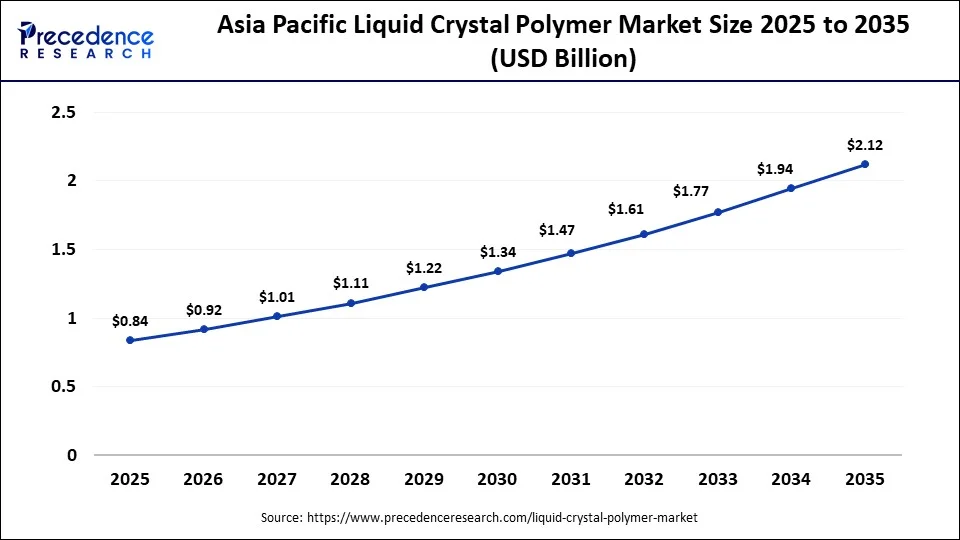
The Asia Pacific liquid crystal polymer market size was exhibited at USD 0.92 billion in 2026 and is projected to be worth around USD 2.12 billion by 2035, growing at a CAGR of 9.20% from 2026 to 2035.
Asia Pacific Dominated the Market With a 46% Share in 2026
Asia Pacific dominated the liquid crystal polymer market by holding a major share of 46% in 2026 and is expected to expand at the fastest CAGR of 9.2% during the forecast period. This is mainly due to the growing industrialization in emerging economies. Moreover, rapid growth in consumer electronics manufacturing, along with rising demand for automotive electronics, supports the regional market growth.
China Market Analysis
China leads in the Asia Pacific market, with strong demand from its electrical and electronics industry. Manufacturers in China are heavily investing in research and development to improve the performance of advanced liquid crystal polymer components.
North America: The Second-Largest Market
North America held the second-largest market share of 24% in 2026 and is expected to grow at a CAGR of 6.9% in the upcoming period. This is mainly due to the increasing demand for high-performance materials in industries like electronics, automotive, and healthcare, along with strong demand in semiconductor manufacturing and adoption in automotive electronics. The existence of advanced electronics manufacturers in the region contributes to market expansion.
U.S. Market Analysis
The U.S. is leading the North American market, driven by rising investments in 5G infrastructure, development of semiconductor packaging, and expansion in electronics manufacturing. Furthermore, the regional market is expected to undergo significant changes influenced by technological advancements and changes in consumer preferences.
Europe Held a 21% Market Share in 2026
Europe held a 21% share of the liquid crystal polymer market in 2026 and is expected to grow at a notable CAGR of 6.7% from 2026 to 2035. The regional market growth is supported by an increase in electric vehicle production. The rising use of lightweight materials in the aerospace industry and a strong regulatory focus on fuel-efficient materials also support market expansion in the region.
Germany Market Analysis
Germany is at the forefront of the European liquid crystal polymer market, driven by its consumption in automotive radar and industrial connector applications. There is also a focus on technological adoption and sustainability efforts that enhance the application of liquid crystal polymer in high-performance products.
How is the Opportunistic Rise of the Middle East & Africa in the Market?
The Middle East & Africa (MEA) held nearly 4% share of the liquid crystal polymer market in 2026 and is expected to grow at a CAGR of 6.8% in the coming years. This growth is supported by increasing investments in industrial manufacturing, rising demand for miniaturized electronics, and the expansion of petrochemical downstream industries. The development of industrial infrastructure also supports regional market growth.
UAE Market Analysis
The UAE is experiencing significant growth due to the rising adoption of liquid crystal polymer in telecommunications for high-frequency applications. There is also an expanding application of LPC in medical devices and consumer electronics, along with increasing demand for lightweight materials in automotive and electronics.
What Drives the Market Within Latin America?
Latin America held nearly 5% share of the liquid crystal polymer market in 2026 and is projected to grow at a CAGR of 6.5% in the coming years, driven by increasing automotive component manufacturing and rising demand in industrial electronics. The growing use of engineering plastics and increasing foreign manufacturing investments support regional market growth.
Brazil Market Analysis
Brazil is dominating the Latin American market due to the rising adoption of high-performance materials that have exceptional chemical resistance, low moisture absorption, and excellent dielectric properties. Collaboration between polymer manufacturers and electronics original equipment manufacturers is supporting rapid product innovation.
Competitive landscape
The liquid crystal polymer market is semi-consolidated, with a mix of established players in developed regions driving adoption across various developing markets. Manufacturers are increasingly focusing on its use in miniaturization, the expansion of 5G in remote areas, and applications in medical devices and aerospace. Strategic collaborations, mergers, and partnerships are shaping the market's landscape.
Companies are leveraging cutting-edge expertise in polymer science and novel compound development, with a strong emphasis on research, sustainable manufacturing, and eco-friendly liquid crystal polymer solutions. However, high innovation costs and significant initial setup investments remain key barriers to adoption for small and medium-sized enterprises, making LCP-based solutions relatively expensive for end users. Consequently, ongoing research and development activities aimed at improving cost efficiency and enhancing the properties of LPC are likely to shape the market in the future.
Liquid Crystal Polymer Market Companies
- Celanese Corporation
- Sumitomo Chemical
- Toray Industries
- Polyplastics Co.
- Solvay
- Ueno Fine Chemicals Industry
- RTP Company
- SABIC
- Shanghai PRET Composites
- Kingfa Sci. & Tech.
- Ensinger
- Kuraray
- Chang Chun Group
- Mitsubishi Engineering-Plastics
- Shenzhen Wote Advanced Materials
Recent Developments
- In April 2026, Z-Polymers Inc. received a strategic investment from the wholly owned U.S. subsidiary of Tokyo-based Kureha Corp., alongside a joint development agreement designed to accelerate the commercialization of Z-Polymers' proprietary Tullomer liquid crystal polymer (LCP) platform. (Source: https://www.plasticstoday.com)
- In February 2026, ASUS introduced a new high-performance case fan tailored for performance-oriented systems. Its high static pressure, strong airflow, and optimized acoustic performance make it suitable for both traditional airflow configurations and AiO water-cooling setups. The fan features blades made from liquid crystal polymer (LCP), a material distinguished by its high stability, low thermal expansion, and inherent vibration damping, enhancing overall efficiency and durability. (Source: https://basic-tutorials.com)
Segment Covered in the Report
By Type
- Thermotropic Liquid Crystal Polymer
- Lyotropic Liquid Crystal Polymer
By Form
- Resin
- Fibers
- Films
- Others
By Application
- Electrical & Electronics
- Automotive
- Consumer Goods
- Industrial Components
- Medical Devices
- Others
By End-use Industry
- Electronics & Semiconductor
- Automotive
- Industrial Manufacturing
- Healthcare
- Aerospace & Defense
- Others
By Processing Technology
- Injection Molding
- Extrusion
- Blow Molding
- Compression Molding
By Region
- North America
- Latin America
- Europe
- Asia-Pacific
- Middle East and Africa
For inquiries regarding discounts, bulk purchases, or customization requests, please contact us at sales@precedenceresearch.com
Frequently Asked Questions





Ask For Sample
No cookie-cutter, only authentic analysis – take the 1st step to become a Precedence Research client
 Get a Sample




 sales@precedenceresearch.com
 Schedule a Meeting
