



Malonic Acid Market Revenue to Attain USD 312.40 Mn by 2035
Published: 24 Jun 2026
Author: Precedence Research



Malonic Acid Market Revenue and Trends 2026 to 2035
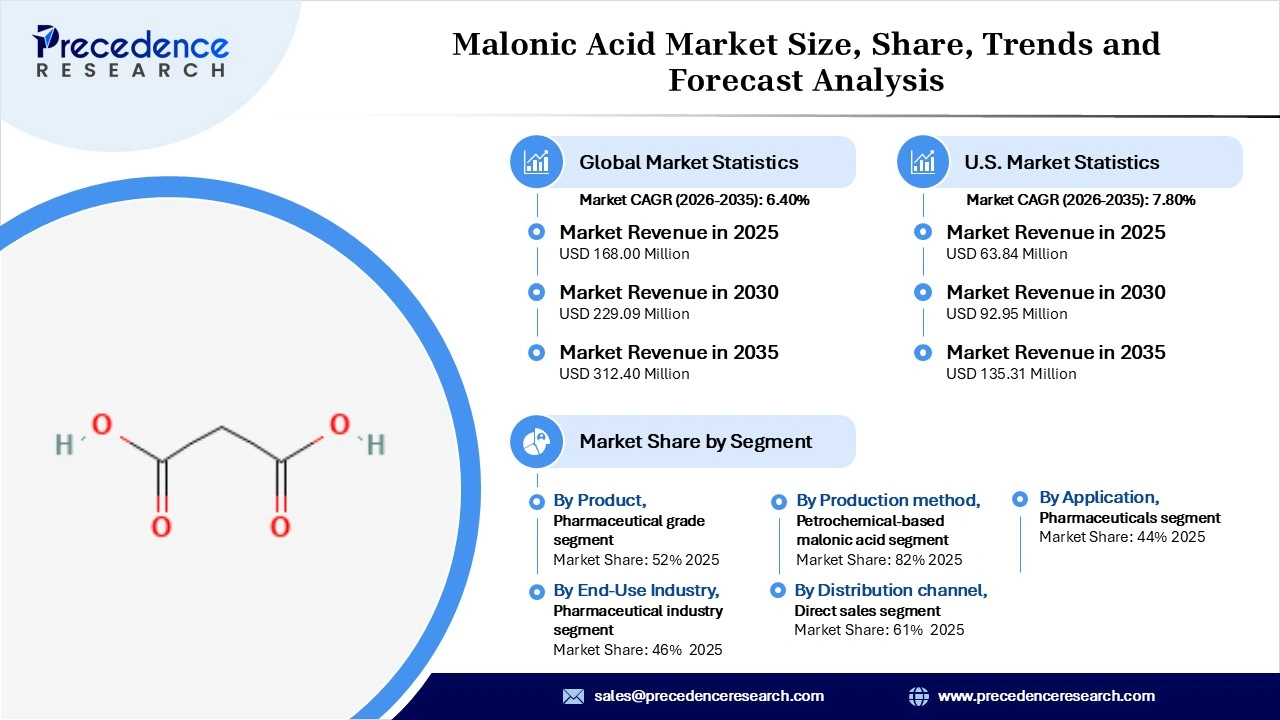
The global malonic acid market revenue was valued at USD 168.00 million in 2025 and is expected to attain around USD 312.40 million by 2035, growing at a CAGR of 6.40% during forecast period. The market is driven by the vast applications of malonic acid as an intermediate compound in the production of medicines, agrochemicals, specialty chemicals, flavors, fragrances, dyes, as well as the rising demand from the electronics sector for surface treatment.
Versatile Intermediate for Pharmaceuticals and Agrochemicals
The malonic acid market includes the manufacture, purification, and worldwide marketing of the compound and that of esters such as diethyl malonate and dimethyl malonate. Malonic acid acts as an important organic intermediate used in the synthesis of barbiturates, vitamins such as Vitamin B1 and B6, and pharmaceutical intermediates. In agrochemical applications, it is used in the synthesis of herbicides, fungicides, and plant growth regulators.
This compound is also used as a flavor and fragrance intermediate, a cross-linking agent in resins, and as a surface treatment agent in the electronics sector. The major derivatives of this compound include malononitrile, malonyl chloride, and substituted malonic esters for custom synthesis. This market has been adopted by pharmaceutical companies, agrochemical companies, specialty chemical manufacturers, flavors and fragrances producers, and electronics companies.
Engineered Yeast Promotes Sustainable Malonic Acid Production
Malonic acid manufacturing is moving away from conventional chemical methods to adopt sustainable operations. The latest advancements employ metabolic engineering strategies to generate malonic acid through renewable raw materials with higher yields and reduced environmental footprint. Such strategies help overcome the problems of low yield and environmental contamination linked with conventional processes. In 2025, a study published in the Journal of Advanced Science by scientists at Jiangnan University demonstrated a metabolically engineered Yarrowia lipolytica strain that attained a yield of 63.6 g/L of malonic acid with a productivity of 0.41 g/L/h in a 5-L fermenter.
High Quality Biomass Films Made From Malonic Acid-Based Ionic Liquid
There are various new applications of malonic acid in green chemistry, such as its use in preparing protonic ionic liquids (PILs) for the treatment of biomass. The PIL provides a means of dissolving lignocellulosic biomass without fractionation. This offers a way to produce high-quality biomass films that can be used in packaging, coatings, and biodegradable plastics. In 2025, researchers from the University of Science and Technology of China reported that a malonic acid-DBU PIL dissolves up to 10.2 percent by weight of biomass, resulting in films with 107 MPa of tensile strength, 99% UV light blocking capability, high water stability, and excellent biodegradability.
Government Policies to Promote Innovation in Specialty Chemicals
Governments across the world have introduced industrial policies to improve local chemical manufacturing and minimize dependence on imported goods, strengthening the malonic acid market. National authorities help in developing productive capacity, less environmental impact, and greater resiliency of the supply chain related to important chemical intermediates through various grants and subsidies. In 2025, the Ministry of Industry and Information Technology of China, together with six other ministries, released the “Plan for Promoting Growth of the Petrochemical and Chemical Industry (2025-2026). The plan seeks to reach the goal of 5% average annual growth in the industry.
Decarboxylative Michael Addition Reaches 89% Yield Using Malonic Acid Derivatives
In 2025, scientists from the University of Paris-Est Creteil described the decarboxylative Michael addition of substituted malonic acid half-oxyesters (SMAHOs) to methylidene malonates catalyzed by 10-40 mol% of NMM or DIPEA, giving yields of 22% to 89%. The maximum yield was provided by an allyl-substituted SMAHO (89%), while propargyl-substituted SMAHO had a 76% yield, benzyl-substituted SMAHO had a 60% yield, and acetamido SMAHO had a 25% yield.
Market Segmentation Overview
- By product type, the pharmaceutical grade segment led the malonic acid market with 52% share in 2025, and is expected to expand at the highest CAGR of 7% during the forecast period, because of the importance of malonic acid as an intermediate for the production of barbiturates and vitamin B1 and B6. These applications demand high purity to guarantee product quality and compliance with regulations.
- By product type, the industrial grade segment held the second-largest market share of 38% in 2025, owing to the fact that industries like agricultural chemicals, fragrances, and flavors don’t need ultra-high-purity malonic acid and need to produce affordable end-products suitable for bulk usage. This segment has been widely adopted by industry players, especially in those countries where cost concerns outweigh purity concerns.
- By production method, the petrochemical-based malonic acid segment dominated the market with 82% share in 2025, since hydrolysis of diethyl malonate produced from chloroacetic acid is the industrial process used for many years for the production of PFP on a large-scale basis with efficient cost structure and a reliable supply chain for industrial, agrochemical, and food purposes.
- By production method, the bio-based malonic acid segment is expected to grow at the fastest CAGR of 10.4% from 2026 to 2035, due to its potential to counter the environmental impact and dependence on petroleum in the conventional production process with the help of a sustainable solution that has a lower carbon footprint and low dependency on fossil fuels. With the stringent environmental policies being adopted by governments, the companies in the chemical and pharmaceutical industries are looking forward to bio-based feedstocks.
- By application, the pharmaceuticals segment led the malonic acid market with 44% share in 2025, and is expected to expand at the highest CAGR of 7.2% during the forecast period, because of the critical role of malonic acid in the production of important APIs such as barbiturates, which are sedatives and anticonvulsants, and vitamins B1 and B6, which are manufactured in huge quantities all across the world.
- By application, the agrochemicals segment held the second-largest market share of 21% in 2025, since malonic acid plays an important role in the preparation of herbicides such as glyphosate and fungicides that are consumed on a massive scale for agriculture worldwide. This segment has been widely adopted in major agricultural countries, which ensures continuous and high demand for malonic acid.
- By end-use industry, the pharmaceutical industry segment dominated the market with 46% share in 2025 and is expected to grow at the fastest CAGR of 7.1% from 2026 to 2035, due to its need for high-purity malonic acid and long-term supplier partnerships, as it needs to adhere to pharmacopeial standards. Pharmaceutical companies are willing to pay premium prices for high-quality compounds and for assured supply continuity.
- By end-use industry, the chemical industry segment held the second-largest market share of 28% in 2025, because of the nature of malonic acid as a base raw material in the production of different specialty chemicals, such as flavors, fragrances, polymer additives, cross-linkers, and surfactants that are produced in bulk quantities.
- By distribution channel, the direct sales segment led the market with 61% share in 2025, because malonic acid is an industrial specialty chemical used mainly by the pharmaceutical, agrochemical, and chemical industries, which usually make purchases in large volumes. This segment ensures consistency in quality, technical assistance, custom packaging, and contractual arrangements.
- By distribution channel, the online sales segment is expected to expand at the highest CAGR of 8.3% during the forecast period, since it reduces the entry barriers for small laboratories in pharmaceutical research and development, agrochemical formulators, and specialty chemical customers that require small amounts of malonic acid. This segment facilitates procuring the chemical without having to enter into long-term commitments and purchase large order minimums typically required in direct sales.
Regional Analysis
Asia-Pacific dominated the malonic acid market with 38% share in 2025 and is expected to grow at the fastest CAGR of 7.8% from 2026 to 2035, due to its position as the largest producer of pharmaceuticals, agrochemicals, and specialty chemicals in the world. China led the market in Asia-Pacific owing to its large chemical industry infrastructure, integrated logistics chains of vital raw materials, dominance in the production of both malonic acid and its derivatives, and its position as the largest supplier of pharmaceutical and agrochemical products in the world. India witnessed notable market growth because of rapid growth in generic drugs and agrochemicals production, and growing demand for malonic acid in the synthesis of vitamins, barbiturates, and herbicides.
Europe held the second-largest market share of 26% in 2025, owing to the presence of mature chemical and pharmaceutical industries demanding pure malonic acid in the production of APIs, vitamins, and specialty chemicals, and the presence of stringent regulations ensuring adherence to quality standards in the production of pharmaceutical intermediates. Germany dominated the market in Europe due to the presence of world-class manufacturing facilities, extensive research and development activities, and high demand for malonic acid in the production of pharmaceutical intermediates and industrial specialty chemicals. France is a significant contributor to the market because of its well-established pharmaceutical and agrochemical industries, fine chemical synthesis research, and significant exports of pharmaceutical intermediates, along with the government’s support in the development of the chemical manufacturing industry.
North America held the third-largest market share of 24% in 2025, due to significant innovations being made for higher-value special purposes of malonic acid, like advanced pharmaceutical intermediates, custom synthesis, and bio-based chemicals. This region has superior research and development infrastructure and intellectual property protection, which offers tremendous value addition potential for premium pricing. The U.S. led the market in North America because of its well-developed pharmaceutical and biotechnology industries, which require ultra-high-purity malonic acid for developing advanced drugs, in addition to leading innovation in the domain of bio-based chemicals. Canada witnessed notable market growth owing to the presence of emerging specialty chemicals and pharmaceuticals research centers, involvement in bio-based chemical innovations, and active industrial-academic collaborations for developing new malonic acid derivatives.
Malonic Acid Market Coverage
| Report Attribute | Key Statistics |
| Market Revenue in 2025 | USD 168.00 Million |
| Market Revenue by 2035 | USD 312.40 Million |
| CAGR from 2026 to 2035 | 6.40% |
| Quantitative Units | Revenue in USD million/billion, Volume in units |
| Largest Market | North America |
| Base Year | 2025 |
| Regions Covered | North America, Europe, Asia-Pacific, Latin America, and the Middle East & Africa |
Top Companies in the Malonic Acid Market
Lonza Group, Shandong Xinhua Pharmaceutical, and Anhui Jinhe Industrial are some of the key players that are engaged in the production of malonic acid and its derivatives used in the pharmaceutical, agriculture, flavors, and fragrances industries. Tokyo Chemical Industry, Merck KGaA, Thermo Fisher Scientific, and Toronto Research Chemicals offer high-purity malonic acid and its esters for research, customized synthetic applications, and pharmaceutical intermediates. Wuhan Rongcan Pharmaceutical and Henan Tianfu Chemical are some of the major Chinese fine chemicals companies offering malonic acid derivatives for sale in domestic and international markets. Lygos Inc. and Trace Zero LLC deal with producing bio-based malonic acid through green chemistry methods and fermentation processes.
Segments Covered in The Report
By Product Type
- Pharmaceutical Grade
- Industrial Grade
- Food Grade
By Production Method
- Petrochemical-Based Malonic Acid
- Bio-Based Malonic Acid
By Application
- Pharmaceuticals
- Agrochemicals
- Flavors and Fragrances
- Specialty Chemicals
- Food Additives
- Others
By End-Use Industry
- Pharmaceutical Industry
- Chemical Industry
- Agriculture Industry
- Food and Beverage Industry
- Cosmetics and Personal Care
By Distribution Channel
- Direct Sales
- Specialty Chemical Distributors
- Online Sales
By Region
- North America
- Latin America
- Europe
- Asia-pacific
- Middle and East Africa
Get this report to explore global market size, share, CAGR, and trends, featuring detailed segmental analysis and an insightful competitive landscape overview @ https://www.precedenceresearch.com/sample/8514
You can place an order or ask any questions. Please feel free to contact us at sales@precedenceresearch.com |+1 804 441 9344