



Medical Device Vigilance and Patient Safety Software Market Revenue to Attain USD 4.23 Bn by 2035
Published: 28 Apr 2026
Author: Precedence Research



Medical Device Vigilance and Patient Safety Software Market Revenue and Trends 2026 to 2035
The global medical device vigilance and patient safety software market revenue surpassed USD 1.40 billion in 2025 and is predicted to attain around USD 4.23 billion by 2035, growing at a CAGR of 11.70%. The market is growing due to tightening regulatory reporting requirements, increasing complexity of connected and AI-enabled medical devices, and the rising volume of adverse events that organizations must manage efficiently.
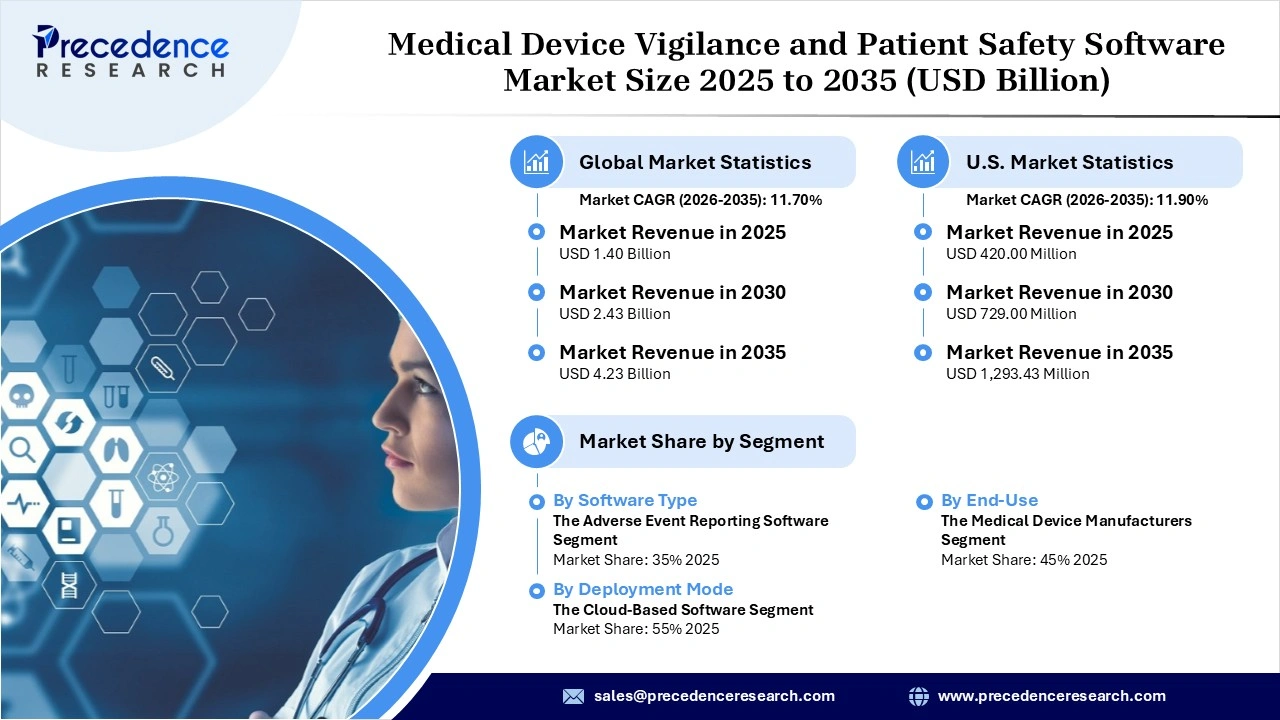
Market at a Glance
Medical device vigilance & patient safety software refers to digital systems used to monitor, evaluate, and report adverse events across the entire lifecycle of medical devices. These platforms act as a structured bridge between manufacturers, healthcare providers, and regulatory authorities, ensuring incidents are captured, investigated, and reported within mandated timelines. Beyond compliance, they enable advanced capabilities such as signal detection, trend analysis, and risk management, transforming them from reactive reporting tools into proactive patient safety systems.
The scope of these solutions extends beyond basic incident reporting to include adverse event intake, case processing, regulatory submissions, signal detection, and global post-market surveillance. They are deployed across cloud and on-premises environments and integrate with quality management systems, clinical applications, hospitals, manufacturers, and contract research organizations (CROs). The ongoing shift from manual documentation to automated, analytics-driven safety monitoring is becoming a core feature of modern healthcare ecosystems.
Major Trends in the Medical Device Vigilance & Patient Safety Software Market
- Data Overload is Driving Software Adoption: The U.S. Food and Drug Administration receives over 2 million medical device adverse event reports annually, a volume that exceeds the capacity of manual processing systems. This is accelerating the adoption of automated vigilance platforms capable of real-time case triage, classification, and escalation, significantly reducing processing delays.
- Real-Time Safety Monitoring is Emerging as a New Standard: Legacy databases contain more than 6 million historical adverse event records, representing a vast source of safety intelligence. Modern software solutions are transforming this static data into dynamic, predictive risk detection systems that can identify emerging safety signals early, helping prevent recalls and regulatory actions before they occur.
- Increasing Use of AI: Artificial intelligence and machine learning are increasingly being used to identify patterns in adverse event data and detect potential safety risks earlier. This shift enables organizations to move from reactive reporting to proactive risk prevention, improving patient safety and regulatory compliance.
Market Segmentation Overview
- By software type, the adverse event reporting software segment held a 35% share in the medical device vigilance & patient safety software market in 2025, driven by strict regulatory requirements that mandate timely and accurate incident reporting. As global authorities strengthen post-market surveillance, manufacturers increasingly rely on structured systems to capture, document, and submit safety events within tight regulatory timelines, making this software essential for compliance.
- By software type, the risk management software segment is expected to grow at the fastest CAGR of 13.5% between 2026 and 2035 due to the growing need for proactive identification and mitigation of device-related risks. This software enables organizations to address potential safety issues before they escalate into patient harm or regulatory actions.
- By deployment mode, the cloud-based software segment led the medical device vigilance & patient safety software market by holding a 55% share in 2025, owing to its scalability, flexibility, and ability to support real-time data access across multiple geographies. It enables seamless exchange of safety information between manufacturers, regulators, and healthcare providers without infrastructure limitations.
- By deployment mode, the hybrid software segment is expected to grow at the highest CAGR of 12.5% in the market between 2026 and 2035, as organizations seek a balance between data control and operational flexibility. By combining cloud scalability with on-premises security, hybrid models address concerns around sensitive safety data while enabling broader system integration.
- By end-use, the medical device manufacturers segment held a revenue share of 45% in the medical device vigilance & patient safety software market in 2025, driven by regulatory obligations and the need for continuous post-market monitoring of device performance. Medical device manufacturers use these software solutions due to their responsibility for ensuring patient safety throughout the product lifecycle.
- By end-use, the contract research organizations (CROs) segment is expected to expand rapidly with a CAGR of 14% in the coming years, supported by their increasing role in post-market surveillance and clinical monitoring. As outsourcing expands, CROs are adopting vigilance platforms to manage distributed safety data and ensure compliance across global regulatory frameworks.
Regional Analysis
North America dominated the medical device vigilance & patient safety software market with a share of 40% in 2025, driven by strict regulatory standards and well-established reporting frameworks. A strong culture of audit readiness has encouraged organizations to adopt comprehensive vigilance systems, while early adoption of advanced safety technologies has further reinforced the region’s leadership. The U.S. leads the market with its extensive adverse event reporting ecosystem, while Canada supports growth through structured compliance initiatives and steady digital integration in healthcare systems. The presence of major medical device manufacturers has also strengthened demand, making vigilance software an essential operational requirement rather than an optional tool.
Asia Pacific held a market share of 20% in 2025 and is expected to grow at the fastest CAGR of 16% during the forecast period, driven by rising healthcare investments, stricter regulatory frameworks, and increasing adoption of medical devices. China is expected to lead the regional market, supported by expanding domestic manufacturing capabilities and strengthening regulatory oversight. Meanwhile, India is steadily formalizing materiovigilance practices alongside rapid advancements in healthcare digitization. Together, these factors are positioning Asia Pacific as a high-growth region for patient safety and vigilance software adoption.
Medical Device Vigilance & Patient Safety Software Market Coverage
| Report Attribute | Key Statistics |
| Market Revenue in 2025 | USD 1.40 Billion |
| Market Revenue by 2035 | USD 4.23 Billion |
| CAGR from 2026 to 2035 | 11.70% |
| Quantitative Units | Revenue in USD million/billion, Volume in units |
| Largest Market | North America |
| Base Year | 2025 |
| Regions Covered | North America, Europe, Asia-Pacific, Latin America, and the Middle East & Africa |
Top Companies in the Medical Device Vigilance & Patient Safety Software Market
Medtronic plc, Stryker Corporation, Becton, Dickinson and Company, GE HealthCare, and Siemens Healthineers integrate vigilance software directly into their medical device ecosystems. These systems support monitoring, reporting, and safety analytics across the full product lifecycle, with AI-enabled updates and real-time surveillance enhancing overall functionality. In contrast, companies such as Oracle Corporation, Veeva Systems Inc., IQVIA Inc., and Wolters Kluwer N.V. approach vigilance as a broader platform capability rather than a standalone feature. Their competitive advantage lies in cloud-native architectures and automated regulatory workflows that streamline compliance, reporting, and end-to-end safety management.
Segments Covered in the Report
By Software Type
- Adverse Event Reporting Software
- Risk Management Software
- Regulatory Compliance Management Software
- Incident Management and Investigation Software
- Post-Market Surveillance Software
- Others
By Deployment Mode
- Cloud-based Software
- On-premise Software
- Hybrid Software
By End-Use
- Medical Device Manufacturers
- Contract Research Organizations (CROs)
- Regulatory Authorities
- Hospitals and Healthcare Providers
- Others
By Region
- North America
- Latin America
- Europe
- Asia-pacific
- Middle and East Africa
Get this report to explore global market size, share, CAGR, and trends, featuring detailed segmental analysis and an insightful competitive landscape overview @ https://www.precedenceresearch.com/sample/8345
You can place an order or ask any questions, please feel free to contact us at sales@precedenceresearch.com |+1 804 441 9344