



Optogenetics Market Revenue to Attain USD 2,823.59 Mn by 2035
Published: 07 Apr 2026
Author: Precedence Research



Optogenetics Market Revenue and Trends 2026 to 2035
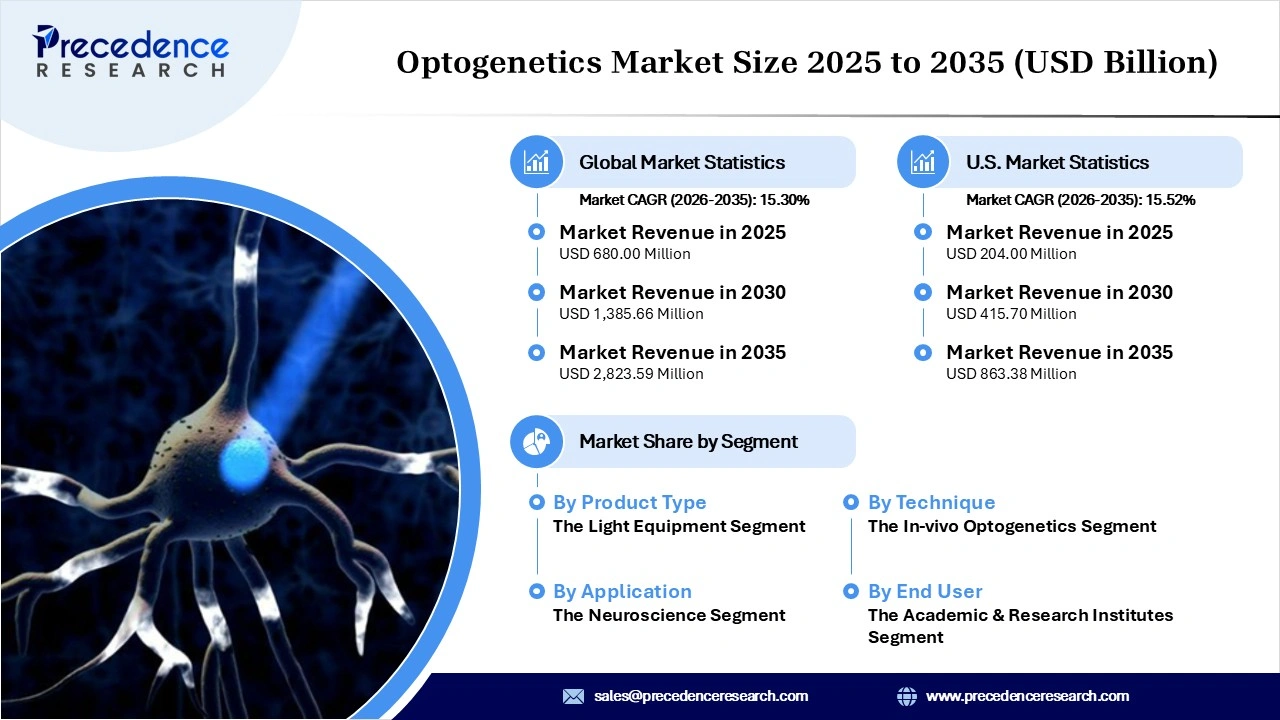
The global optogenetics market revenue was valued at USD 680.00 million in 2025 and is expected to attain around USD 2,823.59 million by 2035, growing at a CAGR of 15.30% during forecast period. The market is driven by the rising use of light-based neural control technologies for precise treatment of neurological disorders, advancing research, and enabling next-generation therapies.
Market at a Glance
The optogenetics market refers to the industry centered on technologies and tools that use light to control genetically modified cells, primarily neurons, with high precision. It encompasses optical devices, genetic constructs, and software used for research, disease modeling, and therapeutic development in neuroscience and related biomedical fields. The market serves both academic and commercial applications, enabling advanced studies of brain function, neurological disorders, and innovative treatment strategies.
The market encompasses the full spectrum of technologies, from advanced light-delivery systems and engineered opsins to integrated platforms, used in neuroscience for applications such as vision restoration, behavioral studies, and precision neuromodulation. The market is growing rapidly due to the rising development of targeted therapies and innovations in optics and neural data analysis.
Market Forecast
- Expansion of Clinical Applications Beyond Ocular Disorders: Optogenetics is moving beyond retinal diseases like retinitis pigmentosa to target neurological disorders such as Parkinson’s disease, epilepsy, and depression. Early clinical trials, including those by RetroSense Therapeutics with around 15 patients, demonstrate the feasibility of human applications, signaling a broader therapeutic potential. With neurological disorders affecting over 450 million people globally, this expansion represents a massive opportunity for developing multi-indication therapies that combine precise cellular control with real-time modulation.
- Integration with Gene Therapy for Scalable Therapeutics: The combination of optogenetics with viral vector-based gene therapy allows light-sensitive protein expression in targeted cells, effectively turning biological processes into programmable circuits. This approach enhances procedural efficiency, reduces treatment time, and supports near real-time therapeutic interventions, especially in ophthalmology. As global ophthalmic disorders are projected to affect over 1 billion people by 2050, this scalable and precise integration positions optogenetics as a high-growth market opportunity for commercialized therapies.
Government Funding Driving Optogenetics Innovation
Governments and public research agencies are actively funding optogenetics research as part of broader neuroscience efforts. For example, the U.S. National Institutes of Health (NIH) BRAIN Initiative supports development of next‑generation tools for precise neural circuit manipulation, including optogenetic technologies, as part of its priority areas for advancing brain science.
Government agencies (like NIH) offer funded awards and administrative supplements specifically for promoting optogenetics applications in both basic and translational neuroscience research, helping laboratories expand capabilities and adopt optogenetic methods.
Market Segmentation Overview
- By product type, the light equipment segment held a major revenue share of 48% in the optogenetics market in 2025, as optogenetic technologies rely heavily on accurate illumination systems. Its rapid adoption in neuroscience labs, along with the growing prominence of laser and LED technologies, has solidified its role, since accurate light delivery is crucial for experimental success.
- By product type, the sensors segment is expected to grow at the fastest CAGR in the market during the studied years, driven by the increasing need for real-time monitoring of neural activity. Innovations in biosensor design and integration with imaging systems are expanding their adoption in brain mapping and other neuroscience applications.
- By application, the neuroscience segment led the global market with a share of 52% in 2025, owing to the increased study of brain function and neural pathways. Continuous institutional funding and support for clinical trials targeting neurological diseases remain key drivers of optogenetics development.
- By application, the ophthalmology segment is expected to grow at the fastest CAGR in the market between 2026 and 2035, driven by the focus on therapies for restoring vision. Advancements in retinal disease research and light-based therapeutic technologies are positioning this segment as a leading area for innovation.
- By technique, the in-vivo optogenetics segment held the largest market share of 62% in 2025, due to its application in live organisms in which real-time monitoring of neural activity is required. Animal models and advances in neural mapping technologies have enabled a sustained prominence of this approach in experimental research.
- By technique, the in-vitro optogenetics segment is expected to grow at the fastest rate between 2026 and 2035, as controlled laboratory environments become increasingly important. The rise of cell-based research and the need for reproducible, cost-effective experiments are driving broader adoption in early-stage testing and research initiatives.
- By end user, the academic & research institutes segment held a major revenue share of 64% in the market in 2025, supported by strong funding and a surge of neuroscience-focused initiatives. Their collaborative ecosystems continue to make these institutions key centers for the initial development of optogenetics innovations.
- By end user, the pharmaceutical & biotechnology companies segment is expected to expand rapidly in the coming years, as optogenetics becomes more integrated into drug discovery and therapeutic development. Increasing investment in neurological therapies and expanded clinical research further reinforces the segment’s growth potential.
Regional Insights
North America dominated the optogenetics market with a major share of 40.0% in 2025. The region’s dominance is driven by substantial research funding, a concentration of leading universities, and an early adoption of advanced neurotechnology. The U.S. has been pivotal, leveraging federally funded neuroscience initiatives and biopharma ventures that translate laboratory discoveries into applied science. Meanwhile, Canada supports the region through strong university-led research and cross-border collaborations, collectively reinforcing North America’s leadership in optogenetic innovation.
Asia Pacific held a 22% share of the market in 2025 and is expected to grow at the fastest CAGR in the upcoming period, driven by increasing investments in biotechnology, expansion of laboratory infrastructure, and collaboration among academic institutions. China is leading the region with aggressive funding policies and government-backed scientific institutes, while Japan advances precision technologies within neuroscience research. India’s growing research capabilities, supported by favorable policies, are further accelerating the region’s development, positioning Asia Pacific as a key hub for optogenetics innovation.
Optogenetics Market Coverage
| Report Attribute | Key Statistics |
| Market Revenue in 2025 | USD 680.00 Million |
| Market Revenue by 2035 | USD 2,823.59 Million |
| CAGR from 2026 to 2035 | 15.30% |
| Quantitative Units | Revenue in USD million/billion, Volume in units |
| Largest Market | North America |
| Base Year | 2025 |
| Regions Covered | North America, Europe, Asia-Pacific, Latin America, and the Middle East & Africa |
Top Companies in the Optogenetics Market
Companies such as Scientifica Ltd., Bruker Corporation, and Danaher Corporation are driving the market forward with high-precision imaging, electrophysiology, and integrated laboratory systems that convert light-based stimulation into quantifiable biological data. Similarly, PerkinElmer, Inc. enhances the ecosystem with advanced analytics and detection platforms that blur the line between observation and intervention. In the optical hardware segment, Laserglow Technologies, Shanghai Laser & Optics Century Co., Ltd., and Prizmatix Ltd. provide precise wavelengths and intensities to manipulate cells, competing on customization, performance, and capabilities.
Segments Covered in the Report
By Product Type
- Light Equipment
- Lasers
- LEDs
- Actuators
- Channelrhodopsins
- Halorhodopsins
- Archaerhodopsins
- Sensors
- Calcium Sensors
- Voltage Sensors
By Application
- Neuroscience
- Neural Circuit Mapping
- Behavioral Studies
- Cardiology
- Cardiac Rhythm Studies
- Ophthalmology
- Vision Restoration Research
- Others
- Psychiatry
- Metabolic Disorders
By Technique
- In-Vivo Optogenetics
- In-Vitro Optogenetics
By End User
- Academic & Research Institutes
- Universities
- Research Labs
- Pharmaceutical & Biotechnology Companies
- Contract Research Organizations (CROs)
By Region
- North America
- Asia Pacific
- Europe
- South America
- MEA
Get this report to explore global market size, share, CAGR, and trends, featuring detailed segmental analysis and an insightful competitive landscape overview @ https://www.precedenceresearch.com/sample/8274
You can place an order or ask any questions, please feel free to contact us at sales@precedenceresearch.com |+1 804 441 9344