



Shipping Software Market Revenue to Attain USD 25.55 Bn by 2035
Published: 12 May 2026
Author: Precedence Research



Shipping Software Market Revenue and Trends 2026 to 2035
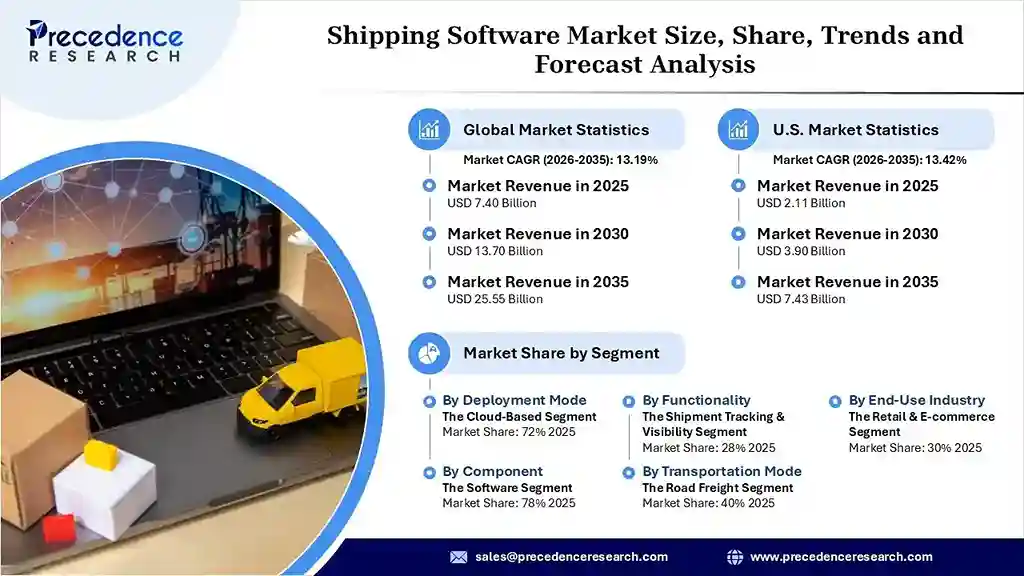
The global shipping software market revenue surpassed USD 7.40 billion in 2025 and is predicted to attain around USD 25.55 billion by 2035, growing at a CAGR of 13.19%. The market is driven by the rapid growth of e-commerce and direct-to-consumer sales, the increasing need for efficient deliveries with tracking services, and post-delivery communication.
Market Overview
he shipping software market comprises digital solutions that enable businesses to manage the entire shipping lifecycle, from carrier selection and rate comparison to label generation and package tracking. These platforms integrate with multiple carriers such as UPS, FedEx, DHL, USPS, and regional last-mile providers, allowing organizations to optimize cost, speed, and delivery efficiency.
These solutions typically include features such as address verification to ensure accuracy before shipment, shipment manifestation for generating carrier documentation, and real-time tracking capabilities to provide visibility across the delivery process. Shipping software is widely adopted by e-commerce retailers, third-party logistics providers, distributors, wholesalers, and manufacturers to streamline operations and enhance customer experience.
What Trends Impact the Shipping Software Market?
AI-Powered Predictive Decision-Making for Smarter Shipping
AI-based predictive decision-making has become a key aspect in the market with the development of shipping software that is equipped with predictive AI that uses machine learning from the moment the order is placed to the delivery of the shipment. The software automatically selects the most affordable rate based on the current price among several other carriers and predicts potential weather and capacity problems.
- In 2026, ShipStation rolled out ShipStation Intelligence, a bundle of AI features that lowers shipping costs per order by 10 to 20 percent. This solution replaced up to 5 other logistic software products per merchant and saved about USD 2700 per month in subscription fees.
Adoption of Modular Logistics Tools
The emerging trend in the market is a shift toward modular solutions equipped with features that facilitate integration with legacy systems rather than requiring companies to replace everything in their technology stack. Many freight forwarding companies have complained about huge costs required to completely replace their legacy systems with modern tools, thus prompting them to adopt modular integration techniques.
- In 2026, FourKites introduced the Agentic Ocean Booking Platform, which is the world’s first fully agentic booking system for ocean freight with automated contracts management, intelligent carrier selection, and automated documentation handling.
Government Efforts to Digitize Logistics and Cargo Tracking
Governments across the world have initiated funding programs to digitize logistics and upgrade logistics infrastructure. Governments have acknowledged the role played by logistics applications and platforms in minimizing logistics costs and trade barriers. Such funding programs help the digital transition of logistics businesses and transport companies, and the development of AI-based route planning and interoperability technologies. In 2025, Italy’s Ministry of Infrastructure and Transport released the outcomes of the LogIN Business call, where over 1200 logistics and transport companies were selected for digitization, receiving an average of USD 316,000 per business.
Shipping Software Market Driven by Automation-Ready Vessels and Real-Time Tracking Expansion
- According to the International Association of Classification Societies, more than 45% of the newly crafted vessels in 2025 are to be outfitted with automation-ready digital systems that underpin autonomous and remotely operated shipping capabilities.
- According to the Digital Container Shipping Association, around 40% increase in API usage of container tracking and visible system was recorded between September 2023 and March 2024.
- The current count of ports that have implemented Port Community Systems is reported to be more than 100 ports or clusters of ports in 58 countries, out of an estimated total population of nearly 1300 key global ports with an even wider range of smaller ports and small clusters of ports, incorporating some level of integration with the wider system population.
Market Segmentation Overview
- By Deployment Model: The cloud-based segment led the shipping software market with a 72% share in 2025 and is expected to expand at the highest CAGR during the forecast period. This is mainly due to the fact that it allows enterprises to use high-quality shipping services without the need for expensive infrastructure.
- By Deployment Model: The on-premises segment held the second-largest market share of 28% in 2025. This is because big corporations in the automotive, manufacturing, and defense sectors continue to use legacy enterprise resource planning and warehouse management systems, which are built on the company campus itself for security and integration purposes.
- By Functionality: The shipment tracking & visibility segment dominated the market with a 28% share in 2025. This is due to the increasing demand from customers to track where their orders are at all times, when their orders are delivered, and any problems that might occur during the process.
- By Functionality: The order management segment held the second-largest market share of 22% in 2025, since it acts as the vital link between the e-commerce system and the actual shipping process by consolidating all orders from various selling channels, verifying the addresses, and enforcing business policies regarding appropriate shipping.
- By Transportation Mode: The road freight segment led the shipping software market with 40% share in 2025, since the majority of e-commerce deliveries, retail store replenishments, and business-to-business deliveries are done through trucks and parcel carriers.
- By Transportation Mode: The sea freight segment is expected to grow at the fastest rate from 2026 to 2035. This is because global shipments are rapidly increasing, with millions of tons of cargo moving around the globe, and the need for tracking the shipments in real-time is important due to the huge amount of costs involved.
- By End-Use Industry: The retail & e-commerce segment dominated the shipping software market with 30% share in 2025 and is expected to expand at the highest CAGR during the forecast period. This is primarily due to rapid growth in online shopping and the increasing requirement for shipping software to compare carriers, print labels, and send tracking information.
- By End-Use Industry: The logistics & transportation segment held the second largest market share of 28% in 2025, since third-party logistics companies, freight forwarders, and dedicated carriers operate shipments on behalf of thousands of retail and manufacturing customers who have different agreements with various carriers, which necessitates the adoption of multi-tenant shipment software.
Regional Analysis
North America led the shipping software market with a 38% share in 2025, driven by the high penetration of e-commerce and widespread adoption of digital logistics solutions. Retailers and logistics providers increasingly rely on shipping software to optimize carrier selection, automate label generation, and enable real-time tracking. The United States dominates the regional market due to its highly fragmented shipping ecosystem, requiring businesses to manage multiple carriers efficiently. Canada is also a key contributor, as its vast geography, dispersed population, and challenging weather conditions increase logistical complexity, encouraging the adoption of advanced shipping technologies.
Asia Pacific is expected to grow at the fastest CAGR during the forecast period, supported by rapid e-commerce expansion, rising middle-class population, and increasing smartphone penetration. China leads the regional market due to the presence of major e-commerce platforms such as Alibaba, JD.com, and Pinduoduo, along with a highly fragmented logistics network that drives demand for integrated shipping solutions. India is witnessing strong growth due to its rapidly digitizing economy, government initiatives such as Digital India and ONDC, and a large, tech-savvy population increasingly adopting online commerce.
Shipping Software Market Coverage
| Report Attribute | Key Statistics |
| Market Revenue in 2025 | USD 7.40 Billion |
| Market Revenue by 2035 | USD 25.55 Billion |
| CAGR from 2026 to 2035 | 13.19% |
| Quantitative Units | Revenue in USD million/billion, Volume in units |
| Largest Market | North America |
| Base Year | 2025 |
| Regions Covered | North America, Europe, Asia-Pacific, Latin America, and the Middle East & Africa |
Top Companies in the Shipping Software Market
Oracle, SAP, and Infor are some of the key players in the market that provide shipping software within their suite of logistics and supply chain management solutions. Descartes Systems Group, Trimble, and Manhattan Associates supply end-to-end transportation management systems (TMS) and logistics solutions for shippers and carriers. MercuryGate and FreightPOP specialize in multi-carrier shipment software. ShipStation, Shippo, Easyship, Pitney Bowes, and Stamps.com serve e-commerce shipping needs through multi-carrier shipping management.
Segments Covered in the Report
By Deployment Model
- Cloud-based
- On-premise
By Component
- Software
- Services
By Functionality
- Order Management
- Shipment Tracking & Visibility
- Rate & Route Optimization
- Warehouse Integration
- Analytics & Reporting
By Transportation Mode
- Road Freight
- Air Freight
- Sea Freight
- Rail Freight
By End-Use Industry
- Retail & E-commerce
- Logistics & Transportation
- Manufacturing
- Healthcare
- BFSI
- Government
By Region
- North America
- Latin America
- Europe
- Asia-pacific
- Middle and East Africa
Get this report to explore global market size, share, CAGR, and trends, featuring detailed segmental analysis and an insightful competitive landscape overview @ https://www.precedenceresearch.com/sample/8394
You can place an order or ask any questions, please feel free to contact us at sales@precedenceresearch.com |+1 804 441 9344