



Smart Tourism Market Revenue to Attain USD 2,785.14 Mn by 2035
Published: 05 Feb 2026
Author: Precedence Research



Smart Tourism Market Revenue and Trends 2026 to 2035
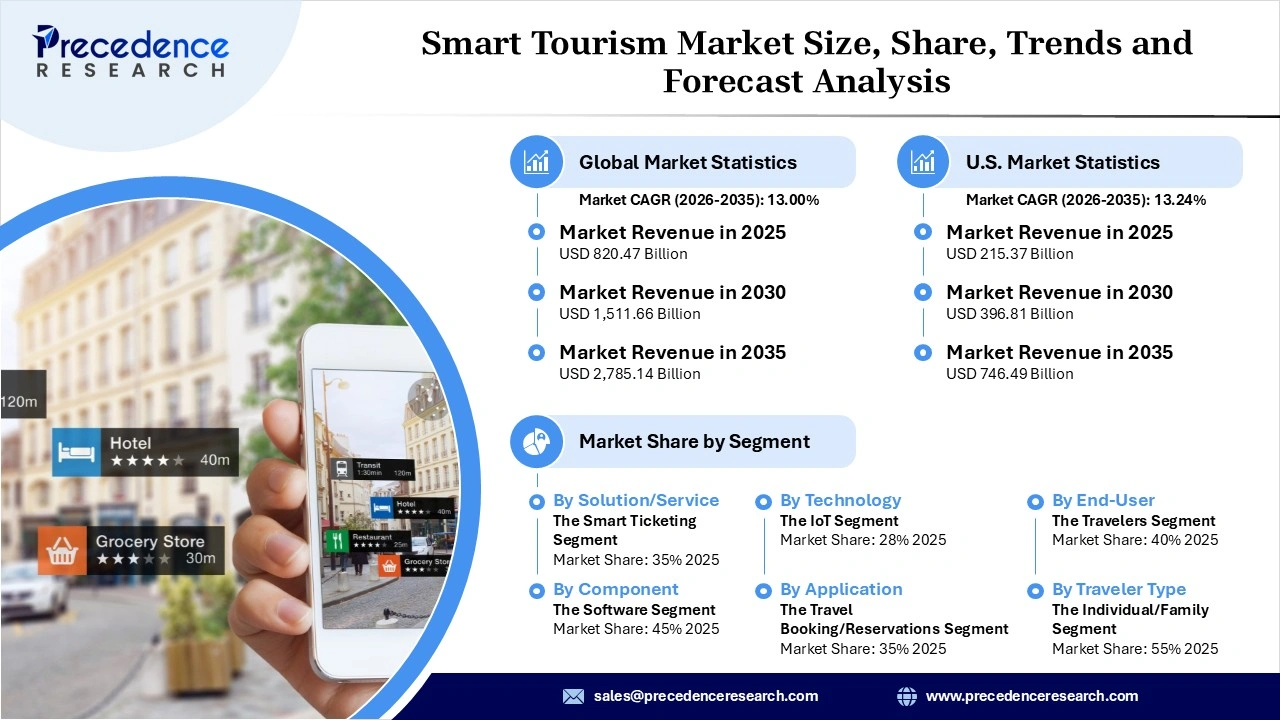
The global smart tourism market revenue was valued at USD 820.47 million in 2025 and is expected to attain around USD 2,785.14 million by 2035, growing at a CAGR of 13.00% during forecast period.The market's growth is driven by the significant investment in digital infrastructure and the rising integration of advanced technologies.
What are the Major Factors Driving the Growth of the Smart Tourism Market?
The rising demand for real-time, personalized experiences, navigation tools, and tailored recommendations is a major driver responsible for accelerating the growth of the market in the coming years. Several governments are investing heavily in smart city & infrastructure development: The market’s growth is also primarily supported by the increasing adoption of advanced technology such as Artificial Intelligence (AI), Machine Learning (ML), Internet of Things (IoT), and big data analytics to create efficient, personalized, and sustainable travel experiences.
Segment Insights
- By solution/service, the smart ticketing segment held a dominant share of 35% in the market in 2025. Smart ticketing provides a fast, secure, and smooth entry of travelers by combining mobile apps, NFC, QR codes, and contactless payments to reduce waiting time and enhance the overall visitor experience.
- By component, the software segment held a major revenue share of 45% in 2025, owing to the increasing demand for AI-powered personalization, widespread use of mobile apps, and increasing adoption of AR/VR. Software facilitates seamless connectivity among tourists, travel agencies, hotels, and government bodies.
- By technology, the IoT segment led the global market with a share of 28% in 2025, owing to the increasing use of smart sensors, wearables, smart kiosks, and connected devices. IoT sensors provide real time insights, allowing to manage crowds, optimization of operations, and enhanced security.
- By application, the travel booking/reservations segment registered its dominance in the market with a share of 35% in 2025, owing to the rising travelers' need for convenience in booking hotels, flights, and attractions through digital platforms. Moreover, the adoption of AI enables personalized recommendations, predictive offers, and loyalty programs to enhance overall customer satisfaction.
- By end-user, the travelers segment dominated the market with a share of 40% in 2025, owing to the rising awareness of contactless service, increasing adoption of smartphones, mobile application, and other advanced digital services that deliver personalized travel experiences.
- By traveler type, the individual/family segment held a major revenue share of 55% in the market in 2025, owing to the increasing preference for convenient and personalized experiences. The growth of the segment is also supported by widespread use of smartphone apps, a surge in travel awareness, rising disposable incomes, and increasing adoption of mart technologies for leisure.
Regional Insights
North America held the dominant share in the global smart tourism market. The region’s leadership is driven by high smartphone adoption, growing demand for personalized & tech-enabled travel experiences, rising government investments in IoT-enabled infrastructure, and rapid technological integration. Additionally, increased collaboration among tourism organizations, technology providers, and local communities is anticipated to promote the development of smart tourism ecosystems and enhance visitor experiences. These collaborations create job opportunities and encourage sustainable tourism practices.
On the other hand, the Asia Pacific region is anticipated to grow at the fastest CAGR in the smart tourism market during the forecast period. The fastest growth of the region is attributed to the increasing smartphone & internet penetration, growing tourists' demand for contactless & personalized experiences, and rising investment in smart cities. Moreover, the rising use of mobile technology in the region facilitates real-time information access, booking, and navigation.
Smart Tourism Market Coverage
| Report Attribute | Key Statistics |
| Market Revenue in 2025 | USD 820.47 Million |
| Market Revenue by 2035 | USD 2,785.14 Million |
| CAGR from 2026 to 2035 | 13.00% |
| Quantitative Units | Revenue in USD million/billion, Volume in units |
| Largest Market | North America |
| Base Year | 2025 |
| Regions Covered | North America, Europe, Asia-Pacific, Latin America, and the Middle East & Africa |
Recent Developments
- In January 2026, the Incheon Tourism Organization announced that it plans to begin a pilot operation of the "Incheon AI Travel Assistant" chatbot service, which is based on generative artificial intelligence (AI), within its smart tourism app "Incheon e-zi." This aims to help tourists prepare for and enjoy their trips to Incheon more easily.(Source: https://cm.asiae.co)
Get this report to explore global market size, share, CAGR, and trends, featuring detailed segmental analysis and an insightful competitive landscape overview @ https://www.precedenceresearch.com/sample/7539
You can place an order or ask any questions, please feel free to contact us at sales@precedenceresearch.com |+1 804 441 9344