



Stannooxalate Market Revenue to Attain USD 190.92 Mn by 2035
Published: 22 Jun 2026
Author: Precedence Research



Stannooxalate Market Revenue and Trends 2026 to 2035
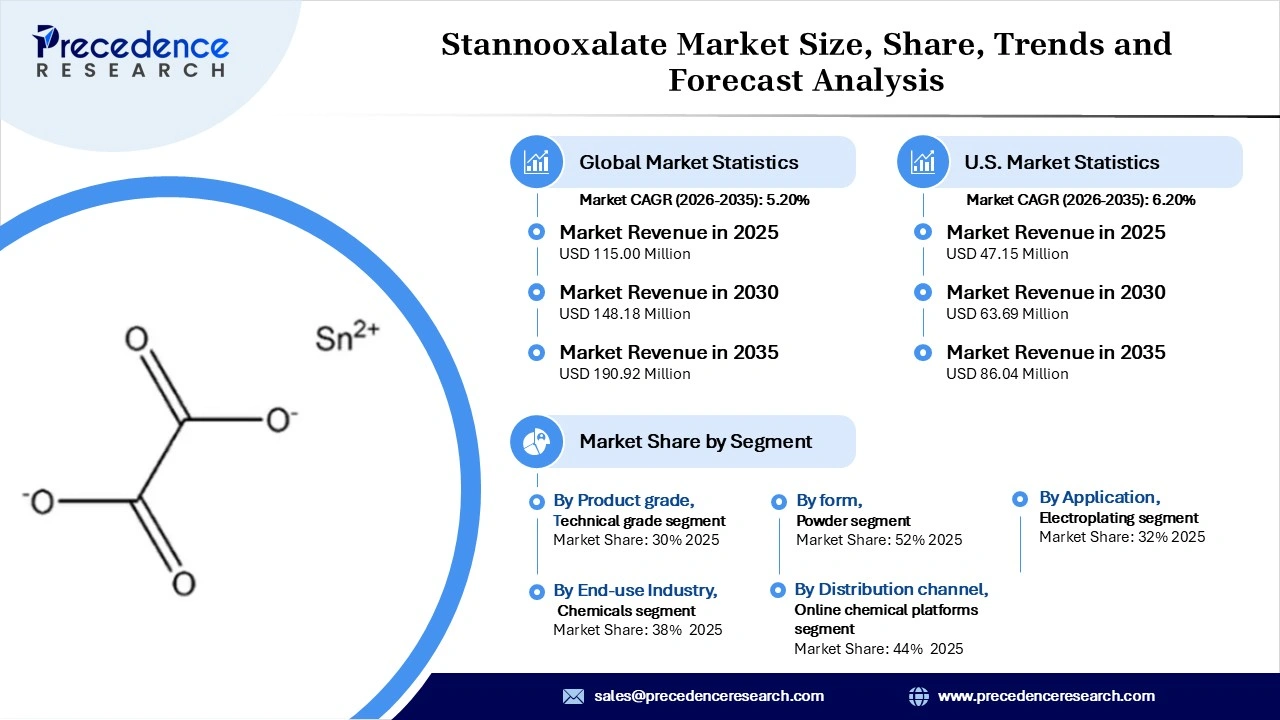
The global stannooxalate market revenue was valued at USD 115.00 million in 2025 and is expected to attain around USD 190.92 million by 2035, growing at a CAGR of 5.20% during forecast period. The market is driven by its extensive use as a catalyst and a precursor in the manufacturing of polysilicon in solar PV cells and semiconductors, and for electroplating purposes, where it serves to prevent corrosion.
Powering the Solar and Semiconductor Industry Through Tin-based Catalyst
The stannooxalate market involves the manufacturing, transportation, and use of stannooxalate, also known as tin oxalate, which is a tin compound that comes as a highly purified white crystalline powder used mainly as a catalyst and starting material in the synthesis of special chemicals. The largest use of tin oxalate is as a catalyst in polysilicon synthesis for making solar panels and semiconductors.
This market also involves other applications, such as the use of tin oxalate as a source of stannous ions in electroplating for providing protection against corrosion, reduction, and synthesis of organic compounds, and synthesis of tin nanoparticles. This market has been adopted by polysilicon manufacturers, electroplating companies, special chemical producers, and researchers.
Metal Salts Facilitate the Development of Advanced Batteries With Improved Stability
The applications of stannooxalate in energy storage have started to emerge, thanks to recent studies that are revealing new areas in which this compound can be used apart from its existing catalytic role. It can form protective coatings for metal anodes, helping solve problems such as dendrites and corrosion in aqueous batteries. In 2025, Green Chemistry published a study in which the in situ formation of a tin-based coating on a zinc anode was demonstrated through the use of stannous oxalate. The lifecycle of the resulting Zn/Zn symmetric cell at 1 mA cm-2 was 2,300 hours, and the MnO2/Zn full cell kept at 94.74 mAh g-1 specific capacity after 1,000 cycles.
Oxalate-Derived Tin Oxide Heterostructures Allow Effective Degradation of Dyes
The stannooxalate market is exploring opportunities in environmental protection by developing environmentally friendly processes for creating advanced photocatalyst materials. Stannooxalate is used in the creation of heterostructures that can be used to degrade organic pollutants through photocatalysis under visible light. In 2026, researchers published a paper in the Materials Science and Engineering Journal on the creation of heterostructures through the use of stannooxalate via an oxalate-assisted co-precipitation route. The C-coupled SnO/SnO2 heterostructures exhibited degradation percentages of 99.26% and 76.19% for acidic and basic dye pollutants, respectively, in visible light within 5 consecutive runs.
National Resource Strategies and Quality Controls for Critical Metal Supply Chains
Governments across the globe have introduced measures to ensure domestic supply chains and enhance manufacturing capacity. Such measures include comprehensive strategies that look at natural resources and quality controls for raw materials used in industries. In 2025, the Ministry of Mines, Government of India, through Gazette notification No. GSR686 (E), published the Tin Ingot (Quality Control) Order 2025. This order requires all tin ingots, whether made in India or imported into the country, to meet the requirements of the Bureau of Indian Standards (BIS). This requirement ensures that the quality of the tin metal, one of the main raw materials used in the production of stannooxalate, is consistent.
Tin Oxalate Being Adopted as a Green Catalyst for Esterification
A scientific article published by the QG Group in 2025 confirms that tin oxalate can be used as an effective esterification catalyst, reaching up to 95% yield in 4.5 hours, surpassing the results of conventional catalysts such as sulfuric acid (85% yield) and p-toluenesulfonic acid (90%). It works at relatively low temperatures (60 °C – 100 oC), is recyclable, and has a wide variety of applications ranging from pharmaceutical intermediates and perfumes to biodiesel. Tin oxalate provides 93% yield of ethyl salicylate and 94% yield of fatty acid methyl esters in 4 hours.
Market Segmentation Overview
- By product grade, the technical grade segment led the stannooxalate market with 30% share in 2025, due to its ability to act as an active ingredient, which is necessary for various industrial applications, such as electroplating, catalysts, and batteries. It makes up the vast majority of chemical tonnage in the supply chain and is bought in massive quantities by formulators and industrial players.
- By product grade, the high purity grade segment is expected to expand at the highest CAGR of 8.1% during the forecast period, because of its increasing requirement in applications like battery anode production, photovoltaic batteries, and semiconductors in order to guarantee consistent results and reliability.
- By form, the powder segment dominated the market with 52% share in 2025, since stannooxalate naturally exists in the form of powder that is easy to handle and dose, thereby providing a stable product during storage for its intended uses like catalyst formation, plating baths, and chemical manufacturing. Powder is cheap to transport and is less perishable than other forms.
- By form, the crystalline segment is expected to grow at the fastest CAGR of 5.8% from 2026 to 2035, owing to its ability to provide greater purity and uniformity than the amorphous form, making it suitable for use in specialized applications like battery manufacture and semiconductors, where even trace amounts of contaminants can affect the quality of the final product.
- By application, the electroplating segment led the market with 32% share in 2025, because stannooxalate acts as a very efficient and economic source of stannous ions for tin electroplating baths, which play an important role in the formation of anti-corrosive tin layers on electronics and automobile components.
- By application, the electronics and semiconductors segment is expected to expand at the highest CAGR of 8.5% in the stannooxalate market during the forecast period, due to the rapid adoption of advanced semiconductor packaging, 5G infrastructure, and electronics in electric vehicles, resulting in unprecedented demand for high-purity tin-coated materials and solders in which stannooxalate plays an important role. It acts as a precursor of tin salts utilized in electroless and electrolytic tin plating processes.
- By end use industry, the chemicals segment dominated the market with 38% share in 2025, since stannooxalate finds major applications as an industrial catalyst in esterification, polymerization, and organic synthesis reactions. It is also used as a precursor for developing compounds using tin.
- By end use industry, the electronics segment is expected to grow at the fastest CAGR of 7.2% from 2026 to 2035, because of the increasing demand for high-quality tin plating and soldering solutions, where the primary source of stannous ions is stannooxalate. The increased miniaturization of electronics, along with the development of complex substrates in the semiconductor industry, calls for high-purity tin plating.
- By distribution channel, the direct sales segment led the market with 44% share in 2025, because stannooxalate is purchased in bulk, and companies in the chemicals, electroplating, and electronics industries prefer dealing directly with suppliers to guarantee quality, obtain technical expertise, and receive better prices on bulk purchases.
- By distribution channel, the online chemical platforms segment is expected to expand at the highest CAGR of 9.2% during the forecast period, since it enables small producers, laboratories, and specialty buyers to order stannooxalate in smaller quantities without committing to any long-term deals and having minimum order requirements.
Regional Analysis
Asia-Pacific led the stannooxalate market with 41% share in 2025 and is expected to grow at the fastest CAGR of 6.2% from 2026 to 2035, because of its well-established electronics and semiconductors manufacturing, where stannooxalate is extensively used for pure tin electroplating on circuit boards, connectors, and advanced packaging, and a catalyst for chemical synthesis and polyester formation. China led the market in Asia-Pacific due to significant production of printed circuit boards and semiconductor components, aided by extensive production of chemicals requiring large amounts of stannooxalate for purposes of esterification and polymerization reactions. India witnessed notable market growth owing to the rapid development of the electronics manufacturing industry, a growing ecosystem of semiconductor packaging, and government policies for local electronics manufacturing and significant investments in industrial chemicals and metal finishing.
Europe held the second-largest market share of 24% in 2025, due to its mature electronics and chemical industries, and stringent environmental regulations, which create demand for high-purity tin salts for electroplating applications and catalytic purposes in automobiles, aircraft, and semiconductors. Germany dominated the market in Europe owing to its well-developed automotive and electronics industries, which necessitate the usage of high-grade tin plating in connectors and circuit boards, as well as an advanced chemical industry that employs stannooxalate as a catalyst for the production of specialty polymers and pharmaceutical products. The U.K. is a significant contributor to the market because of the significant presence of advanced electronics and semiconductor research and development activities, significant stannooxalate demand for aerospace electroplating, and the emerging specialty chemicals industry.
North America held the third-largest market share of 19% in 2025, due to its preeminence in high-purity and application-specific stannooxalates to cater to the technological sophistication of its aerospace, medical devices, and military electronics industries. The U.S. led the market in North America owing to its advanced research and development environment for semiconductors and electronics, and its well-established specialty chemicals industry, which requires extremely high-purity tin compounds for its electroplating, catalysis, and other specialized uses. Canada witnessed notable market growth because of its stringent quality control measures and an increasing electronics manufacturing base that relies on sustainable chemicals and precision engineering.
Stannooxalate Market Coverage
| Report Attribute | Key Statistics |
| Market Revenue in 2025 | USD 115.00 Million |
| Market Revenue by 2035 | USD 190.92 Million |
| CAGR from 2026 to 2035 | 5.20% |
| Quantitative Units | Revenue in USD million/billion, Volume in units |
| Largest Market | North America |
| Base Year | 2025 |
| Regions Covered | North America, Europe, Asia-Pacific, Latin America, and the Middle East & Africa |
Top Companies in the Stannooxalate Market
Noah Chemicals, American Elements, and MP Biomedicals are key players that manufacture specialty chemicals and supply stannooxalate with high-purity levels. Alfa Aesar (a subsidiary of Thermo Fisher Scientific), Merck KGaA (Sigma-Aldrich), TCI Chemicals, and Avantor Inc. are global distributors of life sciences and fine chemicals that supply research-grade stannooxalate around the world. Sisco Research Laboratories (SRL), Loba Chemie Pvt. Ltd., Central Drug House (CDH), Otoo Chemie Pvt. Ltd., and HiMedia Laboratories are some of the Indian suppliers of stannooxalate. GFS Chemicals Inc., Spectrum Chemical Manufacturing Corp., and Santa Cruz Biotechnology are some of the key suppliers of stannooxalate based in the U.S.
Segments Covered in This Report
By Product Grade
- Technical Grade
- Industrial Grade
- Reagent Grade
- Electronic Grade
- High Purity Grade
By Form
- Powder
- Crystalline
- Granular
- Others
By Application
- Electroplating
- Chemical Intermediates
- Catalysts
- Ceramics and Glass Manufacturing
- Laboratory Reagents
- Electronics and Semiconductors
- Others
By End Use Industry
- Chemicals
- Electronics
- Automotive
- Industrial Manufacturing
- Research and Academic Institutions
- Others
By Distribution Channel
- Direct Sales
- Chemical Distributors
- Specialty Chemical Suppliers
- Online Chemical Platforms
By Region
- North America
- Latin America
- Europe
- Asia-pacific
- Middle and East Africa
Get this report to explore global market size, share, CAGR, and trends, featuring detailed segmental analysis and an insightful competitive landscape overview @ https://www.precedenceresearch.com/sample/8500
You can place an order or ask any questions. Please feel free to contact us at sales@precedenceresearch.com |+1 804 441 9344