



Stem Cell Therapy for Neurological Disorders Market Revenue to Attain USD 12.67 Bn by 2035
Published: 09 Jun 2026
Author: Precedence Research



Stem Cell Therapy for Neurological Disorders Market Revenue and Trends 2026 to 2035
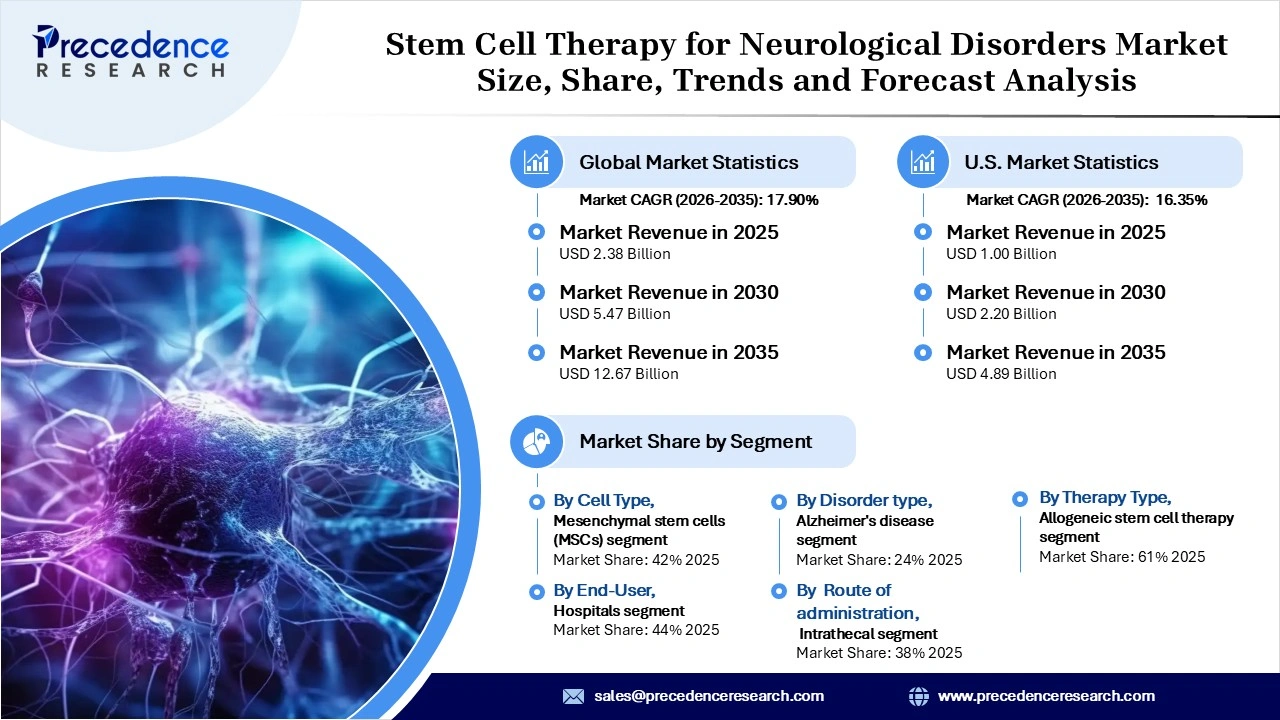
The global stem cell therapy for neurological disorders market revenue surpassed USD 2.38 billion in 2025 and is predicted to attain around USD 12.67 billion by 2035, growing at a CAGR of 17.90%. The market is driven by the increasing worldwide incidence of neurological diseases like Parkinson’s disease, multiple sclerosis, and spinal injuries, along with the increasing evidence indicating that stem cell therapies can help to repair neurons and inhibit inflammation.
Market Overview
The stem cell therapy for neurological disorders market includes stem cell-based therapeutic approaches used to repair and replace damaged nervous system tissues in conditions such as Parkinson’s disease, Huntington’s disease, ALS, multiple sclerosis, spinal cord injury, stroke, and traumatic brain injury. It involves key stem cell types such as mesenchymal stem cells (MSCs), neural stem cells (NSCs), induced pluripotent stem cells (iPSCs), and hematopoietic stem cells (HSCs).
The market spans the full value chain from preclinical research to commercialization and includes biotechnology companies, academic institutions, and contract development organizations. Stem cells are primarily adopted across hospitals, specialized clinics, and research facilities focused on advancing regenerative medicine and neurological disorder treatment.
What are the Major Trends Driving the Market?
Advances in iPSC Technology for Neurological Disorders
The market is benefiting from advancements in induced pluripotent stem cell (iPSC) technology, which enables the development of patient-specific or off-the-shelf neural cell therapies. These approaches aim to restore neurological function damaged by conditions such as Parkinson’s disease, spinal cord injuries, and stroke. Regulatory agencies in major markets are increasingly approving such therapies following extensive experimental research. In 2026, Amchepry, the first iPSC-based therapy for Parkinson’s disease, received conditional marketing approval from Japan’s Ministry of Health, Labour and Welfare, marking a significant milestone for the field.
Adoption of Mesenchymal Stem Cell Therapy
There is a growing adoption of mesenchymal stem cell (MSC) therapies due to their proven clinical safety and demonstrated efficacy in treating autoimmune conditions. MSC-based treatments, available as both autologous and off-the-shelf products, work by modulating immune responses and providing neuroprotective effects, particularly in multiple sclerosis (MS) patients who do not respond adequately to existing disease-modifying therapies. In 2025, Hope Biosciences reported positive Phase 2 clinical trial results for its autologous adipose-derived MSC therapy in patients with relapsing-remitting MS, highlighting continued progress in validating stem cell-based approaches for neurological disorders.
Government Grants for Stem Cell Research to Enhance Neurological Treatments
Governments across the globe are providing grants to develop treatments based on stem cells and regenerative medicine for diseases that were once considered incurable due to their neurological nature. Such initiatives help accelerate innovations in all aspects of research and development, bridging the gap between discoveries and implementation. In 2026, the Maryland Stem Cell Research Commission awarded 38 grants more than USD 12.6 million, under the Maryland Stem Cell Research Fund Program, towards advanced stem cell research and development of technology.
Aspen Neuroscience Raises USD 115 Million for Parkinson’s Disease Treatment
In 2025, Aspen Neuroscience announced that it had secured USD 115 million in Series C funding to develop its novel iPSC-based treatment, ANPD001, for moderate-to-advanced-stage Parkinson’s disease. This pushes their total capital raised to over USD 340 million. These funds will be used to complete the Phase 2a clinical trials and expand manufacturing capacity for potential pivotal studies.
Market Segmentation Overview
- By cell type, the mesenchymal stem cells (MSCs) segment led the stem cell therapy for neurological disorders market with a 42% share in 2025, driven by their ease of extraction from adult sources such as bone marrow and adipose tissue, along with a strong safety profile, lower tumorigenicity risk, and ethical advantages over embryonic stem cells and induced pluripotent stem cells (iPSCs).
- By cell type, the iPSCs segment is expected to grow at the highest CAGR of 22.4% during the forecast period, owing to their patient-derived origin that minimizes immune rejection risk and their ability for unlimited self-renewal, enabling scalable production of cells for treating neurological disorders.
- By disorder type, the Alzheimer’s disease segment dominated the market with a 24% share in 2025 and is expected to grow at the fastest CAGR of 19.6% from 2026 to 2035. This is mainly due to the fact that it is the leading neurodegenerative condition affecting a significant number of patients, with its occurrence rates of about 60% to 80% of all dementia patients.
- By disorder type, the Parkinson’s disease segment held the second-largest market share of 21% in 2025, owing to its well-characterized nature, involving loss of dopaminergic neurons, which makes it treatable via cell transplantation therapy, which is advancing rapidly to facilitate commercial adoption.
- By therapy type, the allogeneic stem cell therapy segment led the stem cell therapy for neurological disorders market with a 61% share in 2025 and is expected to expand at the highest CAGR of 19.1% during the forecast period. This is because it offers convenience by ensuring off-the-shelf availability and consistency in manufacturing processes at a reduced cost per patient relative to the autologous treatments.
- By therapy type, the autologous stem cell therapy segment held the second-largest market share of 39% in 2025 because it removes the threat of rejection from the body and is ethically better than both allogeneic and embryonic therapies, but is costlier in production than other therapies.
- By end-use, the hospitals segment dominated the stem cell therapy for neurological disorders market with a 44% share in 2025, since these facilities provide the required infrastructure for administering stem cell therapy treatment, such as the infrastructure for cell processing, neuro-imaging to target the brain precisely, and multi-disciplinary personnel capable of handling difficult neurological cases.
- By end-use, the regenerative medicine centers segment is expected to grow at the fastest CAGR of 19.4% from 2026 to 2035, due to their purposeful design for offering innovative stem cell therapy treatments, which require specialization that is not easily accessible at general hospitals.
Regional Analysis
North America led the stem cell therapy for neurological disorders market with a 41% share in 2025, owing to its solid financing environment comprising extensive NIH and CIRM grants, fast regulatory routes like FDA’s RMAT program, and the significant presence of prominent research institutions and bioengineering firms. The U.S. dominated the market in North America because of the significant number of clinical trials targeting neurological disorders, extensive venture capital investments in iPSC and MSC platforms, and fast-track approval processes of investigational cell therapies. Canada witnessed notable market growth due to government programs, including the Canada Brain Research Fund and Stem Cell Network, as well as a publicly funded healthcare system that enables the clinical application of stem cell therapies for neurological conditions.
Asia Pacific is expected to expand at the highest CAGR of 21.4% during the forecast period because of its large population, rapidly aging population, increased prevalence of neurological diseases, and an increase in government funding towards establishing infrastructure related to regenerative medicine. China led the market in Asia Pacific owing to its large patient base, extensive government funding for stem cell technology research, and rapid approval processes for clinical studies of cellular therapies. India is a significant contributor to the market due to the significant prevalence of neurological illnesses, an increasing number of stem cell clinics, and cheaper manufacturing costs.
Stem Cell Therapy for Neurological Disorders Market Coverage
| Report Attribute | Key Statistics |
| Market Revenue in 2025 | USD 2.38 Billion |
| Market Revenue by 2035 | USD 12.67 Billion |
| CAGR from 2026 to 2035 | 17.90% |
| Quantitative Units | Revenue in USD million/billion, Volume in units |
| Largest Market | North America |
| Base Year | 2025 |
| Regions Covered | North America, Europe, Asia-Pacific, Latin America, and the Middle East & Africa |
Top Companies in the Stem Cell Therapy for Neurological Disorders Market
BrainStorm Cell Therapeutics, Mesoblast, ReNeuron Group, and Neuroplast are some of the key players that are working on the development of mesenchymal and neural stem cell treatments. Stempeutics Research, CorestemChemon, Medipost, and Anterogen focus on MSC-based neurological treatments targeting ALS and spinal cord injuries. Pluri, BlueRock Therapeutics, and Century Therapeutics utilize PSCs and iPSCs to target various neurodegenerative diseases. Aspen Neuroscience, Fujifilm Cellular Dynamics, Linease Cell Therapeutics, and Sana Biotechnology are developing iPSC-derived neuron and glial cell replacement therapies.
Segments Covered in the Report
By Cell Type
- Mesenchymal Stem Cells (MSCs)
- Neural Stem Cells (NSCs)
- Induced Pluripotent Stem Cells (iPSCs)
- Hematopoietic Stem Cells (HSCs)
- Embryonic Stem Cells (ESCs)
By Disorder Type
- Alzheimer's Disease
- Parkinson's Disease
- Amyotrophic Lateral Sclerosis (ALS)
- Multiple Sclerosis
- Stroke
- Spinal Cord Injury
- Others
By Therapy Type
- Autologous Stem Cell Therapy
- Allogeneic Stem Cell Therapy
By End-Use
- Hospitals
- Specialty Neurology Clinics
- Research Institutes & Academic Centers
- Regenerative Medicine Centers
By Route of Administration
- Intrathecal
- Intravenous
- Intracerebral
- Others
By Region
- North America
- Latin America
- Europe
- Asia-pacific
- Middle and East Africa
Get this report to explore global market size, share, CAGR, and trends, featuring detailed segmental analysis and an insightful competitive landscape overview @ https://www.precedenceresearch.com/sample/8460
You can place an order or ask any questions. Please feel free to contact us at sales@precedenceresearch.com |+1 804 441 9344