



Pressure Vessels Market Size, Key Companies, Company Market Share, Production Capacity, Raw Material Pricing, Export & Import Analysis, Manufacturing Cost, Competitive Positioning, and Demand Forecast
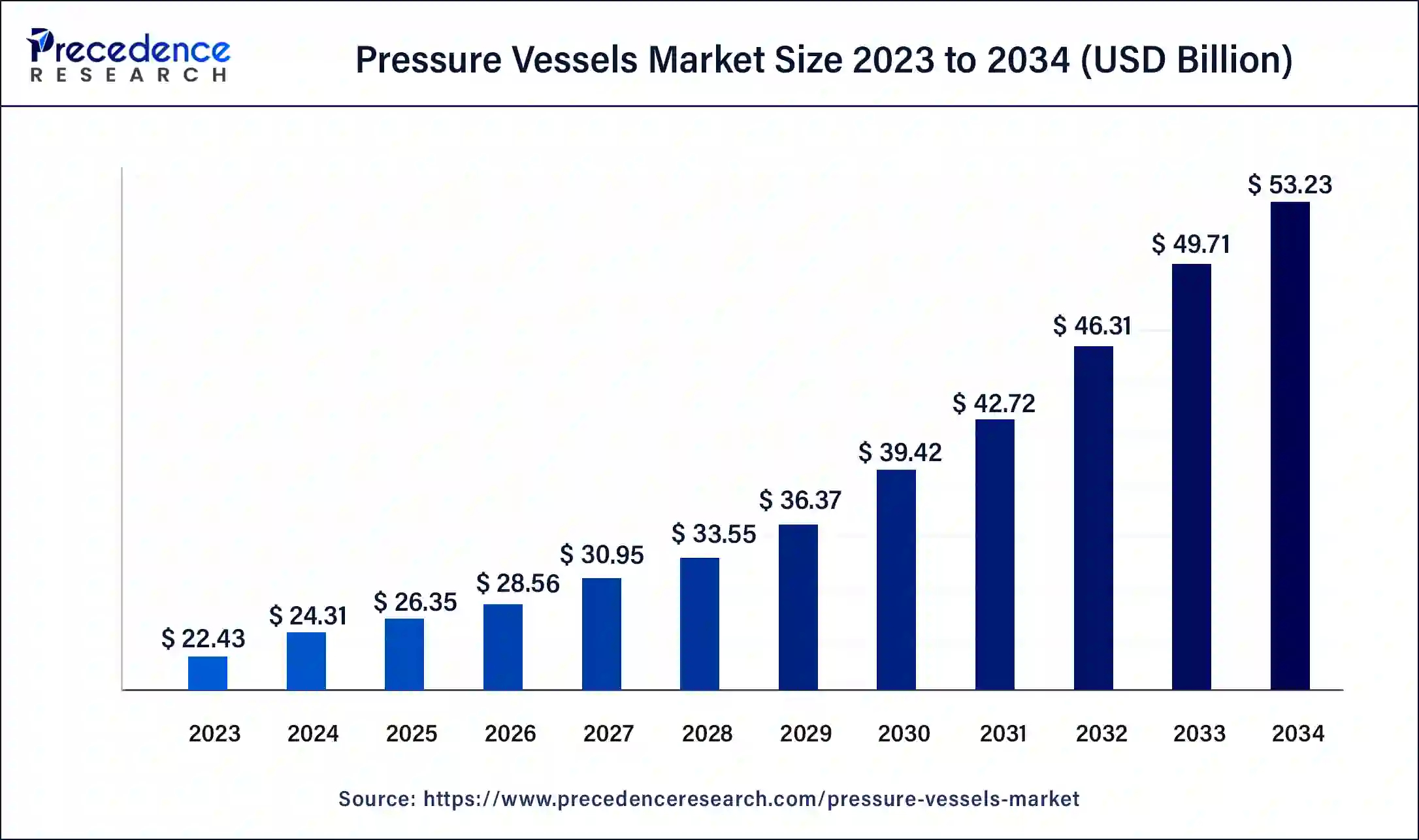
The global pressure vessels market is projected to grow from USD 28.56 billion in 2026 to USD 56.67 billion by 2035, registering a CAGR of 7.96%. Growth is driven by rapid industrialization, expanding energy infrastructure, and rising investments in oil & gas, chemicals, hydrogen storage, and power generation. Asia Pacific dominates the market, while North America is expected to witness the fastest growth, supported by smart manufacturing, advanced materials, and clean energy projects.
Source: https://www.precedenceresearch.com/pressure-vessels-market
 Get a Sample
 Table Of Content


What is Pressure Vessels Market Size?
The global pressure vessels market size accounted for USD 28.56 billion in 2026 and is predicted to reach around USD 56.67 billion by 2035, growing at a CAGR of 7.96% from 2026 to 2035. The pressure vessels market is driven by increasing industrialization and expansion of the energy sector.
Market Highlights
- By Region, Asia Pacific held a majority revenue share of the pressure vessels market in 2025.
- By Region, North America is expected to grow at the fastest CAGR in the market during the forecast period.
- By product, the boiler segment held a dominant position in the market with a share of 60% in 2025.
- By product, the nuclear reactor segment is expected to grow at the fastest CAGR of 7% in the market between 2026 and 2035.
- By material, the steel segment accounted for a considerable revenue share of 30% in the market in 2025.
- By material, the nickel & nickel alloys segment is expected to grow with the highest CAGR in the market during the studied years.
- By end-use, the chemicals & petrochemicals segment led the global market with a share of 41% in 2025.
- By end-use, the power generation segment is expected to expand rapidly in the market with a CAGR in the coming years.
Advancing the Pressure Vessels Market Through Material Innovation and Smart Manufacturing
Pressure Vessels Market refers to the design, manufacturing, and supply of closed-sized containers designed to safely hold a valuable liquid, gas, or vapor under pressures that vary considerably from ambient. They are considered by many companies as the key to success in their activities dealing with oil & gas, chemical processing, power generation, pharmaceuticals, food processing and water treatment. The major drivers behind the growth of the market are fast industrialization, widening energy infrastructure, and rising investments in chemical and petrochemical plants around the globe. Advanced pressure vessels are also being used in more hydrogen storage and hydrogen sealing applications as well as carbon capture facilities.
Pressure Vessels Market Growth Factors
Rising adoption of supercritical power generation technologies along with prominent growth in the petrochemical & chemical industry is the key factor that propels the growth of the pressure vessels market. Pressure vessels offer resistance from corrosion and cross-contamination that drives its application in various chemical procedures. Subsequently, the flourishing growth of chemical industry along with the benefits of pressure vessel expected to fuel the market growth.
Further, industrial sector is significantly impacted by the technological innovations particularly in the United States. Hence, the investment for the production & exploration activities in various industries such as oil & gas, power generation, chemicals, and many other sectors have seek hike in the recent past, this expected to augment the market growth over the coming years.
Market Outlook
- Industry Outlook: The industry is consolidating technical expertise, fabrication capacity, and certification credentials. Large fabricators with global quality accreditations and integrated engineering capabilities are expanding service portfolios to include design-for-manufacturability, finite-element analysis (FEA) validation, automated NDT (non-destructive testing), and long-term inspection services.
- Sustainability Trend: Sustainability here is technical and operational: reducing embodied carbon through material optimization, high-strength alloys requiring less mass, increasing the use of recycled steel and low-carbon production techniques, and designing vessels for disassembly and recyclability. Operational sustainability includes leak reduction, monitoring for emissions (esp. fugitive gas), and materials that reduce corrosion-related failures (thus preventing spills and energy losses).
- Major Investment: Investment is flowing into capacity expansion for high-spec fabrication automated plate rolling, robotic welding cells, large-diameter forging/rolling lines, cryogenic tank facilities, composite filament-winding lines for lightweight high-pressure vessels, and advanced NDT laboratories ultrasonic phased array, X-ray CT. Capital also targets digitalization, digital twins for fatigue prediction, integrated asset-management platforms, and remote inspection tooling.
- Start-ups Ecosystem: Start-ups are innovating on materials, manufacturing techniques, and monitoring services: companies developing composite pressure vessels, carbon-fibre-wrapped tanks for lightweight high-pressure storage; firms creating modular, rapidly deployable pressure vessel systems for remote energy projects; sensor-and-IoT startups offering embedded monitoring for pressure, strain, and corrosion.
Market Scope
| Report Coverage | Details |
| Market Size by 2025 | USD 26.35 Billion |
| Market Size in 2026 | USD 28.56 Billion |
| Market Size in 2035 | USD 56.67 Billion |
| Market Growth Rate from 2026 to 2035 | CAGR of 7.96% |
| Largest Market | Asia Pacific |
| Base Year | 2025 |
| Forecast Period | 2026 to 2035 |
| Segments Covered | Product, End User, Material, Regions |
| Regions Covered | North America, Europe, Asia-Pacific, Latin America, and Middle East & Africa |
Market Dynamics
Driver
Rising Investments in Industrial and Energy Infrastructure
The pressure vessels market is gaining momentum due to the increasing industrialization of the region along with the growth of energy projects in the region. Rising demand for high-performance pressure vessels driven by investments in oil & gas, petrochemicals, power generation, production of hydrogen, and water treatment will generate high demand. Rapid industrialization in emerging economies and modernisation of manufacturing plants are also supporting the markets. The use of pressure vessels is also rising in the renewable energy sector, such as for hydrogen storage and capture of carbon.
Restraint
High Manufacturing Costs and Stringent Regulatory Requirements
High manufacturing costs of pressure vessels, testing, and certification are some of the challenges faced in the pressure vessels market. The use of advanced materials like stainless steel, nickel alloys, and composite materials greatly adds to the manufacturing costs. The problems for the manufacturers are in compliance, where international standards and regulations must be followed with extensive quality control and documentation, followed by wide inspections. Volatile prices of raw materials and disruptions in the value chain further affect production costs and project timelines.
Opportunity
Growing Hydrogen Economy and Renewable Energy Projects
The pressure vessels market has a opportunity to offer significant deals in the field of clean energy. With the surge of growth of hydrogen use, particularly in generation, storage, and transportation, additional funding is required for pressure vessels to continue to make hydrogen transport safer and more efficient. Governments are encouraging green energy infrastructure with enabling policies and investment schemes to encourage manufacturers towards new concepts and designs for sailing vessels.
Segment Insights
Product Insights
Boiler product segment led the global pressure vessels market and accounted for a market share of approximately 60% in the year 2025 due to superior performance of boilers in different industrial processes. Boilers are available in different types that include super thermal power plant, industrial, utility, and supercritical parameter boilers. Boiler manufacturers are mainly focused on offering application-specific products.
The nuclear reactor anticipated to witness the fastest growth rate of around 7% over the analysis period. Increasing demand for energy projected to propel the number of nuclear power plants across the globe, thereby positively impacting the growth of the segment during the upcoming years. A nuclear reactor is a critical part of a nuclear power plant that initiates and controls a self-continued nuclear chain reaction.
Major types of pressure vessels are reactors, boilers, and separators; besides this, there are numerous other types of pressure vessels present that include fractional distillation columns, storage tanks, and heat exchangers. Flourishing growth in the industrial activity along with increasing demand for application-specific product functioning and design expected to fuel the growth of the other segment.
The separator segment is expected to witness steady growth during the forecast period as it is used in various applications, such as oil & gas, chemical processing, and power generation, to name a few. Effective gas, oil, water, and other contaminant separation fosters process efficiency and operability. Advanced separation equipment is in demand, as more and more upstream and downstream energy infrastructure is being invested in.
Material Insights
Steel dominated the global pressure vessels market accounting for more than 30% of the value share in 2025. Stainless steel and carbon steel are the preferred choice of materials for the manufacturers on the basis of their properties such as high resistance to corrosion, easy recyclability, low prices, resistance toward shocks & vibrations, excellent tensile strength, and capability to withstand high temperatures or humid conditions.
Nickel & nickel alloys registered robust growth rate over the upcoming period because of the benefits offered by the material over others, such as oxidation & carburization resistance, heat resistance, reliability, along with sustainability in harsh environments. Various types of nickel alloys include incoloy, hastelloy, carpenter alloy 60, and monel. Nickel and nickel alloys are largely used in manufacturing of nuclear reactors.
The titanium segment is projected to grow at a notable pace owing to its superior corrosion resistance, high strength-to-weight ratio, and durability. It is finding increasing applications in chemical processing, desalination, and marine and offshore applications with difficult operating environments. Titanium pressure vessels are highly durable; they can lower the maintenance costs and downtime of the system.
The Hastelloy segment is expected to witness steady growth during the forecast period through being resistant to corrosion, oxidation, and high-temperature environments. It is commonly used in chemical processes, pharmaceutical production, and power production environments, which demand the highest performance of materials. This material's performance in corrosive environments and extreme operating conditions bolsters the reliability and longevity of equipment.
End-use Insights
Chemical & petrochemical end-use segment headed the global pressure vessels market with a value share of early 41% in 2025. The significant growth of the segment is majorly due to the increasing demand of chemicals and their products for various applications. Furthermore, rising number of chemical facilities in different countries across the globe is one of the significant factors that drive the demand of pressure vessels in the segment.
Pressure vessels are largely used in numerous power generation facilities that include hydro, nuclear, and thermal power plants. The above mentioned factor expected to augment the power generation end-use segment at the fastest growth during the forthcoming period. Other end-use industries include pulp & paper, mining, HVAC & refrigerators, water treatment, and pharmaceuticals. Increasing adoption of pressure vessels across the aforementioned industries attributed to the presence of diverse products, such as boilers, heat exchangers, storage tanks, and reactors.
The oil & gas segment is projected to witness stable growth during the forecast period as the amount of exploration, production, refining, and storage activity worldwide is expected to increase. Pressure vessels are used in many important applications such as processing hydrocarbons, separating gas, and high-pressure storage. Cutthroat demand for advanced pressure vessels is gathering momentum with increasing investments in projects offshore, LNG & petrochemicals.
Regional Insights
Asia Pacific Pressure Vessels Market Size and Growth 2026 to 2035
The Asia Pacific pressure vessels market size is valued at USD 9.49 billion in 2025 and is expected to be worth around USD 20.40 billion by 2035, at a CAGR of 7.95% from 2026 to 2035.
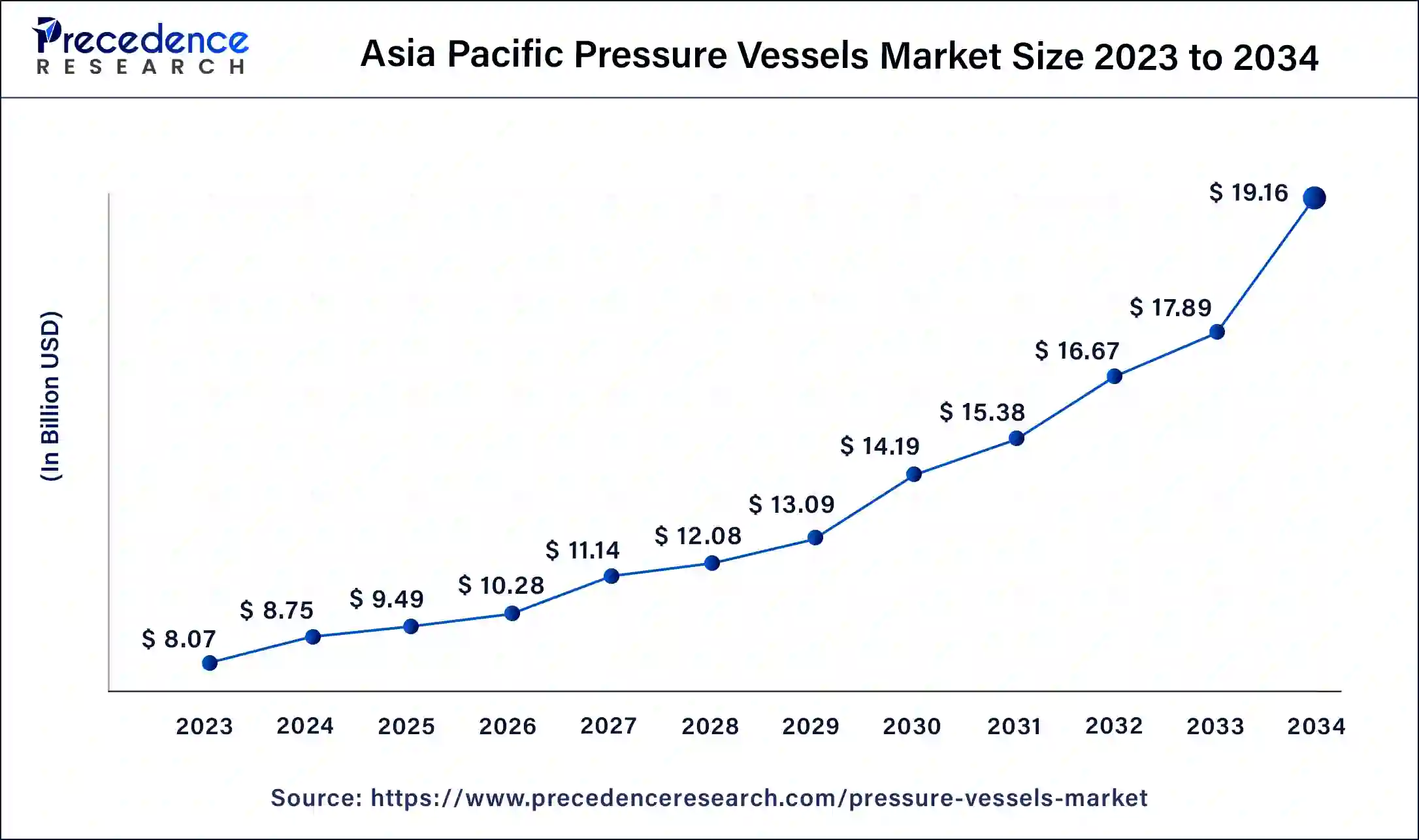
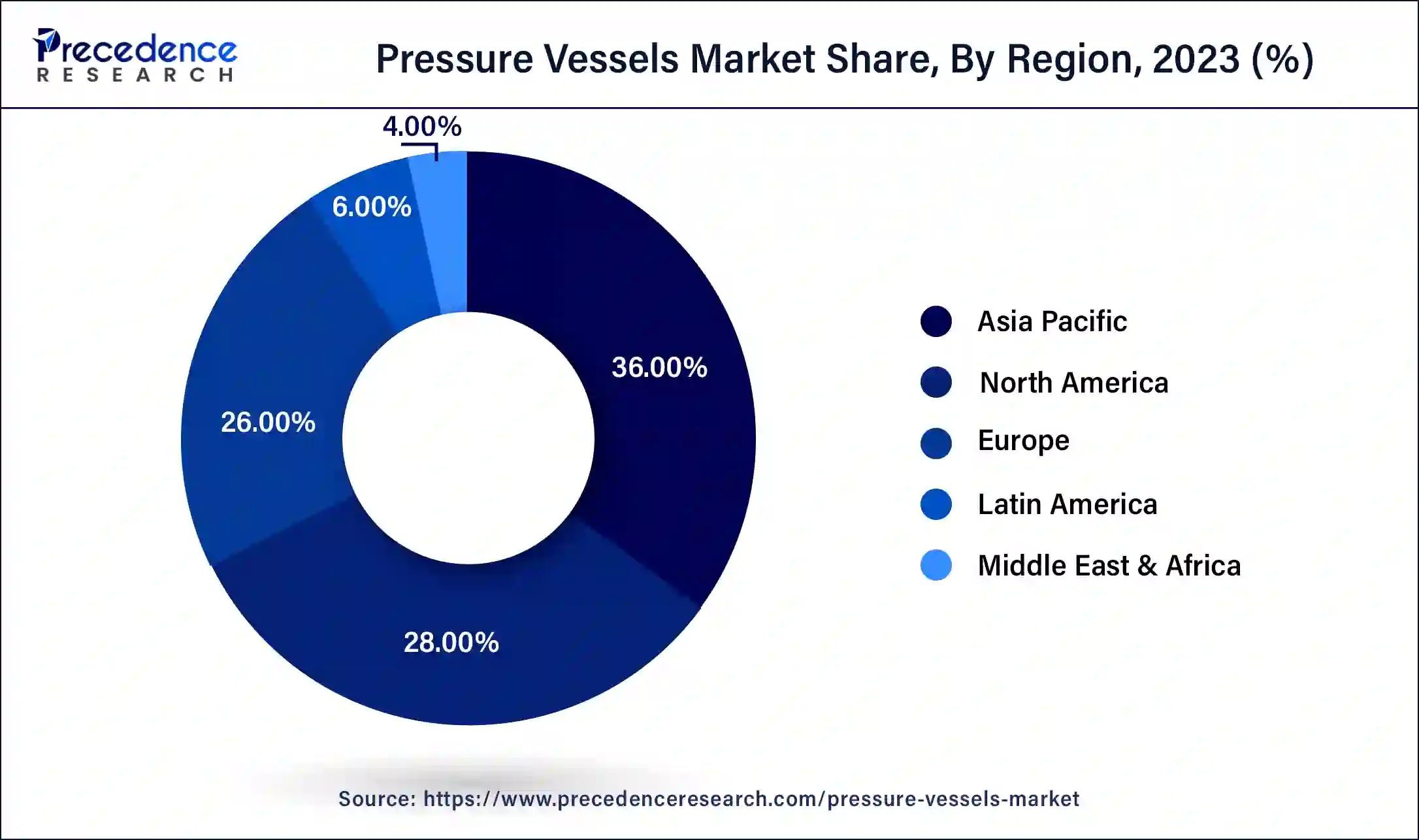
The Asia Pacific emerged as a global leader in the pressure vessels market with a revenue share of approximately 36% in 2025 and estimated to retain its dominant position throughout the projected period. The prominent growth of the region is majorly due to the rapid expansion of power sector in the region. Shifting trend of power generation towards renewable resources and green energy anticipated to boost the demand for pressure vessels in the region. Rising installation of nuclear powerhouses along with significant expansion of chemical and oil & gas sectors predicted to prosper the market growth in the region.
China Market Trends
China's pressure vessels market is anticipated to grow significantly, owing to the extensive investments made by the country in its industry production capacity and energy infrastructure. Increasing demand for pressure vessels for the country's growing petrochemical and power plant and refining industries remains strong. Government policies for supporting clean energy, hydrogen production, and advanced manufacturing are generating new growth prospects.
Advancements in the Pressure Vessels Market in Europe
Europe is expected to witness significant market growth throughout the forecast period with investments in clean energy and hydrogen deployment, as well as sustainable industrial development. Industries are favouring the replacement of aging pressure vessels with advanced systems as environmental and safety rules are being implemented. The emphasis is on lightweight materials, corrosion-resistant alloys and digital monitoring solutions.
Germany Market Trends
Germany market is anticipated to grow significantly, owing to its robust industrial manufacturing and engineering capabilities. The robust pressure demand from the country's chemical, pharmaceutical, and automotive sectors continues to sustain the demand for advanced pressure vessels. Smart manufacturing and Industry 4.0 technologies are becoming an integral part of the manufacturing processes to enhance production efficiency.
Key Trends in the Pressure Vessels Market in Latin America
Latin America is expected to witness significant growth in the market. The growth of investments in refining, petrochemicals, and mining activities is driving the demand for pressure vessels. Governments are supporting projects in energy infrastructure to enhance energy security in the region. The market is also expanding, bolstered by industrial modernization and increasing use of advanced process equipment. Long-term growth should also come from the growth of foreign investments in the manufacturing and energy industries.
Brazil Market Trends
Brazil pressure vessels market is anticipated to grow significantly, as offshore oil exploration and refining operations are increasing. Advanced pressure vessels are being needed as investments in the production of petrochemicals and industrial infrastructure increase. The use of corrosion-resistant equipment in harsh operating conditions has been increasing in the country. Market expansion is encouraged by the growth in the energy sector and by an improving modernization of production facilities.
Growth of the Middle East and Africa in the Pressure Vessels Market
The Middle East and Africa region is expected to witness significant growth in the market. Domestic demand for pressure vessels remains firm on the back of large-scale refinery, petrochemical, and LNG projects. The government is providing funding for industrial diversification and for energy infrastructure investment to sustain economic growth. Programmed advancement of more cutting-edge process equipment is improving the efficacy in every industrial area.
Saudi Arabia Market Trends
Saudi Arabia market is anticipated to grow significantly, due to sustained investments made in oil refining and petrochemicals and in industrial diversification. The Vision 2030 projects have sped up the progress of advanced manufacturing and energy infrastructure and are aiding in its development throughout the country. Industrial modernization and increased capacity of chemical processing plants are also contributing to the market growth.
Supply Chain Analysis-Pressure Vessels Market
- Feedstock Procurement: Good and high-quality metal products, stainless steel products, nickel alloys, titanium, composite products, and industrial-grade metal products are purchased from certified suppliers to guarantee strength, corrosion resistance, and reliability.
Key Players: Outokumpu Oyj, Nippon Steel Corporation, ArcelorMittal - Quality Testing and Certification: Pressure Vessels are tested for dimensional measurement, hydrostatic, non-destructive testing, and certified to meet the ASME and International Standards like ISO.
Key Players: TÜV SÜD, Bureau Veritas, Lloyd's Register - Distribution to Industrial Users: Logistics services providers who are well qualified to handle pressure vessels with a safe process for timely delivery to Oil and Gas, Chemical, Power Generation, nd Manufacturing factories.
Key Players: Samuel Pressure Vessel Group, Doosan Enerbility, Mitsubishi Heavy Industries
Market Value Chain Analysis
- Raw Material Sourcing: Raw material sourcing centers on high-quality carbon steels, low-alloy steels, stainless alloys (304, 316L, duplex), nickel alloys for high-temperature/corrosive services, and composite feedstocks (carbon/aramid fibres, epoxy resins) for filament-wound vessels. Sourcing criteria prioritize traceable mill certificates, mechanical-property consistency, and compliance with pressure-vessel material standards.
- Technological Advancements: Technologies reshaping the market include robotic welding and automated seam-tracking for higher throughput and consistent weld quality; advanced non-destructive testing, such as phased-array ultrasonics and computed tomography for internal flaw detection.
Competitive Landscape
The manufacturers make pressure vessels specialize in industrial pressure vessels, boilers, and pressure container solutions. The key companies will be capable of global competition are Babcock & Wilcox Enterprises, Inc.; IHI Corporation; and Pressure Vessels. Mitsubishi Hitachi Power Systems, Ltd.; and Alloy Products Corp. Through product innovations, advanced materials, and strategic partnerships, strengthening their market position.
Advanced automation, digital engineering, and fabrication are driving investments and helping to simplify and optimize operations and boost product quality for leading manufacturers. The participants want to expand their production capacities as well as meet growing price demands from the Oil & Gas, Chemical, and Power Generation industry segments. The high production costs, volatile raw material rates, and demanding safety standards are some of the key challenges.
Pressure Vessels Market Companies
- Babcock & Wilcox Enterprises, Inc.
- IHI Corp.
- Mitsubishi Hitachi Power Systems, Ltd.
- Pressure Vessels (India)
- Alloy Products Corp.
- Samuel, Son & Co.
- Doosan Heavy Industries & Construction.
- Abbott & Co (Newark) Ltd.
- Larsen & Toubro Ltd.
- Bharat Heavy Electricals Ltd.
- Tinita Engineering Pvt. Ltd.
- Mersen, Xylem Inc.
- WCR Inc.
Key Companies & Market Share Insights
- The global pressure vessels industry is highly competitive and concentrated in nature because of the presence of a numerous manufacturers ranging from large scale to small scale. Major companies adopt various marketing strategies that include geographical expansion with a vision to augment their foothold in the global market.
Recent Developments
- In April 2024, Babcock & Wilcox won a contract worth over USD 7 million to upgrade three waste-to-energy (WtE) boilers at a power plant in Southeast Asia. The project comprises new pressure equipment as well as enhanced combustion equipment, reducing emissions and increasing operational efficiency, with an extension in boiler life. (Source: https://www.babcock.com)
Segments Covered in the Report
By Product
- Nuclear Reactor
- Boiler
- Separator
- Others
By Material
- Titanium
- Hastelloy
- Tantalum
- Steel
- Duplex Steel
- Stainless Steel
- Super Duplex Steel
- Carbon Steel
- Others
- Nickel & Nickel Alloys
- Others
By End-Use
- Chemicals & Petrochemicals
- Power Generation
- Oil & Gas
- Others
By Region
- Asia-Pacific
- North America
- Europe
- Latin America
- Middle East & Africa
For inquiries regarding discounts, bulk purchases, or customization requests, please contact us at sales@precedenceresearch.com
Frequently Asked Questions
Tags





Ask For Sample
No cookie-cutter, only authentic analysis – take the 1st step to become a Precedence Research client
 Get a Sample




 sales@precedenceresearch.com
 Schedule a Meeting
