



Ship-to-Shore (STS) Container Cranes Market Trends, Companies, Revenue / Sales Performance, Production Capacity, Equipment Utilization, Pricing Analysis, Distribution Performance, Competitive Landscape, and Demand Forecast
Ship-to-Shore (STS) Container Cranes Market (By Product Type: High Profile Cranes, Low Profile Cranes; By Power Supply: Diesel, Electric, Hybrid; By Outreach: Up to 40m, 40m to 49m, 50m to 60m, Greater than 60m; By Lifting Capacity: Panamax STS Cranes, Post Panamax STS Cranes, Super-Post Panamax STS Cranes) - Global Industry Analysis, Size, Trends, Leading Companies, Regional Outlook, and Forecast 2026 to 2035
Source: https://www.precedenceresearch.com/ship-to-shore-container-cranes-market
 Get a Sample
 Table Of Content


What is the Ship-to-Shore (STS) Container Cranes Market Size in 2026?
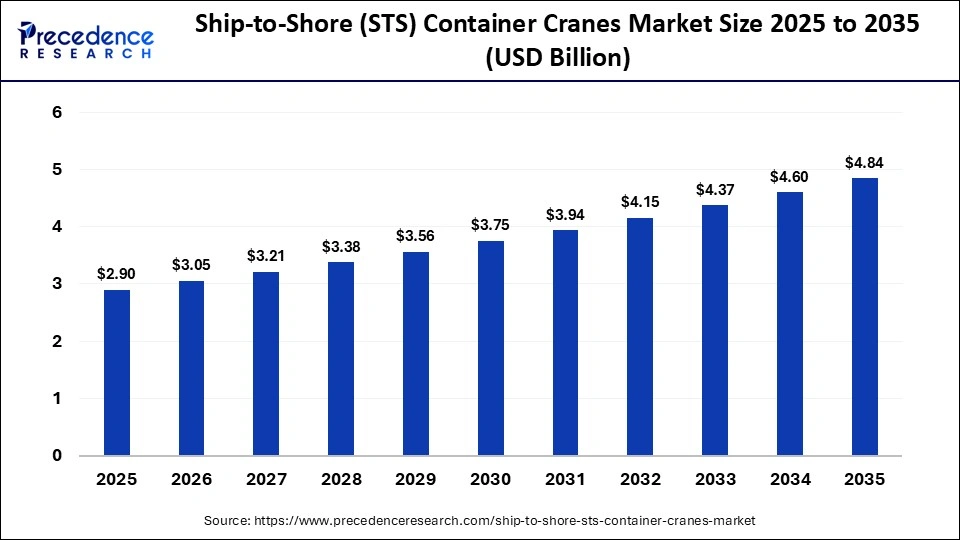
The global ship-to-shore (STS) container cranes market size accounted for USD 2.90 billion in 2025 and is predicted to increase from USD 3.05 billion in 2026 to approximately USD 4.84 billion by 2035, expanding at a CAGR of 5.25% from 2026 to 2035. The market is driven by expanding global trade, rising port automation, and increasing containerized cargo volumes.
Key Takeaways
- Asia Pacific held the largest share of the ship-to-shore (STS) container cranes market in 2025.
- North America is anticipated to witness the fastest growth during the forecasted years.
- By product type, the high profile cranes segment held the largest share of the market in 2025.
- By product type, the low profile cranes segment is expected to grow at the fastest CAGR in the market over the forecast period.
- By power supply, the electric segment held a major market share in 2025.
- By power supply, the hybrid segment is anticipated to grow at a significant rate in the market over the forecast period.
- By outreach, the 40m to 49m segment held a significant share of the market in 2025.
- By outreach, the 50m to 60m segment is expected to grow at a significant rate in the market over the forecast period.
- By lifting capacity, the super-post panamax STS cranes segment held a major market share in 2025.
- By lifting capacity, the post panamax STS cranes segment is anticipated to grow at a significant CAGR in the market over the forecast period.
Market Overview
Ship-to-shore (STS) container cranes are specialized port handling equipment that are designed for the efficient and safe loading and offloading of intermodal containers. These cranes have a long horizontal boom, which stretches over the ship, and a trolley, which travels along the boom to hoist containers between the ship and the dock with the help of spreaders. These cranes are crucial in modern port infrastructure, as they facilitate seamless transfer of cargo between ships and dock-based logistics networks, including trucks and rail. The global ship-to-shore (STS) container cranes market has experienced steady growth, driven primarily by expanding global trade and the increasing adoption of containerization in maritime shipping.
How is AI Integration into Ship-to-Shore (STS) Container Cranes Driving the Market?
The integration of AI into STS container cranes is transforming the overall market. AI greatly increases automation, efficiency, and safety of the ports. With AI-controlled systems, cranes move automatically and can optimize the sequence of loading/offloading containers with a minimum of human involvement. AI-driven predictive maintenance is beneficial to track the condition of crane parts, including motors, cables, and spreaders, warning of their possible breakdowns in advance and, thus, reducing downtimes. AI-based analytics also streamline the coordination inside the yard by aligning the crane operations with the terminal trucks and automated guided vehicles (AGVs) to enhance the total port throughput.
Major Market Trends
- The adoption of automation and remotely controlled cranes is rising in large container terminals, which is enhancing port efficiency, reducing labor requirements, improving safety, and minimizing vessel turnaround times.
- Increasing investments in smart port infrastructure, including IoT sensors, real-time analytics, and predictive maintenance, are streamlining crane operations and optimizing workflow.
- There is a growing use of electric and hybrid-powered STS cranes to support sustainability initiatives by lowering carbon emissions and aligning port operations with global decarbonization policies.
- Government-backed modernization programs and strategic public-private partnerships are accelerating the deployment of advanced STS cranes, boosting trade competitiveness and logistics
Market Scope
| Report Coverage | Details |
| Market Size in 2025 | USD 2.90 Billion |
| Market Size in 2026 | USD 3.05 Billion |
| Market Size by 2035 | USD 4.84 Billion |
| Market Growth Rate from 2026 to 2035 | CAGR of 5.25% |
| Dominating Region | Asia Pacific |
| Fastest Growing Region | North Aemrica |
| Base Year | 2025 |
| Forecast Period | 2026 to 2035 |
| Segments Covered | Product Type, Power Supply, Outreach, Lifting Capacity, and Region |
| Regions Covered | North America, Europe, Asia-Pacific, Latin America, and Middle East & Africa |
Segment Insights
Product Type Insights
Why Did the High Profile Cranes Segment Lead the Ship-to-Shore (STS) Container Cranes Market?
The high profile cranes segment led the market, holding the largest share in 2025. This is because of their versatility in operation and widespread applications in modern port infrastructure. These cranes have high boom designs that enable easy handling of a container that covers long vessels without compromising on the clearance of the port and the maneuvering in the dock. Their applicability to a large variety of ships and terminal designs predetermines their popularity in large commercial ports with traffic of high cargo volumes. Moreover, high-profile cranes assist in loading and unloading the vessels in shorter periods, thereby enhancing the throughput efficiency and shortening vessel turnaround time.
The low profile cranes segment is expected to grow at the fastest CAGR in the upcoming port, since ports are seeking cranes for space-constrained and height-restricted environments. Low-profile cranes have lower boom heights, making them suitable for terminals that are situated in proximity to urban areas, bridges, or airspace-constrained environments. With the expansion of global trade to diverse port locations, infrastructure flexibility has become a priority, leading to the adoption of low-profile STS cranes. These cranes offer enhanced safety, reduced visual impact in densely populated areas, and compliance with regulatory and environmental planning standards.
Power Supply Insights
What Made Electric the Dominant Segment in the Ship-to-Shore (STS) Container Cranes Market?
The electric segment dominated the market with the largest revenue share in 2025 because it is efficient, has environmental benefits, and is cost-effective in the long term. Electric cranes offer stability, excellent control, and less mechanical complexity in comparison to traditional fuel-based systems. Their stable lifting power supports operations of high-frequency container handling, which is necessary for the large commercial ports with continuous cargo traffic. Moreover, their low direct emissions align with increasingly stringent environmental regulations in port operations.
The hybrid segment is expected to grow at a significant CAGR over the forecast period. This is because these cranes combine electric power with auxiliary energy sources like diesel or energy storage to meet varying operational demands. This dual-power capability ensures reliable performance during peak loads or in areas with limited electrical infrastructure, making hybrid cranes ideal for developing or transitional ports. Growing emphasis on reducing emissions without compromising productivity is encouraging port operators to adopt hybrid systems as a transitional step toward full electrification.
Outreach Insights
Why Did the 40m to 49m Segment Contribute the Most Revenue in the Market?
The 40m to 49m segment held the largest share of the ship-to-shore (STS) container cranes market in 2025, since it aligns well with the size requirements of most container fleets worldwide. This outreach range provides adequate horizontal coverage for medium-to-large vessels while maintaining structural stability and cost-effectiveness. Most standard container terminals are designed to accommodate ships of this size, making 40-49m cranes highly compatible with existing infrastructure and capable of efficient cargo handling with lower capital investment compared to extended-reach systems.
The 50m to 60m segment is expected to grow at a significant rate over the projection period as global shipping trends increasingly favor larger container vessels with wider beams, necessitating cranes with extended horizontal reach. These long-reach STS cranes allow operators to efficiently access outer container rows, boosting productivity and turnaround times. Ports are upgrading their infrastructure, including expansion, modernization, and deep-water terminal development, to accommodate these mega-ships. This combination of larger vessels and enhanced port capabilities is driving strong demand for 50-60m outreach cranes.
Lifting Capacity Insights
Why Did the Super-Post Panamax STS Cranes Segment Lead the Ship-to-Shore (STS) Container Cranes Market?
The super-post panamax STS cranes segment led the market with a major revenue share in 2025 because of their capability to service the largest and most advanced container ships. These cranes are especially designed for ultra-wide vessels that carry large volumes of containers. Their high lifting power, large reach, and sound structure make them effective in handling heavy container loads on many rows, and this has a great way of enhancing the productivity of the terminals in a significant manner. As the shipping industry increasingly relies on larger vessels to maximize operational efficiency, key ports are investing heavily in equipment capable of accommodating these mega-ships.
The post-panamax STS cranes segment is expected to grow at a significant CAGR over the forecast period, as these cranes offer an optimal balance between lifting power, reach, and cost. They are ideal for ports upgrading to handle larger vessels without requiring full-scale infrastructure changes. Many regional and developing trade hubs are investing in post-panamax cranes to manage increasing cargo volumes while maintaining operational and financial flexibility. Their versatility allows terminals to accommodate a wide range of vessel sizes, adapt to diverse shipping requirements, and respond to evolving logistics networks.
Region Insights
Why Made Asia Pacific the Dominant Region in the Ship-to-Shore (STS) Container Cranes Market?
Asia Pacific dominated the ship-to-shore (STS) container cranes market by holding the largest share in 2025. The region's dominance in the market is attributed to a high level of industrialization and increasing export-oriented production, driving a high volume of containers. Countries like China and India are experiencing a high rate of growth in trade and infrastructure investments, which increases the demand for high-capacity STS cranes. Expansion of deep-water ports and smart ports continues to fuel equipment acquisition. Moreover, increasing adoption of automation and digital port management systems improves the efficiency of operations and encourages crane modernization.
Why is North America Undergoing the Fastest Growth in the Ship-to-Shore (STS) Container Cranes Market?
North America is expected to grow at the fastest rate in the market, driven by an increase in trading levels that are aided by the growth in e-commerce transactions and the growing global supply chains. Large ports in the U.S. and Canada are experiencing a large volume of container traffic that requires advanced and high-capacity STS cranes. These cranes are necessary to safeguard proper cargo management, reduce the vessel turnaround time, and promote purposeful logistics activities. High investments in the modernization of ports, automation systems, and the modernization of infrastructure also serve as additional contributors to regional market growth.
Why is the European Ship-to-Shore (STS) Container Cranes Market Experiencing Notable Growth?
The market in Europe is growing at a notable rate, driven by active sea trade and port modernization initiatives focused on sustainability. Strategically located ports in the UK, Germany, Spain, and other countries enable high container throughput, while consistent demand is fueled by equipment replacement and technological upgrades. Increasing automation and digitalization of ports aim to enhance productivity and reduce emissions, with infrastructure modernization projects often executed through partnerships between port authorities and private companies.
Ship-to-Shore (STS) Container Cranes Market Companies
- Shanghai Zhenhua Heavy Industries Co., Ltd
- Liebherr-International AG
- Sany Group (China)
- Doosan Corporation (South Korea)
- Cargotec (Kalmar) (Finland)
- Konecranes (Finland)
- PACECO CORP. (U.S.)
- ANUPAM-MHI Industries Limited (India)
- HYUNDAI SAMHO HEAVY INDUSTRIES CO., LTD. (South Korea)
- Henan Weihua Heavy Machinery Co., LTD. (China)
Recent Developments
- In December 2025, Liebherr Group agreed to provide two ship-to-shore cranes to Port Tampa Bay. The accord helped the expansion plan of the port vision 2030, which includes the development of a 100-acre container terminal that would have a capacity of one million TEU per year.(Source: https://www.liebherr.com)
- In December 2025, Shanghai Zhenhua Heavy Industries Company Limited (ZPMC) would be contracted to provide DP World with STS cranes to Banana Port, a project in the Democratic Republic of Congo. The development was meant to improve direct access of the country to world container shipping routes.(Source: https://www.worldcargonews.com)
- In October 2024, APM Terminals Maasvlakte II ordered a large quantity of automated quay cranes from Konecranes. The order was a component of a large-scale port modernization program, which strengthened the need to have automation-enabled crane systems in the main port centres across Europe.
(Source: https://www.apmterminals.com)
Segments Covered in the Report
By Product Type
- High Profile Cranes
- Low Profile Cranes
By Power Supply
- Diesel
- Electric
- Hybrid
By Outreach
- Up to 40m
- 40m to 49m
- 50m to 60m
- Greater than 60m
By Lifting Capacity
- Panamax STS Cranes
- Post Panamax STS Cranes
- Super-Post Panamax STS Cranes
By Region
- North America
- Asia Pacific
- Europe
- Latin America
- Middle East and Africa
For inquiries regarding discounts, bulk purchases, or customization requests, please contact us at sales@precedenceresearch.com
Frequently Asked Questions





Ask For Sample
No cookie-cutter, only authentic analysis – take the 1st step to become a Precedence Research client
 Get a Sample




 sales@precedenceresearch.com
 Schedule a Meeting
