



Stem Cell Transplantation Market Size, Key Companies, Market Share, Transplant Type Adoption, Stem Cell Source Demand, Disease Indications, End-User Trends, and Forecast
Stem Cell Transplantation (By Transplant Type: Allogeneic Transplant, Autologous Transplant, Syngeneic Transplant; By Stem Cell Source: Peripheral Blood Stem Cell Transplant, Bone Marrow Transplant, Cord Blood Transplant; By Indication/Disease: Leukemia, Lymphoproliferative Disorders, Non-malignant Disorders, Others; By End-User: Hospitals, Transplant/Cellular Therapy Centers, Specialty Clinics) - Global Industry Analysis, Size, Trends, Leading Companies, Regional Outlook, and Forecast 2026 to 2035.
Source: https://www.precedenceresearch.com/stem-cell-transplantation-market
 Get a Sample
 Table Of Content
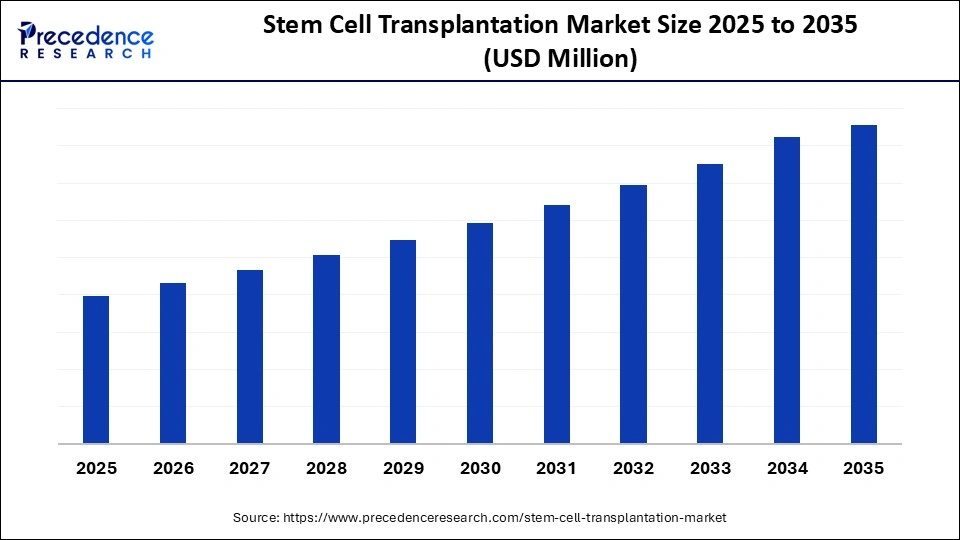
What is the Stem Cell Transplantation Market Size?
The stem cell transplantation market is witnessing substantial growth driven by the increasing prevalence of chronic and degenerative diseases, such as cancer, cardiovascular conditions, and autoimmune disorders. This expansion is further fostered by significant advancements in novel cell technologies, including induced pluripotent stem cells (iPSCs) and gene editing techniques like CRISPR, which are further spurring R&D investments and expanding clinical pipelines across various therapeutic areas.
Market Highlight
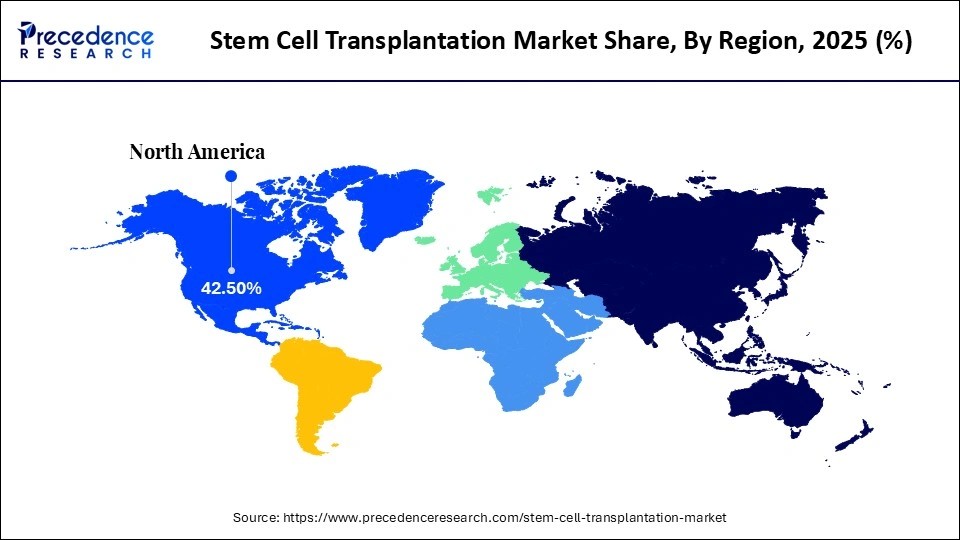
- North America dominated the market with around 42.5% of the market share in 2025.
- Asia Pacific is expected to grow at the fastest CAGR of about 15.5% between 2026 and 2035.
- By transplant type, the allogeneic transplant segment held a major market share of 55.3% in 2025.
- By transplant type, the autologous transplant segment is expected to expand at a notable CAGR of 13.7% from 2026 to 2035.
- By stem cell source, the peripheral blood stem cell transplant segment captured the highest market share of 62.3% in 2025.
- By stem cell source, the cord blood transplant segment is poised to grow at a healthy CAGR of 14.1% between 2026 and 2035.
- By indication/disease, the leukemia segment generated the biggest market share of 52.4% in 2025.
- By indication/disease, the non-malignant disorders segment is expanding at the fastest CAGR of 14.0% between 2026 and 2035.
- By end-user, the transplant/cellular therapy centers segment accounted for the largest market share of 57.5% in 2025.
- By end-user, the academic & research institutes segment is projected to grow at a solid CAGR of 13.8% between 2026 and 2035.
What Is the Stem Cell Transplantation Market?
The stem cell transplantation market comprises medical procedures and related services for replacing damaged or diseased hematopoietic stem cells with healthy ones to restore blood and immune function, primarily in conditions like leukemia, lymphoma, and other hematologic disorders. It includes allogeneic (donor-derived), autologous (patient-derived), and syngeneic transplant types, involving bone marrow, peripheral blood, or cord blood sources. Market growth is driven by rising cancer prevalence, improved transplant outcomes, and expanding healthcare infrastructure worldwide.
How Will AI Revolutionize the Stem Cell Transplantation Market?
Artificial intelligence (AI) is revolutionizing the global market by enhancing the precision, speed, and safety of therapies, accelerating research, and enabling personalized medicine. AI and its subsets, such as machine learning and deep learning, are integrated across the entire stem cell therapy value chain, from research to clinical application. AI algorithms analyze vast datasets of cellular images and genetic information and streamline the design, monitoring, and data processing of clinical trials, providing predictive insights into efficacy and safety. AI is also being applied to scale up stem cell production, making stem cell therapies more cost-effective and accessible.
Market Scope
| Report Coverage | Details |
| Dominating Region | North America |
| Fastest Growing Region | Asia Pacific |
| Base Year | 2025 |
| Forecast Period | 2026 to 2035 |
| Segments Covered | Transplant Type, Stem Cell Source, Indication/Disease, End-User, and Region |
| Regions Covered | North America, Europe, Asia-Pacific, Latin America, and Middle East & Africa |
SegmentS Insights
Transplant Type Insights
How Did the Allogeneic Transplant Segment Dominate the Stem Cell Transplantation Market in 2025?
The allogeneic transplant segment dominated with 55.3% market share in 2025. This dominance is mainly because it offers a graft-versus-tumor effect, using donor immune cells to fight residual cancer, which is crucial for high-risk blood cancers where autologous transplants fall short. It is effective for patients with high-risk cancers or those whose own stem cells aren't suitable. Additionally, techniques like T-cell-depleted transplants reduce Graft-versus-Host Disease (GvHD), improving outcomes and adoption, with expanding use for genetic and autoimmune issues and improved donor matching further solidifying its market leadership.
The autologous transplant segment is anticipated to have the fastest growth, with a CAGR of 13.7%. This growth is mainly driven by its use of the patient's own cells, which eliminates GvHD, reduces relapse risk from immune issues, offers faster recovery, shorter hospital stays, lower costs, and avoids donor matching. Additionally, it eliminates the challenge and time of finding a matched donor. It is standard for high-dose chemotherapy regimens in cancers like myeloma and lymphoma, with quicker immune reconstitution and engraftment.
Stem Cell Source Insights
What Made the Peripheral Blood Stem Cell Transplant Segment Lead the Stem Cell Transplantation Market in 2025?
The peripheral blood stem cell transplant segment led with 62.3% market share in 2025. This is mainly because it offers faster engraftment, quicker immune reconstitution, less donor discomfort, and potentially reduced costs, and it is safer and more efficient for patients. This transplant leads to quicker recovery of white blood cells and platelets, significantly shortening the risky period of low blood counts. Faster recovery translates to lower infection risk, reduced morbidity, and potentially better safety for patients needing urgent transplants.
The cord blood transplant segment is expected to have the fastest growth, with a CAGR of 14.1%. This is due to increased awareness of its life-saving potential for cancers and genetic disorders, simpler collection than bone marrow, reduced immune risks, and expanding regenerative medicine applications. From traditional blood cancer treatments to exploring regenerative uses for neurodegenerative diseases, diabetes, and injuries, expanding its patient base. It often requires less stringent HLA matching than adult stem cells, making it more accessible for unrelated donors.
Indication/Disease Insights
How Did the Leukemia Segment Dominate the Stem Cell Transplantation Market in 2025?
The leukemia segment dominated with 52.4% market share in 2025. This is mainly due to the high global prevalence of leukemia and the fact that stem cell transplantation, particularly allogeneic HSCT, is often considered the most effective, and sometimes only, curative treatment option for many high-risk and relapsed cases as well. Stem cell transplantation is a well-established and critical component of standard treatment protocols for various types of leukemia, including AML, acute lymphocytic leukemia, and chronic myeloid leukemia.
The non-malignant disorders segment is experiencing the fastest growth, with a CAGR of 14.0%. This is mainly due to better supportive care, new conditioning regimens, expanded donor options, and integration with gene therapy for blood disorders. Advances in preparative regimens, better donor matching, and graft manipulation reduce risks and expand eligibility. Beyond blood disorders, applications are growing in autoimmune diseases, severe burns, and neurological conditions, attracting more research and investment.
End-User Insights
Why did The Transplant/Cellular Therapy Centers Segment Lead the Stem Cell Transplantation Market in 2025?
The transplant/cellular therapy centers segment led with 57.5% market share in 2025. This is mainly because these facilities offer integrated, comprehensive care; advanced infrastructure like ICUs; specialized teams; and convenience for complex procedures, handling both routine transplants and emergencies. This leadership is further driven by extensive resources, centralized treatment, and increased adoption into standard practice for various chronic diseases. Additionally, patients prefer these centers for their ability to handle emergencies and manage diverse treatment needs.
The academic & research institutes segment is anticipated to experience the fastest growth, with a CAGR of 13.8%. This growth is due to increased funding, robust clinical trials for diverse diseases, increasing demand for advanced therapies, and crucial industry-academia partnerships. As these institutions are hubs for exploring stem cell potential in treating conditions like diabetes, Parkinson's, heart failure, and osteoarthritis, leading to new therapies. Significant funding from governments and private entities, coupled with collaborations between biotech firms and medical centers, fuels growth.
Regional Insights
How Did North America Dominate the Stem Cell Transplantation Market in 2025?
North America dominated the market with 42.5% market share in 2025. This is mainly due to robust R&D investment, advanced infrastructure, a supportive regulatory environment, and the presence of key industry players. The region benefits from substantial funding in stem cell research from both public sources like the National Institutes of Health in the U.S. and the Canadian Institutes of Health Research in Canada, and private sources, which accelerates the pace of innovation and clinical trials. The region is home to many prominent pharmaceutical and biotechnology companies like Thermo Fisher Scientific, Merck KGaA, Vertex Pharmaceuticals, and specialized CDMOs, fostering a competitive and dynamic market.
U.S. Stem Cell Transplantation Market Trends
The U.S. is the dominant leader in the region, primarily due to advanced research, a significant number of clinical trials, and substantial investments from both public and private sectors. The U.S. has a robust ecosystem of biotechnology firms and research institutions like Harvard, focused on developing innovative therapies for a wide range of conditions, including cancer, neurological disorders, and cardiac ailments. The FDA provides a structured, albeit complex, regulatory pathway for approved treatments.
How Will Asia Pacific Be Considered the Fastest Growing Region in the Stem Cell Transplantation Market in 2025?
Asia Pacific region is expected to experience the fastest growth in the stem cell market, with a CAGR of 15.5%. This growth is primarily driven by increased government support and funding, a large and aging patient population, significant technological advancements, and heightened public awareness of stem cell therapies. Countries in the region, especially Japan, China, South Korea, and India, have implemented favorable policies and allocated substantial funding for research and development in regenerative medicine. Continuous technological breakthroughs in areas such as cell acquisition, processing, cryopreservation, and gene editing are enhancing the efficacy, safety, and scalability of stem cell therapies.
India Stem Cell Transplantation Market Trends
India is emerging as a rapidly growing market within the Asia Pacific region due to its cost-effectiveness and a skilled workforce of medical professionals, making it a prime destination for medical tourism. The country boasts a growing number of world-class hospitals and research centers, such as AIIMS and NCBS, which focus on research in mesenchymal cells, regenerative medicine, and bone marrow transplants. The Indian government has fostered a supportive regulatory environment and offers incentives, such as streamlined medical visa processes, to promote the sector.
Why Did Europe Consider the Notable Region in the Stem Cell Transplantation Market in 2025?
Europe is also considered a notably growing market for stem cell therapies, driven by its advanced healthcare infrastructure, substantial investment in research and development, strong government support, and a high volume of transplant procedures. The European Society for Blood and Marrow Transplantation is one of the world's largest organizations in this field, compiling extensive data that shows high transplantation activity across the continent. The European Medicines Agency provides clear, albeit strict, guidelines for the approval and use of advanced therapy medicinal products, creating a predictable market for developers and facilitating the rapid adoption of new technologies and treatments.
Germany Stem Cell Transplantation Market Trends
Germany has emerged as a key player in Europe, known for its strong scientific background, rigorous ethical and safety regulations, and focus on translational research. Though the country prohibits the production of human embryonic stem cell lines, it allows the importation of existing lines for high-priority research. The focus in Germany primarily lies on adult stem cell therapies, which operate under strict German and EU regulations.
What Has Caused the Emergence of Latin America in the Stem Cell Transplantation Market?
Latin America is becoming a significant region in the stem cell market, primarily due to increased investments in healthcare infrastructure, a growing number of clinical trials, a diverse patient population, and cost-effective treatments compared to other regions. Several countries, particularly Brazil, Mexico, and Argentina, have identified regenerative medicine as a research priority and an area of investment, leading to the creation of advanced research facilities and training programs. The region offers access to a diverse patient population, which is essential for developing universally applicable medical solutions.
Brazil Stem Cell Transplantation Market Trends
Brazil stands out as a leading player in Latin America, characterized by a high volume of transplant procedures and substantial government-backed research initiatives focused on public health needs. The country has made significant progress in clinical trials utilizing cell therapies for conditions such as type 1 diabetes and Chagasic cardiomyopathy. Its diverse genetic population serves as an important testing ground for global biobank initiatives and approaches to personalized medicine.
How Will the Middle East and Africa Surge in the Stem Cell Transplantation Market in 2025?
The Middle East and Africa region is also witnessing significant growth, driven by a growing and aging population that has led to a higher incidence of chronic and degenerative conditions, including cardiovascular disorders, cancer, orthopedic issues, and neurodegenerative diseases. Governments in the GCC countries, such as the UAE, Saudi Arabia, and Qatar, are actively funding and supporting stem cell research initiatives, infrastructure development, and the establishment of advanced research centers, which foster innovation and accelerate market growth.
Saudi Arabia Stem Cell Transplantation Market Trends
Saudi Arabia is experiencing rapid market growth, fueled by substantial government investment and a national vision to develop its biotechnology sector. The country is increasing funding for scientific research, particularly in regenerative medicine and personalized healthcare, as part of its Vision 2030 economic diversification plan. The establishment of new research centers, innovation hubs, and biotech clusters aims to attract top talent and promote collaboration between academia and industry.
Stem Cell Transplantation Market Value Chain Analysis
- Research & Development (R&D)
This identifies target genes, explores cell sources, develops therapeutic vectors, and performs initial safety and efficacy testing in labs and animal models.
Key Players: Novartis, Pfizer, Sarepta Therapeutics, Charles River Laboratories, IQVIA, STEMCELL Technologies Inc., and Thermo Fisher Scientific, Inc.
- Clinical Trials & Regulatory Approval
This involves conducting human trials to prove safety and efficacy, followed by extensive data submission and approval from regulatory bodies.
Key Players: Sarepta Therapeutics, Pfizer, Novartis, Bluebird Bio, Mesoblast Ltd., Gamida Cell Ltd., and Takeda Pharmaceutical Company Limited.
- Manufacturing
This involves the highly complex production of the viral vectors and formulating the final drug product in sterile conditions.
Key Players: Catalent, Lonza, FUJIFILM Diosynth Biotechnologies, Biogen, Gilead Sciences, Sartorius AG, and CellGenix GmbH.
- Logistics & Patient Delivery
This involves specialized cryogenic or cold chain logistics to transport the bespoke therapies from manufacturing sites to hospitals.
Key Players: DHL Group, FedEx Logistics, Marken, UPS Healthcare, Cryoport Systems, and CBR Systems Inc.
- Treatment & Commercialization
This involves the administration of the therapy to the patient within certified treatment centers, often involving high-value payment models and specialized patient support programs.
Key Players: Novartis, Roche, Vertex, St. Jude Children's Research Hospital, Bristol Myers Squibb, and Gilead Sciences.
Stem Cell Transplantation Market Companies
- Lonza Group Ltd.
- Novartis AG
- Merck KGaA
- Cynata Therapeutics Ltd.
- Pluristem Therapeutics Inc.
- ThermoGenesis Holdings, Inc.
- Escape Therapeutics, Inc.
- Regen BioPharma, Inc.
- CSG-BIO Company, Inc. (CellSave)
- CBR Systems, Inc.
- Global Cord Blood Corporation
- ViaCord, LLC
- bluebird bio, Inc.
- Kiadis Pharma
- Marker Therapeutics, Inc.
Leaders Announcement
- In August 2024, Getinge completed the acquisition of Paragonix Technologies, aiming to enhance its organ transport services for USD 477 million. While the acquisition will slightly impact adjusted earnings per share in 2024, positive contributions are expected starting in 2028. (Source : https://www.getinge.com)
Recent Developments
- In May 2025, Zydus Lifesciences launched ANVIMO (Letermovir), a significant advancement in CMV infection prevention for hematopoietic stem cell and kidney transplant patients. Available in 240 mg and 480 mg dosages, ANVIMO offers a safer alternative to traditional CMV treatments, reducing costs by 91% from imported innovator prices, making it accessible for Indian patients.(Source: https://www.expresspharma.in)
- In December 2025, OMER received FDA approval for YARTEMLEA (narsoplimab-wuug) to treat hematopoietic stem cell transplant-associated thrombotic microangiopathy (TA-TMA), the first therapy of its kind. Approved for adults and children aged two and older, YARTEMLEA works by blocking a key enzyme in the immune response, with the FDA approval based on a study of 28 adult patients.(Source: https://finance.yahoo.com)
Segments Covered in the Report
By Transplant Type
- Allogeneic Transplant
- Autologous Transplant
- Syngeneic Transplant
By Stem Cell Source
- Peripheral Blood Stem Cell Transplant
- Bone Marrow Transplant
- Cord Blood Transplant
By Indication/Disease
- Leukemia
- Lymphoproliferative Disorders
- Non-malignant Disorders
- Others
By End-User
- Hospitals
- Transplant/Cellular Therapy Centers
- Specialty Clinics
By Region
- North America
- Europe
- Asia-Pacific
- Latin America
- Middle East & Africa
For inquiries regarding discounts, bulk purchases, or customization requests, please contact us at sales@precedenceresearch.com
Frequently Asked Questions





Ask For Sample
No cookie-cutter, only authentic analysis – take the 1st step to become a Precedence Research client
 Get a Sample
.webp)



 sales@precedenceresearch.com
 Schedule a Meeting
