



Tissue Nanotransfection Market Size, Companies, Share, Patient Volume, Treatment Adoption Rates, Pricing Analysis, Regulatory Landscape, Competitive Positioning, and Demand Forecast
Tissue Nanotransfection Market (By Technology: Electroporation, Magnetoporation, Optoporation, Others; By Application: Dermatology, Cardiology, Neurology, Oncology, Others; By End-User: Hospital, Speciality Clinics, Research Institutions, Others) - Global Industry Analysis, Size, Trends, Leading Companies, Regional Outlook, and Forecast 2026 to 2035
Source: https://www.precedenceresearch.com/tissue-nanotransfection-market
 Get a Sample
 Table Of Content


What is the Tissue Nanotransfection Market Size?
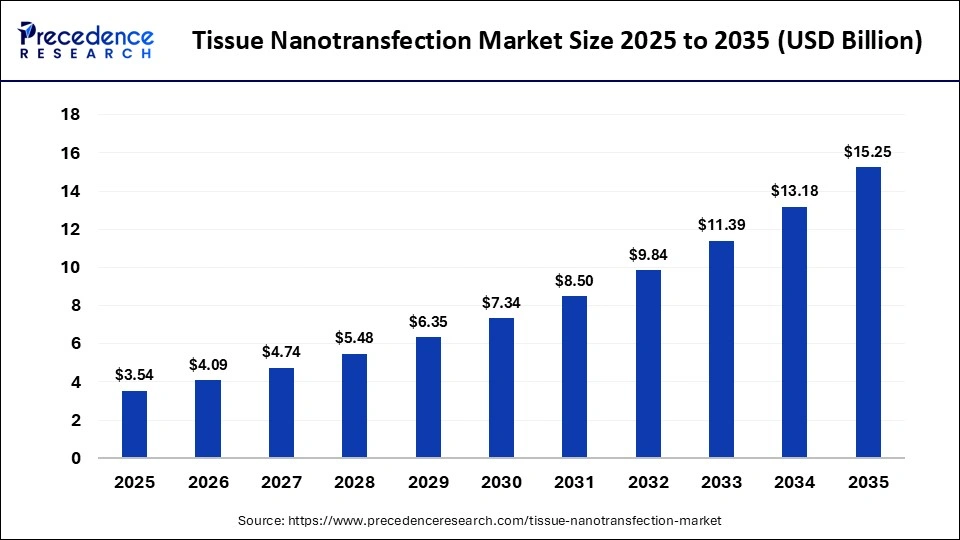
The global tissue nanotransfection market size accounted for USD 3.54 billion in 2025 and is predicted to increase from USD 4.09 billion in 2026 to approximately USD 15.25 billion by 2035, expanding at a CAGR of 15.74% from 2026 to 2035. This market is growing because of the rising focus on regenerative medicine, demand for safe and non-viral gene delivery, and growing preference for minimally invasive therapies.
Key Takeaways
- North America dominated the tissue nano transfection market in 2025.
- Asia-Pacific is expected to be the fastest-growing region between 2026 and 2035.
- By technology type, the electroporation segment held a dominant position in the market in 2025.
- By technology type, the magnetoporation segment is expected to grow at the fastest CAGR during the forecast period.
- By application type, the oncology segment held a dominant position in the tissue nanotransfection market in 2025.
- By application type, the neurology segment is expected to witness the fastest growth in the market over the forecast period.
- By end user, the hospitals segment registered its dominance over the global market in 2025.
- By end user, the speciality clinics segment is expected to expand rapidly in the market in the coming years.
Market Overview
The tissue nanotransfection market involves a new way of delivering genes directly into the skin using a small chip-based device that uses a brief electric field to deliver DNA or RNA. This technology aids regenerative applications such as wound healing, ischemic tissue repair, and organ regeneration. Market growth is supported by increasing demand for minimally invasive therapeutic solutions and a safe alternative to traditional cell transplantation approaches. As the regenerative medicine field is advancing, tissue nanotransfection is gaining attention for its potential to simplify procedures and reduce immune complications.
What is the Role of AI in the Tissue Nanotransfection Market?
Artificial intelligence is slowly changing research and development in the market. AI-powered tools can analyze large biological datasets to identify suitable gene targets and predict outcomes after reprogramming. This reduces trial-and-error in experimental development, which further minimizes the timeline and cost of the development. During preclinical and clinical phases, AI is used in interpreting imaging data and monitoring healing patterns. It can also assist in patient selection by analyzing medical records and predicting treatment suitability. Overall, AI is helping companies to accelerate research to the clinical stage more efficiently.
What are the Tissue Nanotransfection Market Trends?
- A significant shift towards non-viral gene therapy due to safety concerns, immunological reactions, and complex manufacturing requirements. Tissue nanotransfection offers a non-viral approach, improves localized gene transfer, and minimizes side effects.
- Healthcare providers and patients prefer minimally invasive therapies. Tissue nanotransfection uses a small chip device directly on the skin, avoiding surgical procedures. This approach is safe, less invasive, and more efficient.
- Nanotechnology is expanding in healthcare due to its advantage such as targeted drug delivery, advanced diagnostics, and gene transfer approaches. Genes and biomolecules, by using nanotechnology, can be delivered to cells, which provides precision delivery, increased efficiency, and reduced cellular damage.
- Rising innovation in novel nanotransfection techniques such as electroporation, sonoporation, and particle bombardment gives more effectiveness and specificity as compared to conventional methods.
- Growing focus on personalized medicines, the tissue nanotransfection is gaining attention for neurological, cardiological, and dermatological applications.
Market Scope
| Report Coverage | Details |
| Market Size in 2025 | USD 3.54 Billion |
| Market Size in 2026 | USD 4.09 Billion |
| Market Size by 2035 | USD 15.25 Billion |
| Market Growth Rate from 2026 to 2035 | CAGR of 15.74% |
| Dominating Region | North America |
| Fastest Growing Region | Asia Pacific |
| Base Year | 2025 |
| Forecast Period | 2026 to 2035 |
| Segments Covered | Technology, Application, End-User, and Region |
| Regions Covered | North America, Europe, Asia-Pacific, Latin America, and Middle East & Africa |
Segmental Insights
Technology Insights
Why Did the Electroporation Segment Hold the Largest Share of the Tissue Nanotransfection Market?
The electroporation segment registered its dominance over the global market in 2025 because it is well known in gene delivery research. The method works by applying a brief electrical pulse that temporarily puncture cell membrane, allowing genetic material to enter the cell. This method is used in research and academic laboratories, which gives a well-established safety profile and performance understanding compared to new emerging methods. In tissue nanotransfection, electroporation supports localized gene transfer without relying on viral vectors. The ongoing development in device control and pulse precision is further contributing to the segment dominance in the market.
The magnetoporation segment is expected to gain the highest share of the market over the forecast period. This method works by using magnetic fields to guide the gene-loaded particles towards target cells. Advantages of this method are targeted delivery, controlled release, and reduced tissue damage. Magnetoporation is still in an earlier stage of development, and researchers are actively exploring its compatibility with regenerative applications. Ongoing research and development of an advanced magnetoporation system will further boost the growth of this technology.
Application Insights
What Made the Oncology Segment Dominant in the Tissue Nanotransfection Market?
The oncology segment held a dominant position in the market in 2025 because of increasing prevalence and growing demand for targeted cancer therapies. Researchers are exploring how direct, localized gene therapy will influence tumor behaviour and strengthen immune responses in cancer patients. Tissue nanotransfection offers a non-viral and site-specific approach, while minimizing damage to healthy tissues, which aligns with the demand for safe and controlled cancer therapy. The rising burden of cancer and continuous development and investment in advanced treatment support the growth of the segment.
The neurology segment is expected to witness the fastest growth in the market over the forecast period as researchers are exploring better ways to address nerve damage and degenerative conditions. Neurological disorders such as Parkinson's disease and Alzheimer's disease have limited treatment options. Tissue nanotransfection offers direct delivery of genetic material to targeted neural tissue and supporting repair at the site of injury. Continuous research focused on TNT-based neurological disorder therapies is expected to drive the rapid growth of the segment in the market.
End-User Insights
How Hospitals Segment Dominated the Tissue Nanotransfection Market in 2025?
The hospitals segment accounted for a considerable revenue share in the market in 2025 because it is a primary point of contact for the patients. Hospitals have advanced therapeutic technologies and skilled healthcare professionals to treat critical conditions such as oncology, neurology, and regenerative medicine. They also manage a high volume of patients, which supports greater utilization of emerging procedures. Large hospitals typically collaborate with research institutes and biotechnology companies for clinical studies, which support new technology availability in the hospitals. The easy access to skilled professionals and advanced equipment strength dominance of the segment in the market.
The speciality clinics segment is expected to grow at the fastest CAGR in the market over the forecast period. These clinics are often specific therapeutic areas like orthopaedics, neurology, or regenerative treatments, which makes them highly adopt targeted technologies. Patients increasingly prefer speciality clinics for their easy accessibility and personalized care plans.
Regional Insights
What Factors Made the North America Region the Dominant Region in the Market?
North America dominated the global tissue nanotransfection market in 2025 because of strong research funding, advanced healthcare infrastructure, and early adoption of novel technologies. Research institutes and biotechnology firms are actively exploring gene delivery and regenerative medicine applications. The well-established pharmaceutical and biotechnology companies encourage collaborations. Favorable regulatory frameworks for novel therapies and government support for biomedical research further strengthen the dominance of the region in the market. In addition, growing awareness of advanced therapy options among healthcare providers and patients continues to drive demand, and North America is steadily expanding in the tissue nanotransfection market.
The U.S. Market Trends
The United States represents the largest market in North America due to its strong healthcare ecosystem and huge investment in the life sciences field. Researchers are actively exploring novel approaches for cancer, neurological disorders, and tissue repair. The government is supporting and funding advanced research to develop innovative therapies. A high burden of chronic disease increases demand for advanced treatments. Strong healthcare infrastructure, huge funding, and scientific talent together contribute to the growth of the country in the tissue nanotransfection market.
Which Factors Influence the Fastest Growth of the Asia Pacific Market?
Asia Pacific is expected to grow at the fastest CAGR in the tissue nanotransfection market during the forecast period due to a large population and increasing healthcare expenditure. Governments are encouraging innovation, and collaboration between universities and biotech firms is increasing. The demand for cost-effective yet advanced treatment is increasing across both developed and developing regions. The region is improving access to healthcare services, which supports the growth of the region.
China Market Trends
China plays an important role in the tissue nanotransfection market because of the country's large population base and rising prevalence of chronic disease. China is actively advancing in biomedical technologies, including gene delivery and regenerative medicine. Academic institutions and domestic biotech companies are significantly investing in research and the biomedical sectors. The government is encouraging innovation, and improving healthcare infrastructure is driving the growth of the country.
India Market Trends
India is steadily growing its position in the tissue nanotransfection market because of expanding research initiatives and improving healthcare facilities. The country has a growing biotechnology sector supported by a government program aimed at encouraging innovation and startup development. Academic research in gene therapy and regenerative medicine is gaining attention. Collaboration between research bodies and private companies is accelerating advancement in the regeneration medicines sector. The rising awareness of innovative therapies and increasing healthcare investment are also contributing to market growth.
Which Factors Made Europe a Significantly Growing Region in the Market?
Europe shows steady growth in the tissue nanotransfection market, driven by advancements in research and collaboration between academics and pharmaceutical companies. Countries such as Germany, the United Kingdom, and France are actively investing in regenerative medicines and the advanced gene delivery area. Growing interest in minimally invasive and non-viral gene delivery approaches perfectly aligns with tissue nanotransfection. Significant funding for health programs encourages innovation across the region. These factors are supporting the growth of Europe in the market.
Germany Market Trends
The German market is driven by a highly developed biomedical engineering environment and the potential of substantial capital and resources available for investments in Regenerative medicine innovation. With a strong research infrastructure and a number of outstanding laboratories, Germany is home to many researchers working on the development of nano-medicines, tissue engineering, and precision medicine technologies. Germany also has strong manufacturing capabilities for pharmaceuticals and there are numerous government-sponsored scientific research initiatives adding to the favorable environment for developing and commercializing tissue nanotransfection technologies.
Why is Latin America Growing in the Tissue Neurotransfection Market?
Latin America is expected to grow at a considerable CAGR in the upcoming period, due to the increasing health modernization and growing awareness of biotechnology, and increasing investment in advanced research for regenerative medicine. Many academic institutions and healthcare organizations are beginning to use nanotechnology-based therapeutic platforms for the repair of tissue or for wound healing. In addition, governments in the region are creating more innovation partnerships with international biotech companies and research institutes.
Brazil Market Trends
The Brazilian market is growing due to an increase in investment into biotechnology research and the increase in regenerative medicine initiatives. The growth of clinical research infrastructures in Brazil's medical community is also providing a platform for the future development of nanomedicine. Additionally, many Brazilian medical institutions have been collaborating with global biotechnology companies to promote awareness and adoption of innovative tissue regeneration platforms such as nano-enabled gene delivery technologies.
Will the Middle East and Africa Grow in the Tissue Neurotransfection Market?
The Middle East and Africa region is expected to grow at a notable CAGR in the foreseeable future, due to increasing biotech and healthcare infrastructure, rising government support and funding for biotech developmental projects, and increasing investment in regenerative medical solutions. The growing use of innovative therapies for wound healing and minimally invasive methods of tissue repair also augments the market. Furthermore, the increasing awareness of the applications of nanomedicine and precision healthcare is prompting research organizations to further investigate new developments in cell reprogramming and nano-electroporation technologies as potential future therapies.
Saudi Arabia Market Trends
Saudi Arabia is the leader in the MEA and is growing due to a commitment to biotechnology and medical research investment through multiple healthcare technology transformation initiatives. Current government support for next-generation therapeutic technologies within many of its national healthcare modernization programs continues to stimulate the growth of the tissue nanotransfection industry. Additionally, the increasing frequency of partnering with both international healthcare and biotechnology organizations will further enhance Saudi Arabia's ability to utilize new innovative technologies associated with tissue repair and gene therapy.
Tissue Nanotransfection Market Value Chain Analysis
- R&D: Research and development in the tissue nanotransfection market focuses on improving nanochip technology and optimizing gene delivery. Pre-clinical studies are performed to establish safety, efficiency, and reproducibility before human application.
Key Players: Osiris Therapeutics, Zimmer Biomet, Integra LifeSciences, AbbVie Inc. (Allergan), Bio Tissue Technologies. - Clinical Trials and Regulatory Approvals: Clinical trials evaluate safety, dosing precision, and tissue regenerative outcomes in nanotransfection patients. Regulatory approvals involve submitting safety, efficacy, and manufacturing data of the product and ensuring compliance with strict medical standards, building trust among physicians, patients, and healthcare providers worldwide.
Key Players: AmpliVec commercializes TNT technology, NanoMed Therapeutics, Zimmer Biomet, Integra LifeSciences, B. Braun Melsungen AG, Becton, Dickinson and Company
Tissue Nanotransfection Market Companies
- Osiris Therapeutics
- Zimmer Biomet
- AbbVie Inc.
- Integra Lifesciences
- Bio Tissue Technologies
- B. Braun Melsungen AG
- Becton
- Dickinson and Company (C. R. Bard)
- Organogenesis
- Biotime Inc
- Braun Melsungen AG
- Becton
- Imaxio SA
- Integra Lifesciences
- Nano Biotechnology Co. Ltd.
- NanoBio Corporation
- NanoSonic Inc.
- Novartis AG
- Organogenesis
- Others
Recent Developments
- In May 2025, the McGowan Institute for Regenerative Medicine (MIRM) is strengthening its partnership to advance research in the regenerative medicine field. MIRM aims to accelerate tissue engineering, wound care research, and bring advanced cell-based therapies to improve patient outcomes.(Source: https://www.bioprocessintl.com)
- In May 2024, researchers at the McGowan Institute for Regenerative Medicine are advancing tissue nanotransfection by testing how the body can act as its own bioreactor. The company recently announced the success of the phase 2 trial for a product used in severe burn patients.(Source: https://www.pharmavoice.com)
Segments Covered in the Report
By Technology
- Electroporation
- Magnetoporation
- Optoporation
- Others
By Application
- Dermatology
- Cardiology
- Neurology
- Oncology
- Others
By End-User
- Hospital
- Speciality Clinics
- Research Institutions
- Others
By Region
- North America
- Europe
- Asia-Pacific
- Latin America
- Middle East & Africa
For inquiries regarding discounts, bulk purchases, or customization requests, please contact us at sales@precedenceresearch.com
Frequently Asked Questions





Ask For Sample
No cookie-cutter, only authentic analysis – take the 1st step to become a Precedence Research client
 Get a Sample
.webp)



 sales@precedenceresearch.com
 Schedule a Meeting
