



US Anesthesia Devices Market Size, Share and Trends 2026 to 2035
US Anesthesia Devices Market (By Product: Anesthesia Delivery Machine, Anesthesia Disposables & Accessories, Anesthesia Monitors, Anesthesia Information Management Systems (AIMS); By Type: General Anesthesia, Local Anesthesia, By Application, Cardiology, Neurology, Urology, Orthopedics, Dental, Ophthalmology, Others; By End User: Clinics, Ambulatory Service Centers, Hospitals) - Industry Analysis, Size, Trends, Leading Companies, Regional Outlook, and Forecast 2026 to 2035
Source: https://www.precedenceresearch.com/us-anesthesia-devices-market
 Get a Sample
 Table Of Content


US Anesthesia Devices Market Size and Forecast 2026 to 2035
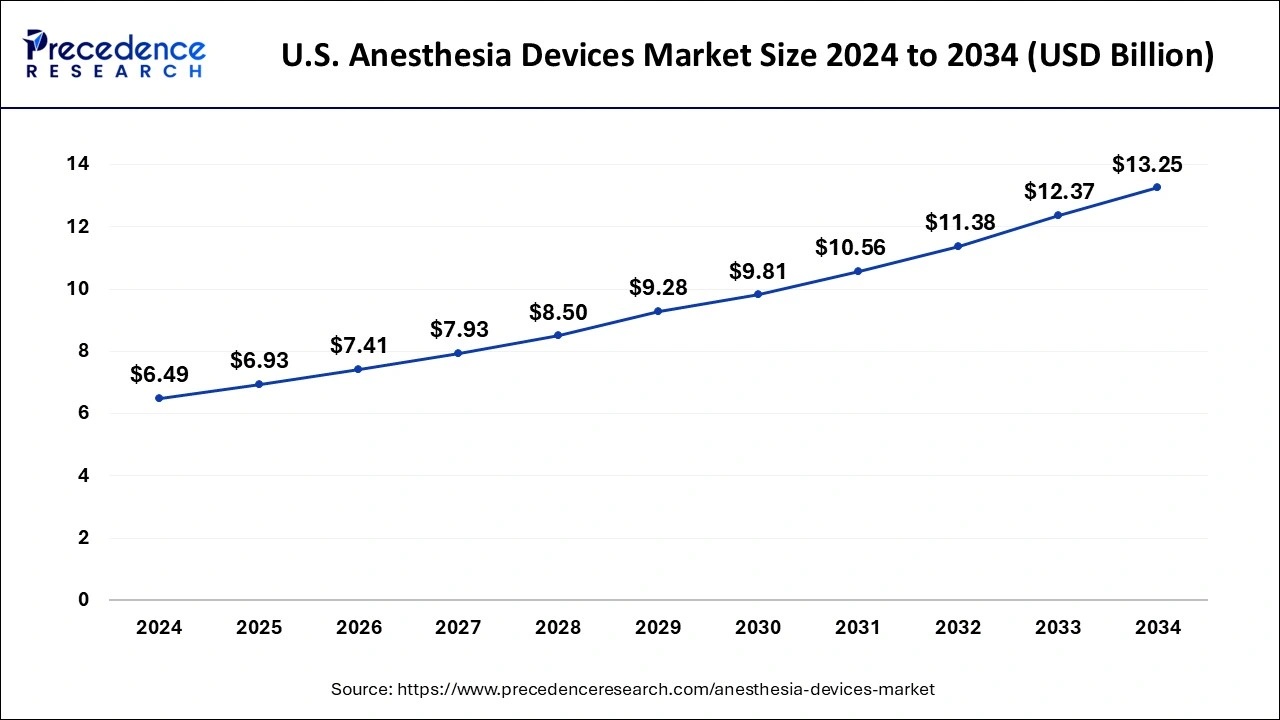
The US anesthesia devices market size was calculated at USD 6.93 billion in 2025 and is predicted to increase from USD 7.41 billion in 2026 to approximately USD 14.20 billion by 2035, expanding at a CAGR of 7.44% from 2026 to 2035. The market growth is attributed to increasing surgical procedure volumes, expanding ambulatory care infrastructure, and continuous advancements in anesthesia delivery and patient monitoring technologies.
Key Takeaways
- By product, the anesthesia delivery machine segment held the largest market share in 2025.
- By product, the anesthesia disposables and accessories segment is expected to expand with the highest CAGR during the forecast period.
- By type, the general anesthesia segment held the largest share of the market in 2025.
- By type, the local anesthesia segment is expected to grow with the highest CAGR between 2026 and 2035.
- By application, the cardiology segment held the highest share of the market in 2025.
- By application, the ophthalmology segment is expected to grow with the highest CAGR during the forecast period.
- By end user, the hospitals segment held the highest share of the market in 2025.
- By end user, the ambulatory service centers segment is expected to grow with the highest CAGR during the forecast period.
Market Overview
The growing volume of surgical procedures and increasing emphasis on patient safety are driving the U.S. anesthesia devices market. Anesthesia devices encompass a variety of technologies utilized during surgeries, including workstations, ventilators, vaporizers, gas delivery systems, and monitoring technologies.
These computing systems enable the safe use of anaesthetics and constant monitoring of a patient throughout perioperative care. Furthermore, the recent FDA corrective actions involving anesthesia workstations have encouraged providers to modernize aging systems and improve patient safety.
Impact of Artificial Intelligence on the U.S. Anesthesia Devices Industry
Hospitals increasingly deploy AI-enabled anesthesia workstations that analyze physiological data and support clinicians during complex procedures. These systems continually monitor changes in vital signs and are able to alert providers before problems worsen. Intelligent analytics continue to be a key focus of leading manufacturers who continue to work on the new incorporation of the smart sensor into monitoring and anesthesia platforms, such as GE HealthCare, Medtronic, Philips, Drager, and Masimo.
Market Report Coverage and Key Metrics
| Report Coverage | Details |
| Market Size in 2025 | USD 6.93 Billion |
| Market Size in 2026 | USD 7.41 Billion |
| Market Size by 2035 | USD 14.20 Billion |
| Market Growth Rate from 2026 to 2035 | CAGR of 7.44% |
| Base Year | 2025 |
| Forecast Period | 2026 to 2035 |
| Segments Covered | Product, Type, Application, and End User |
Market Dynamics
Drivers
Rising Surgical Procedure Volumes Across Healthcare Facilities
Rising surgical procedure volumes across hospitals, ambulatory surgical centers, and specialty clinics are projected to drive the U.S. anesthesia devices market in the coming years. Anesthesia work stations, ventilators, vaporizers, and monitoring devices have increasingly become necessary tools in the hands of healthcare providers for cardiovascular, neurological, and gastrointestinal procedures.
- In 2024, the total procedural volume of ASPS across cosmetic surgical, minimally invasive, and reconstructive practices reached 30,877,819 procedures.
Furthermore, the growing emphasis on patient safety and perioperative monitoring is expected to drive the adoption of advanced anesthesia technologies across healthcare facilities.
Restraint
High Capital and Maintenance Costs
High acquisition and maintenance costs are expected to hamper the market growth. The state-of-the-art anesthesia workstations feature built-in monitoring systems, digital interfaces, and advanced ventilation features, which come at a considerably high cost. The financial resources of capitalists often result in extended equipment replacement periods and delayed introduction of new anesthesia equipment.
Opportunity
Surging Technological Advancements in Anesthesia Workstations
Surging technological advancements in anesthesia workstations are estimated to create immense opportunities for the players competing in the market. There is a growing trend in the healthcare industry towards implementing connected systems that work in unison with other systems, such as EMRs and perioperative management software. Furthermore, the High demand for minimally invasive and complex surgical procedures is likely to strengthen investment in advanced anesthesia equipment.
Market Segmentation Analysis
Product Insights
The Anesthesia Delivery Machine Segment Dominated the Market in 2025
The anesthetics delivery machine segment dominated the U.S. anesthesia devices market in 2025, as healthcare providers relied on many high-tech technologies and precision-driven perioperative care. Modern systems integrate the delivery of anesthesia, respiratory care, monitoring of the airways, and patient surveillance into one system. Large hospitals also scaled up investments in e-operating rooms, which demand high-tech anesthesia systems, thus further facilitating the segment growth.
The anesthesia disposables and accessories segment is expected to grow rapidly from 2026 to 2035, as every anesthesia procedure requires recurring consumption of airway and respiratory products. Breathing circuits, filters, masks, laryngeal masks, endotracheal tubes, and airway management accessories are tools increasingly applied at the hospital to allow for safe anesthesia administration. Such factors make anesthesia disposables and accessories the fastest-growing product segment in the industry.
Type Insights
The General Anesthesia Segment Led the Market in 2025
The general anesthesia segment led the U.S. anesthesia devices market in 2025 due to its high utilization in cardiovascular, neurological, orthopedic, oncological, and transplant surgeries. Academic medical centers kept developing and growing high-acuity surgical programs and high rates of general anesthesia use in operating rooms.
The local anesthesia segment is expected to grow at the fastest CAGR between 2026 and 2035, supported by the number of ambulatory surgeries and physician office and outpatient surgeries. These interventions frequently necessitate regional anesthesia instead of general anesthesia, resulting in more efficient and less time-consuming interventions and recovery.
Application Insights
The Cardiology Segment Dominated the Market in 2025
The cardiology segment contributed the biggest U.S. anesthesia devices market share in 2025 due to the increasing demand for advanced anesthesia support during high-acuity cardiovascular procedures. The general principles behind these procedures make significant use of both anesthetic work stations and ventilators with capnography and hemodynamic monitoring systems.
According to the American Heart Association, nearly 48.6% of U.S. adults live with some form of cardiovascular disease, creating a substantial procedural burden across healthcare facilities. Additionally, the growth in hybrid operating rooms and structural heart programs continued to drive up the demand for integrated anesthesia systems.
The ophthalmology segment is expected to gain the highest market share between 2026 and 2035, driven by the increasing volume of age-related vision procedures performed in outpatient settings. Specialists in eye care foresee performing an ever-increasing volume of cataract, glaucoma, retinal, and corneal surgeries across the U.S., with sedation. This creates demand for anesthesia-related technologies needed for most ophthalmic procedures.
The NIH estimates that over 3.8 million cataract procedures occurred annually in the U.S. in 2025. Large-scale ophthalmology networks are still investing in outpatient surgical centers that might have the latest and greatest technologies for anesthesia monitoring. This is driving further advancement in the use of anesthesia in an ophthalmic environment.
End User Insights
The Hospitals Segment Dominated the Market in 2025
The hospitals segment dominated the U.S. anesthesia devices market in 2025, as these healthcare settings deal with a high number of ophthalmic, pain management, gastrointestinal, and dermatological procedures. This segment continues to invest in modern anesthesia monitoring solutions to improve patient outcomes and operational performance, thus facilitating the market growth in the coming years.
The ambulatory service centers segment is expected to show the fastest growth over the forecast period, owing to the ongoing efforts of healthcare systems to move surgical procedures from traditional inpatient settings. Healthcare groups are building ambulatory surgical facilities in big metropolitan and suburban areas. Those factors are contributing to churned-up long-term demand for equipment in outpatient surgery facilities.
U.S. Anesthesia Devices Market: Country-Level Analysis
Why Did California Dominate the U.S. Anesthesia Devices Industry?
The market in California is growing due to the state's support of one of the largest healthcare delivery networks in the nation. According to the state's 2025 population estimate, the state had around 39.4 million residents, resulting in a widespread demand for surgery in various specialties, including cardiovascular, orthopedic, neurological, and oncological procedures. This strength of trends was continuing to increase equipment utilization in outpatient surgical centers and hospitals.
Why is Texas Becoming the Fastest-Growing State in the U.S. Anesthesia Devices Industry?
Texas is considered to be a significantly growing area, supported by healthcare facility growth, growing outpatient surgery networks, and growing specialty treatment centers. Texas saw its population continue to grow, driving up demand for surgical and interventional procedures. Healthcare providers are sinking significant resources into new facilities with modern anesthesia equipment, such as hospitals, ambulatory surgery centers, cardiovascular treatment facilities, and orthopedic treatment centers.
U.S. Anesthesia Devices Market Value Chain Analysis
- Raw Material & Electronic Component Sourcing
Medical-grade plastics, sensors, semiconductors, valves, circuit boards, and precision metal components form the foundation of anesthesia device manufacturing.
Key Players: TE Connectivity, Honeywell, Amphenol, Molex, DuPont.
- Device Manufacturing & System Integration
Manufacturers assemble anesthesia workstations, ventilators, vaporizers, and monitoring systems under stringent quality and regulatory standards.
Key Players: GE HealthCare, Dräger, Philips, Mindray, Getinge.
- Distribution & Healthcare Procurement
Completed devices move through distributors and direct sales networks to hospitals, clinics, and ambulatory surgical centers.
Key Players: Cardinal Health, Medline Industries, McKesson, Owens & Minor.
- Clinical Deployment & Aftermarket Services
Healthcare facilities deploy systems for surgical procedures while manufacturers provide maintenance, software upgrades, and technical support.
Key Players: GE HealthCare, Dräger, Philips, Mindray, Baxter International.
Market Competitive Landscape: Leading Companies and Strategies
The U.S. anesthesia devices market is moderately consolidated, with global manufacturers competing based on technology leadership and clinical innovation. Major companies, such as GE HealthCare, Drager, Philips, Medtronic, Mindray, Masimo, Baxter International, and Getinge, have solid footing in place. These firms will exploit their far-reaching relationships with hospitals, wide product lines, and comprehensive perioperative platforms to enhance their competitive edge.
Key investments, launches, and AI integration are transforming the competitive landscape in the industry. In 2025, Masimo improved advanced monitoring, and Philips broadened its peri- and connected care innovations. GE HealthCare and Dräger further developed digital OR environments to enhance efficiency and clinical results. Furthermore, the ambulatory surgery center and the smart operating room are expected to lead the way in driving innovation in the field of anesthesia technology.
U.S. Anesthesia Devices Market Companies
- aXcent medical
- BPL Medical Technologies
- Drägerwerk AG & Co. KGaA
- GE Healthcare
- Getinge AB
- Heal Force Bio-Meditech Holdings Limited
- Koninklijke Philips N.V.
- Medtronic
- Mindray Bio-Medical Electronics Co., Ltd.
- Penlon
Recent Development U.S. Anesthesia Devices Market (2025-2026)
- In November 2025, GE Healthcare launched its Carestation 850, a next-generation anesthesia delivery system to adapt to evolving clinical and operational demands with customizable tools and a space-efficient footprint. The device is awaiting its FDA 510(k) clearance from the U.S. FDA. (Source: https://respiratory-therapy.com)
Segments Covered in the Report
By Product
- Anesthesia Delivery Machine
- Anesthesia Disposables & Accessories
- Laryngoscopes
- HME
- Anesthesia Circuits
- Anesthesia Masks
- Others
- Anesthesia Monitors
- Anesthesia Information Management Systems (AIMS)
By Type
- General Anesthesia
- Local Anesthesia
By Application
- Cardiology
- Neurology
- Urology
- Orthopedics
- Dental
- Ophthalmology
- Others
By End User
- Clinics
- Ambulatory Service Centers
- Hospitals
For inquiries regarding discounts, bulk purchases, or customization requests, please contact us at sales@precedenceresearch.com
Frequently Asked Questions





Ask For Sample
No cookie-cutter, only authentic analysis – take the 1st step to become a Precedence Research client
 Get a Sample




 sales@precedenceresearch.com
 Schedule a Meeting



