



US Battery Logistics Market Size, Companies, Share, Vehicle Production Volume, Sales Performance, Export & Import Analysis, Technology Adoption, Competitive Positioning, and Demand Trends
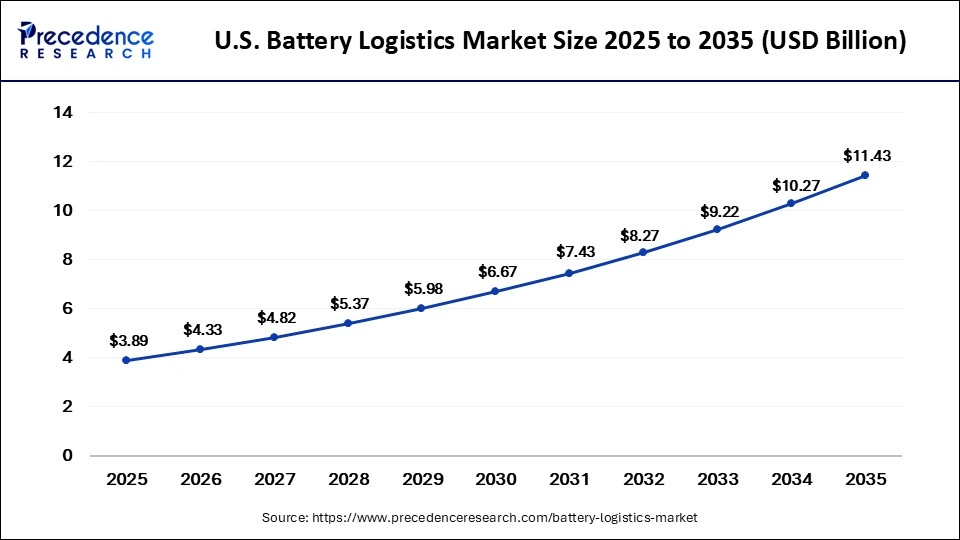
According to automotive sector expert, Laxmi Narayan notes that the US battery logistics market stands at USD 4.33 billion in 2026 and is expected to reach USD 11.43 billion by 2035, growing at a CAGR of 11.38%. Leading US battery logistics market companies such as DHL Supply Chain, FedEx Corporation, UPS Supply Chain Solutions are driving market development across segments including battery type, logistics service, transportation mode, application, battery lifecycle, end user.
Source: https://www.precedenceresearch.com/us-battery-logistics-market
 Get a Sample
 Table Of Content


US Battery Logistics Market Size and Forecast 2026 to 2035
The US battery logistics market size accounted for USD 3.89 billion in 2025 and is predicted to increase from USD 4.33 billion in 2026 to approximately USD 11.43 billion by 2035, expanding at a CAGR of 11.38% from 2026 to 2035. The market is driven by the rapid increase in electric vehicle production, increasing domestic battery manufacturing, and rising demand for specialized transportation and storage solutions for lithium-ion batteries.
Key Takeaways
- By batter type, the lithium-ion batteries segment held the largest share of the market in 2025.
- By battery type, the flow batteries segment is expected to grow with the highest CAGR during the forecast period.
- By logistics service, the transportation services segment dominated the market in 2025.
- By logistics service, the warehousing & storage segment is expected to grow at a significant CAGR between 2026 and 2035.
- By transportation mode, the road transportation segment led the market in 2025.
- By transportation mode, the multimodal transport segment is expected to grow at a significant CAGR during the forecast period.
- By application, the electric vehicles (EVs) segment held the largest share of the market in 2025.
- By application, the energy storage systems segment is expected to grow with a notable CAGR during the forecast period.
- By battery lifecycle, the finished battery distribution segment led the market in 2025.
- By battery lifecycle, the recycling & secondary-life logistics segment is expected to grow at a rapid pace in the coming years.
- By end user, the automotive OEMs segment held the largest share of the market in 2025.
- By end user, the energy & utility companies segment is expected to grow at the fastest rate over the forecast period.
Market Overview
The U.S. battery logistics market revolves around the transportation, warehousing, inventory management, packaging, reverse logistics, and recycling services. These services support the movement of batteries across the supply chain. The market serves battery manufacturers, EV companies, energy storage providers, and electronics firms while ensuring regulatory compliance, safety, traceability, and operational efficiency.
The U.S. battery logistics market is experiencing significant growth driven by the growing deployment of energy storage systems, growing investments in domestic battery manufacturing, and the growing electric vehicle (EV) industry. For a variety of battery types, including lithium-ion batteries, which need special handling because of safety and regulatory requirements, the market includes transportation, warehousing, packaging, and distribution services.
The development of battery gigafactories, improvements in logistics infrastructure, and growing government support for bolstering the local battery supply chain are all contributing to the market's expansion. Additionally, market players are seeing new development prospects due to the growing demand for effective and legal logistical solutions for battery recycling and end-of-life management.
How is AI Influencing the U.S. Battery Logistics Market?
By optimizing route planning, expanding supply chain visibility, and improving inventory management, artificial intelligence (AI) is drastically transforming the U.S. battery logistics business. Logistics companies can save transportation costs and minimize delivery delays by using AI-powered analytics to forecast demand variations, track battery conditions in real time, and manage warehouse operations. Furthermore, AI-driven predictive maintenance ensures the safe handling of lithium-ion batteries and adherence to strict hazardous materials standards by identifying possible problems during storage and transit. The battery logistics ecosystem's entire supply chain resilience, traceability, and operational efficiency are all being further enhanced by the integration of AI with IoT and sophisticated tracking technologies.
- In March 2026, U.S.-based logistics technology company Nuvocargo launched Nuvo AI, an AI-native freight execution platform designed to automate freight operations, optimize transportation routes, and improve supply chain efficiency for North American shippers, including battery manufacturers and suppliers.
Market Report Coverage and Key Metrics
| Report Coverage | Details |
| Market Size in 2025 | USD 3.89 Billion |
| Market Size in 2026 | USD 4.33 Billion |
| Market Size by 2035 | USD 11.43 Billion |
| Market Growth Rate from 2026 to 2035 | CAGR of 11.38% |
| Base Year | 2025 |
| Forecast Period | 2026 to 2035 |
| Segments Covered | Battery Type, Transportation Mode, Application, Battery Lifecycle, and End User |
Market Dynamics
Drivers
Rising Electric Vehicle Production and Domestic Battery Manufacturing
The U.S. battery logistics market is driven by rising demand for specialized transportation, warehousing, and handling services, as well as the rapid growth of electric vehicle production and increased investments in domestic battery manufacturing. The need for effective and compliant logistics networks is growing as more battery gigafactories are built across the nation. Additionally, the continued need for cutting-edge logistics solutions is supported by the growing deployment of battery energy storage systems.
Restraint
Stringent Safety Regulations and High Compliance Costs
For logistics companies in the market, strict laws controlling the storage and shipping of lithium-ion batteries, as well as expensive expenses associated with compliance and safety, present obstacles. Complex rules pertaining to hazardous products must be followed by businesses, necessitating specific packaging, oversight, and qualified staff. These regulations raise operating costs and may cause delays in both domestic and international shipments.
Opportunity
Expanding Battery Recycling Ecosystem
Logistics firms have significant prospects to establish specialist reverse logistics and end-of-life battery management services due to the increased emphasis on battery recycling and the creation of a circular battery economy. The need for secure battery collection, transportation, and storage is being driven by rising investments in battery recycling plants. Additionally, opportunities to increase productivity and traceability across the battery supply chain are being created by developments in digital tracking and AI-enabled logistics platforms.
How is the Government Contributing to the U.S. Battery Logistics Market?
The U.S. government is playing a crucial role in the growth of the U.S. battery logistics market through funding programs, manufacturing incentives, and policies aimed at strengthening domestic battery supply chains. New gigafactories have been established as a result of initiatives under the Infrastructure Investment and Jobs Act (IIJA) and the Inflation Reduction Act (IRA) that have stimulated investments in battery manufacturing, recycling, and critical mineral processing. This has increased demand for transportation, warehousing, and distribution services. In order to promote battery production and recycling initiatives, the U.S. Department of Energy (DOE) has also launched multibillion-dollar grant programs, which will increase logistics operations along the battery value chain.
- In March 2026, the U.S. Department of Energy (DOE) announced a funding opportunity of up to US$500 million to expand domestic critical mineral processing, battery manufacturing, and recycling capabilities, aiming to strengthen the U.S. battery supply chain and support the development of related logistics infrastructure across the country.
Market Segmentation Analysis
Battery Type Insights
The Lithium-ion Batteries Segment Dominated the Market in 2025
The lithium-ion batteries segment dominated the U.S. battery logistics market with the largest share in 2025, as lithium-ion batteries are widely used in energy storage systems, consumer devices, and electric cars. The demand for specialist logistics services for lithium-ion batteries was further reinforced by the swift growth of domestic battery manufacturing facilities and rising investments in EV production. Additionally, the segment's dominance was reinforced by favorable government regulations that encouraged local battery production.
The flow batteries segment is expected to expand at the highest CAGR during the forecast period. This is due to the expanding implementation of renewable energy integration initiatives and grid-scale energy storage devices. The transportation and storage needs for flow battery components are anticipated to increase with increased expenditures in long-duration energy storage technologies. Growing emphasis on energy resiliency and grid upgrading is anticipated to support segment expansion.
Logistics Service Insights
Why Did the Transportation Services Segment Dominated the Market in 2025?
The transportation services segment dominated the U.S. battery logistics market while holding a major share in 2025. This is because battery components, raw materials, and completed batteries are transported in large quantities along the supply chain. Segment dominance was further reinforced by battery makers' requirement for just-in-time delivery and specialized transportation of hazardous materials. Additionally, the demand for transportation services was raised by the growth of both domestic and international battery trade.
The warehousing & storage segment is expected to expand at the highest CAGR during the forecast period. This is due to the growing need for specialized battery storage facilities with cutting-edge safety features. The expansion of battery gigafactories and recycling facilities is also driving investments in specialized storage infrastructure. The segment's growth is being further driven by the implementation of smart warehouse technology.
Transportation Mode Insights
The Road Transportation Segment Held a Major Market Share in 2025
The road transportation segment led the U.S. battery logistics market with the largest share in 2025. This is because of its extensive transportation network, operational flexibility, and ability to support door-to-door delivery across battery manufacturing, assembly, distribution, and recycling facilities. The rapid expansion of electric vehicle (EV) production and battery gigafactories across the U.S. has significantly increased the movement of lithium-ion batteries and battery components through trucking networks, making road transport the preferred logistics mode.
The multimodal transport segment is expected to expand at the highest CAGR during the forecast period. This is because businesses are increasingly using integrated air, sea, rail, and road transportation options to increase the effectiveness of their supply chains. Growing international sourcing and cross-border battery trade are contributing to the segment's expansion. Multimodal transportation also minimizes transit times and optimizes logistical expenses.
Application Insights
The Electric Vehicles (EVs) Segment Dominated the Market in 2025
The electric vehicles (EVs) segment dominated the market with the largest share in 2025. This is because EV production and sales have significantly increased in the U.S. The demand for logistics was further boosted by growing investments in local EV battery production and government incentives encouraging car electrification. The segment's position was further reinforced by the construction of additional EV assembly facilities.
The energy storage systems segment is expected to expand at the highest CAGR during the forecast period. This is because utilities and renewable energy developers are increasingly deploying battery storage systems to enhance grid reliability and support renewable integration. This trend is creating substantial demand for battery transportation and storage services. Increasing investments in utility-scale storage projects are further supporting segment expansion.
Battery Lifecycle Insights
Why Did the Finished Battery Distribution Segment Dominated the Market in 2025?
The finished battery distribution segment dominated the U.S. battery logistics services market with the largest share in 2025. This is because manufacturing facilities are shipping more completed battery packs to wholesalers, energy storage companies, and automakers. The expansion of the segment was further aided by the increasing number of battery manufacturing facilities in the United States. The segment's growth was further reinforced by growing demand for safe and prompt battery delivery.
The recycling & second-life logistics segment is expected to expand at the highest CAGR during the forecast period. This is due to the growing emphasis on the circular economy and sustainability measures. Logistics demand is anticipated to be greatly impacted by increases in the quantity of EV batteries that are nearing the end of their useful lives, as well as expenditures in infrastructure for battery recycling. Battery recycling-promoting regulations are also anticipated to boost market expansion.
End User Insights
What Made Automotive OEMs the Leading Segment in the Market in 2025?
The automotive OEMs segment led the U.S. battery logistics market with the largest share in 2025. This is because the manufacturing of electric vehicles has increased significantly. As a result, automakers are purchasing more battery packs. Increased logistics activity was also a result of strategic alliances between automakers and battery producers. Additionally, the need for storage and transportation has grown due to the localization of battery supply chains.
The energy & utility companies segment is expected to expand at the highest CAGR during the forecast period because utilities are increasingly investing in battery energy storage systems to modernize grid infrastructure and support renewable energy deployment. This is expected to create strong demand for specialized battery logistics services. Growing adoption of renewable energy sources across the U.S. is further boosting segment growth.
State-Level Analysis
California
California held a significant position in the U.S. battery logistics market because of its robust ecosystem for electric vehicles, extensive battery manufacturing operations, and aggressive clean energy legislation. The state's battery transportation and distribution operations are further supported by the existence of large ports, battery producers, and top EV manufacturers. Furthermore, battery demand and related logistical activities are still being driven by California's aggressive zero-emission vehicle ambitions.
Massachusetts
Massachusetts is emerging as a prominent market because of increased funding for energy storage initiatives, battery research, and renewable energy technology. Demand for battery logistics services is anticipated to rise due to the state's robust innovation ecosystem and growing emphasis on decarbonization. Research partnerships and supportive state regulations are bolstering industry expansion even more.
Texas
Texas represents a key market due to substantial investments in EV-related infrastructure, expanding battery production facilities, and increasing capacity for renewable energy. The state's position in the battery logistics sector is further strengthened by its advantageous location, extensive transportation system, and welcoming business climate. The market is expanding because of rising investments in large-scale energy storage projects.
North Carolina
North Carolina is witnessing substantial growth in the market because of growing expenditures in EV supply chain facilities and battery production facilities. During the projection period, market expansion is anticipated to be accelerated by the state's favorable policies, trained workforce, and growing industrial investments. Additionally, it is anticipated that the state's demand for logistics would increase due to the existence of new battery manufacturing projects.
Market Competitive Landscape: Leading Companies and Strategies
The U.S. battery logistics market is moderately consolidated, with global logistics providers, specialized hazardous-material transportation companies, and supply chain technology firms competing to support the rapidly growing battery and electric vehicle ecosystem. Market participants are focusing on expanding warehousing capacity, developing battery-specific transportation solutions, strengthening reverse logistics networks, and enhancing compliance with stringent lithium-ion battery transportation regulations. The surge in EV production, battery manufacturing investments, and battery recycling initiatives has intensified competition among logistics providers seeking long-term contracts with automakers, battery manufacturers, and energy storage companies.
Leading companies such as DHL Supply Chain, FedEx Corporation, UPS Supply Chain Solutions, Kuehne+Nagel, DB Schenker, and DSV are investing in dedicated battery logistics infrastructure, temperature-controlled storage facilities, real-time shipment monitoring, and specialized packaging solutions for hazardous battery materials. These companies are also expanding multimodal transportation capabilities and digital tracking platforms to improve supply chain visibility and safety.
US Battery Logistics Market Companies
- DHL Supply Chain
- FedEx Corporation
- UPS Supply Chain Solutions
- Kuehne+Nagel
- DB Schenker
- DSV A/S
- CEVA Logistics
- GEODIS
- Ryder System Inc.
- Expeditors International
- C.H. Robinson
- XPO Logistics
- J.B. Hunt Transport Services
- Nippon Express Holdings
- Lineage Logistics
Recent Developments US Battery Logistics Market (2025-2026)
- In June 2026, Maersk Logistics & Services USA Inc. announced the launch of a dedicated lithium-ion battery transportation solution within its North American ground freight network to support the growing U.S. battery supply chain.(Source: https://www.maersk.com)
- In October 2025, ITS Logistics announced the launch of its Battery Logistics Hubs network, providing integrated warehousing and transportation solutions for lithium-ion battery and EV supply chains in the U.S.(Source: https://www.globenewswire.com)
- In April 2026, 6K Energy announced a strategic collaboration with CRG Defense to strengthen the domestic U.S. battery supply chain for mission-critical applications, supporting logistics and material movement across the battery ecosystem.(Source: https://www.prnewswire.com)
Segments Covered in the Report
By Battery Type
- Lithium-Ion Batteries
- Lead-Acid Batteries
- Nickel-Based Batteries
- Flow Batteries
- Others
By Logistics Service
- Transportation Services
- Warehousing & Storage
- Inventory Management
- Freight Forwarding
- Reverse Logistics & Recycling
By Transportation Mode
- Road Transportation
- Rail Transportation
- Ocean Freight
- Air Freight
- Multimodal Transport
By Application
- Electric Vehicles (EVs)
- Consumer Electronics
- Energy Storage Systems
- Industrial Equipment
- Others
By Battery Lifecycle
- Finished Battery Distribution
- Cell & Pack Logistics
- Raw Material Logistics
- End-of-Life Collection
- Recycling & Second-Life Logistics
By End User
- Automotive OEMs
- Battery Manufacturers
- Energy & Utility Companies
- Electronics Manufacturers
- Others
For inquiries regarding discounts, bulk purchases, or customization requests, please contact us at sales@precedenceresearch.com
Frequently Asked Questions





Ask For Sample
No cookie-cutter, only authentic analysis – take the 1st step to become a Precedence Research client
 Get a Sample




 sales@precedenceresearch.com
 Schedule a Meeting
