



Applied AI in Autonomous Vehicles Market Size, Companies, Share, Vehicle Production Volume, Sales Performance, Export & Import Analysis, Technology Adoption, Competitive Positioning, and Demand Trends
Applied AI in Autonomous Vehicles Market (By AI Technology: Computer Vision, Machine Learning, Deep Learning, Natural Language Processing (NLP), Sensor Fusion and Data Analytics; By Autonomous Vehicle Type: Level 1 (Driver Assistance), Level 2 (Partial Automation), Level 3 (Conditional Automation), Level 4 (High Automation), Level 5 (Full Automation); By Application: Navigation and Mapping, Object and Pedestrian Detection, Path Planning and Decision Making, Driver Monitoring, Traffic Prediction and Traffic Light Recognition, Vehicle Control and Operation, Others; By End-Use: Passenger Vehicles, Commercial Vehicles, Public Transport, Freight and Logistics, Other) - Global Industry Analysis, Size, Trends, Leading Companies, Regional Outlook, and Forecast 2026 to 2035
Source: https://www.precedenceresearch.com/applied-ai-in-autonomous-vehicles-market
 Get a Sample
 Table Of Content


What is the Applied AI in Autonomous Vehicles Market Size in 2026?
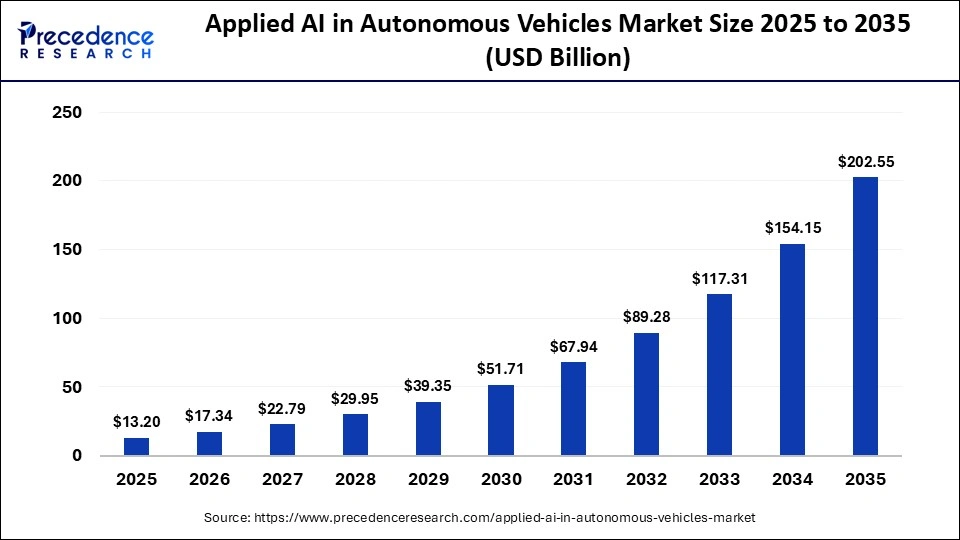
The global applied AI in autonomous vehicles market size accounted for USD 13.20 billion in 2025 and is predicted to increase from USD 17.34 billion in 2026 to approximately USD 202.55 billion by 2035, expanding at a CAGR of 31.40% from 2026 to 2035. The market is rapidly expanding due to the increasing demand for enhanced road safety, the adoption of neural networks for autonomous vehicles, and the acceleration of level 4 and 5 autonomies.
Key Takeaways
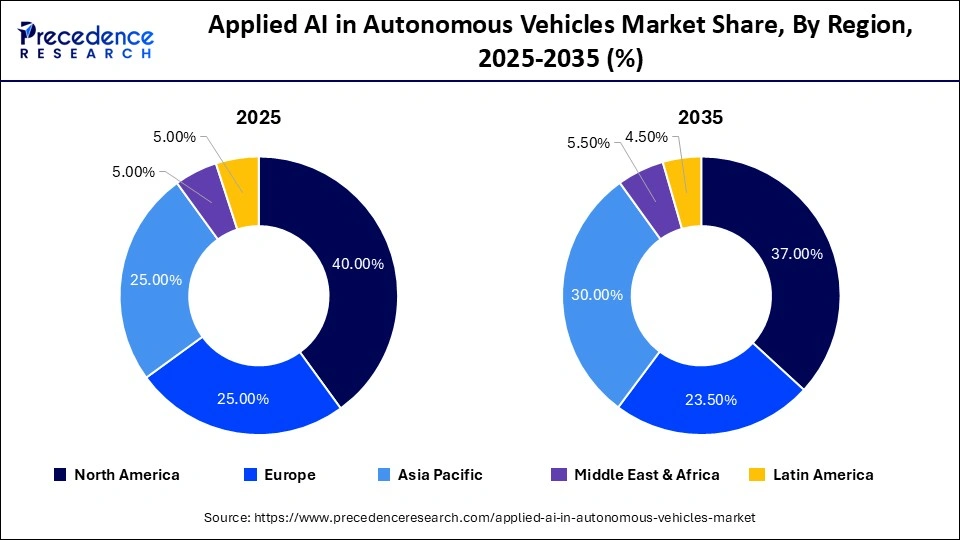
- North America held the largest market share of 40% in 2025.
- The Asia Pacific is expected to grow at the fastest CAGR during the foreseeable period of 2026-2035.
- By AI technology, the machine learning segment held the largest market share of 35% in 2025.
- By AI technology, the computer vision segment is the second-largest shareholder and is expected to grow at the fastest CAGR during the forecast period.
- By autonomous vehicle type, the level 3 (conditional automation) segment held the largest market share of 30% in 2025.
- By autonomous vehicle type, the level 2 (partial automation) segment was the second largest shareholder in 2025 and is expected to grow at a significant CAGR during the projection period.
- By application, the navigation and mapping segment held the largest market share of 30% in 2025.
- By application, the object and pedestrian detection segment was the second largest shareholder in 2025 and is expected to grow at a significant CAGR during the foreseeable period.
- By end-use, the passenger vehicles segment held the largest market share of 55% in 2025.
- By end-use, the commercial vehicles segment was the second largest shareholder in 2025 and is expected to grow at the fastest CAGR during the foreseeable period.
Market Overview
The applied AI in autonomous vehicles market deals with the integration of advanced artificial intelligence technologies like machine learning, deep learning, and computer vision. These technologies enable self-driving capabilities, improved safety, and increased operational efficiency. The market is rapidly expanding due to the increasing demand for enhanced safety features, the need to reduce human errors, and the expansion of robotaxis and autonomous logistics. The major driving factors for the market growth include technological breakthroughs in hardware and software, demand for generative AI in simulation, and government and regulatory support.
Applied AI in Autonomous Vehicles Market Trends
- The automotive industry is rapidly shifting from rule-based systems to end-to-end and unified neural networks that learn from raw sensor data, enabling better generalization, enhanced handling of rare scenarios, and highly effective decision-making.
- There is increasing adoption of edge-based AI processing within a vehicle rather than depending solely on cloud deployment. This approach helps manage redundancy and offers faster decision-making in the case of rare scenarios that may lead to catastrophic results by enabling vehicles to process huge amounts of data in real-time.
- The growing integration of AI systems in vehicles is driving the market. Applied AI is enhancing vehicle safety through predictive analytics, object detection, and advanced control systems
- The market is witnessing increasing commercial applications of AI in logistics and driver-less taxi fleets like Waymo and Baidu. It is largely driven by the growing demand for reduced operational costs and enhanced transport support.
Market Scope
| Report Coverage | Details |
| Market Size in 2025 | USD 13.20 Billion |
| Market Size in 2026 | USD 17.34 Billion |
| Market Size by 2035 | USD 202.55 Billion |
| Market Growth Rate from 2026 to 2035 | CAGR of 31.40% |
| Dominating Region | North America |
| Fastest Growing Region | Asia Pacific |
| Base Year | 2025 |
| Forecast Period | 2026 to 2035 |
| Segments Covered | AI Technology, Autonomous Vehicle Type, Application, End-Use, and Region |
| Regions Covered | North America, Europe, Asia-Pacific, Latin America, and Middle East & Africa |
Market Dynamics
Drivers
Increasing Production of Autonomous Vehicles
The market is growing rapidly due to the rising production of autonomous vehicles powered by AI systems that help reduce human error and improve road safety. Technologies such as LiDAR, cameras, and radar create 360-degree environmental models that reduce response times by around 20% and improve decision-making accuracy by nearly 15%. Additionally, the shift toward centralized high performance computing architectures enables over-the-air updates and continuous improvement of driving systems throughout a vehicle's lifecycle.
Restraint
‘Long-Tail' Problems
Despite having major benefits of applying AI in autonomous vehicles, the market is seeing some barriers in terms of technical challenges, cybersecurity risks, high implementation costs, and long-tail hurdles. Generally, AI systems may struggle with unpredictable situations such as unusual pedestrian behavior, rare traffic conditions, or extreme weather, where performance can become unreliable. Additionally, autonomous vehicles are vulnerable to hacking, which is a major cause of public hesitancy to adopt them fully, thereby restraining the market growth.
Opportunity
Expansion of Gen AI
The market presents significant opportunities with the growing use of generative AI for accelerated simulation and data augmentation, enabling AI models to learn from vast synthetic edge-case scenarios more efficiently than real-world testing alone. Additionally, rapid commercialization across applications such as shuttle services, robotaxis, and autonomous construction equipment is further driving market expansion and accelerating real-world deployment of autonomous technologies.
Segment Insights
AI Technology Insights
Applied AI in Autonomous Vehicles Market Share, By AI Technology, 2025-2035 (%)
| AI Technology | 2025 | 2035 | CAGR (%) |
| Machine Learning | 35.00% | 38.00% | 30.00% |
| Computer Vision | 30.00% | 28.00% | 32.00% |
| Deep Learning | 20.00% | 22.00% | 33.00% |
| Natural Language Processing (NLP) | 5.00% | 6.00% | 28.00% |
| Sensor Fusion and Data Analytics | 10.00% | 12.00% | 30.50% |
The Machine Learning Segment Held a 35% Market Share in 2025
The machine learning segment dominated the applied AI in autonomous vehicles market with a share of 35% in 2025. This is because machine learning plays an essential role in processing high-volume, real-time sensor data, which allows perception, prediction, and instant decision-making that outperforms conventional rule-based programming in dynamic environments. Autonomous vehicles heavily depend on machine learning models for ADAS, which are essential for full autonomy in vehicles.
The computer vision segment was the second-largest shareholder in 2025, holding a 30% share, and is projected to grow at a notable rate in the upcoming period. This is because of its ability to replicate human-like vision and provide a high-resolution, cost-effective perception system that complements other sensors such as LiDAR. Computer vision plays a critical role in identifying speed limit signs, interpreting traffic light signals, and recognizing road markings for safe and efficient autonomous driving.
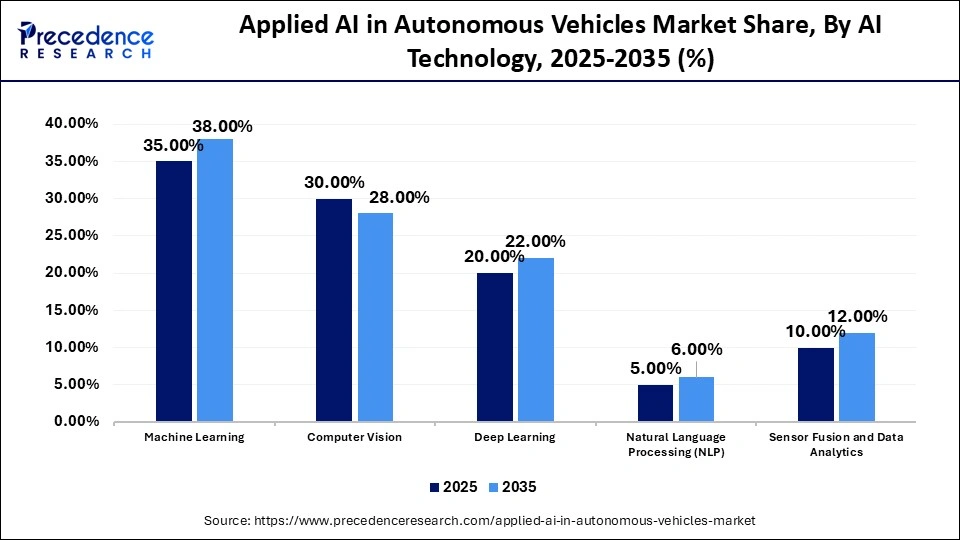
The deep learning segment held a 20% share of the market in 2025 and is expected to grow at the fastest CAGR during the forecast period. The segment's growth is attributed to its advanced data-driven capabilities, which enable it to handle the complexity and unpredictability of real-world environments more effectively than traditional rule-based algorithms.
The sensor fusion and data analytics segment held the market share of 10% in 2025 and is expected to grow at a significant CAGR between 2026 and 2035. The segment growth is driven by its ability to address key challenges related to safety, reliability, and real-time environmental perception by integrating data from multiple sensors. This technology enables a comprehensive 360-degree view of the surroundings, making it critical for automotive AI systems, while deep learning-based perception further enhances the processing of high-dimensional data from sensors such as radar and LiDAR for improved object detection, classification, and semantic segmentation.
Autonomous Vehicle Type Insights
Applied AI in Autonomous Vehicles Market Share, By Autonomous Vehicle Type, 2025-2035 (%)
| Autonomous Vehicle Type | 2025 | 2035 | CAGR (%) |
| Level 1 (Driver Assistance) | 10.00% | 8.00% | 12.00% |
| Level 2 (Partial Automation) | 25.00% | 20.00% | 20.00% |
| Level 3 (Conditional Automation) | 30.00% | 28.00% | 25.00% |
| Level 4 (High Automation) | 20.00% | 24.00% | 35.00% |
| Level 5 (Full Automation) | 15.00% | 20.00% | 40.00% |
The Level 3 (Conditional Automation) Segment Held a 30% Market Share in 2025
The level 3 (conditional automation) segment dominated the applied AI in autonomous vehicles market with a major share of 30% in 2025, as it provides a first-hand experience that allows drivers to disengage from monitoring the road during specific conditions like traffic jams. It represents the most commercially viable balance between automation and human control, allowing vehicles to handle most driving tasks while still requiring driver intervention in specific scenarios. Additionally, growing integration of advanced AI features such as perception systems, predictive analytics, and driver monitoring in Level 3 vehicles has accelerated their adoption across premium passenger cars and early autonomous mobility solutions.
The level 2 (partial automation) segment was the second-largest shareholder in 2025, holding a 25% share, and is projected to grow at a notable CAGR during the forecasted period of 2026-2035. This is mainly due to its widespread adoption in mass-market vehicles, where advanced driver-assistance systems (ADAS) such as adaptive cruise control, lane-keeping assist, and automatic braking enhance safety and driving comfort at relatively lower costs. Its rapid growth is also supported by increasing consumer demand for affordable semi-autonomous features and automakers' ability to integrate AI-enabled systems without the regulatory and technical complexities associated with higher autonomy levels.
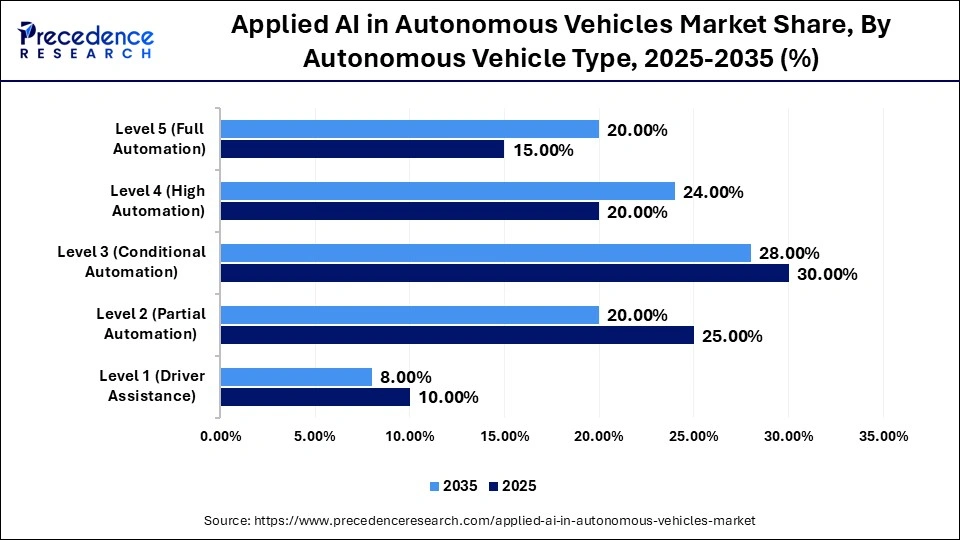
The level 4 (high automation) segment held a 20% market share in 2025 and is projected to grow at a significant CAGR in the upcoming period. This is mainly due to rapid advancements in AI, sensor fusion, and high-performance computing, which enable vehicles to operate autonomously within defined geofenced environments with minimal or no human intervention. Its growth is further driven by increasing commercial deployment in robotaxi services, autonomous shuttles, and logistics applications, where operators benefit from improved efficiency, safety, and reduced operational costs.
The level 5 (full automation) segment held the market share of 15% in 2025 and is expected to grow at the fastest CAGR during the forecast period due to continuous advancements in AI, deep learning, and sensor technologies that are gradually making fully driverless operation feasible across all environments without human intervention. Full automation is significantly growing as it is the future of autonomous vehicles. Level 5 vehicles are capable of operating without human support, driving rapid innovation and investment in the sector.
Application Insights
The Navigation and Mapping Segment Held a 30% Market Share in 2025
The navigation and mapping segment dominated the applied AI in autonomous vehicles market with a share of 30% in 2025, as AI-based navigation and mapping systems allow vehicles to recognize the road environment and make real-time decisions that ensure safety and precise navigation. It is essential for planning trajectories, predicting scenarios, and ensuring regulatory safety compliance.
The object and pedestrian detection segment was the second-largest holder, holding a 25% share in 2025, and is expected to grow at a significant CAGR during the foreseeable period of 2026-2035. The segment is growing as the object and pedestrian detection systems are the fundamental systems of safety and navigation, highlighting their crucial role in allowing a vehicle to perceive and react to its surroundings. The growing importance of safety features such as object and pedestrian detection systems in autonomous vehicles is driving the adoption of AI in this area.
Applied AI in Autonomous Vehicles Market Share, By Application, 2025-2035 (%)
| Application | 2025 | 2035 | CAGR (%) |
| Navigation and Mapping | 30.00% | 32.00% | 32.00% |
| Object and Pedestrian Detection | 25.00% | 28.00% | 31.00% |
| Path Planning and Decision Making | 20.00% | 22.00% | 35.00% |
| Driver Monitoring | 10.00% | 9.00% | 28.00% |
| Traffic Prediction and Traffic Light Recognition | 10.00% | 8.50% | 25.00% |
| Vehicle Control and Operation | 5.00% | 5.50% | 40.00% |
The path planning and decision-making segment held the market share of 20% in 2025 and is expected to grow at a notable CAGR during the foreseeable period. The segment's growth is attributed to its crucial role in transforming raw environmental data into safe and actionable tasks. It works as the brain of the vehicle that makes crucial decisions in a fraction of a second. Path planning is essential for autonomous vehicles, with AI systems continuously improving to make optimized, real-time decisions.
The driver monitoring segment held a share of 10% in 2025 and is projected to grow at a considerable rate during the projection period. The segment's growth is driven by the convergence of strict regulatory mandates, growing need for safe handover in semi-autonomous driving, and the high-volume adoption of camera-based in-cabin technology. AI-driven driver monitoring ensures safety by detecting signs of driver fatigue or distractions in vehicles with partially automated features.
End-Use Insights
Why Did the Passenger Vehicles Segment Dominated the Market in 2025?
The passenger vehicles segment dominated the applied AI in autonomous vehicles market with a share of 55% in 2025. This is primarily due to the increasing consumer demand for safety and convenience, rapid integration of advanced driver assistant systems, and huge investments from automakers in software-defined vehicles. Also, consumers seek stress-free commuting, which is driving the demand for level 3 automation driving, especially for personal cars. Also, passenger cars are the primary target for AI-driven ADAS to reduce accidents.
The commercial vehicles segment was the second-largest shareholder in 2025, holding a 20% share, and is expected to grow at a significant CAGR during the foreseeable period of 2026-2035. The segment is growing as it actively resolves the problem of labor shortages, safety issues, and compelling economic incentives. Commercial vehicles are prone to more accidents due to driver fatigue. But an AI system creates 360-degree awareness and reduces human errors that may cause accidents. Commercial vehicles, including delivery trucks and autonomous taxis, are rapidly adopting AI technologies to improve operational efficiency and reduce labor costs.
Applied AI in Autonomous Vehicles Market Share, By End-Use, 2025-2035 (%)
| End-Use | 2025 | 2035 | CAGR (%) |
| Passenger Vehicles | 55.00% | 52.00% | 20.00% |
| Commercial Vehicles | 20.00% | 21.00% | 28.00% |
| Public Transport | 15.00% | 14.00% | 23.00% |
| Freight and Logistics | 5.00% | 6.00% | 30.00% |
| Others | 5.00% | 7.00% | 32.00% |
The public transport segment held the market share of 15% in 2025 and is expected to witness notable growth during the foreseeable period. The segment is expanding due to its commercial viability, fewer regulatory hurdles in comparison with personal cars, and its major role in creating autonomous public transport in a smart city. AI-powered public transportation systems, such as autonomous buses and shuttles, are growing due to urbanization and increased demand for smart transport solutions.
The freight and logistics segment held a 5% share of the market in 2025 and is expected to witness the fastest growth during the forecast period. This is because of the rising demand for autonomous trucks and AI-driven route optimization solutions. Logistics firms are highly motivated to reduce accidents by operating them on predictable routes, driving the adoption of applied AI.
Regional Insights
North America Applied AI in Autonomous Vehicles Market Size and Growth 2026 to 2035
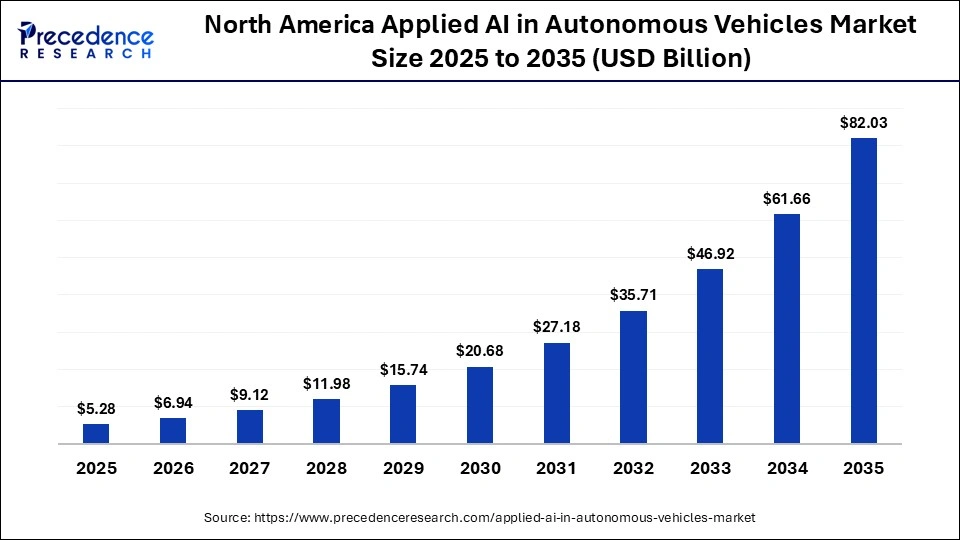
The North America applied AI in autonomous vehicles market size is estimated at USD 5.28 billion in 2025 and is projected to reach approximately USD 82.03 billion by 2035, with a 31.56% CAGR from 2026 to 2035.
North America Held the Highest Market Share of 40% in 2025.
North America dominated the applied AI in autonomous vehicles market with a share of 40% in 2025 due to strong R&D investments from leading tech companies such as Google and NVIDIA, along with a well-established autonomous vehicle testing ecosystem and supportive regulatory frameworks. The region is also home to major technology leaders like Waymo, Tesla, NVIDIA, and Microsoft, which are driving innovation in AI, machine learning, and computer vision critical for autonomous driving. Additionally, rapid commercialization through driverless ride-hailing services such as Waymo One and expanding robotaxi fleets is further strengthening regional dominance.
U.S. Applied AI in Autonomous Vehicles Market Size and Growth 2026 to 2035
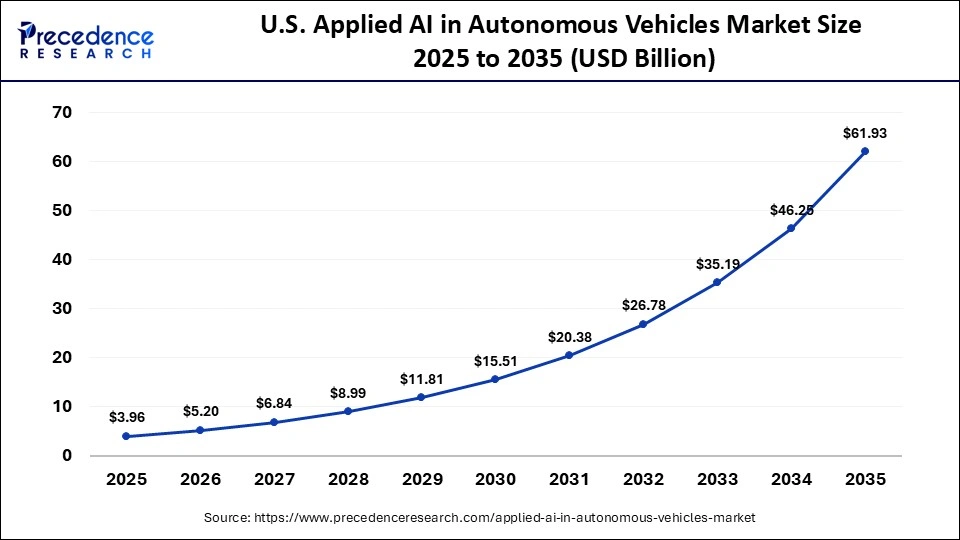
The U.S. applied AI in autonomous vehicles market size is calculated at USD 3.96 billion in 2025 and is expected to reach nearly USD 61.93 billion in 2035, accelerating at a strong CAGR of 31.65% between 2026 and 2035.
U.S. Applied AI in Autonomous Vehicles Market Analysis
The U.S. is a major contributor to the North American applied AI in autonomous vehicles market due to its early adoption of advanced technologies, a supportive regulatory environment, and substantial capital investments in AI and machine learning across industries. It serves as a global hub for AI research, where leading tech companies and collaborators are actively developing scalable Level 4 autonomous systems, including robotaxi services and long-haul autonomous trucking solutions.
Asia Pacific: The Fastest-Growing Region
Asia Pacific is expected to grow at the fastest rate in the market during the forecast period, driven by proactive government policies, rapid smart infrastructure development, and widespread 5G adoption that support AI integration in mobility systems and smart cities. Governments across the region are also heavily investing in vehicle-to-everything (V2X) communication technologies, further enabling connected and autonomous driving ecosystems. Additionally, the region's leadership in electric vehicle manufacturing and adoption provides a strong foundation for AI integration, particularly in optimizing energy efficiency and battery management systems.
China Applied AI in Autonomous Vehicles Market Analysis
China is a leading frontier in the adoption of applied AI in autonomous vehicles due to strong government support, extensive data availability, and a vertically integrated ecosystem of technology and automotive companies. The government has established nearly 20 national-level pilot zones for intelligent connected vehicles, which are accelerating the commercialization of AI-driven autonomous mobility solutions. In addition, China's advanced smart infrastructure, including 5G connectivity, intelligent traffic systems, and urban planning for connected mobility, combined with a strong domestic supply chain, is further enabling large-scale deployment of autonomous vehicle technologies.
How is the Opportunistic Rise of Europe in the Market?
Europe held a 25% share of the market in 2025 and is expected to grow at a significant CAGR during the foreseeable period of 2026-2035. The region's growth is driven by strong investments from leading automotive OEMs, strict safety regulations that encourage advanced driver-assistance technologies, and the rapid expansion of smart city infrastructure. Additionally, Europe's structured regulatory framework enables the controlled deployment of Level 4 autonomous vehicles in designated areas, supporting safer and more scalable adoption of autonomous mobility solutions.
Applied AI in Autonomous Vehicles Market Companies
- Nvidia Corporation
- Alphabet Inc.
- Intel Corporation
- Microsoft Corporation
- IBM Corporation
- Qualcomm Inc.
- Tesla Inc.
- BMW AG
- Micron Technology
- Xilinx Inc.
- Harman International Industries Inc.
- Volvo Car Corporation
- Audi AG
- General Motors Company
- Ford Motor Company
- Motor Corporation
- Honda Motor Co. Ltd.
Recent Developments
- In April 2026, Aptiv and Hyundai's venture collaboratively developed an end-to-end autonomous driving system that overrides the traditional system of autonomous driving technology. It offers ML-based end-to-end motion planning that integrates multiple steps into a single learned decision process.(Source: https://aimagazine.com)
- In April 2026, Cygn reported ongoing commercial expansion as industrial AI adoption inclined towards scaled deployment across industrial operations instead of isolated pilots. The company has improved bookings and raised deployments with leading marketers like G&J Pepsi and Coasts, and extended its reach to sectors like agriculture via Chandler Automation.
Segments Covered in the Report
By AI Technology
- Computer Vision
- Machine Learning
- Deep Learning
- Natural Language Processing (NLP)
- Sensor Fusion and Data Analytics
By Autonomous Vehicle Type
- Level 1 (Driver Assistance)
- Level 2 (Partial Automation)
- Level 3 (Conditional Automation)
- Level 4 (High Automation)
- Level 5 (Full Automation)
By Application
- Navigation and Mapping
- Object and Pedestrian Detection
- Path Planning and Decision Making
- Driver Monitoring
- Traffic Prediction and Traffic Light Recognition
- Vehicle Control and Operation
- Others
By End-Use
- Passenger Vehicles
- Commercial Vehicles
- Public Transport
- Freight and Logistics
- Other
By Region
- North America
- Latin America
- Europe
- Asia-pacific
- Middle and East Africa
For inquiries regarding discounts, bulk purchases, or customization requests, please contact us at sales@precedenceresearch.com
Frequently Asked Questions





Ask For Sample
No cookie-cutter, only authentic analysis – take the 1st step to become a Precedence Research client
 Get a Sample




 sales@precedenceresearch.com
 Schedule a Meeting
