



US Bone Grafts and Substitutes Market Size, Share and Trends 2026 to 2035
US Bone Grafts and Substitutes Market (By Material: Allograft, Synthetic; By End User: Hospital, Specialty Clinics, Others) - Industry Analysis, Size, Trends, Leading Companies, Regional Outlook, and Forecast 2026 to 2035
 Get a Sample
 Table Of Content


US Bone Grafts and Substitutes Market Size and Forecast 2026 to 2035
The US bone grafts and substitutes market size accounted for USD 1.31 billion in 2025 and is predicted to increase from USD 01.38 billion in 2026 to approximately USD 2.25 billion by 2035, expanding at a CAGR of 5.56% from 2026 to 2035. Market growth is driven by the increasing prevalence of orthopedic disorders, rising sports injuries, a growing aging population, and expanding demand for minimally invasive surgical procedures.
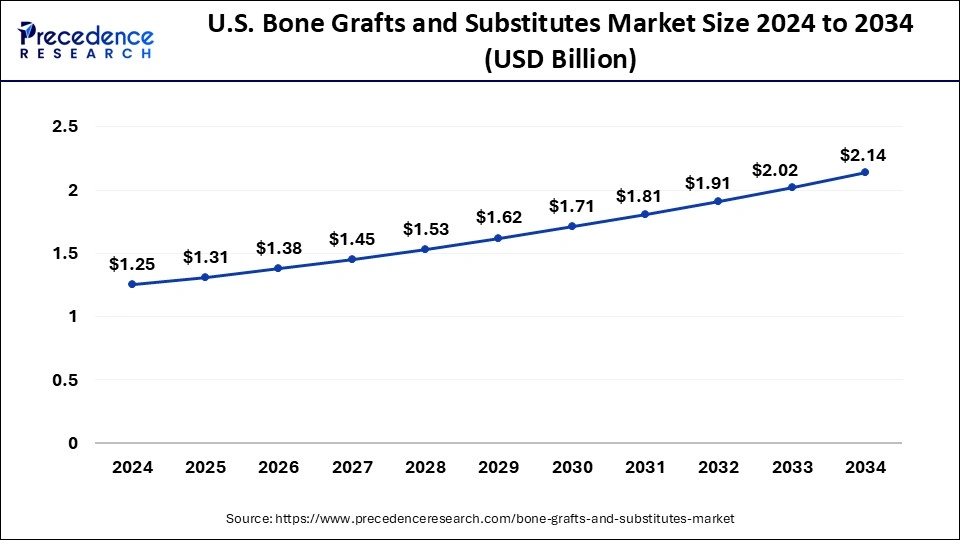
Key Takeaways
- By material, the allograft segment held the largest market share in 2025.
- By material, the synthetic segment is expected to expand with the highest CAGR during the forecast period.
- By end-user, the hospitals segment held the highest share of the market in 2025.
- By end-user, the specialty clinics segment is expected to grow with the highest CAGR during the forecast period.
Market Overview
The U.S. bone grafts and substitutes market refers to medical products that can fix or rebuild bones and is made up of both biological and synthetic items that have been damaged during an orthopedic procedure or spine fusion, affected by trauma, or reconstruction. These items include the following: allografts; autografts, demineralized bone matrix, and advanced synthetic substitutes to aid in bone healing and support the structural rebuilding of bones. The market is seeing an ongoing annual increase, mainly due to the increased prevalence of osteoporosis, degenerative disease (spinal), fractures, those who participate in sports, and osteoporosis due to aging.
An increase in the number of orthopedic procedures and dental implants, and the increasing use of minimally invasive procedures, are additional factors that are increasing demand. Continuous improvement in the biomaterial industry, regenerative medicine, and bioactive synthetic grafts will also result in better clinical results, which will create additional areas where this can be used, resulting in ongoing growth in the U.S. market.
AI Revolutionizing Precision and Innovation in the U.S. Bone Grafts and Substitutes Sector
The use of artificial intelligence is revolutionizing the U.S. bone grafts and substitutes sector by improving the design, manufacturing, surgical planning, and outcome prediction for these products. Using AI analytics allows manufacturers to develop and test new biomaterials, better match grafts to patients, and achieve quicker research and development cycles.
Machine learning algorithms also improve the way individual patients are treated through data analysis of each patient, so that potential problems are reduced and recovery times improved. As more healthcare providers adopt digital technology, AI will continue to facilitate innovation, streamline operational efficiency, and enhance precision for surgeries that involve bone regeneration and reconstruction.
U.S. Bone Grafts and Substitutes Market Trends
- Increasing Volume of Orthopaedic Procedures: The number of spinal fusions, fracture repairs, and reconstructive surgeries to joints has greatly increased in the U.S., which has caused an increase in demand for both bone grafts and substitutes for orthopaedic applications.
- Increased Acceptance of Synthetic Grafts: Providers are using synthetic graft materials for bone grafting more frequently than they have in the past, since they provide much more predictable results than natural graft tissues, and they reduce infection risks and allow for much better availability than traditional sources of graft materials.
- Need for Bone Healing: Improved results in bone healing promote the use of innovation through regenerative medicine advances; developments in biomaterials, tissue engineering, and biologically active graft substitutes are resulting in improved outcomes for patients undergoing surgery to produce new bone formation.
- Quality Assurance: Quality assurance based on the presence of advanced health care facilities, acceptance by health care providers of orthopaedic procedures for many types of surgery, and existing regulatory requirements to ensure product quality and safety is a supportive factor for the market growth.
Market Report Coverage and Key Metrics
| Report Coverage | Details |
| Global Market Size in 2025 | USD 1.31 Billion |
| Global Market Size in 2026 | USD 01.38 Billion |
| Global Market Size by 2035 | USD 2.25 Billion |
| Growth Rate from 2026 to 2035 | CAGR of 5.56% |
| Base Year | 2025 |
| Forecast Period | 2026 to 2035 |
| Segments Covered | Material, and End User |
Market Dynamics
Drivers
Increase in Orthopedic and Spinal Procedures
Increasing levels of orthopedic surgical interventions and spinal fusion procedures have led to a greater demand for bone grafts and substitutes needed to support bone regeneration, improve success rates in surgical procedures, and help address the growing incidence of musculoskeletal dysfunction.
Restraint
Cost of Treatment and Products
The expense associated with advanced bone graft materials and substitutes continues to be a major hindrance to this marketplace, as the use of premium biologics and/or synthetic grafts will drive up overall procedure costs, provide obstacles to the adoption of such products within a cost-conscious delivery system, and create reimbursement issues for both providers and patients.
Opportunity
Growth of Regenerative Biomaterials
The emergence of innovative regenerative medicine technologies combined with advances in biomaterials science will create tremendous opportunities for growth within the market. The development of next-generation synthetic grafts, products containing growth factors, and tissue-engineered solutions is anticipated to enhance the healing process for individuals undergoing procedures related to bone and expand the available applications for physicians performing such procedures at their healthcare facility.
Market Segmentation Analysis
Material insights
Which Material Segment Dominated the U.S. Bone Grafts and Substitutes Market?
The allograft segment accounted for the largest market share in 2025. This is due to the large volume of allografts used throughout the world; their proven clinical efficacy in a variety of procedures; their wide range of forms (e.g., freeze-dried and fresh-frozen); and their ability to help replace bone by providing a matrix for natural bone regeneration. There has been extensive use of allografts in orthopedic, spinal, and dental procedures, which has helped increase their continued leadership in the market.
The synthetic segment is expected to grow with the highest CAGR in the market during the studied years, due to continuing advancements in biomaterials, reduced risk of disease transmission associated with synthetic grafts, and their increased customization capabilities. The growing preference for engineered bone graft substitutes by surgeons and patients is also driving the growth of synthetic grafts in a variety of surgical applications.
End User Insights
Why Did the Hospital Segment Dominate the U.S. Bone Grafts and Substitutes Market?
The hospital segment contributed the highest market share in 2025, primarily because of its large volume of patients treated, its advanced surgical infrastructure, and its ability to offer specialized surgical services in the area of orthopedic and trauma care. The continued growth of bone reconstruction and spinal surgeries has been a significant factor in the dominance of this market segment.
The specialty clinics segment is expected to expand rapidly in the market in the coming years due to the increased demand for outpatient procedures, a decreasing length of surgical procedures, and the ability to provide cost-effective care. In addition, specialty clinics now have greater access to specialized services in the area of orthopedic and dental services, which is contributing to increased patient preference for these outpatient services.
Market Competitive Landscape: Leading Companies and Strategies
The U.S. bone grafts and substitutes market is moderately covered by a mix of major medical device manufacturers and specialized bio-materials companies that leverage product innovation, clinical results, and surgeon adoption to compete against one another. The strong regulatory requirements impose moderate barriers on new companies entering into the marketplace, while major established distribution channels create high barriers in terms of gaining market share for those that have yet to enter into the bone grafts market.
Some leading companies involved in the bone grafts/substitutes have established significant market positions by leveraging their wide product lines, far-reaching distribution channels, and cutting-edge bio-material technologies. Competition typically consists of acquisitions, strategic alliances, product launches, and investments in regenerative medicine. High cost of R&D, the need for intellectual property protection, and the need to meet rigorous FDA regulatory requirements will limit the number of new competitors entering the bone graft market. Future competition is anticipated to intensify within the marketplace as companies develop next-generation synthetic and biologic grafts to increase their overall market share.
U.S. Bone Grafts and Substitutes Market Companies
- SeaSpine
- AlloSource
- Bioventus
- DePuy Synthes Companies (Johnson & Johnson Services, Inc.)
- Stryker
- Zimmer Biomet
- MTF Biologics
- Orthofix Holdings, Inc.
Recent Developments in the U.S. Bone Grafts and Substitutes Market (2025-2026)
- In June 2025, Cerapedics received U.S. FDA approval for PearlMatrix™ P-15 Peptide Enhanced Bone Graft, the first proven bone growth accelerator for lumbar fusion, demonstrating superior fusion speed and clinical outcomes in spinal surgery patients. (Source: https://www.prnewswire.com)
- In October 2025, Aurora Spine launched its new Aurora Biologics division and biologics portfolio, integrating regenerative bone graft solutions with its spinal implant systems to enhance fusion success, surgical efficiency, and long-term patient outcomes. (Source: https://orthospinenews.com)
Segments Covered in the Report
By Material
- Allograft
- Demineralized Bone Matrix
- Others
- Synthetic
- Ceramics
- HAP
- β-TCP
- α-TCP
- Bi-phasic Calcium Phosphates (BCP)
- Others
- Composites
- Polymers
- Bone Morphogenic Proteins (BMP)
- Ceramics
By End User
- Hospital
- Specialty Clinics
- Others
For inquiries regarding discounts, bulk purchases, or customization requests, please contact us at sales@precedenceresearch.com
Frequently Asked Questions





Ask For Sample
No cookie-cutter, only authentic analysis – take the 1st step to become a Precedence Research client




 sales@precedenceresearch.com
 Schedule a Meeting



