



US CAR T-Cell Therapy Market Size, Share and Trends 2026 to 2035
US CAR T-Cell Therapy Market (By Product: Abecma (idecabtagene vicleucel), Breyanzi (lisocabtagene maraleucel), Carvykti (ciltacabtagene autoleucel), Kymriah (tisagenlecleucel), Tecartus (brexucabtagene autoleucel), Yescarta (axicabtagene ciloleucel), Others; By Disease Indication: Leukemia, Lymphoma, Multiple Myeloma, Others; By End-Use: Hospitals, Cancer Treatment Centers) - Industry Analysis, Size, Trends, Leading Companies, Regional Outlook, and Forecast 2026 to 2035
 Get a Sample
 Table Of Content


What is the US CAR T-Cell Therapy Market Size in 2026?
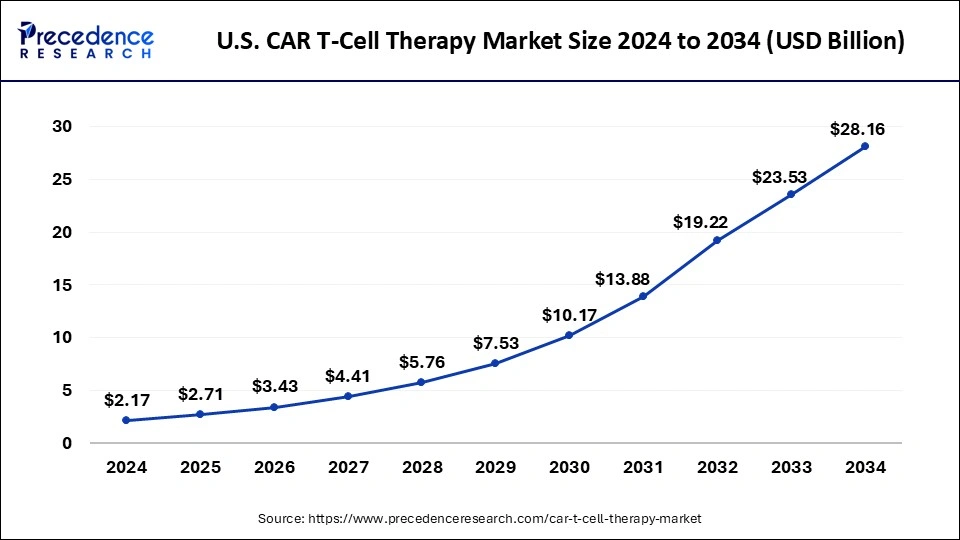
The US CAR T-cell therapy market size accounted for USD 2,299.97 million in 2025 and is predicted to increase from USD 2,684.84 million in 2026 to approximately USD 11,510.04 million by 2035, expanding at a CAGR of 17.47% from 2026 to 2035. The market is expanding rapidly due to increasing cancer incidence, growing adoption of personalized medicine, and continuous FDA approvals for new indications and products.
Key Takeaways
- By product, the Yescarta segment contributed the largest market share in 2025.
- By product, the Carvykti segment is anticipated to experience substantial growth in the market during the forecasted period.
- By disease indication, the lymphoma segment held the largest market share in 2025.
- By disease indication, the multiple myeloma segment is expected to expand at the highest CAGR from 2026 to 2035.
- By end-use, the hospital segment contributed the biggest market share in 2025.
- By end-use, the cancer treatment centers segment is expected to be the fastest-growing segment over the studied period.
Market Overview
The U.S. CAR T-cell therapy market involves taking a patient's T cells and modifying them genetically to identify and eliminate malignant tumor cells. CAR T-cell therapeutics have shown great success in clinical trials for the treatment of hematologic malignancies, such as leukemia, lymphoma, and multiple myeloma. This has driven their widespread use at specialized cancer treatment centers in the U.S. There are several factors contributing to the strong growth of the market, including an increasing number of FDA approvals for CAR T-cell therapies, expanding indications for their use in treating patients, rising amounts of investment in research for cell and gene therapies, and new advances in technology related to their manufacture.
In addition, increasing regulatory support for the development of CAR T-cell therapies and an increasing body of evidence supporting the long-term benefits of these therapies for patients are contributing to the continued growth of the market. Healthcare providers continue to adopt more personalized treatment options for patients with cancer, which will create additional demand for CAR T-cell therapies across the oncology landscape in the U.S.
How is AI Transforming the U.S. CAR T-Cell Therapies Market?
AI is playing an increasingly important role in the development of CAR T-cell therapies in the U.S., from the early stages of development and manufacturing to patient management. Using AI-driven analytics, researchers can identify which antigens are the best targets for therapy, predict how patients will respond to treatment, and create more efficient clinical trial designs; all of these factors can lead to shorter development timelines for CAR T-cell therapies.
Machine learning algorithms are being used to assist with quality control and process optimization in the manufacturing of CAR T-cell therapies, leading to more consistent production of these personalized cell therapies. As the demand for precision oncology solutions continues to grow, the integration of AI into the CAR T-cell therapy development process will help to accelerate the pace of innovation, improve the rates of successful treatment outcomes, and further commercialize CAR T-cell therapies throughout the United States.
U.S. CAR T-Cell Therapy Market Trends
- The U.S. is the predominant market for CAR T-cell treatments worldwide. The increased adoption rate of personalized cancer therapies is attributed to an expansive biotech ecosystem, ongoing and intensive clinical trials, and a rapid escalation of CAR T-cell therapy use throughout top cancer treatment centers.
- Ongoing pharmaceutical approvals and amendments to the labelling of CAR T-cell products are increasing the number of eligible patients with new cancer indications such as leukemia, lymphoma, and multiple myeloma.
- Manufacturing capacity expansion and accessibility have become a focus of innovators, manufacturers, and healthcare systems to address problems in production and provide patients with improved access to therapeutics.
- Given that there is strong evidence that CAR T-cell therapies provide superior clinical outcomes, the high costs and difficulties in obtaining reimbursement will hinder broader uptake of these therapies while driving manufacturers toward the development of more cost-effective and scalable CAR T-cell products.
- Recent initiatives by the FDA to facilitate the development of gene and cell therapies will enhance innovation, lower product development timelines, and ultimately contribute to the future growth of the CAR T-cell economy.
Market Report Coverage and Key Metrics
| Report Coverage | Details |
| Market Size in 2025 | USD 2,299.97 Million |
| Market Size in 2026 | USD 2,684.84 Million |
| Market Size by 2035 | USD 11,510.04 Million |
| Market Growth Rate from 2026 to 2035 | CAGR of 17.47% |
| Base Year | 2025 |
| Forecast Period | 2026 to 2035 |
| Segments Covered | Product, Disease Indication, and End-Use |
Market Dynamics
Drivers
Increasing Adoption of Personalized Cancer Treatments
As an increasing number of people are opting for personalized medicine, the market is expected to grow rapidly. Using CAR T-cell therapies provides targeted treatment of hematologic cancers that can lead to improved patient outcomes and increased survival rates. There has been a continual increase in the approval of these therapies, the success rate of clinical trials, and physician confidence, which will lead to growing usage among oncology centers.
Restraint
High Costs of Treatment and Manufacturing
The market for CAR T-cell therapies faces challenges largely due to the expense of the therapies and the complexity of manufacturing them. The costs related to collecting cells, genetically modifying them, hospitalization, and monitoring after treatment will limit access. Hence, this creates challenges related to reimbursement and affordability for both the healthcare provider and the patient.
Opportunity
Expansion into Solid Tumor Applications
There is a significant opportunity to develop new CAR T-cell therapies for use in solid tumors. Much research is currently underway regarding overcoming the barriers presented by the solid tumors' microenvironment and increasing the efficacy of the therapies. Successful expansion of CAR T-cell therapies into areas other than hematologic cancers could lead to a significant increase in the eligible patient population and create a number of new commercial opportunities for manufacturers.
Market Segmentation Analysis
Product Insights
Why Did the Yescarta Segment Dominate the U.S. CAR T-Cell Therapy Market?
The Yescarta segment held the largest market share in 2025, due to strong adoption of this therapy for the treatment of relapsed/refractory lymphoma patients, increased clinical evidence supporting its use, physician acceptance of Yescarta, and its use with current treatment infrastructures established at large clinical centers across America.
The Carvykti segment is expected to experience significant growth in the market because of the high level of clinical outcomes achieved in patients treated with multiple myeloma, an increasing number of regulatory approvals, high physician confidence, and an increasing need for advanced cellular therapies to provide long-term durable responses.
Disease Indication Insights
Which Disease Indication Segment Dominated the U.S. CAR T-Cell Therapy Market?
The lymphoma segment dominated the market in 2025, as multiple CAR T-cell products have been approved and utilized on lymphoma patients. There is an extremely large patient population for re-treatment, and lymphoma patients have experienced very high clinical success rates from CAR T-cell therapy.
The multiple myeloma segment is expected to witness the fastest growth in the market over the forecast period, due to the increased utilization of next-generation CAR T-cell products, the increasing number of specialists in this disease area, the very positive clinical outcomes from CAR T-cell therapy, and the decreasing number of patients who qualify for CAR T-cell treatment.
End-Use Insights
Which End-Use Segment Dominated the U.S. CAR T-Cell Therapy Market?
The hospital segment contributed the biggest market share in 2025, due to the presence of specialized infrastructure, multi-disciplinary treatment teams (physicians/nurses/pharmacists), advanced monitoring equipment, and accreditation needs.
The cancer treatment centers segment is expected to show the fastest growth over the forecast period, as investment into cellular therapy programs grows, referral of more patients, adding more oncology services, and making advanced treatments easier for people to access.
Competitive Analysis
The U.S. CAR T-cell therapy market is relatively concentrated, limiting the number of approved drugs available and creating high barriers to entry due to strict regulations, complex processes for producing CAR T cells, and large amounts of money required to start a company. Large biotech and pharmaceutical companies are competing aggressively to expand their cancer drug offerings.
Some of the major companies that are active in the CAR T-cell therapy space include Novartis, Gilead, Johnson & Johnson, and Bristol Myers Squibb, which are well-positioned because they have therapies already on the market, have many ongoing clinical trials, can manufacture CAR T-cell drugs, and have partnership agreements with various providers.
There are many different factors affecting the competition in this market, including the frequency of new product launches, the number of ongoing clinical trials being developed, how many new collaborations or acquisitions are taking place, and how much money is being invested into the next generation of CAR T technology to treat solid tumors and to have a better safety profile. Ongoing high R&D costs, patents, and regulatory issues against new entrants make it difficult for new companies to enter this market; however, continued development of new products and innovative research will create new market leaders going into the future.
Top Companies in the US CAR T-cell Therapy Market
- Bristol-Myers Squibb Company
- Novartis AG
- Gilead Sciences, Inc.
- Johnson & Johnson Services, Inc.
- JW Therapeutics (Shanghai) Co., Ltd.
- bluebird bio, Inc.
- Merck & Co., Inc.
- Sangamo Therapeutics
- Sorrento Therapeutics, Inc.
- GSK plc.
Recent Developments US CAR T-cell Therapy Market (2025-2026)
- In April 2026, the NexTGen program launched the world's largest CAR-T cell trial for children and young people with relapsed or refractory solid tumors across the U.S. and U.K., aiming to expand treatment options for difficult-to-treat pediatric cancers.(Source: https://www.curetoday.com)
- In February 2026, Lyell Immunopharma initiated patient dosing in the Phase 3 PiNACLE–H2H trial, the first head-to-head randomized CAR T-cell study comparing ronde-cel with approved CAR-T therapies in aggressive large B-cell lymphoma.(Source: https://www.globenewswire.com)
Segments Covered in the Report
By Product
- Abecma (idecabtagene vicleucel)
- Breyanzi (lisocabtagene maraleucel)
- Carvykti (ciltacabtagene autoleucel)
- Kymriah (tisagenlecleucel)
- Tecartus (brexucabtagene autoleucel)
- Yescarta (axicabtagene ciloleucel)
- Others
By Disease Indication
- Leukemia
- Lymphoma
- Multiple Myeloma
- Others
By End-Use
- Hospitals
- Cancer Treatment Centers
For inquiries regarding discounts, bulk purchases, or customization requests, please contact us at sales@precedenceresearch.com
Frequently Asked Questions





Ask For Sample
No cookie-cutter, only authentic analysis – take the 1st step to become a Precedence Research client




 sales@precedenceresearch.com
 Schedule a Meeting



