



U.S. Perfusion System Market Size, Companies, Share, Patient Volume, Treatment Adoption Rates, Pricing Analysis, Regulatory Landscape, Competitive Positioning, and Demand Forecast
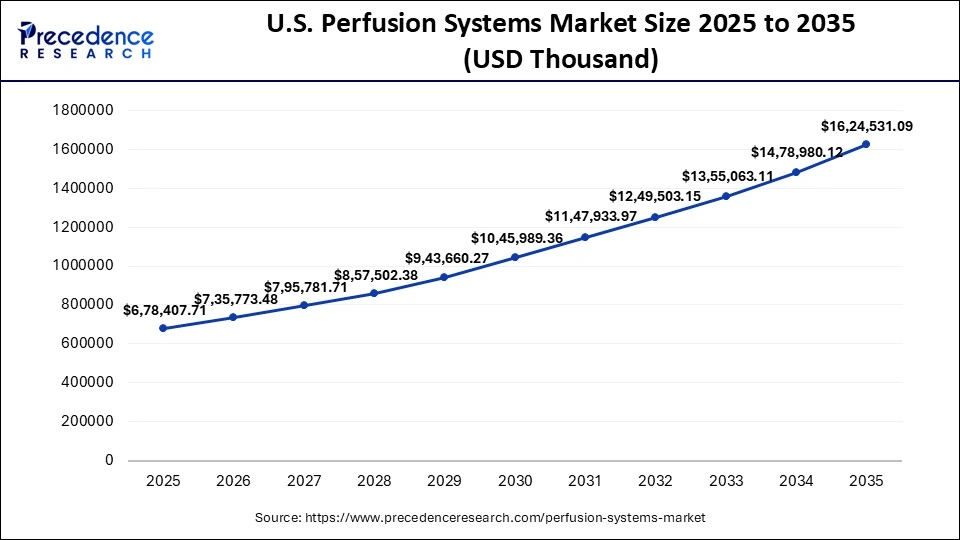
Rohan Patil, a Healthcare Industry Expert, highlights that the U.S. perfusion system market has reached USD 7,35,773.48 thousand in 2026 and is on track to reach USD 16,24,531.09 thousand by 2035, advancing at a CAGR of 9.20%. Key U.S. perfusion system market companies shaping the market include Medtronic plc, Getinge AB, LivaNova PLC, while major growth segments span By System Type - Hardware Only, By Component Type - Hardware Only, By End-use Industry, By Automation Level.
Source: https://www.precedenceresearch.com/us-perfusion-system-market
 Get a Sample
 Table Of Content


What is the U.S. Perfusion System Market Size in 2026?
The U.S. perfusion system market size accounted for USD 6,78,407.71 thousand in 2025 and is predicted to increase from USD 7,35,773.48 thousand in 2026 to approximately USD 16,24,531.09 thousand by 2035, expanding at a CAGR of 9.20% from 2026 to 2035. The market is witnessing substantial growth due to the increasing prevalence of cardiovascular diseases, an aging population, and a surge in complex cardiothoracic and organ transplant surgeries.
Key Takeaways
- By component, the disposables and consumables segment held the highest market share in 2025.
- By component, the services and maintenance segment is poised to grow at a healthy CAGR between 2026 and 2035.
- By system type, the cardiopulmonary perfusion segment held the biggest market share in 2025.
- By system type, the ex-vivo organ perfusion systems segment is expected to expand at the fastest CAGR between 2026 and 2035.
- By component type, the pumps segment accounted for the largest market share in 2025.
- By component type, the sensors & monitoring modules segment is projected to grow at a solid CAGR between 2026 and 2035.
- By end-use industry, the hospitals-cardiac surgery segment contributed the highest market share in 2025.
- By end-use industry, the transplant centers / organ preservation segment is expected to grow at a strong CAGR between 2026 and 2035.
- By automation level, the manual perfusion systems segment held a major market share in 2025.
- By automation level, the fully automated & closed-system perfusion segment is expected to expand at a notable CAGR from 2026 to 2035.
Market Overview
The U.S. perfusion system market includes medical devices designed to replicate the natural functioning of organs by circulating oxygenated blood and nutrient fluids throughout the body. A perfusion system is an extracorporeal medical device used to maintain the viability of tissues or organs, taking over organ functions during critical medical procedures. The market is driven by advancements in healthcare infrastructure and an increasing volume of complex surgeries, owing to the high prevalence of heart failure, coronary artery diseases, and organ transplants.
How is AI transforming the U.S. Perfusion System Market?
Artificial intelligence (AI) is transforming the market into an essential clinical aid that enhances decision support, automates routine tasks, and provides real-time monitoring during complex procedures. AI algorithms analyze vast amounts of perioperative data in real-time, helping to identify potential complications before they become critical. Additionally, AI assists perfusionists by predicting risks, optimizing blood flow, and improving organ preservation. AI-driven platforms continuously provide real-time data on parameters like oxygen consumption and metabolic activity.
- For instance, in January 2026, the U.S. FDA granted De Novo clearance for Bridge to Life's VitaSmart Hypothermic Oxygenated Perfusion (HOPE) System, marking it as the first cleared device of its kind for liver transplants in the U.S. and establishing a new regulatory classification.
Market Scope
| Report Coverage | Details |
| Market Size in 2025 | USD 6,78,407.71 Thousand |
| Market Size in 2026 | USD 7,35,773.48 Thousand |
| Market Size by 2035 | USD 16,24,531.09 Thousand |
| Market Growth Rate from 2026 to 2035 | CAGR of 9.20% |
| Base Year | 2025 |
| Forecast Period | 2026 to 2035 |
| Segments Covered | Component, System Type, Component Type, End-use Industry, and Automation Level |
Market Dynamics
Drivers
Rising Prevalence of Cardiovascular and End-Stage Organ Failure
The growing burden of chronic cardiovascular conditions, coupled with an aging population, is driving sustained demand for cardiopulmonary and extracorporeal perfusion systems. With complex open-heart surgeries and heart failure interventions performed, advanced heart-lung machines and ECMO devices are indispensable clinical tools. This demand is further amplified by ongoing advancements in perfusion technology that enhance device reliability and improve patient survival rates.
Restraint
High Costs, Regulatory Stringency, and Perfusionist Shortages
Market growth is constrained by the high acquisition and maintenance costs of advanced perfusion equipment, as well as the expenses associated with single-use disposable circuits. Smaller healthcare facilities often face financial barriers to adoption, while stringent regulatory requirements and a shortage of skilled perfusionists further limit market expansion and operational capacity.
Opportunity
Growing Adoption of Machine Perfusion in Organ Transplantation
Machine perfusion technologies are transforming organ transplantation by enabling continuous preservation and real-time assessment of donor organs outside the body. These systems extend organ viability, reduce discard rates, and improve transplant outcomes, particularly for marginal donor organs. Supportive reimbursement policies and increasing regulatory approvals for machine perfusion platforms are expected to expand the donor pool and create significant growth opportunities for the market.
How Are Government Initiatives Supporting the U.S. Perfusion System Market?
Government initiatives are playing a significant role in driving the U.S. perfusion system market by increasing federal investments in organ transplantation research, facilitating FDA approvals of advanced preservation devices, and expanding Medicare reimbursements for procedures such as mechanical thrombectomy and myocardial perfusion imaging. Federal policies and public health mandates continually promote organ donation and the adoption of innovative ex vivo perfusion technologies.
- For instance, FDA approvals of machine perfusion devices enable medical teams to extend the geographical reach of organ procurement, addressing the critical shortage of viable organs.
Segment Insights
Component Insights
The disposables and consumables segment dominated the U.S. perfusion system market in 2025, primarily due to their essential single-use nature and the consistent volume of cardiopulmonary and organ transplant procedures. Strict U.S. regulations and a strong focus on preventing cross-contamination make single-use disposables crucial for patient safety. Additionally, the rising prevalence of cardiovascular diseases contributes to a continuous stream of surgeries, such as coronary artery bypass grafting and valve replacements, ensuring a steady demand in the market.
The services and maintenance segment is expected to experience the fastest growth during the forecast period. This is mainly due to the complexity of the equipment, a shortage of trained technicians, and strict safety regulations. Cardiopulmonary bypass machines, with their intricate electronic and mechanical components, require routine specialized calibration to function correctly during critical surgeries. Healthcare facilities must adhere to rigorous guidelines to ensure patient safety, avoid severe liability issues, and maintain compliance.
System Type Insights
The cardiopulmonary perfusion segment held a dominant position in the U.S. perfusion system market in 2025, driven by the growing elderly population, rising prevalence of cardiovascular and respiratory diseases, and increasing volume of cardiac surgeries and heart-lung bypass procedures. These systems are indispensable for open-heart surgeries, coronary artery bypass grafting, and heart-lung transplantation, while continued FDA clearances and technological advancements are improving device safety, efficiency, and clinical outcomes.
The ex-vivo organ perfusion systems segment is expected to grow at the fastest rate during the forecast period due to its ability to extend organ preservation times, improve utilization of marginal donor organs, and expand the available donor pool. Growing adoption of hypothermic and subnormothermic perfusion technologies, supported by new regulatory approvals, is enabling transplant centers to better assess, preserve, and rehabilitate donor organs, thereby enhancing transplant success rates and driving segment growth.
Component Type insights
The pumps segment led the market in 2025 due to their critical role in open-heart surgeries, ECMO procedures, and organ transplantation. This growth is also driven by a continuous increase in the prevalence of cardiovascular diseases and the rising number of transplant procedures. Industry leaders are constantly launching advanced, smart centrifugal and roller pumps that minimize blood trauma, offer more precise flow control, and integrate seamlessly with real-time monitoring systems, which support the growth of ex vivo machine perfusion.
The sensors & monitoring modules segment is projected to expand at the fastest CAGR during the forecast period. This is primarily due to the rise in complex cardiac surgeries, the integration of real-time analytics, and the increasing demand for automated, highly precise single-use sensor arrays. Modern perfusion workflows increasingly rely on sensor modules that track crucial vital signs, providing continuous, automatic alerts to surgeons and perfusionists, thereby necessitating sophisticated and accurate monitoring hardware.
End-Use Industry Insights
The hospitals-cardiac surgery segment led the U.S. perfusion systems market with a major share in 2025, driven by a large patient pool, the integration of advanced and portable cardiopulmonary systems, and the need for specialized surgical infrastructure. Hospitals have the robust capital resources, critical care units, and clinical expertise required to operate and maintain sophisticated, real-time perfusion monitoring systems, along with integrating portable and compact systems for more complex surgeries and on-site support.
The transplant centers segment is expected to experience the fastest growth during the forecast period, driven by the increasing number of patients requiring organ transplantation and the persistent shortage of donor organs, which is driving demand for advanced organ preservation technologies. Additionally, the rising adoption of machine perfusion systems to extend organ viability, improve transplant success rates, and enable the use of marginal donor organs is accelerating growth in transplant centers.
Automation Level Insights
The manual perfusion systems segment held the largest share of the U.S. perfusion system market in 2025, driven by the high volume of procedures requiring cardiopulmonary bypass, including open-heart surgeries, coronary artery bypass grafting, and heart valve replacement procedures. Strong clinical familiarity, established hospital infrastructure, and continued demand for manual and semi-automated systems have supported the segment's leadership. Moreover, manufacturers are increasingly incorporating automation features to improve efficiency and safety.
The fully automated, closed-system perfusion segment is expected to grow at the fastest rate during the forecast period due to its ability to reduce contamination risks, lower labor requirements, and support compliance with stringent regulatory standards. Growing adoption in cell therapy manufacturing and ex-vivo organ preservation, along with advances in closed-loop normothermic perfusion technologies that enhance donor organ utilization and extend preservation times, is accelerating demand for these systems.
U.S. Perfusion System Market: Country-Level Analysis
- Immersive Cardiovascular Disease Prevalence: States with a high burden of cardiovascular diseases, such as Florida, New York, and Pennsylvania, are experiencing a significant increase in open-heart surgeries and heart transplants. This surge is directly driving the demand for advanced perfusion systems.
- Business Expansions and Manufacturing Hubs: Many industry players are rapidly increasing their production capabilities in industrial hubs like Indiana and Ohio. This effort aims to shorten supply chains and enhance the output of oxygenators and heart-lung machines.
- Opening of New Specialized Hospitals: Major hospital networks are making substantial investments in state-of-the-art cardiovascular facilities in states like Texas and Illinois. This infrastructure expansion necessitates advanced perfusion equipment to outfit new operating and intensive care rooms.
- Joint Ventures and Technological Innovation: Leading medical device companies are forming partnerships with regional biotech innovators in Massachusetts and California to develop next-generation, AI-integrated perfusion systems that aim to improve patient outcomes during complex surgeries.
- Government Healthcare Initiatives and Investments: Federal and state health organizations are investing heavily in medical technology development, which greatly benefits academic medical centers and research hubs located in Maryland and North Carolina.
- Strict U.S. FDA Regulatory Approvals: The U.S. FDA is actively streamlining and overseeing the regulatory clearance of new perfusion devices, ensuring that life-saving cardiopulmonary equipment meets stringent quality standards before being commercially released across the country.
- Conducting Rigorous Clinical Trials: Pharmaceutical and medical device companies are collaborating with hospitals in Minnesota and Tennessee to conduct clinical trials, assessing the safety and efficacy of novel perfusion protocols.
U.S. Perfusion System Market Value Chain Analysis
- Research and Development
It focuses on designing next-generation cardiopulmonary bypass equipment, ex-vivo organ perfusion, and integrating artificial intelligence for real-time monitoring.
Key Players: Medtronic, LivaNova, and TransMedics.
- Clinical Trials and Regulatory Approval
This involves human clinical evaluations to prove safety and efficacy, followed by rigorous data submission and establishing clinical superiority.
Key Players: TransMedics, LivaNova, and Getinge.
- Manufacturing
This focuses on precision, highly complex manufacturing of hardware like console and pump units, and sterile, single-use consumables under strict ISO and FDA quality control standards.
Key Players: Terumo Cardiovascular, Medtronic, and Spectrum Medical.
- Logistics and Patient Delivery
This involves specialized supply chain management to transport fragile capital equipment and time-sensitive, sterile disposables.
Key Players: FedEx Logistics, UPS Healthcare, and DHL Group.
Competitive Landscape
The U.S. perfusion system market is moderately consolidated, primarily dominated by established medical device manufacturers that focus heavily on technological innovation to capitalize on the rising rates of cardiovascular diseases and organ transplants. Key players like Medtronic, Getinge, and LivaNova are strategizing around research and development, along with strategic acquisitions to enhance their portfolios. For instance, LivaNova received FDA clearance for its Essenz Heart-Lung Machine, solidifying its position in the market.
Future opportunities for these major players lie in integrating artificial intelligence into perfusion imaging for enhanced diagnostic accuracy and developing ex-vivo organ preservation therapies. However, emerging players face significant barriers due to high upfront costs, a shortage of skilled perfusionists, and stringent regulatory and FDA compliance hurdles established by industry leaders.
U.S. Perfusion System Market Companies
- Medtronic plc
- Getinge AB
- LivaNova PLC
- Terumo Corporation
- XVIVO Perfusion AB
Recent Developments
- In May 2026, Bridge to Life Ltd announced a groundbreaking study confirming the safety and efficacy of Hypothermic Oxygenated Perfusion (HOPE) using the VitaSmart Perfusion System. The Bridge to HOPE clinical trial led to FDA de novo clearance for use with donor livers after static cold storage.(Source: https://www.prnewswire.com/)
- In May 2026, Tulyp Medical appointed Steve Motes as CEO to guide the commercialization of its pressure-driven perfusion technology for vascular procedures. This platform emphasizes maintaining vascular pressure for better tissue oxygenation and flow-based methods. Motes brings over 30 years of experience in notable companies like Medtronic and Abbott.(Source: https://www.citybiz.co)
Segments Covered in the Report
By Component
- Hardware
- Disposables/Consumables
- Services/Maintenance
By System Type - Hardware Only
- Cardiopulmonary Perfusion (Heart–Lung Machines)
- ECMO Systems
- Ex-Vivo Organ Perfusion (EVOP)
- Cell Perfusion Systems (Biopharma)
By Component Type - Hardware Only
- Perfusion Controllers & Control Units
- Pumps
- Peristaltic Pumps
- Syringe Pumps
- Tubing, Connectors, & Flow Paths
- Sensors & Monitoring Modules
- Flow Sensors
- Pressure Sensors
- Perfusion Bioreactor Vessels
- Media Reservoirs & Waste Collection Units
By End-use Industry
- Hospitals - Cardiac Surgery
- Hospitals - Critical Care / ECMO
- Transplant Centers / Organ Preservation
- Biotech / Biopharma Manufacturing
By Automation Level
- Manual Perfusion Systems
- Semi-Automated Perfusion Systems
- Fully Automated & Closed-Sysyem Perfusion Systems
For inquiries regarding discounts, bulk purchases, or customization requests, please contact us at sales@precedenceresearch.com
Frequently Asked Questions





Ask For Sample
No cookie-cutter, only authentic analysis – take the 1st step to become a Precedence Research client
 Get a Sample




 sales@precedenceresearch.com
 Schedule a Meeting
