



U.S. Pharmacy Automation Market Size, Companies, Share, Patient Volume, Treatment Adoption Rates, Pricing Analysis, Regulatory Landscape, Competitive Positioning, and Demand Forecast
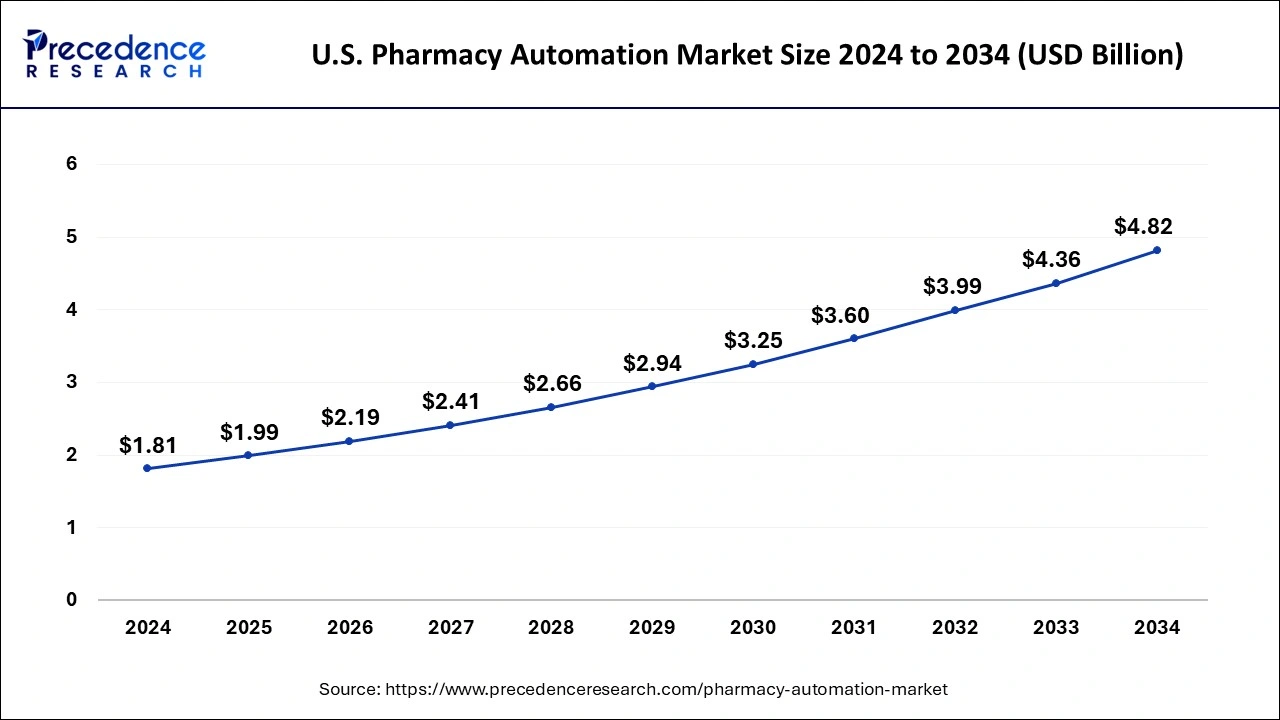
Rohan Patil, a Healthcare Industry Expert, highlights that the U.S. pharmacy automation market has reached USD 2.19 billion in 2026 and is on track to reach USD 5.22 billion by 2035, advancing at a CAGR of 10.12%. Key U.S. pharmacy automation market companies shaping the market include Touchpoint Medical, Talyst, LLC (Swisslog Healthcare), Swisslog Healthcare, Scriptpro LLC, Pearson Medical Technologies, while major growth segments span By Deployment Model, By Service Type, By Organization Size, By Industry Vertical, By Application.
Source: https://www.precedenceresearch.com/us-pharmacy-automation-market
 Get a Sample
 Table Of Content


US Pharmacy Automation Market Size and Forecast 2026 to 2035
The US pharmacy automation market size was calculated at USD 1.99 billion in 2025 and is predicted to increase from USD 2.19 billion in 2026 to approximately USD 5.22 billion by 2035, expanding at a CAGR of 10.12% from 2026 to 2035. The market growth is attributed to the rising adoption of intelligent medication management systems, expanding digital healthcare infrastructure, and increasing demand for accurate, high-volume prescription dispensing.
Key Takeaways
- By product, the dispensing systems segment held the largest market share in 2025.
- By product, the pill sorting machines segment is expected to expand with the highest CAGR during the forecast period.
- By end use, the inpatient pharmacies segment held the largest share of the market in 2025.
- By end use, the outpatient pharmacies segment is expected to grow with a significant CAGR between 2026 and 2035.
Market Overview
Pharmacy workforce shortages and the growing need to improve medication safety are driving the expansion of the U.S. pharmacy automation market. Pharmacy automation utilizes automated dispensing cabinets, a robotic prescription filling system, and workflow software to enhance accuracy and efficiency. These innovations streamline manual duties and support pharmacies in managing growing prescription loads with reduced human mistakes.
Digital evolution of the healthcare infrastructure is also fueling the market, with the Centers for Medicare & Medicaid Services (CMS) continuing to promote e-prescribing to help enhance the quality of care and minimize medication-related errors. Furthermore, growing e-Prescribing platforms and the ongoing advancements in AI-powered pharmacy technology are set to continue fueling the growth of the market.
Impact of Artificial Intelligence on the U.S. Pharmacy Automation Market
Medication management systems are speeding up, improving accuracy, and making better use of intelligence in the field of pharmacy automation, thereby bolstering the market. AI can optimize operations and workflows by analyzing real-time data and common scenarios from the systems. AI software is used by hospitals and retail pharmacies to predict patient needs for prescriptions, manage their inventory, or prevent drug shortages or excesses.
Market Report Coverage and Key Metrics
| Report Coverage | Details |
| Market Size in 2025 | USD 1.99 Billion |
| Market Size in 2026 | USD 2.19 Billion |
| Market Size by 2035 | USD 5.22 Billion |
| Growth Rate from 2026 to 2035 |
CAGR of 10.12% |
| Base Year | 2025 |
| Forecast Period | 2026 to 2035 |
| Segments Covered | Product, and End Use |
Market Dynamics
Drivers
Increasing Prescription Volumes and Medication Demand
Increasing prescription volumes across hospitals, retail pharmacies, and mail-order facilities are expected to fuel the market in the coming years. Doctors and other healthcare providers have to process millions of prescriptions every day, which causes problems regarding the accuracy of medication being dispensed and operational efficiency.
Automated dispensing cabinets, robotic filling systems, and centralized packaging solutions help pharmacies manage high workloads without disrupting service quality. Furthermore, the long-term medication use across the country is projected to grow as aging populations and the growing incidence of chronic diseases have made medications a universal reality of life.
- According to a report from the Population Reference Bureau, the number of Americans aged 65 and older is projected to grow from 58 million in 2022 to 82 million by 2050, marking a 42% increase. Additionally, the share of the total population represented by this age group is expected to rise from 17% to 23%.
Restraint
High Capital Investment and Implementation Costs
High capital investment requirements are expected to limit the deployment of advanced pharmacy automation systems, hindering market growth. Financial constraints may prevent some small hospitals and independent pharmacies from pursuing a large-scale implementation of an automated system. Additionally, the complex integration requirements are anticipated to slow the implementation of connected pharmacy automation platforms.
Opportunity
Rising Adoption of Digital Healthcare Infrastructure
Rising adoption of digital healthcare infrastructure is projected to create immense opportunities for the players competing in the market. The use of digital healthcare infrastructure is expected to drive up connected pharmacy automation platform deployments.
Digital integration also enhances reporting functionality and aids in the implementation of data-informed management decisions for pharmacies. Furthermore, the growing focus on medication safety and dispensing accuracy is anticipated to strengthen demand for advanced pharmacy automation systems.
Market Segmentation Analysis
Product Insights
The Dispensing Systems Segment Dominated the Market in 2025
The dispensing systems segment dominated the U.S. pharmacy automation market in 2025 due to the rising need for accurate high-volume medication distribution. Automated dispensing cabinets and centralized dispensing platforms provide integrated computerization to make handling, tracking, and distributing medication simpler.
These systems have been adopted by major healthcare networks to deal with an increasing number of prescriptions and improve supply chain visibility between multiple sites. Around 75% of hospitals surveyed by ASHP reported using electronic health record-based auto-verification tools for selected medication orders in 2025, highlighting the growing role of automated dispensing workflows.
The pill sorting machines segment is expected to grow at the fastest CAGR from 2026 to 2035, driven by the trend in pharmacies towards improving efficiency in repetitive pill dispensing tasks. These systems automatically receive, sort, and organize medicines, with a high order throughput.
Manufacturers keep reinforcing the development of sophisticated sorting platforms featuring machine vision systems, intelligent sensors, and data analytics skills. New technology detects prescription differences and aids in reducing sorting errors in large-scale operations. Furthermore, the Walgreens Boots Alliance and CVS Health, large pharmacy operators, accelerated digital transformation programs that rely on automated workflow solutions.
End Use Insights
The Inpatient Pharmacies Segment Dominated the Market in 2025
The inpatient pharmacies segment dominated the U.S. pharmacy automation market in 2025 due to the increasing investment in automation to manage complex medication distribution processes. These buildings distribute numerous prescription bottles and drugs during emergencies and manage controlled substances all day long.
ASHP Autoverification Implementation Toolkit also found that 62.2% of hospitals have autoverification capabilities within their CE. Hospital pharmacy operations are increasingly automated to improve inventory controls and accuracy. Moreover, the continuous innovation in intelligent dispensing technologies supported the segment's leading position across the healthcare sector.
The outpatient pharmacies segment is expected to grow at the highest CAGR between 2026 and 2035, driven by increasing emphasis on efficient prescription processing and convenient patient services. Automated technology in the hands of retail, ambulatory care, and specialty pharmacies persists in tackling the expanding prescription workload. Walgreens Boots Alliance manages its approximately 8,500 retail stores across the United States, and both players are growing the need for scalable automation infrastructure. Technology-driven pharmacy operations also continue to drive Amazon's capabilities in digital prescription fulfillment in the coming years.
U.S. Pharmacy Automation Market: Country-Level Analysis
Why Is California Leading the Market?
The market in California is driven by its strong presence of large healthcare networks and digital health investments. The American Hospital Association (AHA) lists over 349 community hospitals in California, generating significant business and a need for automated medication management/dispensing equipment.
Healthcare organizations are making significant investments in automated dispensing systems, robotic pharmacies, and centralized medication management solutions to drive increased efficiency. Widespread implementation of EHRs and digital healthcare technologies further enhances advanced pharmacy automation system integration, thus facilitating the market growth in the coming years.
U.S. Pharmacy Automation Market Value Chain Analysis
- Electronic Components & Hardware Sourcing
The supply chain begins with the procurement of sensors, robotics components, controllers, storage units, and semiconductor devices.
Key Players: Zebra Technologies, Siemens, Rockwell Automation, Schneider Electric.
- Pharmacy Automation Equipment Manufacturing
Manufacturers develop automated dispensing cabinets, pill sorting machines, packaging systems, and robotic pharmacy platforms.
Key Players: Omnicell, BD, ScriptPro, ARxIUM, Swisslog Healthcare.
- Software Integration & System Deployment
Automation platforms are integrated with pharmacy management software, EHR systems, and inventory management solutions.
Key Players: Oracle Health, McKesson Corporation, Capsa Healthcare, TCGRx Pharmacy Workflow Solutions.
- Distribution, Installation & End-User Operations
Completed systems are deployed across hospitals, retail pharmacies, and central fill facilities with ongoing technical support.
Key Players: CVS Health, Walgreens Boots Alliance, Amazon Pharmacy, Cardinal Health.
Market Competitive Landscape: Leading Companies and Strategies
The U.S. pharmacy automation market is relatively fragmented, with market leaders and specialty automation solution suppliers competing for business in hospital and retail pharmacy areas. Omnicell, BD, Baxter International, McKesson Corporation, Swisslog Healthcare, ScriptPro, ARxIUM, Capsa Healthcare, Parata Systems, and TCGRx Pharmacy Workflow Solutions hold strong positions through diversified product portfolios and long-term healthcare partnerships. Companies are now looking at and offering the enhancements that include intelligent robotics, cloud-connected medication management systems, and software upgrades.
Competition increasingly centers on AI, predictive analytics, and centralized pharmacy automation capabilities. Companies are heavily investing in machine vision, stock intelligence, and data-driven workflow optimization technology. McKesson Corporation and Swisslog Healthcare are advancing their solutions for central fill & hospital pharmacies with digital innovation. Future market leadership is expected to depend on artificial intelligence integration, cybersecurity capabilities, and scalable automation platforms that support large healthcare networks and multi-site pharmacy operations.
US Pharmacy Automation Market Companies
- Touchpoint Medical
- Talyst, LLC (Swisslog Healthcare)
- Swisslog Healthcare
- Scriptpro LLC
- Pearson Medical Technologies
- Omnicell, Inc.
- Medacist Solutions Group, LLC
- McKesson Corporation
- Fulcrum Pharmacy Management, Inc.
- Cerner Oracle
- Capsa Healthcare
- Becton Dickinson and Company
- Baxter
- ARxIUM
- Amerisource Bergen Corporation
- Aesynt, Inc
- Accu-Chart Plus Healthcare Systems, Inc.
Recent Developments US Pharmacy Automation Market (2025-2026)
- In June 2026, RxHealing, OpenLoop, and Tenovi launched a pharmacy-driven remote patient monitoring (RPM) program. This partnership allows pharmacists to provide personalized support to chronic care patients between office visits, aiming to improve clinical outcomes, reduce healthcare costs, and create new revenue streams through CMS reimbursement. (Source: https://www.dispatch.com)
- In May 2026, LataMed AI Corp. announced commercial agreements with two pharmacy retail operators to deploy its AI-powered prescription processing and pharmaceutical fulfillment platform. (Source: https://www.eqs-news.com)
Segments Covered in the Report
By Product
- Dispensing Systems
- Pill Sorting Machines
- Labelling Machines
- Packaging Machines
- Inventory Management
- Automated Storage and Retrieval Systems
- Others
By End Use
- Inpatient Pharmacies
- Acute Care Settings
- Long-Term Care Facilities
- Outpatient Pharmacies
- Outpatient/Fast Track Clinics
- Hospital Retail Settings
- Pharmacy Benefit Management Organization And Mail Order Pharmacies
- Retail Pharmacies
For inquiries regarding discounts, bulk purchases, or customization requests, please contact us at sales@precedenceresearch.com
Frequently Asked Questions





Ask For Sample
No cookie-cutter, only authentic analysis – take the 1st step to become a Precedence Research client
 Get a Sample




 sales@precedenceresearch.com
 Schedule a Meeting
