



Wi-Fi Adapter Card Market Trends, Companies, Revenue / Sales Performance, Subscriber Growth, Pricing Strategies, Cloud Adoption, Infrastructure Expansion, Competitive Landscape, and Industry Outlook
Wi-Fi Adapter Card Market (By Form Factor: Internal Wi-Fi Adapter, External USB Adapter; By Technology: Wi-Fi 6E, Wi-Fi 7, Wi-Fi 6, Wi-Fi 5; By Speed: Above 1200 Mbps, 600-1200 Mbps, Below 600 Mbps; By Sales Channel: Online, Offline; By Application: Commercial, Residential, Industrial, Others) - Global Industry Analysis, Size, Trends, Leading Companies, Regional Outlook, and Forecast 2026 to 2035
Source: https://www.precedenceresearch.com/wi-fi-adapter-card-market
 Get a Sample
 Table Of Content


What is the Wi-Fi Adapter Card Market Size in 2026?
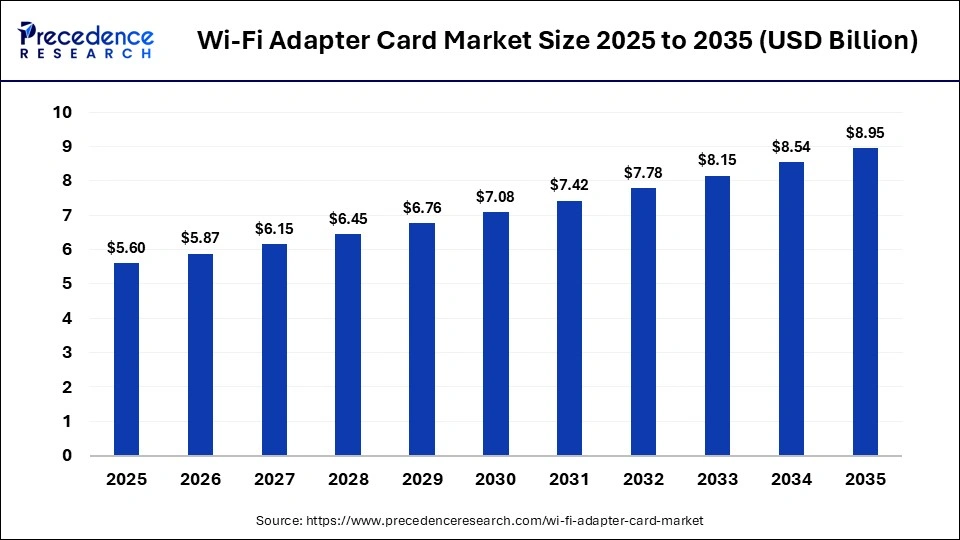
The global Wi-Fi adapter card market size accounted for USD 5.60 billion in 2025 and is predicted to increase from USD 5.87 billion in 2026 to approximately USD 8.95 billion by 2035, expanding at a CAGR of 4.80% from 2026 to 2035. The demand for the market is driven by increasing adoption of wireless devices, technological advancements, and the rising demand for enhanced security features.
Market Highlights
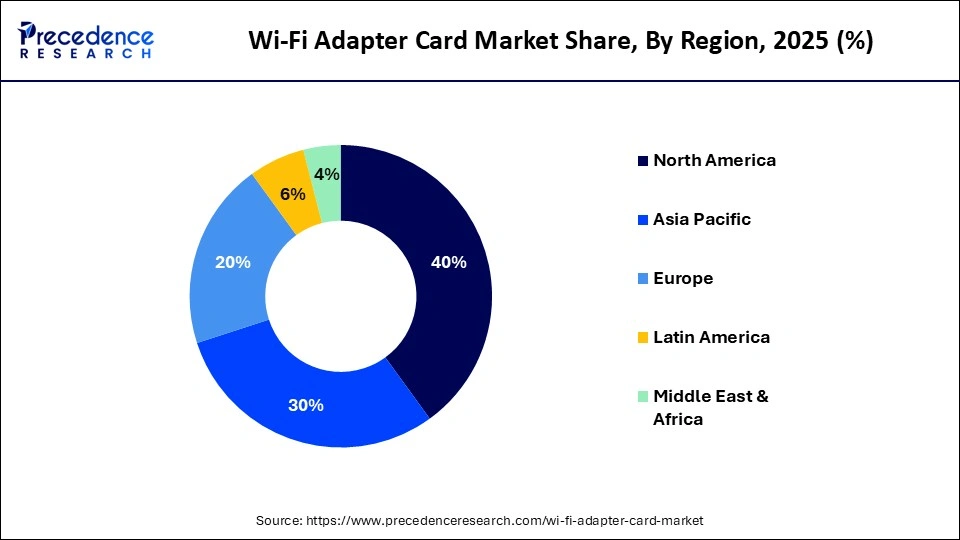
- North America dominated the Wi-Fi adapter card market with a market share of approximately 40% in 2025.
- Asia Pacific is expected to grow at the fastest CAGR of 6.0% in the market during the forecast period.
- By form factor, the internal wi-fi adapter segment held a dominant position in the market with a market share of approximately 55% in 2025.
- By form factor, the external USB adapter segment is expected to grow at the fastest CAGR 4.5% in the market during the forecast period.
- By technology, the Wi-Fi 6E segment held a dominant position in the market with a market share of approximately 42% in 2025.
- By technology, the Wi-Fi 7 segment is expected to grow at the fastest CAGR of 4.3% in the market during the forecast period.
- By speed, the above 1200 Mbps segment held a dominant position in the market with a market share of approximately 45% in 2025.
- By speed, the 600-1200 Mbps segment is expected to grow at the fastest CAGR of 4.6% in the market during the forecast period.
- By sales channel, the online segment dominated the market with a Wi-Fi adapter card market share of approximately 60% in 2025.
- By sales channel, the offline segment is expected to grow at the fastest CAGR of 4.8% in the market during the forecast period.
- By application, the commercial segment held a dominant position in the market with a market share of approximately 38% in 2025.
- By application, the industrial segment is expected to grow at the fastest CAGR of 5.0% in the market during the forecast period.
Market Overview
A Wi-Fi adapter card is a hardware component that enables computers and other electronic devices to connect to a wireless network without physical cables. It receives radio frequency signals from a wireless router or access point and transmits them into data that the device can use to access the internet. The global Wi-Fi adapter card market is expanding due to increasing demand for high-speed internet, growth in wireless devices, and rising popularity of online and professional gaming. Technological advancements, rising demand for enhanced security features, and smart home technologies are driving adoption. However, the growing integration of built-in wireless capabilities in modern devices may limit demand for standalone adapter cards.
Impact of AI in the Wi-Fi Adapter Card Market
AI is enhancing the market by enabling smarter and more efficient wireless connectivity. Network traffic pattern analysis by AI automatically optimizes bandwidth allocation, reduces interference, and improves connection stability by integrating AI technologies into wireless chipsets. AI enhances security by detecting unusual network behavior and potential cyber threats in real-time. AI-driven predictive maintenance improves overall user experience by identifying network issues before they disrupt connectivity. The growing adoption of AI-enabled devices, IoT systems, and high-performance applications such as cloud gaming, AV/VR smart homes, is increasing the demand for advanced Wi-Fi adapter hardware.
Wi-Fi Adapter Card Market Trends
- Growing demand for high-speed connectivity due to cloud computing, online gaming, and remote work. To ensure stable and fast network access, consumers and enterprises are adopting high-speed Wi-Fi adapter cards.
- Integration of Wi-Fi and Bluetooth in a combo in modern adapter card designs, which enables users to connect multiple wireless devices, such as headsets, controllers, and IoT devices, simultaneously while improving overall device connectivity.
- Manufacturers are integrating security protocols such as WPA3 encryption into Wi-Fi adapters, with rising cybersecurity threats.
- Wi-Fi adapter cards support multiple connected devices and higher network traffic efficiently, with the rapid growth of IoT devices and smart home technologies.
Market Scope
| Report Coverage | Details |
| Market Size in 2025 | USD 5.60 Billion |
| Market Size in 2026 | USD 5.87 Billion |
| Market Size by 2035 | USD 8.95 Billion |
| Market Growth Rate from 2026 to 2035 | CAGR of 4.80% |
| Dominating Region | North America |
| Fastest Growing Region | Asia Pacific |
| Base Year | 2025 |
| Forecast Period | 2026 to 2035 |
| Segments Covered | Form Factor, Technology, Speed, Sales Channel, Application, and Region |
| Regions Covered | North America, Europe, Asia-Pacific, Latin America, and Middle East & Africa |
Segment Insights
Form Factor Insights
How Did the Internal Wi-Fi Adapter Segment Lead the Wi-Fi Adapter Card Market?
The internal Wi-Fi adapter segment led the market with a market share of approximately 55% in 2025, due to its widespread adoption in modern computing devices. Since these adapters are installed directly into devices such as laptops, desktops, and tablets, they enable an efficient and clutter-free setup while providing stronger signal stability and reliable connectivity. These adapters deliver faster data transfer speeds, lower latency, and improved performance with the support of advanced wireless standards such as Wi-Fi 6 and Wi-Fi 6E for bandwidth-intensive applications like gaming, streaming, and cloud computing. They offer better security, efficient energy usage, and compatibility with device hardware.
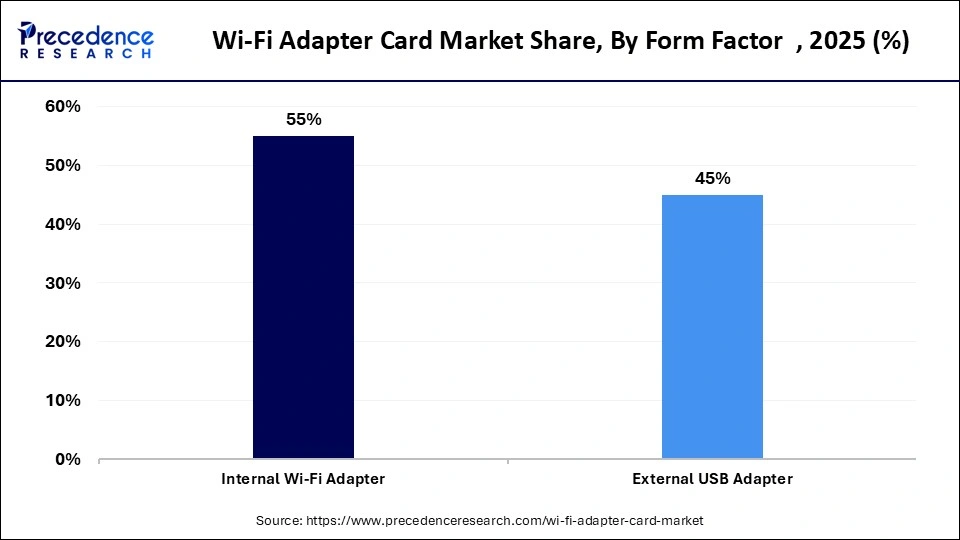
The external USB adapter segment is expected to grow at the fastest CAGR 4.5% in the market during the forecast period, due to its affordability and convenience across a wide range of devices. It enables wireless connectivity on desktops, older laptops, and other devices without built-in Wi-Fi hardware by offering a plug-and-play solution. Remote work, online learning, and increasing internet usage are driving the demand for flexible and portable connectivity solutions. Since these adapters are inexpensive and support modern wireless standards such as Wi-Fi 5 and Wi-Fi 6, the adoption is accelerating in the market.
Technology Insights
How did the Wi-Fi 6E Segment Dominate the Wi-Fi Adapter Card Market?
The Wi-Fi 6E segment held a dominant position in the market with a market share of approximately 42% in 2025. It enables delivery at a faster speed, lower latency, and improved network efficiency. It provides wider channels and reduced interference, which enable devices to handle higher data traffic and support bandwidth-intensive applications such as cloud gaming and streaming. The rapid growth of connected devices and data usage in homes and enterprises drives the adoption of Wi-Fi 6E, as it enables networks to support multiple devices simultaneously. It maintains stability in connection and high performance in dense environments.
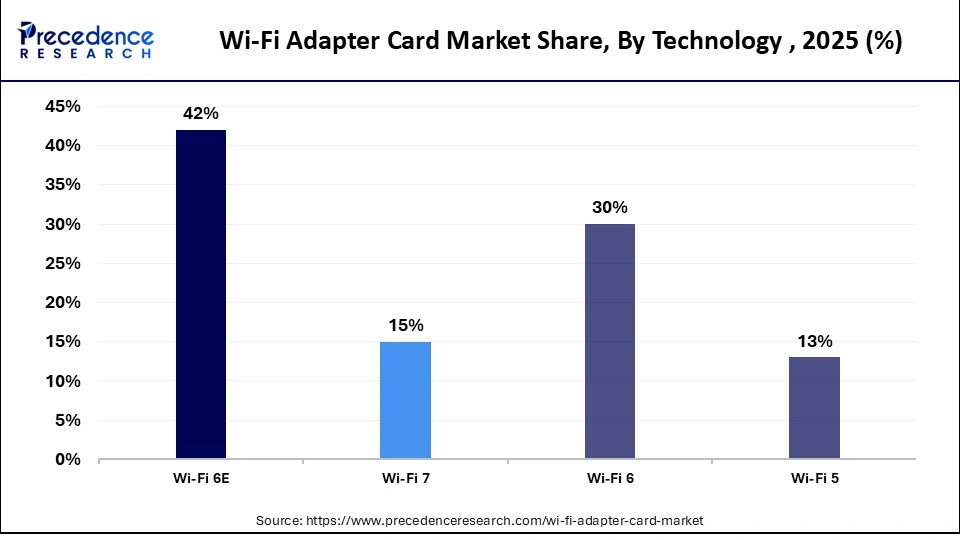
The Wi-Fi 7 segment is expected to grow at the fastest CAGR of 4.3% in the market during the forecast period. It improves wireless performance due to its next-generation capabilities, which support extremely high data speeds up to 40-60 Gbps and introduce 320 MHz channel bandwidth, enabling higher data throughput for bandwidth-intensive applications. Introduction of advanced technologies such as Multi-Link Operation (MLO) and 4096-QAM modulation, which enable devices to transmit data across multiple frequency bands simultaneously, further drives the segment's growth.
Speed Insights
How did the Above 1200 Mbps Segment Dominate the Wi-Fi Adapter Card Market?
The above 1200 Mbps segment held a dominant position in the market with a market share of approximately 45% in 2025. The rising demand for high-speed wireless connectivity supporting modern wireless standards such as Wi-Fi 5, Wi-Fi 6, and Wi-Fi 6E, enabling faster data transfer, reduced latency, and network stability are driving the segment's dominance. Rapid growth of connected devices in homes and workplaces is another key factor boosting the segment's dominance. The widespread adoption of advanced routers and the expansion of high-speed broadband services have further accelerated the demand for the segment.
The 600-1200 Mbps segment is expected to grow at the fastest CAGR of 4.6% in the market during the forecast period. It offers a good balance between performance and affordability, providing reliable high-speed connectivity suitable for everyday activities. It enables improved data transfer rates and stable connectivity without a higher cost by supporting the adoption of wireless standards such as Wi-Fi 5 and Wi-Fi 6. As internet usage across the globe is expanding rapidly, there is an increased demand for cost-effective networking solutions.
Sales Channel Insights
What made the Online Segment Dominate the Wi-Fi Adapter Card Market?
The online segment dominated the market with a market share of approximately 60% in 2025. The transparency, accessibility, the rapid growth of e-commerce platforms, and the increasing preference for convenient digital shopping encourage buyers to purchase through online marketplaces. It enables consumers to easily compare different adaptor models, specifications, prices, and customer reviews before making a purchase. These platforms attract consumers through the provision of attractive discounts, fast delivery options, and a wide variety of products. Another important factor behind the segment's dominance is the availability of global brands, easy return policies, and doorstep delivery.
The offline segment is expected to grow at the fastest CAGR of 4.8% in the market during the forecast period. Consumers and businesses prefer hands-on product evaluation and immediate purchase, as it enables them to compare different adaptor models, understand specifications, and receive guidance from sales representatives before making a purchase. The offline purchasing helps buyers to interact with the salesperson and select a product that is more compatible with their devices and networking requirements. The segment builds customer trust by providing installation support, after-sales services, and warranty assistance.
Application Insights
What made the Commercial Segment Dominate the Wi-Fi Adapter Card Market?
The commercial segment held a dominant position in the market with a market share of approximately 38% in 2025. The rapid digital transformation occurring across businesses and organizations is driving the segment. Organizations such as IT, retail, healthcare, and education increasingly rely on high-speed wireless connectivity to support cloud computing, video conferencing, and data sharing. The demand for reliable and high-performance Wi-Fi adaptor cards continues to rise as workplaces expand their wireless infrastructure and deploy more connected devices. Further, the commercial segment expansion is accelerated with the continued growth of hybrid work environments and digital business processes, encouraging organizations to invest in advanced wireless networking hardware.
The industrial segment is expected to grow at the fastest CAGR of 5.0% in the market during the forecast period. Due to the rapid adoption of industrial automation and smart manufacturing technologies, industries are increasingly integrating wireless connectivity into machinery, monitoring systems, and industrial control networks to enable real-time data exchange, remote monitoring, and efficient production management. With the expansion of Industrial Internet of Things (IIoT) and Industry 4.0 initiatives, companies are deploying sensors, devices, and machines that require stable and high-speed wireless connectivity.
Regional Insights
What Factors Have Driven the Dominance of North America in the Market?
North America dominated the Wi-Fi adapter card market with a market share of approximately 40% in 2025. The extensive digital ecosystem and strong broadband infrastructure enable widespread adoption of high-speed wireless connectivity across homes, businesses, and public networks. The early adoption of advanced technologies such as Wi-Fi 6 and Wi-Fi 6E, supported by a large base of consumers and enterprises, is driving the regional growth. The region has high internet penetration, increasing demand for advanced networking hardware such as Wi-Fi adapter cards. The region hosts major technology companies and manufacturers, encouraging continuous innovation and product development.
North America Wi-Fi Adapter Card Market Size and Growth 2026 to 2035
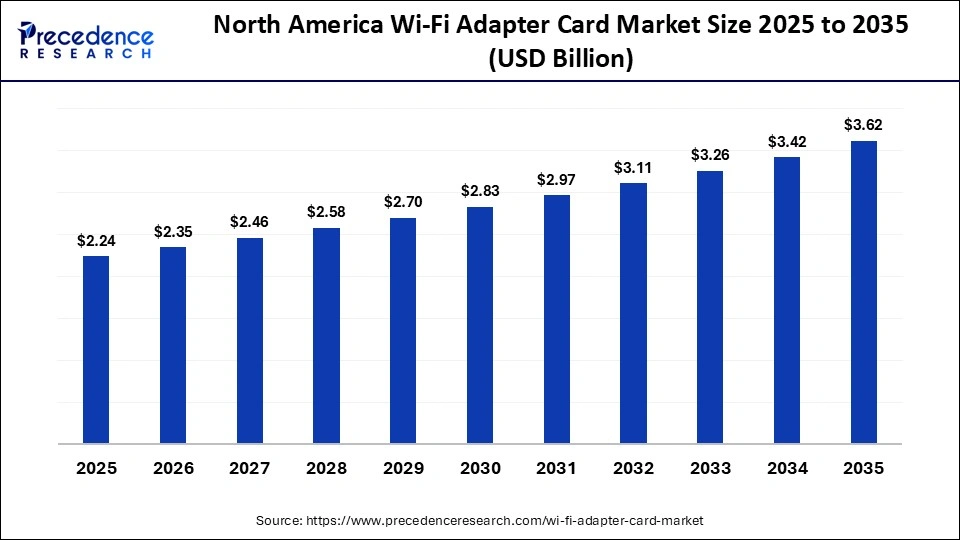
The North America Wi-Fi adapter card market size is estimated at USD 2.24 billion in 2025 and is projected to reach approximately USD 3.62 billion by 2035, with a 4.92% CAGR from 2026 to 2035.
U.S. Wi-Fi Adapter Card Market
The U.S market is witnessing steady growth due to advanced digital infrastructure and high demand for high-speed wireless connectivity. The country has high internet penetration with increasing adoption of smart home devices and the expansion of remote and hybrid work environments, which require reliable and stable wireless connectivity. Consumers and businesses are upgrading their networking hardware with the rapid adoption of advanced wireless technologies such as Wi-Fi 6, Wi-Fi 6E, and emerging Wi-Fi 7. Further, the market is strengthened by increasing use of IoT devices, online gaming, streaming services, and cloud-based applications.
U.S. Wi-Fi Adapter Card Market Size and Growth 2026 to 2035
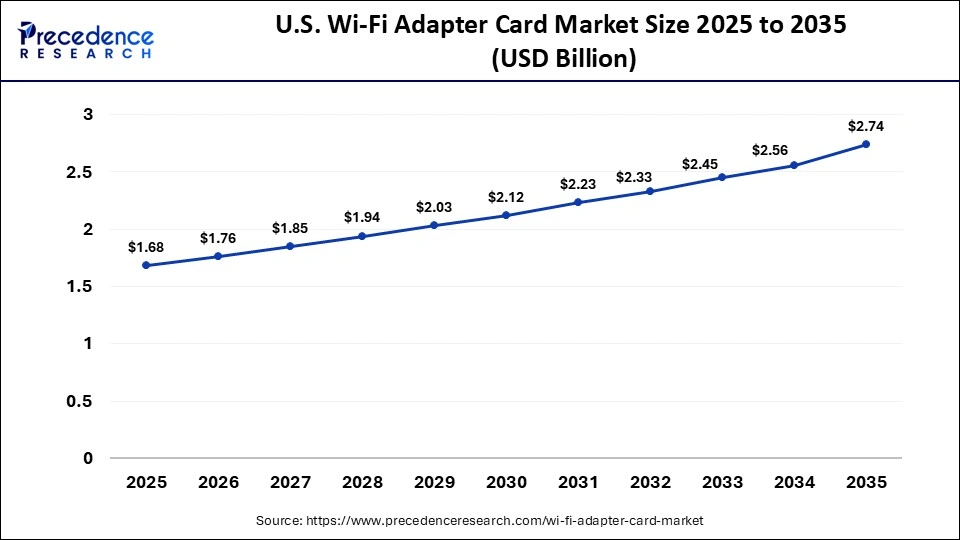
The U.S. Wi-Fi adapter card market size is calculated at USD 1.68 billion in 2025 and is expected to reach nearly USD 2.74 billion in 2035, accelerating at a strong CAGR of 5.01% between 2026 and 2035.
What makes Asia Pacific the Fastest Growing Region in the Wi-Fi Adapter Card Market?
Asia Pacific is expected to grow at the fastest CAGR of 6.0% in the market during the forecast period. The expanding base of connected devices in the region, increasing internet penetration, and rapid digitalization are driving the growth of the region. The region's large population and increasing consumer electronics markets increase demand for wireless connectivity solutions.
Government and private sectors are heavily investing in broadband infrastructure and digital connectivity projects across the region, driving the growth of the market in the region. The need for reliable and stable high-speed wireless networks is increasing with rapid urbanization, a rising middle-class population, the expansion of e-commerce, remote work, online education, and digital platforms for entertainment. The rise of IoT devices, smart cities, and advanced manufacturing technologies is further boosting the demand for Wi-Fi hardware.
China's Wi-Fi Adapter Card Market
China's market is expanding rapidly. The country has a strong digital ecosystem and a large consumer electronics industry, which increases demand for wireless connectivity. The country is witnessing rapid urbanization, increasing internet penetration, and rapid adoption of smart devices, IoT technologies, and home automation systems. The market is further fueled by the increasing use of laptops, PCs, gaming systems, and connected devices in households and businesses. The country has a strong electronics manufacturing ecosystem and hosts major networking equipment producers, accelerating product innovation and adoption of advanced technologies, further supporting market growth.
What are the Advancements in the Wi-Fi Adapter Card Market in Europe?
The European market is predicted to grow substantially throughout the forecast, due to the region's aggressive push toward gigabit connectivity, Wi-Fi 6/6E deployment, and smart infrastructure modernization. The European Union's Digital Decade initiative and Gigabit Infrastructure Act are encouraging large-scale broadband expansion and high-capacity wireless network deployment across homes, enterprises, transportation hubs, and public facilities. Countries such as Germany, France, and the U.K are the key players in this market.
Germany Market Trends
The country's leadership is supported by large-scale digital transformation across manufacturing, logistics, automotive, and smart factory environments, all of which require high-performance wireless connectivity solutions and upgraded Wi-Fi hardware. In addition, German enterprises are among the earliest adopters of secure and high-capacity wireless systems for IoT, AI-enabled industrial operations, and cloud-based applications.
What are the Key Trends in the Wi-Fi Adapter Card Market in Latin America?
The Latin American market is expected to witness significant growth, as broadband penetration, fiber-optic deployment, and enterprise digitalization continue to accelerate across the region. A significant trend is the embedding of Wi-Fi 6 technology in IoT ecosystems and edge computing frameworks. Here again, people's networks, both consumers and enterprises, change, taking their outdated equipment to be upgraded. Furthermore, there has been an increase in fixed broadband subscriptions and, more recently, all kinds of FTTH (Fiber-to-the-Home) networks, which indirectly promote the use of advanced wireless adapters capable of supporting gigabit internet speeds at home.
Brazil Market Trends
Brazil has an active role in improving fiber broadband infrastructure as well as public connectivity initiatives such as Wi-Fi Brazil and the National Broadband Plan. Wi-Fi 6 and Wi-Fi 6E specifications and new equipment are being pushed up in demand through all of this progress.
How is the Middle East and Africa Region Growing in the Wi-Fi Adapter Card Market?
The Middle East and Africa are expected to have significant market growth in the upcoming years, backed up by government initiatives accompanied by telecommunications companies focusing on digital transformation, smart city developments, and coverage of high-speed broadband in the region. Significantly, smart city infrastructure is developing across the Gulf region, and hospitality networks, as well as 5G-enabled fixed wireless access, are becoming prevalent. These advancements are helping both corporations and people move towards higher-performance PCIe and USB Wi-Fi adapters that can ensure low-latency connections as well as multi-gigabit speeds.
Saudi Arabia Market Trends
Saudi Arabia has taken a groundbreaking initiative in assigning the entire 6 GHz spectrum band to Wi-Fi applications. With this critical step, next-generation wireless technologies have an important foundation while also increasing the need for compatible Wi-Fi adapter cards and devices.
Wi-Fi Adapter Card Market Companies
- Intel Corporation
- Qualcomm Technologies, Inc
- Broadcom Inc.
- TP-Link Technologies Co., Ltd.
- Netgear Inc.
- ASUSTek Computer Inc. (ASUS)
- D-Link Corporation
- Belkin International Inc.
- Cisco Systems, Inc.
- Linksys (Belkin subsidiary)
- Zyxel Communications Corp.
- Huawei Technologies Co., Ltd.
- Marvell Technology Group Ltd
- Realtek Semiconductor Corp.
- TP-Link Archer Series/Subsidiary Brands
Recent Developments
- In January 2025, u-blox, a global provider of leading positioning and wireless communication technologies, launched its first automotive-grade Wi-Fi 7 module, which enables OEMs to enhance the user experience of in-vehicle infotainment and telematics. (Source: https://www.u-blox.com)
- In August 2024, ASUS unveils the three devices, ROG Rapture GT-BE19000, ASUS RT-BE86U, and ROG USB-BE92 during Gamescom 2024. These three devices showcase the pinnacle of Wi-Fi 7 network performance, emphasizing low latency for cloud gaming and wireless solutions.(Source: https://press.asus.com)
Segments Covered in the Report
By Form Factor
- Internal Wi-Fi Adapter
- External USB Adapter
By Technology
- Wi-Fi 6E
- Wi-Fi 7
- Wi-Fi 6
- Wi-Fi 5
By Speed
- Above 1200 Mbps
- 600-1200 Mbps
- Below 600 Mbps
By Sales Channel
- Online
- Offline
By Application
- Commercial
- Residential
- Industrial
- Others
By Region
- North America
- Asia Pacific
- Europe
- Latin America
- Middle East & Africa
For inquiries regarding discounts, bulk purchases, or customization requests, please contact us at sales@precedenceresearch.com
Frequently Asked Questions
Tags





Ask For Sample
No cookie-cutter, only authentic analysis – take the 1st step to become a Precedence Research client
 Get a Sample




 sales@precedenceresearch.com
 Schedule a Meeting
