



3D Motion Capture System Market Size, Key Companies, Company Market Share, User Adoption, Technology Deployment, Revenue Growth, Competitive Positioning, and Demand Forecast
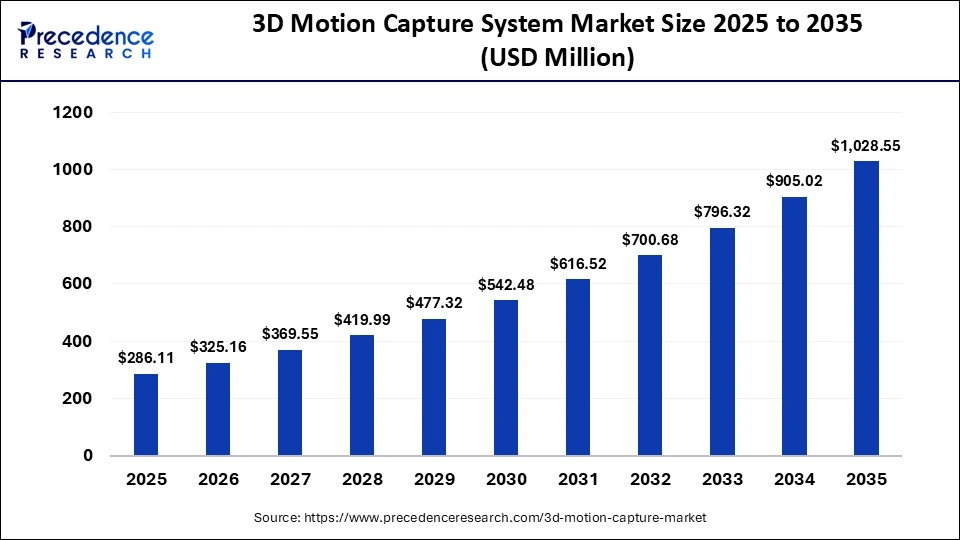
ICT industry specialist Shivani Zoting estimates the 3D motion capture system market at USD 325.16 million in 2026, with continued technology adoption expected to take the market to USD 1,028.55 million by 2035 at a CAGR of 13.65%. Leading 3D motion capture system market providers such as PhaseSpace, Noitom, Rokoko, Noraxon are expanding their capabilities across segments including component, type, technology, end-use industry, deployment, region.
Source: https://www.precedenceresearch.com/3d-motion-capture-system-market
 Get a Sample
 Table Of Content


What is the 3D Motion Capture System Market Size?
The global 3D motion capture system market size is calculated at USD 286.11 million in 2025 and is predicted to increase from USD 325.16 million in 2026 to approximately USD 1,028.55 million by 2035, expanding at a CAGR of 13.65% from 2026 to 2035. The 3D motion capture system market is driven by rising demand for high-precision motion analysis across entertainment, sports, healthcare, and industry applications.
Market Highlights
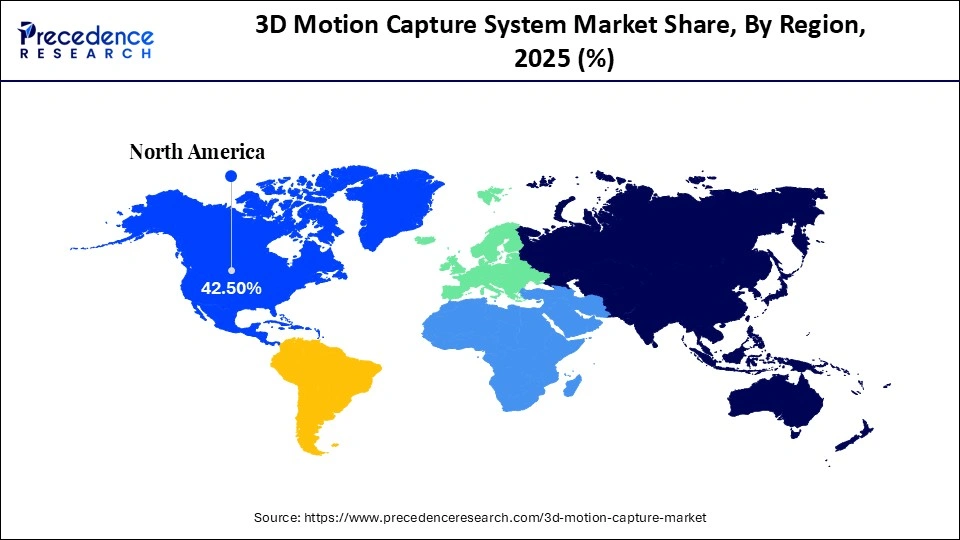
- North America dominated the market, holding the largest market share of 42.5% in 2025.
- The Asia Pacific is expected to expand at a strong CAGR of 14.5% between 2026 and 2035.
- By component, the hardware segment held the largest market share of 58.6% in 2025.
- By component, the software segment is expected to grow at a CAGR of 12.9% between 2026 and 2035.
- By type, the marker-based segment contributed the largest market share of 71.3% in 2025.
- By type, the markerless segment is growing at a CAGR of 13.1% between 2026 and 2035.
- By technology, the optical segment accounted for the biggest market share of 32.6% in 2025.
- By technology, the inertial segment is expanding at a remarkable CAGR of 13.2% between 2026 and 2035.
- By end-use industry, the media & entertainment segment captured the highest market share of 34.5% in 2025.
- By end-use industry, the healthcare & rehabilitation segment is expected to grow at a remarkable CAGR of 13.5% between 2026 and 2035.
- By deployment, the on-premises segment generated the largest market share of 68.7% in 2025.
- By deployment, the cloud segment is poised to grow at a solid CAGR of 13.4% between 2026 and 2035.
Redefining Precision & Performance: How Innovation Is Accelerating the 3D Motion Capture System Market
The 3D motion capture system market is rapidly growing as more industries adopt this technology to accurately track movements for improved performance, diagnostics, design, and virtual environments. These systems convert real-world movement into digital data, which is then used for advanced animation, biomechanical analysis, virtual production, robot development, and immersive simulation. 3D motion capture plays a crucial role in entertainment, sports, healthcare, engineering, and defense applications by providing accuracy, efficiency, and realism. Additionally, integrating AI, cloud connectivity, and real-time processing is transforming how organizations collect, analyze, and utilize human and object movement, making motion data more accessible and scalable than ever before.
The growing demand for realistic digital content, the increasing popularity of virtual production in films and games, and the broader use of biomechanical analysis in medical diagnosis and sports performance optimization drive market growth. Advances in markerless tracking, wearable inertial sensors, and AI-powered analytics have improved system accuracy and simplified operations, leading to wider adoption in small studios, research centers, and industry businesses. Its extensive use in autonomous systems, industrial training, AR/VR environments, and defense simulations contributes to strong market momentum.
How is AI Revolutionizing the 3D Motion Capture System Market?
AI is revolutionizing the 3D motion capture system market by enhancing accuracy, reducing the need for human intervention, and enabling real-time automatic performance across various applications. AI-powered markerless tracking systems allow for the detection of body joints, facial expressions, and object movements in building systems without physical markers, making the process more convenient and faster. Machine learning models help refine motion interpretation by eliminating noise, fixing occlusions, and predicting missing data, resulting in smoother and more natural motion output. Additionally, AI advances biomechanical analysis by identifying performance trends, irregularities, and generating individualized insights for sports, rehabilitation, and clinical diagnostics.
3D Motion Capture System Market Outlook
- Industry Growth Overview: The 3D motion capture system market is growing rapidly due to increasing adoption in gaming, film production, sports analytics, and healthcare applications. Growth is driven by advancements in sensor technology, rising demand for realistic animation, and the integration of AI and VR/AR solutions.
- Global Expansion: The market is growing worldwide due to rising demand in entertainment, sports, healthcare, and virtual reality applications, supported by technological advancements in sensors and AI integration. Emerging regions offer opportunities through expanding gaming and film industries, growing investment in sports analytics, and increasing adoption of AR/VR technologies in education and healthcare.
- Major Investors: Major competitors like Vicon, OptiTrack, Qualisys, Xsens, and Motion Analysis Corporation are innovating with new high-tech hardware and AI-driven analytics. These companies are still investing in research and development, product development, and strategic alliances.
- Startup Ecosystem: The startup ecosystem is flourishing, with companies like Rokoko, Noitom, Manus, and Perception Neuron offering affordable, easy-to-use, and portable motion capture solutions. These startups are making motion tracking more accessible through their focus on inexpensive wearable devices, cloud computing, and tools designed for creators.
Market Scope
| Report Coverage | Details |
| Market Size in 2025 | USD 286.11 Million |
| Market Size in 2026 | USD 325.16 Million |
| Market Size by 2035 | USD 1,028.55 Million |
| Market Growth Rate from 2026 to 2035 | CAGR of 13.65% |
| Dominating Region | North America |
| Fastest Growing Region | Asia Pacific |
| Base Year | 2025 |
| Forecast Period | 2026 to 2035 |
| Segments Covered | Component, Type, Technology, End-use Industry, Deployment, and Region |
| Regions Covered | North America, Europe, Asia-Pacific, Latin America, and Middle East & Africa |
Segment insights
Component Insights
Why Did the Hardware Segment Lead the Market in 2025?
In 2025, the hardware segment led the 3D motion capture system market with a 58.6% share, as physical infrastructure, consisting of a system of cameras, sensors, and data acquisition units, forms the foundation of the system. These hardware solutions record raw motion data, and without such systems, the software cannot be used efficiently. The use of high-performance optical cameras, inertial sensors, and electromagnetic receivers remains essential in applications requiring high accuracy, especially in film, gaming, sports science, and biomechanics.
Industries that rely heavily on detailed movement analytics may need multi-camera arrays, complex sensor suits, and synchronized capture systems, which are costly in terms of hardware. Furthermore, the increasing adoption of virtual production processes and full-body performance capture technology has prompted studios and research facilities to upgrade to high-resolution cameras and next-generation tracking systems.
The software segment is expected to grow at a CAGR of 12.9% during the forecast period, driven by its increasing role in enhancing data interpretation, visualization, and real-time analytics for motion capture. Recent motion capture systems rely on robust software engines that process raw data as input, filter out noisy channels, fill in gaps, apply machine learning filters, and convert motion into useful animations or biomechanical information. The rise of real-time applications in industries such as virtual production, live animation, computer-based sports training, and clinical diagnostics is driving this growth. Additionally, the introduction of cloud-based applications and AI-integrated analysis packages is driving demand for flexible, scalable, and user-friendly software that integrates with animation programs and simulation systems.
Type Insights
What Made Marker-Based the Dominant Segment in the 3D Motion Capture System Market?
The marker-based segment led the market, capturing a 71.3% share in 2025. This is due to its excellent accuracy and reliability. Marker-based systems reduce errors caused by occlusion, provide the high-resolution datasets needed for professional projects, and maintain precise tracking even during complex movements. Their ability to deliver high spatial accuracy and detailed skeletal data keeps them as the industry standard for high-budget projects, scientific research, and advanced training programs, maintaining their dominance in the market.
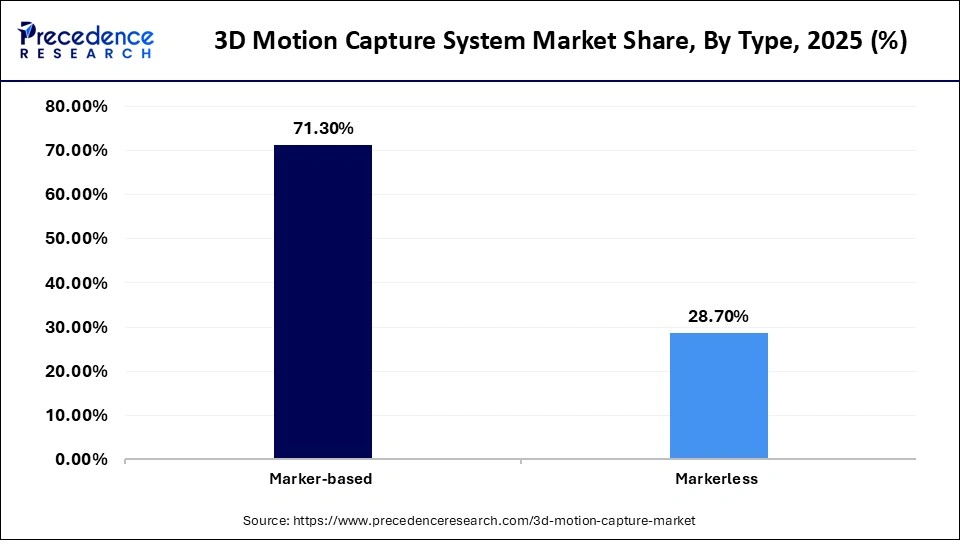
The markerless segment is expected to grow at a 13.1% CAGR during the forecast period because it offers more convenience, flexibility, and faster setup compared to traditional marker-based systems. Its ability to capture motion in natural environments without wearable sensors makes it ideal for applications in gaming, film, sports analytics, and healthcare, driving increased adoption. The rising demand for simple, versatile motion capture solutions across industries is likely to drive segmental growth. Rapid advancements in AI-powered pose estimation, computer vision, and deep learning are making markerless technology as accurate as marker-based. With more affordable hardware and sophisticated algorithms, markerless solutions are expected to see strong growth as small and medium-sized users seek cost-effective motion capture options.
Technology Insights
How Does the Optical Segment Lead the Market in 2025?
In 2025, the optical segment led the 3D motion capture system market with a 32.6% share. This is due to its high accuracy, ability to capture images with high resolution, and its long-standing preference in professional settings. Multi-camera arrays are becoming the most detailed and precise in motion tracking because of the triangulation of marker or subject locations using optical systems. The rise in high-speed camera technology, improved frame rates, and ultra-high-resolution sensors have further increased the appeal of optical motion capture systems. Inertial technology is likely to develop rapidly as additional industries require real-time capture, remote work, and motion analysis using wearable devices.
The inertial segment is expected to grow at a 13.2% CAGR in the coming years because of its portability, affordability, and adaptability across a wide range of applications. Inertial motion capture systems rely on IMUs (inertial measurement units), allowing users to track motion without fixed cameras, making them suitable for outdoor use, sports fields, VR training, and mobile research studies. Additionally, improvements in sensor accuracy, drift-correction algorithms, and integration with AI-driven data-refinement systems are increasing the reliability of inertial systems. Inertial technology is likely to develop rapidly as more industries will require real-time capture, remote work capabilities, and motion analysis using wearables.
End-Use Industry Insights
Why Did the Media & Entertainment Segment Lead the 3D Motion Capture System Market?
The media & entertainment segment dominated the market with a 34.5% share in 2025 due to the growing demand for realistic animations, visual effects, and immersive experiences in films, gaming, and virtual reality content. Motion capture also enables movie producers and video game creators to produce realistic movements, facial expressions, and lively performances that significantly enhance narration and audience engagement. As digital content production increases, with virtual reality, augmented reality experiences, and live-action animation, motion capture has become an essential part of studio workflows to streamline content creation, reduce manual animation efforts, and generate high-quality visual effects. There is also ongoing demand driven by advances in performance capture of humanoid characters, stunt work, and digital doubles. Motion capture remains a vital tool due to the growing immersion and visual sophistication of entertainment content, maintaining its leading role in the industry.
The healthcare segment is projected to grow at a CAGR of 13.5% during the forecast period due to the increasing use of motion capture in clinical assessment, rehabilitation, and biomechanical research. Motion capture allows clinicians to examine gait abnormalities, posture deviations, joint mechanics, movement asymmetries, and more with high accuracy, enabling more precise diagnoses and evidence-based treatments. Mocap data are also used in rehabilitation centers to monitor patients' recovery after surgery or injury, helping therapists develop personalized therapy plans and track real progress. In orthopedics and neurology, 3D motion capture is employed to evaluate motor disorders, balance problems, and musculoskeletal injuries. Mocap is also utilized in sports medicine to optimize athletic biomechanics and prevent injuries.
Deployment Insights
Why Did the On-Premises Segment Lead the Market in 2025?
The on-premises segment led the 3D motions capture system market with took up 68.7% share in 2025 because it ensures high-performance, secure, and low-latency data processing essential for professional motion capture environments. Big studios, research centers, defense agencies, and hospitals benefit from complete access to sensitive data while maintaining compliance with privacy and regulatory standards. Additionally, on-premises systems provide the computing power needed for real-time rendering, high-resolution capture, and advanced biomechanical analysis, making them ideal for high-budget productions, in-depth research, and organizations with legacy workflows that are easier to upgrade on-site than migrate to the cloud.
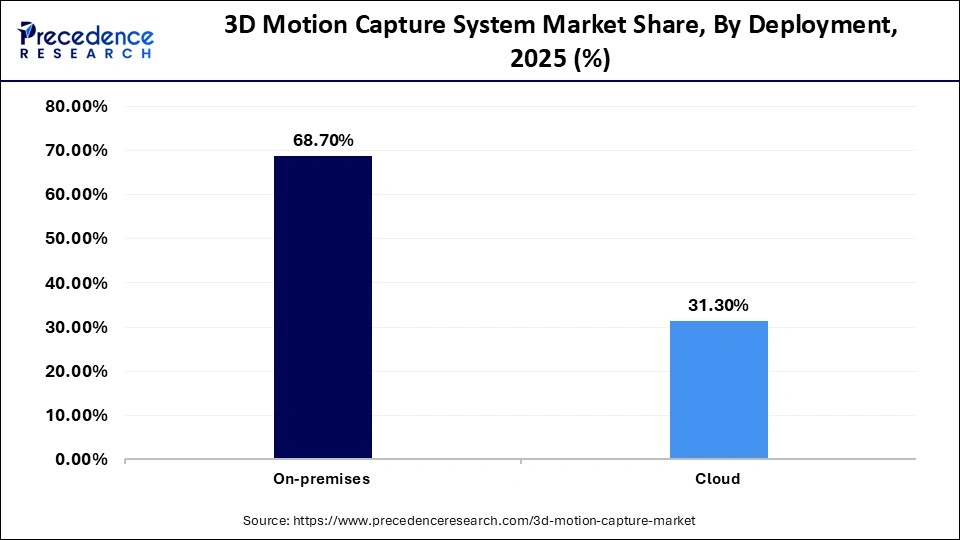
The cloud segment is expected to grow at a 13.4% CAGR in the coming years due to rising demand for scalable, flexible, and cost-effective motion capture workflows. Cloud-based systems enable users to compute, store, and analyze motion data remotely, allowing real-time design across different locations. As AI-based motion detection becomes more popular, cloud systems provide the computing power needed to run deep learning models and automated data-cleaning algorithms without the high costs of on-premises hardware. Cloud deployment is also more affordable initially, making motion capture more accessible to SMEs, indie creators, and universities. The increasing popularity of virtual production, remote training, cloud-based animation pipelines, and similar trends drives this shift.
Regional Insights
How Big is the North America 3D Motion Capture System Market Size?
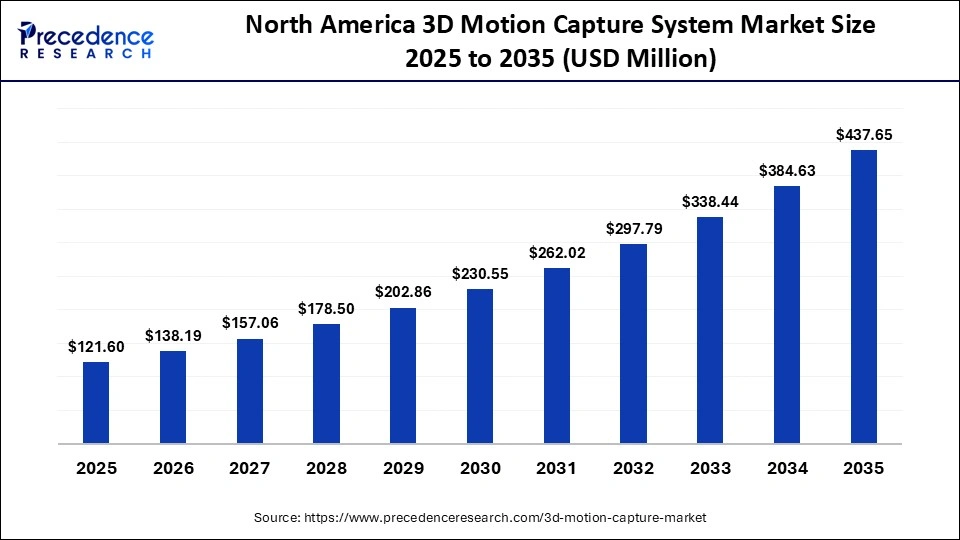
The North America 3D motion capture system market size is estimated at USD 121.60 million in 2025 and is projected to reach approximately USD 437.65 million by 2035, with a 13.66% CAGR from 2026 to 2035.
Why Did North America Lead the Global 3D Motion Capture System Market in 2025?
North America led the 3D motion capture system market with a 42.5% share due to the region's strong presence of major gaming, film, and animation studios that heavily invest in advanced motion capture technologies. High adoption of AR/VR applications, growing demand for realistic visual effects, and significant investments in sports analytics and healthcare solutions further fueled market growth. The availability of advanced infrastructure, skilled professionals, and supportive government initiatives for technology innovation strengthened the region's leadership. Additionally, early adoption of markerless and high-precision systems, along with robust R&D activities, ensured North America maintained a competitive edge in both commercial and research applications.
What is the Size of the U.S. 3D Motion Capture System Market?
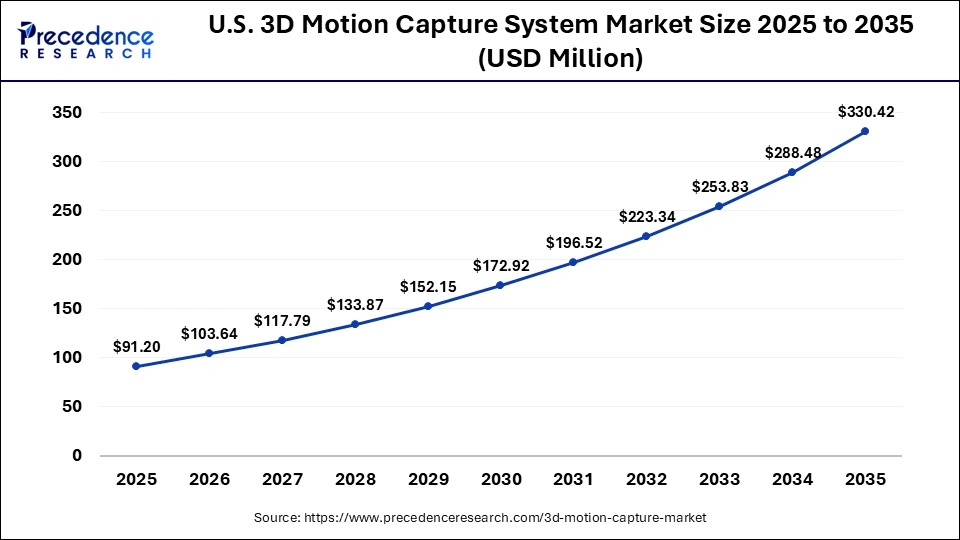
The U.S. 3D motion capture system market size is calculated at USD 91.20 million in 2025 and is expected to reach nearly USD 330.42 million in 2035, accelerating at a strong CAGR of 13.74% between 2026 and 2035.
U.S. 3D Motion Capture System Market Analysis
The U.S. is a major player in the North American market due to its advanced entertainment and gaming sectors, which constantly require the latest motion capture technologies for movies, TV shows, virtual productions, and video games. The country hosts numerous mocap studios, VFX houses, and animation firms that need precise systems to track character movements, facial expressions, and complex action sequences to ensure realism. Additionally, the U.S. leads in research-based applications such as biomechanics, orthopedics, sports performance analysis, military simulation, and robotics development. Significant investment, market competition, and strong infrastructure help the U.S. maintain its leadership in the commercial and scientific use of 3D motion capture technology.
Why is Asia Pacific Considered the Fastest-Growing Region in the 3D Motion Capture System Market?
Asia Pacific is expected to grow at a 14.5% CAGR throughout the forecast period due to the rapid expansion of its gaming, film, and animation industries, along with increasing adoption of AR/VR and virtual production technologies. Motion capture is also being used in industry automation in countries like China, India, Japan, and South Korea for virtual training, animation, and even diagnostics. Governments around the region are actively promoting technological growth through R&D grants and innovation programs, as well as digital transformation initiatives, leading to rapid adoption in both academic and industrial markets.
The region's entertainment sector is booming, with increasing demand for high-quality mocap tools driven by the growth of animation studios and game development companies. Additionally, market momentum is rising with the emergence of consumer-driven VR/AR apps and affordable motion capture startups. Growing technological infrastructure, a large pool of skilled professionals, and supportive government initiatives for digital innovation further accelerate market growth in the region.
China 3D Motion Capture System Market Trends
China plays a significant role in the market within Asia Pacific, as Chinese studios focus on developing next-generation production technologies, such as virtual production stages, markerless motion capture systems, and AI-enhanced animation workflows. Its active support for digital content creation, along with national efforts to boost the capabilities of local gaming and animation companies, leads to high adoption rates. Other expanding sectors like healthcare, sports training, and robotics in China are also adopting motion capture technology, especially where precise movement analysis is essential. Additionally, China's interest in automation and digital twins is fueling increased demand. This growth in industry, technological advances, and development position China as a key driver of growth in the APAC region.
Why is the European 3D Motion Capture System Market Experiencing Notable Growth?
The European 3D motion capture system market is growing at a notable rate. European companies lead in optical systems, markerless capture algorithms, advanced sensor technologies, and real-time processing solutions, creating a competitive and innovative industry environment. Universities and research institutions are crucial for advancements in biomechanics, robotics, human-machine interaction, and digital human modeling. Established studios and strong government support through tax incentives promote widespread use of advanced mocap tools in the region, especially within the thriving film and animation industry. As digital transformation accelerates across various fields, the demand for more precise and specialized motion capture systems continues to rise.
UK 3D Motion Capture System Market Trends
The market in the UK is growing, as the country has a well-established film, television, and animation industry. These studios rely heavily on motion capture to produce high-quality VFX, animated characters, stunt work, and virtual production outputs. Beyond entertainment, UK universities and research centers are very active in biomechanics, medical analysis, rehabilitation engineering, sports science, and robotics, all of which utilize motion capture to obtain precise measurements and enable modeling. An active startup environment also exists in the UK, contributing to innovations such as markerless capture, wearable sensors, and AI-based motion analytics.
What Potentiates the 3D Motion Capture System Market Within the Middle East & Africa?
The market within the Middle East & Africa (MEA) is a growing trend in the 3D motion capture system market is driven by increasing investments in media, entertainment, and gaming industries, particularly in countries like the UAE and Saudi Arabia. Growing interest in virtual reality, animation, and digital content production, along with rising adoption of advanced sports analytics and healthcare applications, further drives demand. Additionally, government initiatives supporting technology adoption, digital transformation, and creative industry development strengthen the market's growth potential in the region.
What Opportunities Exist in South America for the 3D Motion Capture System Market?
South America offers opportunities in the 3D Motion Capture System market due to increasing digital content consumption and adoption of immersive technologies across industries. Countries like Brazil, Mexico, Argentina, and Colombia are driving demand for affordable, small-scale motion capture solutions to support film, animation, gaming, and advertising production. Markerless and wearable systems are increasingly used by studios and digital creators for realistic character animation, while academic and medical institutions adopt motion capture for biomechanics, sports science, rehabilitation, and robotics, further supported by government interest in digital innovation and investment in creative technology startups.
Top Companies in the 3D Motion Capture System Market & Their Offerings
- Vicon: Provides optical motion capture solutions such as Vantage and Vero, which are highly precise and popular in film, game, biomechanics, and virtual production.
- OptiTrack: Offers game-optimized, high-precision optical mocap cameras and systems, VR/AR optimized, animation optimized, and robotics optimized.
- Xsens: Sells more advanced inertial motion capture suits and sensors that have the potential to deliver full body tracking to films, sports science, and industrial simulation.
- Qualisys: Produces optical motion capture cameras and integrated biomechanics analysis systems in the clinical, sport, and research fields.
- Motion Analysis Corporation: Provides motion capture systems that are integrated optical 3D, which involve a combination of high-speed cameras, active/ passive markers, and Cortex software that are used to achieve accurate tracking and biomechanical analysis.
Other Major Companies
- PhaseSpace
- Noitom
- Rokoko
- Noraxon
- Codamotion
- Northern Digital (NDI)
- Simi Reality Motion Systems
- Move.ai
- Defense / Motus Digital
- STT Systems
Recent Developments
- In April 2025, Southwest Research Institute introduced BEAMoCap, a high-end markerless motion capture system designed to make it easier to use studios for recording human motion for 3D animation. The system converts regular video footage into realistic 3D animations, which do not require the use of motion capture suits.(Source: https://www.swri.org)
- In October 2024, OptiTrack entered into a partnership agreement with B&H to distribute its professional motion capture systems to a wider audience in the U.S. In B&H's professional division, The Studio, creative teams, and educational institutions find it easier to acquire OptiTrack mocap solutions.(Source: https://optitrack.com)
- In March 2024, DeepMotion launched SayMotion, an AI-powered platform that allows creating 3D animation in a fast, easy, and cost-effective manner. The instrument is created to streamline motion capture processes of creators in various sectors.(Source: https://www.redsharknews.com)
Segments Covered in the Report
By Component
- Hardware
- Software
- Services
By Type
- Marker-based
- Markerless
By Technology
- Optical
- Inertial
- Electromagnetic
- Ultrasonic/Other
By End-use Industry
- Media & Entertainment
- Sports & Performance Analytics
- Healthcare & Rehabilitation
- Defense & Aerospace
- Robotics & Automation
- Research & Academia
- Industrial/Manufacturing/AR-VR
By Deployment
- On-premises
- Cloud
By Region
- North America
- Europe
- Asia-Pacific
- Latin America
- Middle East and Africa
For inquiries regarding discounts, bulk purchases, or customization requests, please contact us at sales@precedenceresearch.com
Frequently Asked Questions





Ask For Sample
No cookie-cutter, only authentic analysis – take the 1st step to become a Precedence Research client
 Get a Sample




 sales@precedenceresearch.com
 Schedule a Meeting
