



Acid Proof Lining Market Size, Companies, Share, Production Capacity, Raw Material Pricing, Export & Import Analysis, Manufacturing Cost, Competitive Positioning, and Demand Forecast
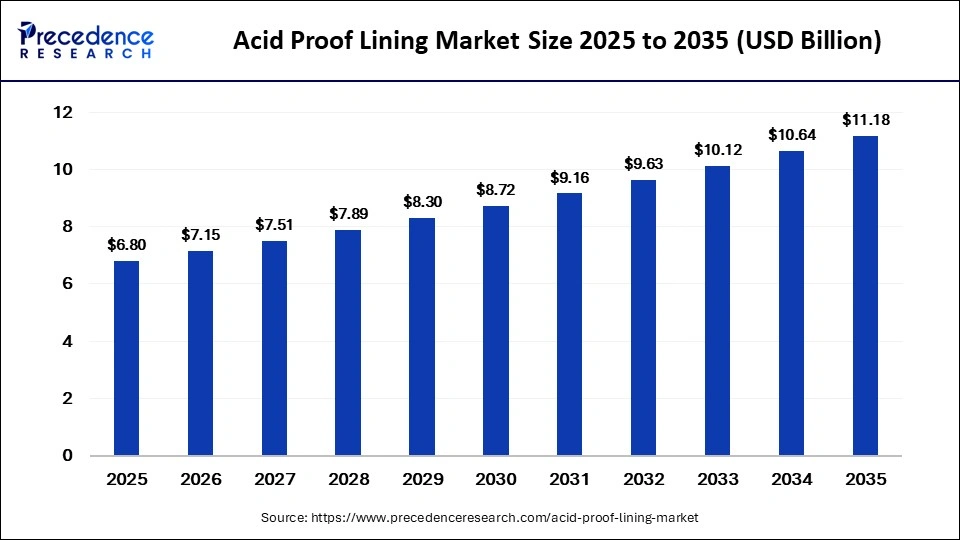
Yogesh Kulkarni, a Chemical and Materials Industry Expert, estimates the acid proof lining market at USD 7.15 billion in 2026, with the market projected to reach USD 11.18 billion by 2035 at a CAGR of 5.10%. Major acid proof lining market companies such as Steuler Group, Saint-Gobain, SGL Carbon, PPG Industries are competing across key material and application segments, including By Material, By Product Type, By Application, By End-use Industry, By Installation Type.
Source: https://www.precedenceresearch.com/acid-proof-lining-market
 Get a Sample
 Table Of Content


What is the Acid Proof Lining Market Size in 2026?
The global acid proof lining market size accounted for USD 6.80 billion in 2025 and is predicted to increase from USD 7.15 billion in 2026 to approximately USD 11.18 billion by 2035, expanding at a CAGR of 5.10% from 2026 to 2035. The market is driven by the increasing need for high-performance corrosion protection in coal-fired power station retrofits for Flue Gas Desulfurization (FGD) systems, which are thus necessary to combat the harsh, low-pH (pH 2-4) environments.
Key Takeaways
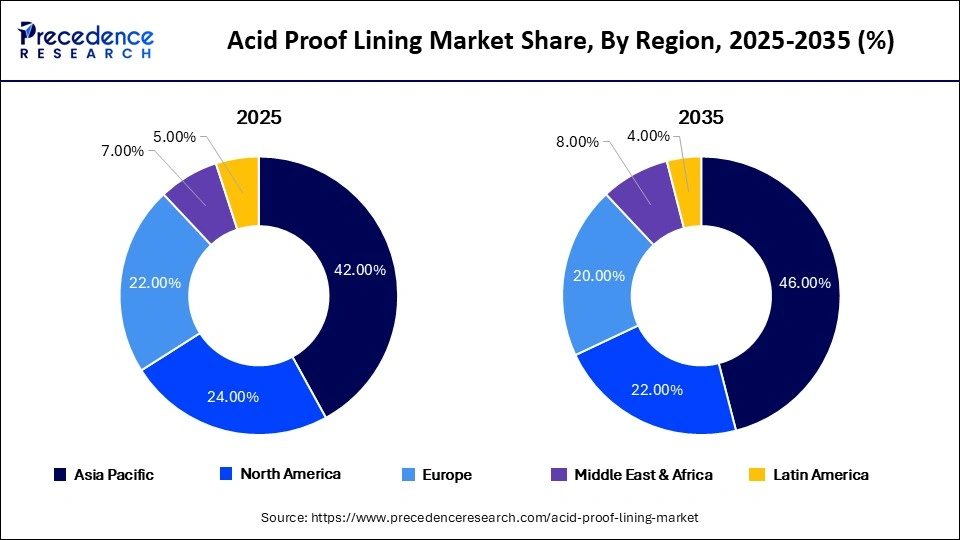
- Asia-Pacific dominated the global acid proof lining market with a share of 42% in 2025 and is expected to grow at the fastest CAGR of 6.5% in the coming years.
- Middle East and Africa region is expected to grow at a notable CAGR of 6.2% during the forecast period.
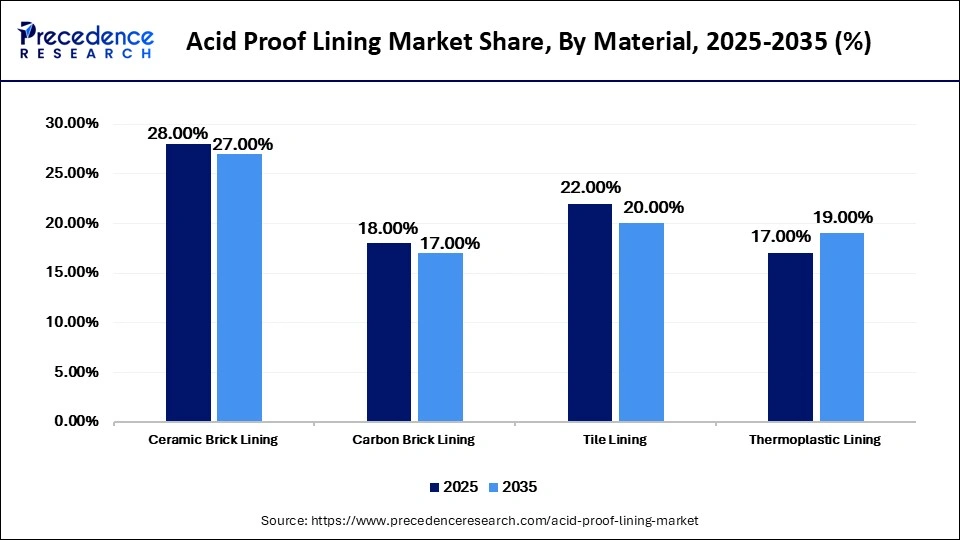
- By material, the ceramic brick lining segment led the global market with a share of 28% in 2025.
- By material, the fluoropolymer lining segment held 15% of the market share and is expected to grow at a 7.2% CAGR between 2026 and 2035.
- By product type, the rubber lining segment accounted for the highest revenue share of 30% in the market in 2025.
- By product type, the vinyl ester lining segment is expected to grow at a 6.2% CAGR between 2026 and 2035.
- By application, the storage tanks segment held the largest revenue share of 28% in the acid proof lining market in 2025.
- By application, the pipelines & drains segment is expected to grow at the fastest CAGR of 5.8% between 2026 and 2035.
- By end-use industry, the chemical processing segment contributed the highest market share of 32% in the market in 2025.
- By end-use industry, the fertilizers segment is expected to grow at the fastest CAGR of 6% during the forecast period.
Market Overview
The acid proof lining market comprises specialized protective materials, like bricks, tiles, and polymers, designed to protect industrial structures, such as storage tanks, reactors, and floors, from corrosion, solvents, acids, and high temperatures. The primary driving factor for the market is the accelerating need for corrosion-resistant, durable infrastructure in heavy industries like chemical manufacturing, oil & gas, and even mining to prevent high-cost equipment failure. This is accelerated by strict environmental regulations, increasing investment in desalination, and even technological advancements in high-performance materials.
How is AI Influencing the Acid Proof Lining Market?
Artificial intelligence is transforming the market by changing from reactive to predictive corrosion management, utilizing IoT-enabled sensors to monitor asset health in real-time and AI-based analytics to predict, rather than just react to, degradation. AI accelerates the development of new, high-performance polymers and even coatings by simulating and predicting chemical resistance, improving R&D efficiency. Moreover, AI decreases waste and lowers energy consumption in production, allowing more sustainable and cost-effective operations.
Acid Proof Lining Market Trends
- A major change toward Industry 4.0 sees the integration of sensors and even AI-enabled analytics to monitor corrosion, chemical resistance, and thermal activities in real-time, allowing proactive maintenance.
- The Asia-Pacific region, contributed by China and India, holds the highest revenue share because of rapid infrastructure development and growth in the oil & gas and pharmaceutical sectors.
- Operators are thus increasingly treating linings as capital-preservation tools rather than maintenance expenses, targeting to avoid high expenses associated with unplanned downtime.
- While carbon bricks and tiles remain dominant, there is a growing need for polymer-based linings, like PTFE and advanced resins, which usually have superior longevity and chemical resistance.
Market Scope
| Report Coverage | Details |
| Market Size in 2025 | USD 6.80 Billion |
| Market Size in 2026 | USD 7.15 Billion |
| Market Size by 2035 | USD 11.18 Billion |
| Market Growth Rate from 2026 to 2035 | CAGR of 5.10% |
| Dominating Region | Asia Pacific |
| Fastest Growing Region | Middle East and Africa |
| Base Year | 2025 |
| Forecast Period | 2026 to 2035 |
| Segments Covered | Material, Product Type, Application, End-Use Industry, Installation Type, and Region |
| Regions Covered | North America, Europe, Asia-Pacific, Latin America, and Middle East & Africa |
Market Dynamics
Drivers
Technological Advancements in Material Science
Technological advancements in material science are the main driver for the acid proof lining market because they directly tackle the evolving demand for higher durability, extreme chemical resistance, and longer equipment lifespans in harsh industrial environments. Innovations in Fiber-Reinforced Polymer (FRP), along with thermoplastic linings, usually offer superior chemical resistance while offering necessary mechanical strength. These materials are being designed to manage higher temperatures and even more aggressive acid concentrations than previous generations.
Restraint
Skilled Labor Shortage
The skilled labor shortage is a major restraint on the market because the installation and maintenance of these systems demand highly specialized, technical expertise that is currently scarce, leading to high failure rates and project delays. The market is changing toward high-integrity protection as a capital-preservation tool rather than simple maintenance, but the shortage of qualified personnel prevents widespread, efficient adoption.
Opportunity
Innovation in Material Science
Innovation in material science represents a major opportunity for the market by allowing the shift from traditional, maintenance-heavy protections to smart, durable, and even eco-friendly solutions. As industries face harsher chemical environments and stricter safety standards, advanced materials, such as high-performance polymers, composites, and IoT-enabled coatings, are improving equipment lifespan and decreasing operational downtime.
Segmental Insights
Material Insights
Acid Proof Lining Market Share, By Material, 2025-2035 (%)
| Material | 2025 | 2035 | CAGR (%) |
| Ceramic Brick Lining | 28.00% | 27.00% | 4.80% |
| Carbon Brick Lining | 18.00% | 17.00% | 4.50% |
| Tile Lining | 22.00% | 20.00% | 4.20% |
| Thermoplastic Lining | 17.00% | 19.00% | 6.50% |
| Fluoropolymer Lining | 15.00% | 17.00% | 7.20% |
The Ceramic Brick Lining Segment Held 28% of Acid Proof Lining Market Share in 2025
The ceramic brick lining segment dominated the market with a share of 28% in 2025, owing to strong resistance to high-temperature acidic environments. It is broadly used in chemical processing and fertilizer plants, and there is an increasing need for durable industrial lining systems. Despite high initial expenses, their decades-long service life lowers the total expense of ownership by decreasing maintenance frequency and thus preventing structural failure in high-risk zones.
The fluoropolymer lining segment held 15% share of the market in 2025 and is expected to grow at the fastest CAGR of 7.2% during the projection period. This is mainly due to the increasing usage in highly corrosive industrial environments, along with superior chemical and thermal resistance properties. Increasing global safety regulations and environmental standards encourage the usage of reliable, long-lasting, high-performance materials.
The thermoplastic lining segment held 17% of the market share in 2025 and is expected to grow at a CAGR of 6.5% during the projection period, driven by rising adoption due to lightweight and flexible properties, and increasing need in chemical storage systems. High requirements from growing sectors, mainly in petrochemicals, chemical processing, and water treatment, have fueled their adoption.
Product Type Insights
Why Did the Rubber Lining Segment Lead the Acid Proof Lining Market?
The rubber lining segment held a dominant position in the market, with a share of 30% in 2025, driven by the exceptional cost-effectiveness, superior resistance to both chemical corrosions mechanical abrasion, and high versatility in protecting heavy industrial equipment. Rubber lining decreases system shutdown expenses, as it is easy to apply and repair on-site without demanding to replace entire assets. Innovations in synthetic rubber compounds, for instance, neoprene and butyl rubber, have enhanced chemical resistance and durability over traditional rubber, increasing their applicability.
Acid Proof Lining Market Share, By Product Type, 2025-2035 (%)
| Product Type | 2025 | 2035 | CAGR (%) |
| Rubber Lining | 30.00% | 28.00% | 4.50% |
| Epoxy-based Lining | 24.00% | 23.00% | 5.00% |
| Polyurethane Lining | 16.00% | 17.00% | 5.8% |
| Vinyl Ester Lining | 18.00% | 19.00% | 6.2% |
| Polyester Lining | 12.00% | 13.00% | 5.5% |
The vinyl ester lining segment held 18% of the market share in 2025 and is expected to grow at the fastest CAGR of 6.2% during the projection period. This is mainly due to the high resistance to acids and corrosive chemicals, and the rising use in chemical processing plants. Vinyl esters act as a hybrid, providing the high corrosion resistance of epoxies but with faster, easier curing processes, lower viscosity, and better toughness compared to conventional options.
The polyurethane lining segment held 16% share of the market in 2025 and is expected to grow at a CAGR of 5.8% during the projection period, driven by the increasing use in abrasion-prone industrial environments along with strong flexibility and impact resistance. PU offers a highly effective, long-lasting barrier against alkalis, harsh acids, and solvents. Polyurethane systems are known for fast polymerization kinetics, allowing rapid application and curing at room temperature, which assists in reducing maintenance shutdowns.
Application Insights
What Made the Storage Tanks Dominant Segment in the Acid Proof Lining Market?
The storage tanks segment dominated the global market with the largest share of 28% in 2025, because of its increasing storage of corrosive industrial chemicals, increasing refinery, and petrochemical infrastructure investments. Regulatory bodies are enforcing stricter standards to prevent hazardous spills, thus forcing industries to upgrade to high-performance tank linings. Firms are adopting durable linings to decrease the frequency of repairs and replacements, thus minimizing waste and even operational downtime.
Acid Proof Lining Market Share, By Application, 2025-2035 (%)
| Application | 2025 | 2035 | CAGR (%) |
| Storage Tanks | 28.00% | 29.00% | 5.80% |
| Flooring & Surface Protection | 20.00% | 18.00% | 4.5% |
| Process Vessels | 22.00% | 23.00% | 5.50% |
| Chimneys & Stacks | 12.00% | 11.00% | 4.20% |
| Pipelines & Drains | 18.00% | 19.00% | 5.80% |
The pipelines and drains segment held 18% of the market share in 2025 and is expected to grow at the fastest CAGR of 5.8% during the projection period. This is mainly due to the rising industrial wastewater transportation needs and the increasing need for corrosion-resistant pipeline systems. Aging infrastructure necessitates frequent repairs, and acid-proof linings provide a cost-effective option to full replacement, with advanced options such as fiber-reinforced polymer and even glass-flake epoxy providing superior chemical resistance.
The process vessels segment held 22% of the market share in 2025 and is expected to grow at a CAGR of 5.5% in the upcoming period, driven by growing chemical processing industry operations and the rising need for corrosion-resistant production systems. New fertilizer complexes, mainly in developing regions such as India, demand massive amounts of lining to protect steel vessels from phosphoric and sulfuric acids. Regulations demand robust linings for tanks, reactors, and chimneys to guarantee worker safety and environmental protection.
End-use Industry Insights
The Chemical Processing Segment Held 32% of Market Share in 2025
The chemical processing segment held a dominant position in the acid proof lining market with a share of 32% in 2025 because of the strong use of corrosive chemicals in industrial operations , along with increasing investments in chemical manufacturing plants. The U.S. Environmental Protection Agency (EPA), combined with similar global bodies, has strict regulations on hazardous waste management, thus necessitating robust containment linings in chemical processors, refineries, and even waste treatment plants. Firms are increasingly viewing anti-corrosion linings as a capital-preservation tool rather than just a maintenance expense, as unplanned downtime can contribute to significant financial losses.
Acid Proof Lining Market Share, By End-Use Industry, 2025-2035 (%)
| End-Use Industry | 2025 | 2035 | CAGR (%) |
| Chemical Processing | 32.00% | 33.00% | 5.80% |
| Metal & Mining | 20.00% | 21.00% | 5.50% |
| Fertilizers | 12.00% | 13.00% | 6.00% |
| Oil & Gas | 10.00% | 11.00% | 5.60% |
| Water & Wastewater Treatment | 8.00% | 6.00% | 5.00% |
The fertilizers segment held 12% of the market share in 2025 and is expected to grow at the fastest CAGR of 6% during the projection period. This is mainly due to growing global fertilizer production capacity and the rising need for corrosion-resistant storage and process systems. Fertilizer plants function continuously and demand high reliability. Advanced linings, like seamless polyurea and glass-flake epoxy, are utilized to prevent leaks and significantly decrease maintenance shutdowns, thereby driving operational efficiency.
The oil and gas segment held 10% of the market share in 2025 and is expected to grow at a CAGR of 5.6% in the upcoming period, driven by the expansion of refineries along with petrochemical infrastructure, and the increasing usage of acid-resistant storage systems. There is an increasing focus on extending the life of existing infrastructure while decreasing maintenance costs and avoiding unplanned downtime, which acid-proof linings offer through durable protection.
Regional Insights
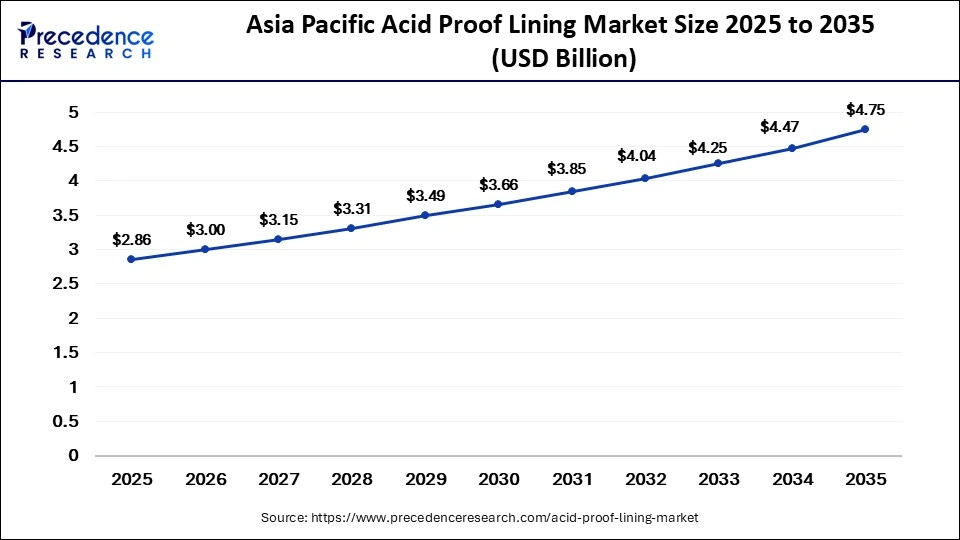
Asia Pacific Acid Proof Lining Market Size and Growth 2026 to 2035
The Asia Pacific acid proof lining market size is estimated at USD 2.86 billion in 2025 and is projected to reach approximately USD 4.75 billion by 2035, with a 5.20% CAGR from 2026 to 2035.
Why Asia-Pacific Led the Global Acid Proof Lining Market?
Asia-Pacific led the market by holding a major share of 42% in 2025. This is due to the rapid growth of chemical manufacturing industries in China and India. Further, there is a rising industrial infrastructure, refinery investments, along with strong demand from the metal processing and mining industries, and increasing government aim on industrial safety and environmental protection demands durable, thus chemically resistant coatings to prevent leaks and thus assist in market growth.
India Market Analysis
India has become a major driver of the global market because of the rapid industrialization, high-growth chemical, petrochemical sectors, and stringent environmental regulations offering durable, anti-corrosive infrastructure. Expansion in key sectors such as petrochemicals, pharmaceuticals, oil and gas, and even mining necessitates robust protection against chemical attacks and corrosion.
How is Latin America Growing in the Acid Proof Lining Market?
Latin America held 5% in 2025 and is expected to grow at a notable CAGR of 4.8% during the projection period, driven primarily by the growing mining and metal processing industries, increasing industrial maintenance activities, and the growth of wastewater treatment infrastructure. Continued investment in wastewater treatment plants along with chemical manufacturing facilities necessitates high-performance coatings, mainly in Brazil and Argentina.
Brazil Market Analysis
Brazil is leading in the global market due to rapid industrial growth, specifically in mining, chemical processing, and wastewater treatment, which necessitates durable corrosion protection. Moreover, increased investments in infrastructure and sanitation projects, which includes wastewater management, drive the adoption of protective liners.
Will the Middle East and Africa Grow in the Acid Proof Lining Market?
The Middle East and Africa held 7% of the market share in 2025 and is expected to grow at the fastest CAGR of 6.2% during the projection period, driven by the expanding refinery and petrochemical infrastructure, growing investments in industrial diversification projects, and even increasing need for corrosion-resistant lining solutions. Operators in the region treat corrosion protection as a vital capital-preservation tool to avoid massive losses from unplanned shutdowns and thus, to extend the life of essential industrial assets.
Saudi Arabia Market Analysis
Saudi Arabia leads the global market due to massive investments in desalination, oil or gas, and chemical processing. Massive expansion in water treatment projects, mainly with projects such as Rabigh 4 IWP, favors advanced ceramic brick and fluoropolymer linings to manage highly corrosive hypersaline brine. Increased environmental regulations and safety compliance standards over the industrial sector necessitate reliable containment and corrosion-resistant solutions, boosting need for advanced lining technologies.
Acid Proof Lining Market COmpanies
- Steuler Group
- Saint-Gobain
- SGL Carbon
- PPG Industries
- Ashland
- BASF
- Hempel
- Akzo Nobel
- Jotun
- The Sherwin-Williams Company
- Carboline
- Sauereisen
- Fosroc
- 3M
- Tnemec Company
Recent Developments
- In April 2025, Calderys introduced CALDE GUARD: a top-of-the-line solution that enhances environmental and operational sustainability and efficiency for foundry customers. Calderys supplies and installs the lining along with the precast top ring in-house at its own foundry service center. This concept is programmed to extend the lifespan of furnaces while reducing downtime as well as increasing equipment availability. Calderys launches CALDE GUARD: a state-of-the-art concept for improving foundry furnaces' lifespan and efficiency
- In October 2025, Syensqo started what it claims is the industry's first certified circular content portfolio of high-performance elastomers along with lubricant fluids from its Spinetta Marengo facility. The specialty polymer producer's new products incorporate up to 29% post-industrial recycled hydrofluoric acid via a mass balance certification system. Syensqo Launches Circular Polymer Portfolio.
Segments Covered in the Report
By Material
- Ceramic Brick Lining
- Carbon Brick Lining
- Tile Lining
- Thermoplastic Lining
- Fluoropolymer Lining
By Product Type
- Rubber Lining
- Epoxy-based Lining
- Polyurethane Lining
- Vinyl Ester Lining
- Polyester Lining
By Application
- Storage Tanks
- Flooring & Surface Protection
- Process Vessels
- Chimneys & Stacks
- Pipelines & Drains
By End-use Industry
- Chemical Processing
- Power Generation
- Metal & Mining
- Fertilizers
- Oil & Gas
- Water & Wastewater Treatment
By Installation Type
- New Installation
- Maintenance & Repair
By Region
- North America
- Latin America
- Europe
- Asia-pacific
- Middle and East Africa
For inquiries regarding discounts, bulk purchases, or customization requests, please contact us at sales@precedenceresearch.com
Frequently Asked Questions
Tags





Ask For Sample
No cookie-cutter, only authentic analysis – take the 1st step to become a Precedence Research client
 Get a Sample




 sales@precedenceresearch.com
 Schedule a Meeting
