



AI Computing Hardware Market Trends, Companies, Revenue / Sales Performance, Subscriber Growth, Pricing Strategies, Cloud Adoption, Infrastructure Expansion, Competitive Landscape, and Industry Outlook
AI Computing Hardware Market (By Type: Graphics Processing Unit, Application Specific Integration Unit, Central Processing Unit, Field Programmable Gate Array, By Application Type: Machine Learning, Natural Language Processing, Computer Vision, Robotics, By End User Type: Healthcare, Automotive, Financial Services, Retail, Manufacturing, By Form Factor Type: Rack-Mounted Systems, Blade Servers, Workstations, Embedded Servers) - Global Industry Analysis, Size, Trends, Leading Companies, Regional Outlook, and Forecast 2026 to 2035
Source: https://www.precedenceresearch.com/ai-computing-hardware-market
 Get a Sample
 Table Of Content


What is the AI Computing Hardware Market Size in 2026?
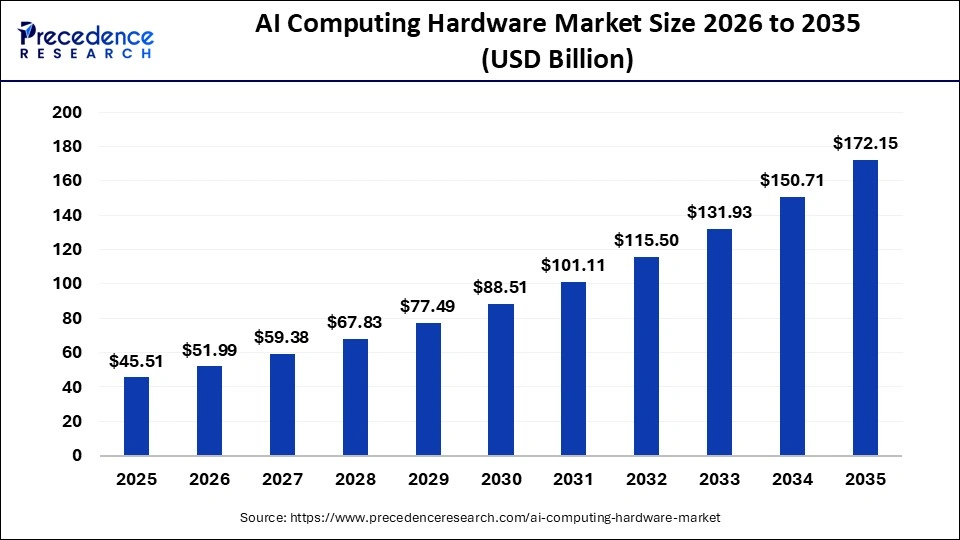
The global AI computing hardware market size was calculated at USD 45.51 billion in 2025 and is predicted to increase from USD 51.99 billion in 2026 to approximately USD 172.15 billion by 2035, expanding at a CAGR of 14.23% from 2026 to 2035. The market is driven by the increasing demand for high-performance computing solutions, the rapid growth of cloud and data center infrastructure, and the growing use of AI in enterprise and industrial segments.
Key Takeaways
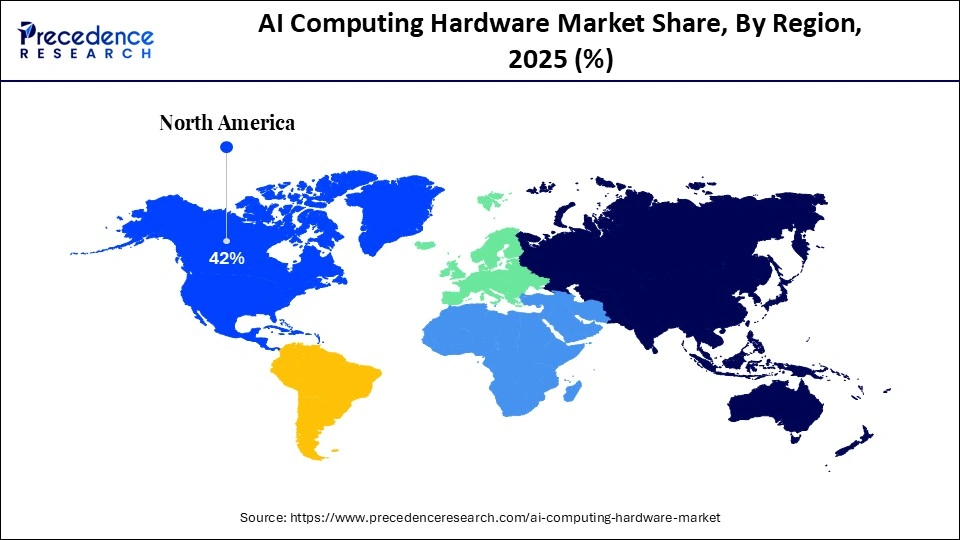
- North America led the AI Computing Hardware market with the largest market share of 42% in 2025.
- Asia Pacific is expected to grow at the highest CAGR during the forecast period.
- By type, the graphics processing unit segment led the market in 2025.
- By type, the application-specific integrated circuit segment is expected to grow at the highest CAGR during the forecast period.
- By application type, the machine learning segment led the market in 2025.
- By application type, the natural language processing segment is expected to expand at the highest CAGR from 2026 to 2035.
- By end user type, the healthcare segment led the market in 2025.
- By end user type, the automotive segment is expected to expand at the highest CAGR from 2026 to 2035.
- By form factor type, the rack-mounted systems segment led the market in 2025.
- By form factor type, the blade servers segment is expected to expand at the highest CAGR from 2026 to 2035.
Technological Shifts in the AI Computing Hardware Market
- There are various technological shifts in the market due to rapid advancements in AI. Specialized computing chips are being adopted instead of traditional CPUs as they are more powerful and efficient in handling complex calculations required in AI and deep learning.
- Computing hardware companies are developing chips that are energy-efficient to facilitate adherence to future sustainability goals.
- Computing chips are being designed in cooperation with software frameworks and libraries to optimize efficiency and computing speed in computing natural language processing and computer vision algorithms.
What is the AI Computing Hardware Market?
The AI computing hardware market involves developing hardware that is utilized to run AI-based computing systems. It involves the development of graphics processing units(GPUs), AI accelerators, field-programmable gate arrays(FPGAs), and high-performance CPUs. These components are fundamental in executing complex operations such as training machine learning models, neural network inferences, and processing large amounts of data. Hardware manufacturing companies are developing chips that are efficient in processing natural language processing and computer vision algorithms, and autonomous systems.
What are the AI Computing Hardware Market Trends?
- Collaborations and Partnerships: Technology companies are collaborating to build robust and efficient chips and systems. This allows the experts in hardware, software, and cloud computing technologies to work together, leading to better AI solutions. For instance, NVIDIA and Meta Platforms have collaborated to use GPUs and other AI hardware to improve AI solutions.
- Government Initiatives: Governments across the world are investing in AI computing infrastructure and research. This helps to improve AI computing capabilities, encourage innovation, and provide access to high-performance computing facilities for research. For instance, South Korea's Ministry of Science and ICT is developing AI computing centers to improve AI computing.
- Business Expansions: Technology companies are expanding their facilities, data centers, and supply chains to improve their AI computing abilities. This facilitates them to handle complicated data more efficiently and provide better AI solutions. For instance, NVIDIA built a new AI data center in Europe to help its clients run high-performance computing for cloud and enterprise clients.
Market Scope
| Report Coverage | Details |
| Market Size in 2025 | USD 45.51 Billion |
| Market Size in 2026 | USD 51.99 Billion |
| Market Size by 2035 | USD 172.15 Billion |
| Market Growth Rate from 2026 to 2035 | CAGR of 14.23% |
| Dominating Region | North America |
| Fastest Growing Region | Asia Pacific |
| Base Year | 2025 |
| Forecast Period | 2026 to 2035 |
| Segments Covered | Type, Application Type, End User Type, Form Factor Type, and region |
| Regions Covered | North America, Europe, Asia-Pacific, Latin America, and Middle East & Africa |
Segmental Insights
Type Insights
Why Did the Graphics Processing Unit Segment Dominate the AI Computing Hardware Market?
The graphics processing unit segment dominated the market in 2025. The market growth of this segment is because GPUs are significantly efficient in parallel processing, which is a fundamental requirement in AI applications like deep learning and neural network training. Unlike CPUs, a GPU is capable of performing thousands of calculations simultaneously, making it suitable for AI applications. There are many software frameworks like TensorFlow and PyTorch that are compatible with GPUs, making it easier to develop AI applications. GPUs are scalable and can be combined in a cluster to perform massive AI training tasks.
The application-specific integrated circuit segment is expected to grow at the highest CAGR from 2026 to 2035. The market growth of this segment is because application-specific integrated circuits(ASICs) are designed to perform one specific task and therefore offer much higher speeds and efficiency compared to general-purpose chips. AI-related tasks, such as training and inference, require massive parallel processing power, and ASIC chips can be designed precisely for such requirements. This makes them ideal for data centers, edge computing, and AI-related tasks where performance and latency are critical factors.
Application Type Insights
Why Did the Machine Learning Segment Dominate the AI Computing Hardware Market?
The machine learning segment dominated the market in 2025. The market growth of this segment is because it is the primary technology used in the implementation of AI in the majority of industries. Organizations use machine learning technology for predictive analysis, automation, and decision making, which are being used in finance, healthcare, and telecom sectors. This technology supports training and inference, which requires high-performance computing infrastructure, thereby creating demand for the same. Compared to AI, the use cases and commercialization of machine learning technology are high. The market growth of this segment is further driven by the rising need for data generation to train various automation models.
The natural language processing segment is expected to expand at the highest CAGR during the forecast period. The market growth of this segment can be attributed to the rapid rise in human-computer interaction with respect to chatbots, voice assistants, translation in real-time, and content generation. There is a significant requirement for training of natural language models, which in turn is fueling the demand for high-performance AI processors and accelerators. There is a significant demand for language AI in customer services, healthcare documents, legal analysis, and education platforms.
End User Type Insights
Why Did the Healthcare Segment Dominate the AI Computing Hardware Market?
The healthcare segment dominated the market by 2025. The market growth of this segment is because the healthcare sector needs high-performance computing to process medical applications such as imaging, diagnostics, genomics, drug discovery, and monitoring.
Hospitals and medical research facilities use high-end AI computing systems to process vast amounts of data, including medical records, for AI-based applications such as radiology, pathology, scanning, and surgical robots. The need for high accuracy and reliability in AI computing systems has prompted healthcare facilities to use premium computing hardware to satisfy their needs.
The automotive segment is expected to grow at the highest CAGR during the forecast period. The market growth of this segment can be attributed to the increasing use of AI in modern vehicles for advanced driver assistance systems(ADAS), autonomous driving, infotainment systems, and sensor processing in vehicles. These technologies demand powerful computing platforms in vehicles that can efficiently process data from cameras, radar, and LiDAR with low latency. Car manufacturers are adopting powerful AI chips and edge computing processors in vehicles to deliver better and safer mobility solutions.
Form Factor Type Insights
Why Did the Rack-Mounted Systems Segment Dominate the AI Computing Hardware Market?
The rack-mounted systems segment dominated the market in 2025. The market growth of this segment is because large-scale AI computing workloads are mostly deployed in data centers, which use the rack format as the standard. Rack-mounted systems offer high-density computing capabilities, which enable the integration of several servers, GPUs, and accelerators into a small and efficient solution. This segment is well-suited for AI model training, big data processing, and high-performance inference workloads, which demand continuous high performance.
The blade servers segment is expected to grow at the highest CAGR during the forecast period. The market growth of this segment can be attributed to the ability of blade servers to offer high computing capability in a compact space, making it suitable for AI data centers. Blade servers offer several benefits, such as sharing of power supplies, cooling systems, and networking components, which reduces costs and makes it a power-efficient solution. This segment is well-suited for scalable solutions, virtualization, and cluster-based processing environments, which require flexibility in resource allocation.
Regional Insights
North America AI Computing Hardware Market Size and Growth 2026 to 2035
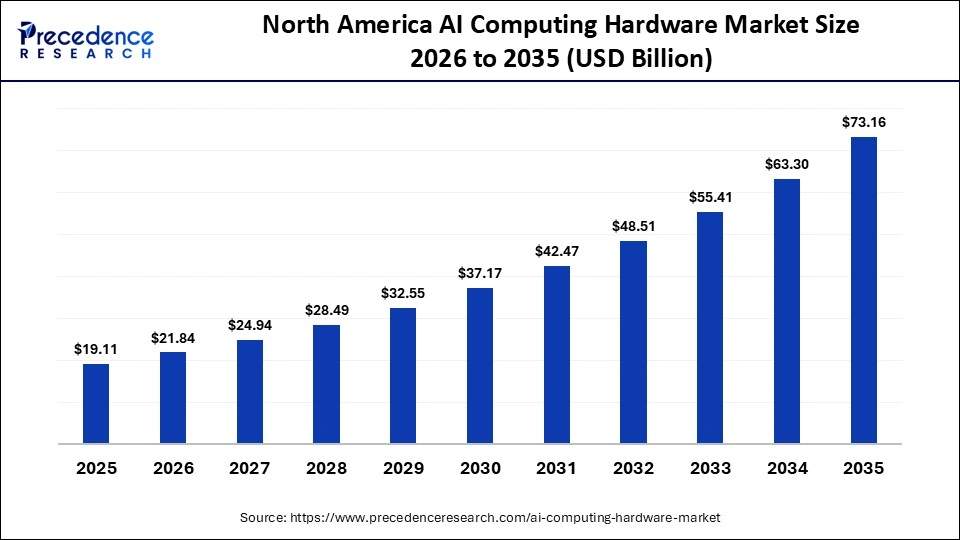
The North America AI computing hardware market market size is estimated at USD 19.11 billion in 2025 and is projected to reach approximately USD 73.16 billion by 2035, with a 14.37% CAGR from 2026 to 2035.
What Made North America the Leading Region in the AI Computing Hardware Market?
North America dominated the market in 2025. The market growth in this region is due to the significant presence of prominent technology companies, large-scale cloud infrastructure, and early adoption of AI systems in enterprises. Key players in North America, such as NVIDIA, Google, Microsoft, and Amazon Web Services, are investing a lot in AI data centers and processors. There have been significant investments in research and development, and a close association of venture capitalists with technologies in this region. The market growth in this region is further driven by the widespread adoption of AI systems in healthcare, finance, and defense sectors.
U.S. AI Computing Hardware Market Size and Growth 2026 to 2035
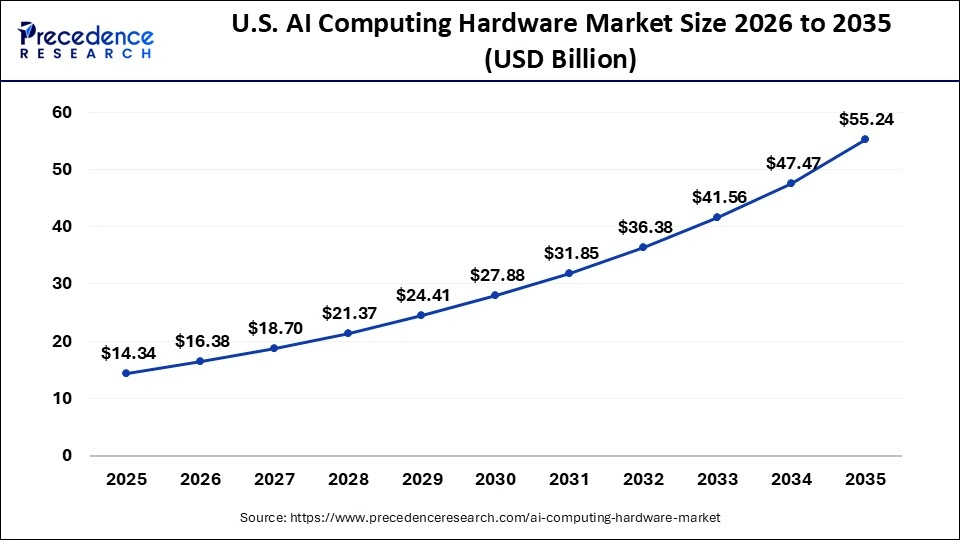
The U.S. AI computing hardware market market size is calculated at USD 14.34 billion in 2025 and is expected to reach nearly USD 55.24 billion in 2035, accelerating at a strong CAGR of 14.44% between 2026 and 2035.
U.S AI Computing Hardware Market Analysis
The U.S. leads the market in North America owing to its well-developed semiconductor design ecosystem, significant presence of hyperscale data centers, and government-funded innovation initiatives. This region benefits from a strong chip fabrication industry, a skilled AI engineering workforce, and a quick pace of adoption of emerging computer technologies. Defense technology innovation and government-funded research labs also contribute to a strong demand for high-performance AI solutions. Robust startup activity in AI silicon and edge computing also adds to a strong hardware innovation ecosystem in the U.S.
What Made Asia Pacific the Fastest Growing Region in the AI Computing Hardware Market?
Asia Pacific is expected to grow at the highest CAGR from 2026 to 2035. The market growth in this region can be attributed to rapid digitalization, increasing cloud infrastructure, and widespread adoption of AI technologies in emerging and developed economies in this region. Governments in this region are investing in AI innovation, semiconductor manufacturing, and smart city infrastructure, thus driving the demand for high-performance computing hardware. Many data centers are being built in this region to accommodate increasing internet subscribers, online shopping, fintech, and smart city initiatives.
China AI Computing Hardware Market Trends
China leads the market in the Asia Pacific because of the rapid development of indigenous semiconductor capabilities and significant investments in AI infrastructure. China is rapidly enhancing its hyperscale data centers and edge computing infrastructure to enable industrial automation, smart manufacturing, and digital government initiatives. Strong state-backed funding programs and national AI development initiatives are driving the development of high-performance computing centers. This country has a massive consumer technology market, and cloud infrastructure providers are growing rapidly, creating a robust demand for high-performance computing processors.
AI Computing Hardware Market Companies
- NVIDIA
- Intel
- Advanced Micro Devices(AMD)
- IBM
- Qualcomm
- Broadcom
- Samsung
- Huawei
- TSMC
- Microsoft
- Apple
- Tesla
- Hewlett Packard Enterprise
- Dell Technologies
Recent Developments
- In September 2025, Huawei launched two new SuperPoD products, namely Atlas 950 and Atlas 960, which consist of thousands of Ascend NPUs. This product is meant to provide the highest level of AI computing power in the industry. These products are equipped with enhanced memory and interconnect bandwidth for massive AI model training and high-speed inference. (Source: https://www.huawei.com)
- In July 2025, Broadcom announced a high-speed networking processor called Tomahawk Ultra, which is used in AI data centers to improve data communication between chips and racks. This processor is meant to improve the performance of larger AI clusters to operate efficiently. (Source: https://investors.broadcom.com)
- In March 2025, NVIDIA launched a new platform called Blackwell Ultra, which consists of a GB300 NVL72 rack-scale AI system. This platform is built using a highly advanced Blackwell architecture, which improves performance in AI training and inference by a significant margin over previous generations.(Source: https://developer.nvidia.com)
Segments Covered in This Report
By Type
- Graphics Processing Unit
- Application Specific Integration Unit
- Central Processing Unit
- Field Programmable Gate Array
By Application Type
- Machine Learning
- Natural Language Processing
- Computer Vision
- Robotics
By End User Type
- Healthcare
- Automotive
- Financial Services
- Retail
- Manufacturing
By Form Factor Type
- Rack-Mounted Systems
- Blade Servers
- Workstations
- Embedded Servers
By Region
- North America
- Latin America
- Europe
- Asia-pacific
- Middle and East Africa
For inquiries regarding discounts, bulk purchases, or customization requests, please contact us at sales@precedenceresearch.com
Frequently Asked Questions





Ask For Sample
No cookie-cutter, only authentic analysis – take the 1st step to become a Precedence Research client
 Get a Sample




 sales@precedenceresearch.com
 Schedule a Meeting
