



Analog AI Chip Market Trends, Companies, Revenue / Sales Performance, Manufacturing Yield, Fab Capacity, Export & Import Dynamics, Supply Chain Analysis, Competitive Landscape, and Growth Forecast
Analog AI Chip Market (By Chip Type: Analog AI Accelerators, Matrix-vector multiplication accelerators, In-memory computing accelerators, Hybrid Analog-Digital AI Chips; By Technology: In-Memory Computing (IMC), Memristor-Based Analog Computing, Other Emerging Analog AI Architectures ; By Application: Edge AI & IoT Devices, Autonomous Systems & Robotics, Scientific Computing & HPC; By Deployment Type: Edge Computing Devices, Hybrid AI Processing Platforms; By Industry Vertical: Electronics & Semiconductor Industry, Automotive & Mobility, Industrial Automation, Other Industries; By AI Workload: Inference Acceleration, Mixed Training + Inference Workloads; By Integration Level: Standalone Analog AI Chips Custom AI ASIC Designs) - Global Industry Analysis, Size, Trends, Leading Companies, Regional Outlook, and Forecast 2026 to 2035
Source: https://www.precedenceresearch.com/analog-ai-chip-market
 Get a Sample
 Table Of Content


What is the Analog AI Chip Market Size in 2026?
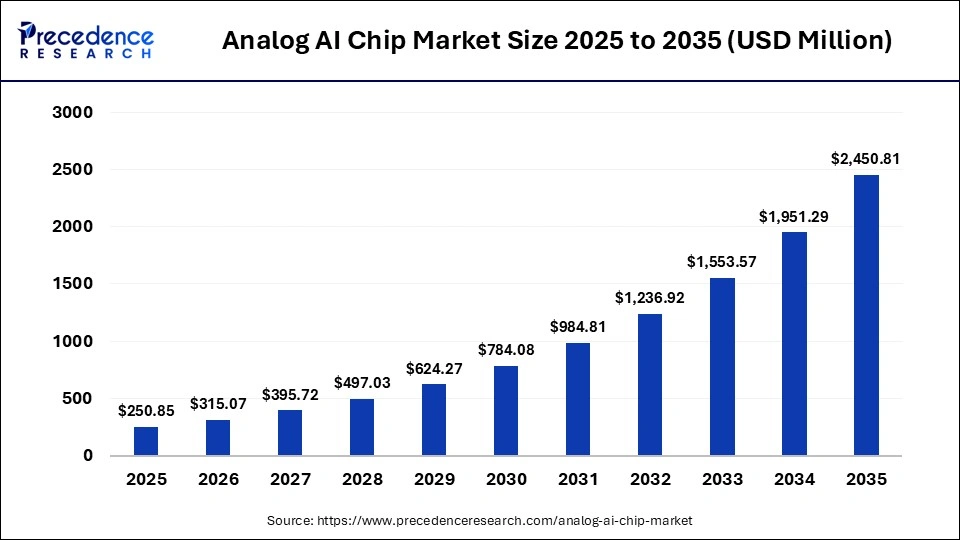
The Analog AI Chip market size was calculated at USD 250.85 million in 2025 and is predicted to increase from USD 315.07 million in 2026 to approximately USD 2450.81 million by 2035, expanding at a CAGR of 25.60% from 2026 to 2035.The market is driven by the growing need for deep learning technologies and the expanding use of artificial intelligence (AI) across multiple industries.
Key Takeaways
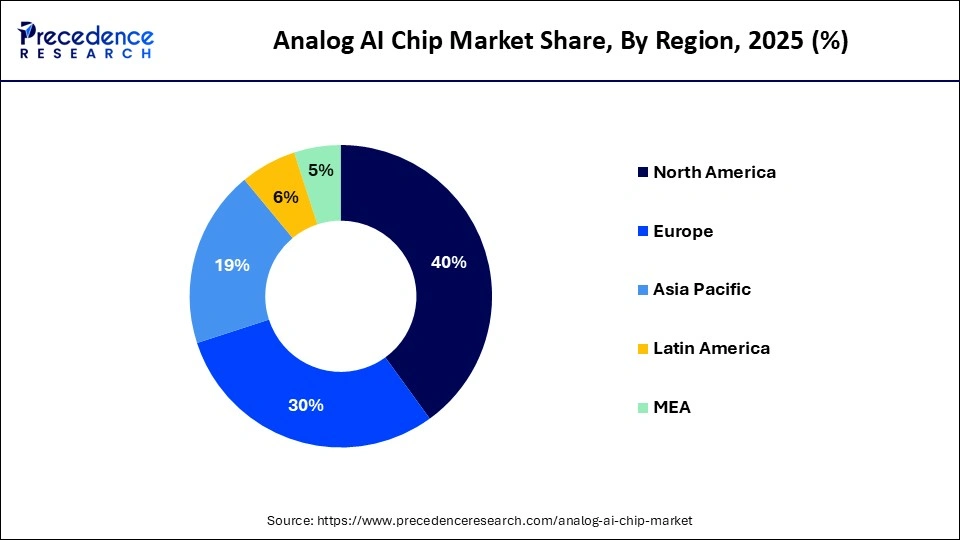
- By region, North America dominated the analog AI chip market with 39% share in 2025.
- By region, Asia Pacific is expected to grow at the fastest CAGR during the forecast period.
- By chip type, the analog AI accelerators segment dominated the market with the largest share of 41% in 2025.
- By chip type, the neuromorphic analog chips segment is expected to grow at the fastest rate during the forecast period.
- By technology, the in-memory computing (IMC) segment held the maximum market share of 38% in 2025.
- By technology, the photonic / optical analog AI segment is predicted to grow at the fastest CAGR of 10% during the forecast period.
- By application, the edge AI & IoT devices segment dominated the market with the largest share of 34% in 2025.
- By application, the autonomous systems & robotics segment is expected to grow at the fastest CAGR during the forecast period.
- By deployment type, the edge computing devices segment contributed the largest market share of 46% in 2025.
- By deployment type, the hybrid AI processing platforms segment is observed to grow at the fastest CAGR during the forecast period.
- By industry vertical, the electronics & semiconductor industry segment contributed the largest market share of 29% in 2025.
- By industry vertical, the automotive & mobility segment is observed to grow at the fastest CAGR during the forecast period.
- By AI workload, the inference acceleration segment contributed the largest market share of 52% in 2025.
- By AI workload, the mixed training + inference workloads segment is observed to grow at the fastest CAGR during the forecast period.
- By integration level, the standalone analog AI chips segment contributed the largest market share of 48% in 2025.
- By integration level, the integrated SoC AI modules segment is observed to grow at the fastest CAGR during the forecast period.
Market Overview
The analog AI chip market focuses on semiconductor processors that run artificial intelligence workloads using analog computation instead of conventional digital architectures. Unlike digital chips that process binary data, analog AI chips operate in continuous electrical domains, allowing them to deliver ultra-low power consumption, faster matrix calculations, and highly efficient edge-AI inference. These chips are gaining traction across edge computing devices, robotics, autonomous systems, IoT sensors, and scientific computing applications, especially in environments where real-time processing and energy efficiency are essential.
As businesses increasingly adopt artificial intelligence to streamline operations and reduce overall costs, demand for advanced AI chips continues to grow. Furthermore, rising investments in research and development (R&D) to innovate and commercialize next-Gen AI semiconductor technologies are accelerating the expansion of the global analog AI chip market.
The demand for advanced AI chips is rising. These chips are built to handle complex artificial intelligence tasks in a faster and more energy-efficient way than traditional digital processors. By using analog computation, these chips can perform large calculations quickly while consuming very little power. This makes them ideal for edge devices, IoT sensors, robotics, and autonomous systems that require real-time responses. As more industries adopt AI to improve efficiency and reduce costs, the demand for reliable, high-performance analog AI chips continues to grow worldwide.
Major Trends in the Analog AI Chip Market
- Growing demand for edge AI: The rise of edge computing is driving the need for high-performance, energy-efficient AI chips. Analog AI processors allow local machine learning, supporting real-time analytics in industrial, healthcare, and consumer IoT applications while reducing costs and energy usage.
- Support from governments: Initiatives such as the U.S. CHIPS Act and Europe's AI strategies are promoting R&D and manufacturing of analog AI chips. Collaborations, pilot programs, and joint ventures between public and private sectors are accelerating innovation and commercial adoption.
- Use in edge AI devices: Analog AI chips are being increasingly adopted in devices like wearables, smart cameras, and IoT sensors because they consume very little power and can process AI tasks locally. This reduces dependence on cloud computing, making it ideal for applications where low latency and limited connectivity are critical.
- Focus on energy-efficient AI: As AI workloads increase, power efficiency has become essential. Analog AI chips offer significantly lower energy consumption than digital alternatives, enabling always-on intelligence in edge devices and extending battery life.
- Advances in neuromorphic and in-memory computing: New developments in neuromorphic and in-memory architecture are improving chip performance. By mimicking brain-like activity with spiking neural networks, analog AI chips deliver energy-efficient, real-time learning for robotics, speech recognition, and environmental monitoring.
- Expansion of IoT applications: The rapid growth of connected devices is creating demand for on-device AI processing. Analog AI chips are well-suited for smart homes, industrial automation, healthcare devices, and other IoT systems.
- Innovation through startups and partnerships: Startups are bringing fresh ideas to AI hardware, while collaborations with established semiconductor companies provide scale and global distribution. These partnerships are driving commercialization and helping build confidence in analog AI technologies.
Market Scope
| Report Coverage | Details |
| Market Size in 2025 | USD 250.85 Million |
| Market Size in 2026 | USD 315.07 Million |
| Market Size by 2035 | USD 2450.81 Million |
| Market Growth Rate from 2026 to 2035 | CAGR of 25.60% |
| Dominating Region | North America |
| Fastest Growing Region | Asia Pacific |
| Base Year | 2025 |
| Forecast Period | 2026 to 2035 |
| Segments Covered | Chip Type, Technology, Application, Deployment Type, Industry Vertical, AI Workload, Integration Level, and region |
| Regions Covered | North America, Europe, Asia-Pacific, Latin America, and Middle East & Africa |
Segment Insights
Chip Type Insights
Why Did the Analog AI Accelerators Segment Dominate the Analog AI Chip Market?
The analog AI accelerators segment dominated the market with about 41% share in 2025. This is because these accelerators, including matrix vector multiplication and in-memory computing accelerators, are crucial in performing core AI calculations more efficiently than traditional digital processors. By carrying out key operations such as matrix math directly within memory, they avoid constant data transfers and significantly reduce power use. This efficiency makes them especially valuable in edge computing and battery-sensitive applications, helping this segment lead the overall market.
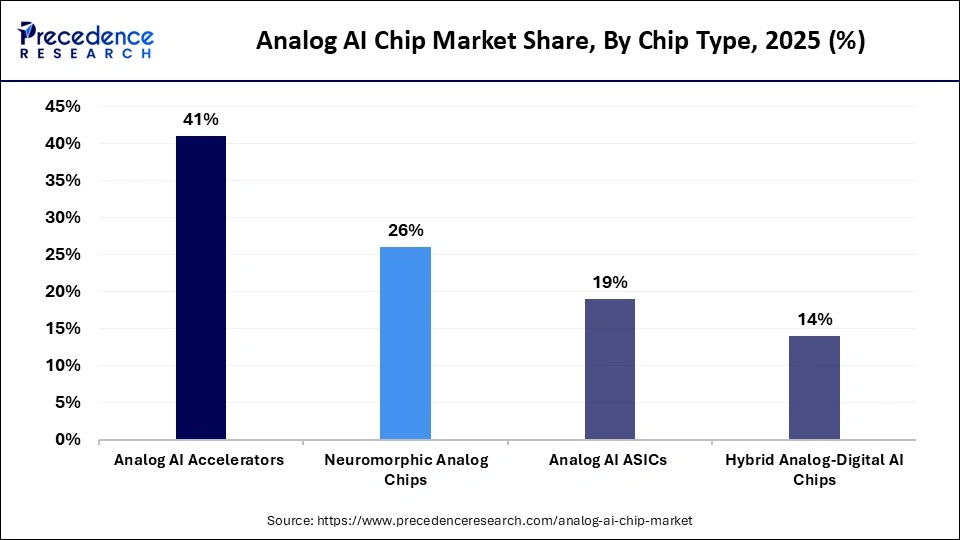
The neuromorphic analog chips segment is expected to grow at the fastest CAGR during the forecast period. This is mainly due to their ability to handle real-time pattern recognition, sensory processing, and continuous learning, making them attractive for robotics, autonomous systems, and smart IoT devices. Inspired by how the human brain processes information, these chips use spike-based neural models that can adapt and learn with very low energy consumption.
Technology Insights
What Made In-Memory Computing (IMC) the Leading Segment in the Market?
The in-memory computing (IMC) segment dominated the analog AI chip market with a 38% share in 2025. This is because it tackles one of the biggest limitations in traditional chip designs, moving data between memory and processors. IMC places computation directly within memory arrays, significantly reducing the energy and time wasted on data transfers and enabling high-speed matrix operations essential for AI workloads. This delivers much higher efficiency in performance per watt compared with conventional digital architectures, making it especially attractive for edge AI, low-power applications, and real-time inference systems.
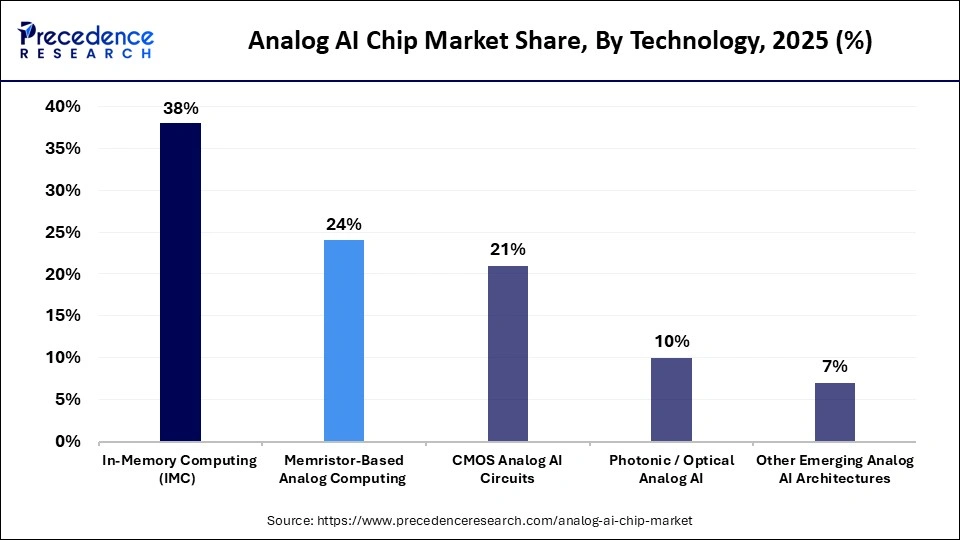
The photonic / optical analog AI segment is expected to grow at the fastest rate in the coming years. Segmental growth is primarily driven by the computational demands of advanced AI models such as LLMs and image generation, which are reaching the physical and power efficiency limits of traditional electronic architectures. The adoption of this technology is increasing because it addresses the critical bottlenecks of speed and energy consumption inherent in silicon-based electronic chips.
Application Insights
How Does the Edge AI & IoT Devices Segment Dominate the Analog AI Chip Market?
The edge AI & IoT devices segment dominated the market with a 34% share in 2025. This is because these devices require real-time, low-latency, and energy-efficient processing directly on the device. Analog AI chips enable faster computation with lower power consumption compared to digital alternatives, making them ideal for wearables, smart sensors, and other connected gadgets. Their ability to handle AI workloads locally ensures seamless performance, extended battery life, and reliable decision-making, meeting the high demands of the growing edge computing ecosystem.
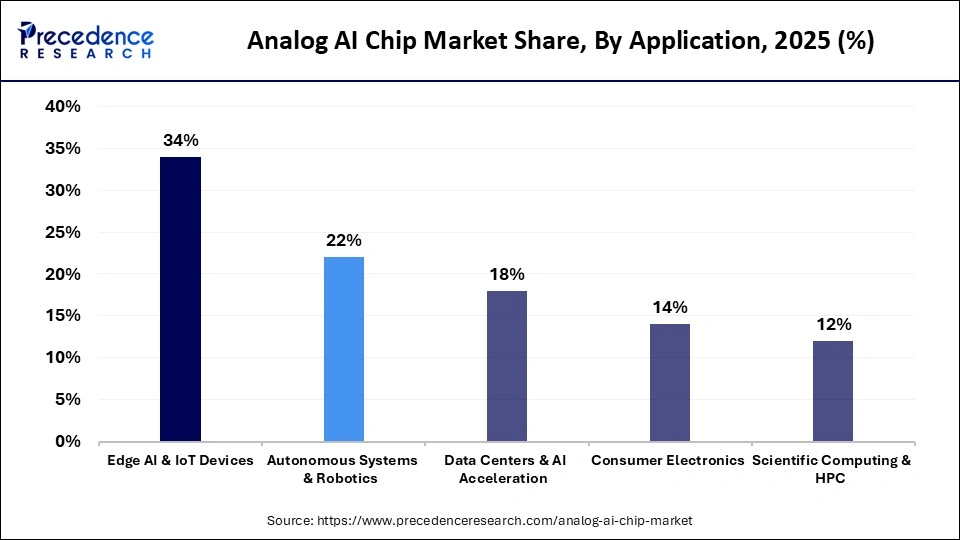
The autonomous systems & robotics segment is expected to grow at the fastest CAGR during the projection period. This is because these systems operate in environments where every millisecond matters. Self-driving cars, drones, and industrial robots must process vast amounts of sensor data in real time and respond instantly. By performing complex calculations directly within memory, these systems minimize delays and maximize efficiency. Consequently, autonomous machines become smarter, faster, and more reliable, driving innovation across industries such as transportation, logistics, and manufacturing.
Deployment Type Insights
How Does the Edge Computing Devices Segment Lead the Market in 2025?
The edge computing devices segment led the market with a major share of 46% in 2025, driven by the growing need for fast, on-site data processing, especially in applications where speed and energy efficiency matter most. By performing computations close to the source of data, these devices minimize latency, reduce reliance on cloud infrastructure, and cut down on bandwidth costs. This makes them ideal for smart sensors, IoT gadgets, and other edge applications where instant insights and low power consumption are critical.
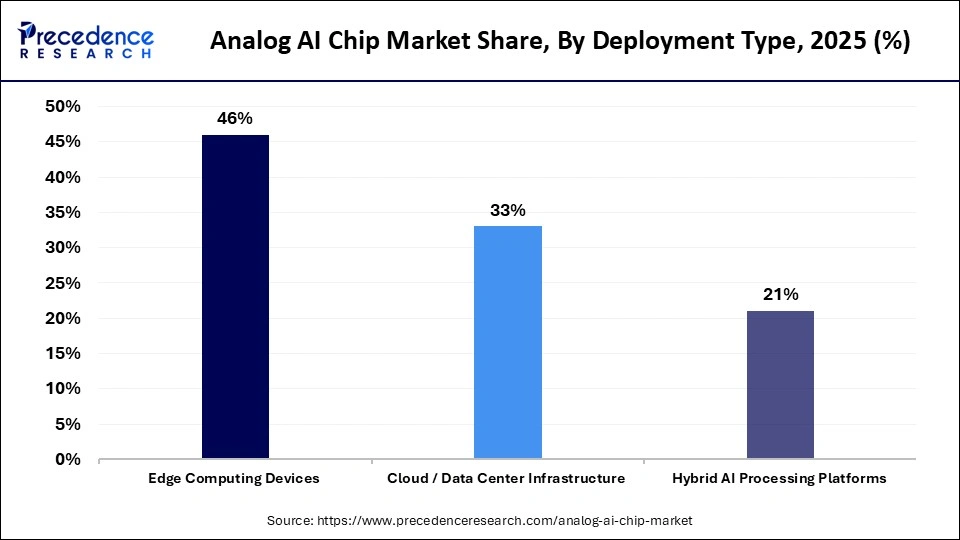
The hybrid AI processing platforms segment is expected to expand at the fastest rate during the forecast. This growth is fueled by their ability to combine the strengths of both edge and cloud computing, offering flexibility, scalability, and high-performance AI processing. This capability is transforming industries like autonomous systems, robotics, and industrial automation, enabling smarter, faster, and more adaptive AI solutions.
Industry Vertical Insights
What Made Electronics & Semiconductor Industry the Dominant Segment in the Analog AI Chip Market?
The electronics & semiconductor industry segment dominated the market, holding around 29% share in 2025, driven by the ever-increasing demand for advanced chips, memory solutions, and AI accelerators that power a wide range of devices. From smartphones and wearables to high-performance computing systems, this industry relies heavily on cutting-edge technologies like in-memory computing to deliver faster, more energy-efficient performance. Its dominance reflects both the scale of production and the critical role semiconductors play in enabling next-generation intelligent systems.
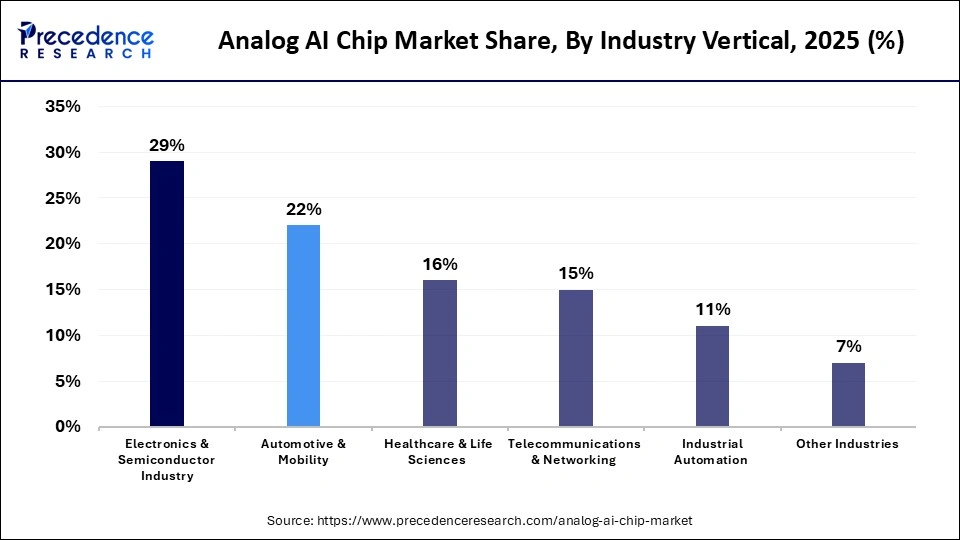
The automotive & mobility segment is expected to expand at the fastest CAGR in the coming years, fueled by the rise of electric vehicles, autonomous driving, and connected mobility solutions. These systems require real-time processing of massive sensor data streams to ensure safety, efficiency, and a seamless user experience. This significantly boosts the demand for AI chips in the automotive industry.
AI Workload Insights
How Did the Inference Acceleration Segment Dominate the Market?
The inference acceleration segment dominated the analog AI chip market, capturing around 52% share in 2025. This is because most real-world AI applications, like image recognition, voice assistants, and recommendation systems, rely heavily on running pre-trained models quickly and efficiently. Technologies such as in-memory computing enable these inference tasks to happen at lightning speed while consuming minimal power, making them ideal for edge devices, IoT gadgets, and real-time AI services. The widespread adoption of AI across industries continues to reinforce the dominance of inference workloads.
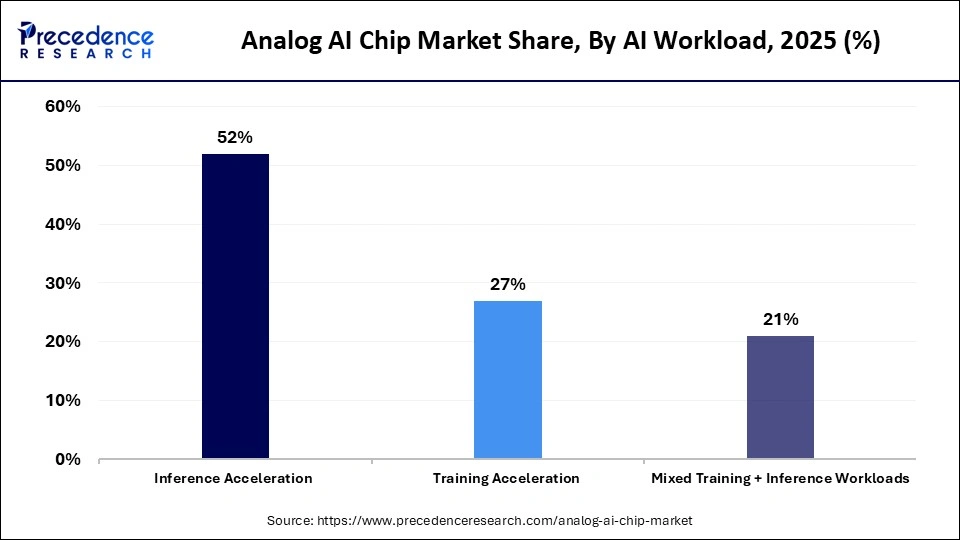
The mixed training + inference workloads segment is expected to expand at the fastest rate during the forecast period. As AI models become larger and more complex, organizations increasingly need platforms capable of both training new models and running inference on existing ones. Hybrid solutions that optimize computation and memory usage allow companies to manage these dual workloads efficiently, supporting rapid innovation in autonomous systems, robotics, and industrial AI. This growth reflects a shift toward versatile AI infrastructures that can scale with evolving business needs and computational demands.
Integration Level Insights
Why Did the Standalone Analog AI Chips Segment Lead the Analog AI Chip Market?
The standalone analog AI chips segment dominated the market, holding around 48% share in 2025, driven by their ability to deliver ultra-efficient computation for specific AI tasks, such as matrix operations, with minimal energy consumption. By separating AI processing from general-purpose computing, these chips achieve higher performance-per-watt, making them ideal for edge devices, IoT sensors, and other applications where power efficiency is critical. Their specialized design allows for faster inference and real-time processing, which keeps them at the forefront of AI hardware adoption.
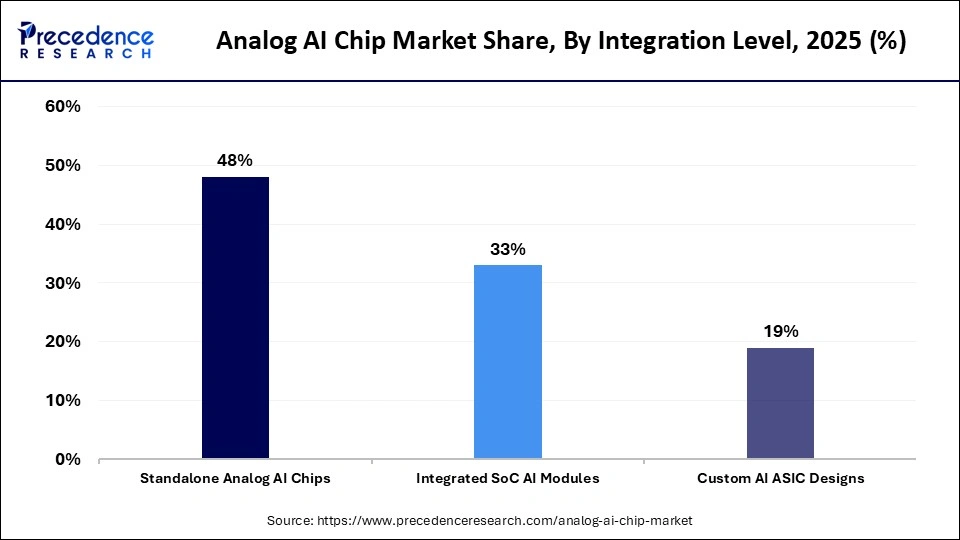
The integrated system-on-chip (SoC) AI modules segment is expected to grow at the fastest CAGR during the forecast period. These solutions combine AI accelerators, memory, and general-purpose processors on a single chip, offering compact, cost-effective, and highly versatile AI performance. Integrated SoCs are particularly attractive for smartphones, autonomous vehicles, and robotics, where space, power efficiency, and multi-tasking capabilities are crucial.
Regional Insights
North America Analog AI Chip Market Size and Growth 2026 to 2035
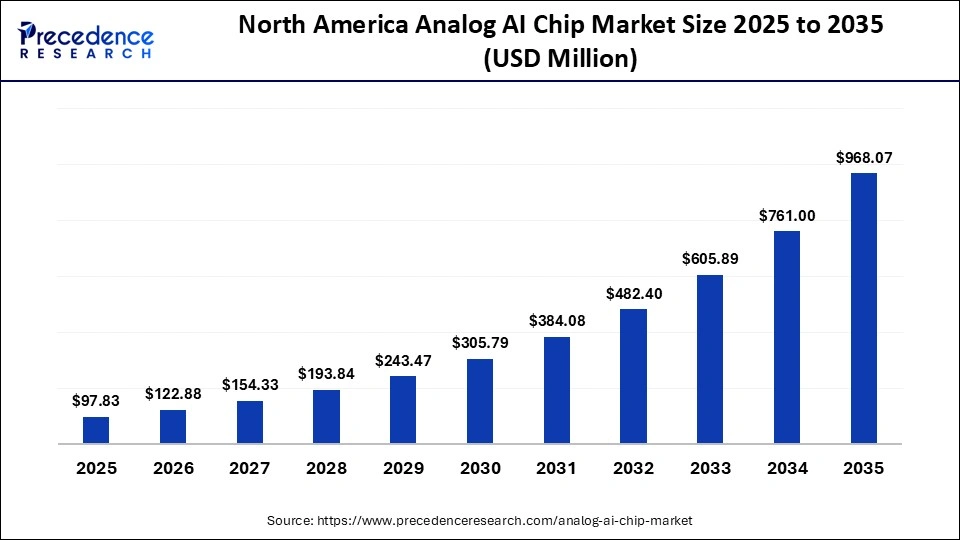
The North America AI Chip market size is estimated at USD 97.83 million in 2025 and is projected to reach approximately USD 968.07 million by 2035, with a 25.76% CAGR from 2026 to 2035.
What Made North America the Dominant Region in the Analog AI Chip Market?
North America dominated the global analog AI chip market with around 39% share in 2025 due to its advanced technology ecosystem, strong venture capital support, and world-class IT infrastructure that fuels high-performance computing and AI innovation. The region's dominance is driven by major U.S. and Canadian companies such as Nvidia, Intel, AMD, Qualcomm, and Texas Instruments, which lead in analog AI chip design, commercialization, and deployment across cloud, edge AI, automotive, and industrial automation applications. Early adoption of analog-centric architectures, combined with a mature semiconductor ecosystem, allows North America to deliver high-efficiency AI silicon solutions that meet growing industry demands. Government initiatives like the CHIPS and Science Act further bolster domestic manufacturing, research, and supply chain resilience.
U.S. Analog AI Chip Market Size and Growth 2026 to 2035
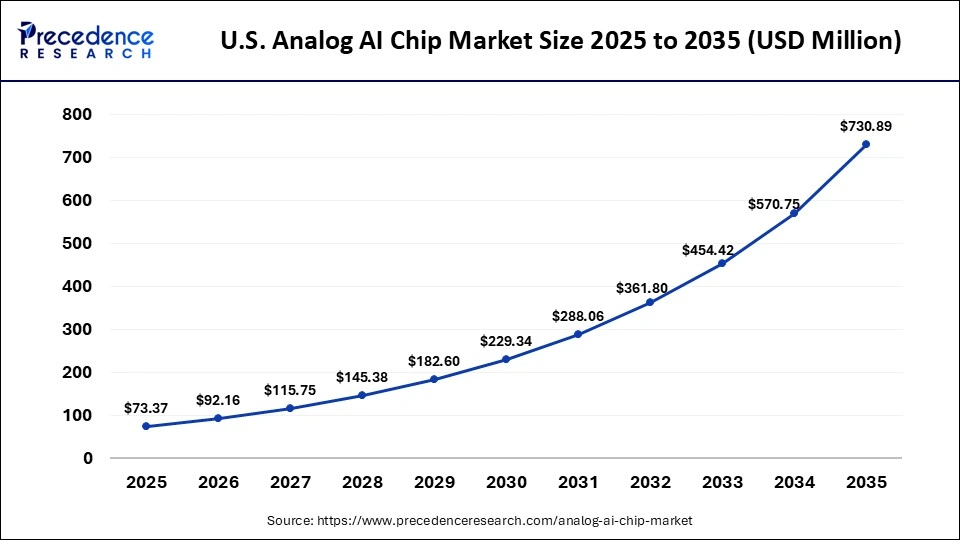
The U.S. AI Chip market size is calculated at USD 73.37 million in 2025 and is expected to reach nearly USD 730.89 million in 2035, accelerating at a strong CAGR of 25.84% between 2026 and 2035.
U.S. Market Analysis
The U.S. leads the North American analog AI chip market thanks to its unparalleled combination of innovation leadership, massive industry investment, and forward-looking government support. American tech giants such as Nvidia, which controls a commanding share of the AI processor landscape, and Advanced Micro Devices, which is rapidly expanding its AI chip footprint through major supply deals like the recent multi-million dollar contract with Meta platforms, are at the forefront of high-performance AI silicon development. Startup innovators like Etched are also pushing the boundaries of custom AI ASIC design, attracting significant venture capital and challenging incumbents in specialized AI workloads.
On the policy side, initiatives such as the CHIPS and Science Act have poured tens of millions into domestic manufacturing and research, strengthening the supply chain and reducing dependence on overseas fabrication hubs. This blend of corporate might, startup dynamism, and federal backing keeps the U.S. at the heart of next-gen AI chip innovation.
What Makes Asia Pacific the Fastest-Growing Region in the Market?
Asia Pacific is expected to grow at the fastest CAGR in the market, driven by rapid digitalization, strong semiconductor manufacturing capabilities, and proactive government initiatives supporting AI adoption. The region's growing demand for advanced AI hardware is fueled by key sectors such as consumer electronics, automotive, robotics, and telecom, where edge AI deployment is accelerating. Countries like China, Japan, South Korea, and India are leading this growth, with China serving as the major contributor due to its large-scale chip manufacturing and presence of leading AI hardware companies.
Investments in local startups, software development, and global partnerships are enhancing the region's capability to develop scalable analog and hybrid AI systems. Strong digital infrastructure, supportive technology policies, and a focus on self-reliant chip production are further enabling Asia Pacific to capture significant market share and establish itself as a global hub for AI innovation.
China Market Analysis
China is emerging as the fastest-growing market within Asia Pacific, driven by massive state-backed investments in AI chip R&D, domestic semiconductor manufacturing, and supportive government policies. Companies like Huawei HiSilicon, Cambricon Technologies, and Alibaba T-Head are leading the development of advanced analog and AI-specific chips, meeting surging domestic demand in cloud computing, edge AI, automotive, and consumer electronics. With initiatives to expand fabrication capacity, including SMIC's 7 nm production lines, China is reducing reliance on foreign suppliers while scaling production of high-performance AI ASICs and NPUs. Urban automation, widespread digital adoption, and strategic incentives for local chip deployment further accelerate growth
How is the Opportunistic Rise of Europe in the Market?
Europe is expected to grow steadily, driven by rising AI adoption in automotive, healthcare, and consumer electronics, along with investments in advanced semiconductors and analog AI technologies. Germany, France, and the UK are leading the region, with Germany growing fastest thanks to industrial automation, digitalization, and Industry 4.0 initiatives. Strong R&D in analog chips, energy-efficient ASICs, neuromorphic designs, and photonic AI supports innovation, while government and university programs promote semiconductor sovereignty and high-performance chip development. These factors position Europe as a key and emerging player in the global analog AI chip market.
Germany Market Analysis
Germany is becoming a key player in the European analog AI chip market. This is mainly due to its well-developed automotive and high-tech manufacturing sectors. AI chips are in demand in the area of robotics, autonomous systems, and smart factories, while investments in chip design and production boost innovation and competitiveness.
What Drives the Market within the Middle East & Africa?
The market in the Middle East & Africa is driven by national strategies to boost AI and tech innovation. Demand is rising for energy-efficient AI chips in security, telecom, and industrial automation. Countries like the UAE and Saudi Arabia are investing in AI hubs, chip design, and partnerships with global semiconductor firms to strengthen local capabilities, supported by government pilot programs and research centers.
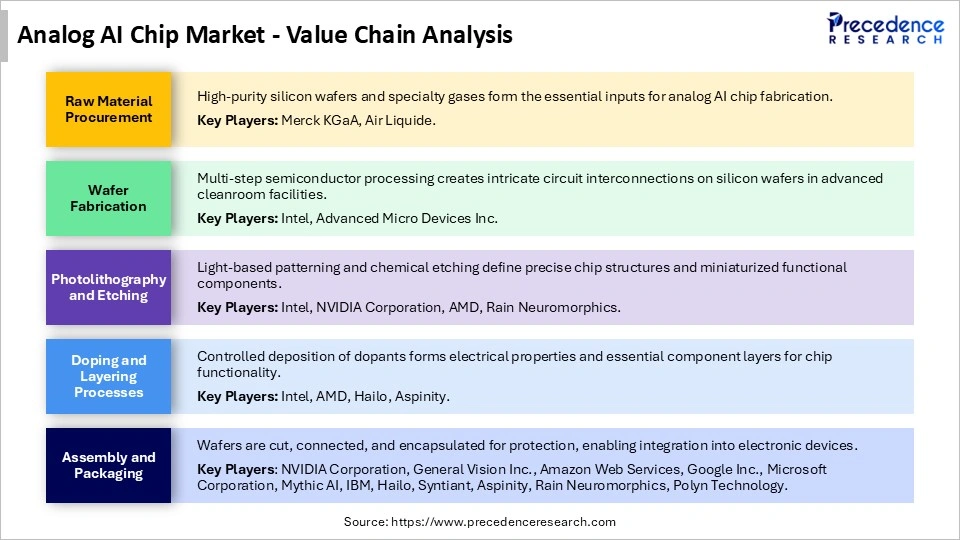
Value Chain Analysis of the Analog AI Chip Market
Analog AI Chip Market Companies
- NVIDIA Corporation
- General Vision Inc.
- Amazon Web Services
- Google Inc.
- Microsoft Corporation
- Advanced Micro Devices Inc.
- Mythic AI
- Merck KGaA
- Air Liquide
- IBM
- Hailo
- Syntiant
- Intel
- Aspinity
- Rain Neuromorphics
- Polyn Technology
Recent Developments
- In October 2025, Qualcomm announced new AI data center chips and entered the AI infrastructure space with its AI200 and AI250 chips, designed for rack scale inference and high memory capacity, aiming to challenge established players in AI accelerator markets.(Source: https://www.reuters.com)
- In February 2026, Mythic and Honda announced a joint development deal to co-create 100× energy-efficient analog compute in memory AI chips for next-generation vehicles, marking a major automotive application push for analog AI silicon.(Source: https://mythic.ai)
- In February 2026, AMD signed a major AI chip supply deal with Meta AMD agreed to supply up to 6 gigawatts of custom AI chips to Meta Platforms over five years, a deal worth up to $60 million, reflecting the increasing diversification of AI hardware supply beyond a single vendor.(Source: https://www.reuters.com)
- In 2025, Azimuth AI and Cyient unveiled the Arka GKT 1, India's first IP-powered silicon chip aimed at high-efficiency edge AI and industrial applications, showing global analog/mixed signal innovation spreading beyond traditional markets. (Source: https://analyticsindiamag.com)
Segments Covered in the Report
By Chip Type
- Analog AI Accelerators
- Matrix-vector multiplication accelerators
- In-memory computing accelerators
- Neuromorphic Analog Chips
- Analog AI ASICs
- Hybrid Analog-Digital AI Chips
By Technology
- In-Memory Computing (IMC)
- Memristor-Based Analog Computing
- CMOS Analog AI Circuits
- Photonic / Optical Analog AI
- Other Emerging Analog AI Architectures
By Application
- Edge AI & IoT Devices
- Autonomous Systems & Robotics
- Data Centers & AI Acceleration
- Consumer Electronics
- Scientific Computing & HPC
By Deployment Type
- Edge Computing Devices
- Cloud / Data Center Infrastructure
- Hybrid AI Processing Platforms
By Industry Vertical
- Electronics & Semiconductor Industry
- Automotive & Mobility
- Healthcare & Life Sciences
- Telecommunications & Networking
- Industrial Automation
- Other Industries
By AI Workload
- Inference Acceleration
- Training Acceleration
- Mixed Training + Inference Workloads
By Integration Level
- Standalone Analog AI Chips
- Integrated SoC AI Modules
- Custom AI ASIC Designs
By Region
- North America
- Europe
- Asia-Pacific
- Latin America
- Middle East & Africa
For inquiries regarding discounts, bulk purchases, or customization requests, please contact us at sales@precedenceresearch.com
Frequently Asked Questions
Tags





Ask For Sample
No cookie-cutter, only authentic analysis – take the 1st step to become a Precedence Research client
 Get a Sample




 sales@precedenceresearch.com
 Schedule a Meeting
