



Anti-Aging Ingredients Market Trends, Leading Companies, Company Revenue / Sales Performance, Plant Utilization, Production Volume, Pricing Dynamics, Supply Chain Performance, Competitive Landscape, and Industry Growth
Anti-Aging Ingredients Market (By Ingredient Type: Antioxidants (Vitamin C, E, and A), Peptides, Moisturizers, Exfoliators; By Product Category: Serum and Essences, Moisturizer and Lotions, Facial Cleaners and Exfoliators, Masques and packs, Supplements; By Target Group: Women, Men, Unisex, Sensitive skin; By Application: Facial Care, Skin Care, Hair Care, Body Care, Cosmetics) - Global Industry Analysis, Size, Trends, Leading Companies, Regional Outlook, and Forecast 2026 to 2035
Source: https://www.precedenceresearch.com/anti-aging-ingredients-market
 Get a Sample
 Table Of Content


What is the Anti-Aging Ingredients Market Size?
The global anti-aging ingredients market size is calculated at USD 11.24 billion in 2025 and is predicted to increase from USD 11.93 billion in 2026 to approximately USD 20.26 billion by 2035, expanding at a CAGR of 6.07% from 2026 to 2035. The rising demand for the anti-aging ingredients market is experienced due to the increasing conscious awareness of protecting one's own skin from external stress and encouraging renewed skin.
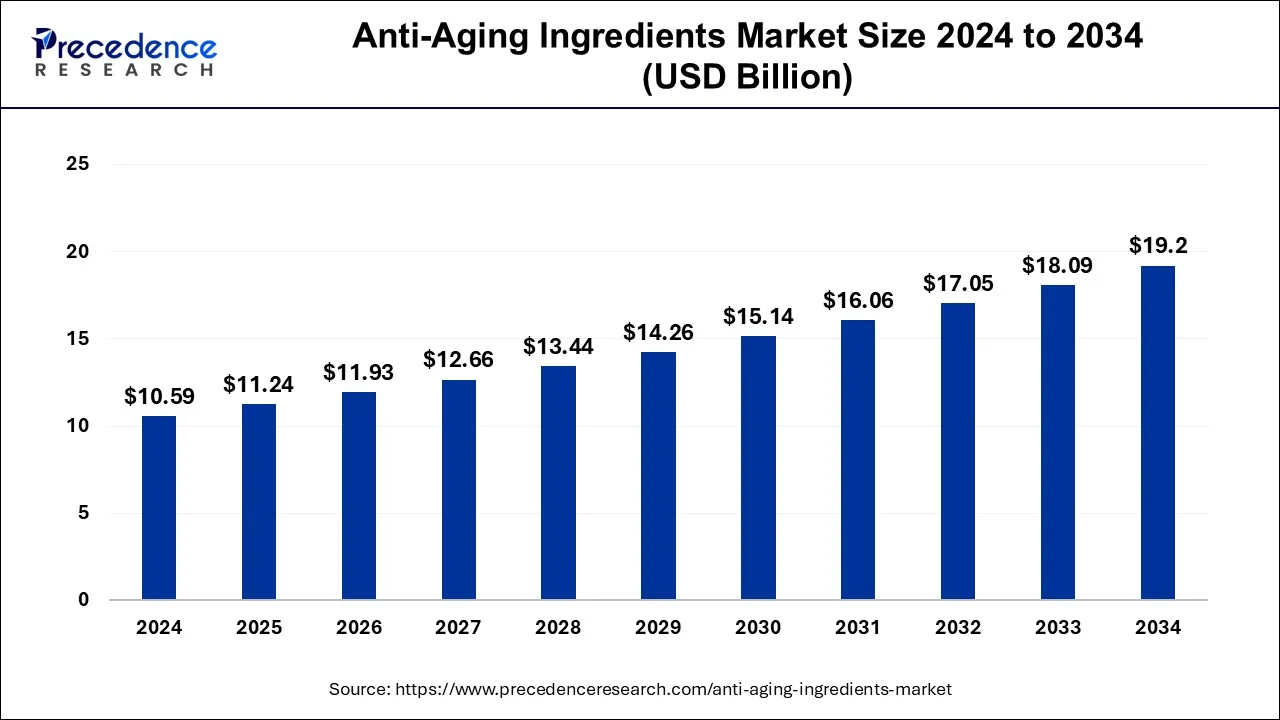
Anti-Aging Ingredients Market Key Takeaways
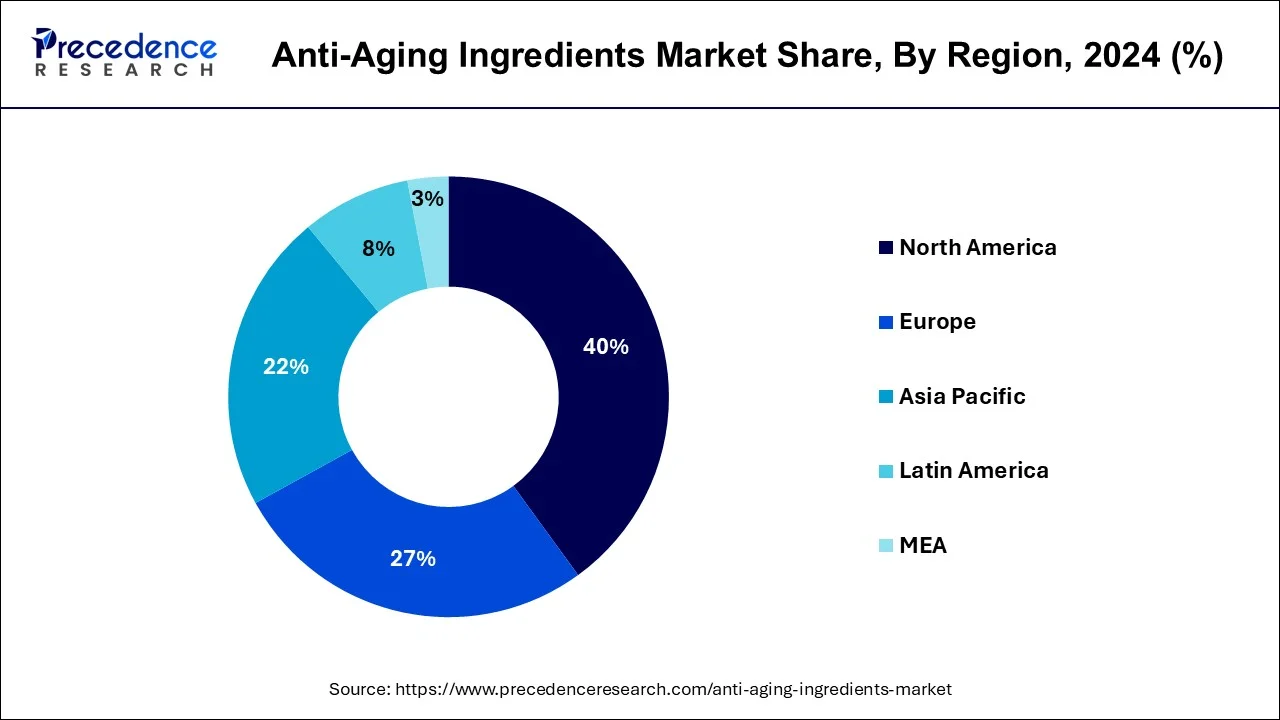
- North America dominated the global market with the largest market share of 40% in 2025.
- Asia Pacific is anticipated to witness the fastest growth during the forecasted years.
- By ingredient type, the antioxidants segment contributed the highest market share in 2025.
- By ingredient type, the peptide segment will witness significant growth during the forecast period.
- By product category, the serums and essences segment contributed the largest market share in 2025.
- By product category, the moisturizer and lotions segment is expected to grow at the fastest CAGR during the forecast period.
- By target group, the women segment captured the biggest market share of the in 2025.
- By target group, the men segment is projected to grow at a significant CAGR during the forecast period.
- By application, the facial care segment generated the major market share of 2% in 2025.
- By application, the skin care segment is expected to grow at the fastest CAGR during the forecast period.
Market Overview
Anti-aging ingredients are chemically formulated products that help get rid of issues that come with older age, including fine lines, wrinkles, less elasticity, and uneven tone. Aging is a natural process; however, incorporating some skincare products into daily skincare routine with specific active ingredients can help reduce these effects and maintain youthful skin. Chemical peels and exfoliants are two commonly used techniques to eliminate aging signs and improve skin conditions. For an immediate result, dermatologists recommend undergoing medical treatments such as prescription creams, injections, chemical peels, microneedling, and laser treatments. Skin protection from direct sun exposure also prevents early signs of aging to an extent by including sunscreen in a daily skincare regime.
- A study conducted by NEOSTRATA reveals that 56% of Gen Z women and 57% of millennials feel stressed about aging, compared to 46% of Gen X and only 31% of baby boomers.
- The first common signs of aging noticed after 40 are fine lines on the face (44%), forehead wrinkles (32%), and age spots (32%).
How Artificial Intelligence (AI) is Changing Anti-Aging Ingredients Market
Integration of artificial intelligence technology is expected to revolutionize the beauty and cosmetics industry. Artificial intelligence in the anti-aging ingredients market utilizes datasets at the molecular, genetic, and biophysical information levels to gain a deeper understanding and help strengthen skin resilience. AI also plays a crucial role in the appearance and stimulation of skin, along with hair and nails. AI-driven technology contributes to skin aging research through method development and data acquisition, interpretation, and evaluation. Additionally, it supports drug development, optimizes treatment, and aids in proving the effectiveness of personalized approaches.
- In June 2024, Lancôme upgraded its absolute Precious Cells Rose Drop Eye Cream with meticulously selected anti-wrinkle ingredients using AI technology. AI has significantly contributed to product research, leaving behind the traditional analysis speed.
Anti-Aging Ingredients Market Growth Factors
- Reduce wrinkles: Incorporation of ingredients such as retinoids (derived from vitamin A), which makes the skin smoother with the help of collagen and vitamin C, which helps to get rid of fine lines and lessen the damage caused by the sun.
- Improves skin texture: Serums with ingredients such as retinoids, peptides, and antioxidants have the ability to stimulate collagen production, which supports healthy aging and minimizes rough, dull, loose, and discolored changes through active ingredients.
- Protects against environmental damage: Products containing hyaluronic acids, ceramides, and glycerine create a skin barrier, keeping the skin well-hydrated with good moisturizer and strengthening it.
- Age spots: Hydroquinone is an over-the-counter drug that bleaches the skin, fading away the dark spots. Vitamin C is also a great ingredient to fade age spots within 12 weeks. Along with that kojic acids help in skin whitening.
- Skin elasticity: The application of serums or creams with fortified hyaluronic acids helps in skin regain its natural elasticity.
Market Scope
| Report Coverage | Details |
| Market Size in 2025 | USD 11.24 Billion |
| Market Size in 2026 | USD 11.93 Billion |
| Market Size by 2035 | USD 20.26 Billion |
| Market Growth Rate from 2026 to 2035 | CAGR of 6.07% |
| Leading Region | North America |
| Fastest Growing Region | Asia Pacific |
| Base Year | 2025 |
| Forecast Period | 2026 to 2035 |
| Segments Covered | Ingredient Type, Product Category, Target Group, Application, and Regions |
| Regions Covered | North America, Europe, Asia-Pacific, Latin America, and Middle East & Africa |
Market Dynamics
Driver
Increasing adoption of cosmetics and skin care
People are becoming more conscious and learning the importance of skincare. People understand how anti-aging products can help to prevent wrinkles, age spots, and other signs of aging. Along with that, it enhances the overall complexion and makes them look best. Lifestyle changes contribute to the growth of skincare. Poor diet and prolonged exposure to skin damage the skin, breaking its protective barrier, which increases the adoption of the anti-aging ingredients market to create a positive impact on the skin.
Restraint
High cost
There is a high cost associated with the production of active ingredients in anti-aging products, which keeps the price elevated. Some main ingredients are priced at tens of thousands of RMB per kilogram, leading to the end products bearing hefty price tags. The high cost is driven by research expenses, and the development of new products and formulation requires a great investment. Luxury brands in the anti-aging ingredients market produce small batches of products to maintain quality and increase the cost. Furthermore, greater marketing campaigns and retailer markups contribute to the expensiveness of the product.
Opportunity
Getting rid of the glycation process
The research and development department at Beiersdoft has ultimately revealed the secret behind achieving longtime and perfect anti-aged skin. Various scientific studies show that excessive sugar consumption has negative impacts on the skin and causes wrinkles. For the last ten years, the company has been working on discovering the importance of Q10 in skin aging. Co-enzyme Q10 in skin care is an essential active ingredient in the anti-aging field. NIVEA was the first brand to launch Q10 products more than 25 years ago. However, the innovation of NAHP- N-Acetyl-L-hydroxyproline helps in preventing the glycation reaction from occurring and prevents the formation of advanced glycation end product (AGEs) at a 68% rate by weakening the sugar molecules before they can bind with proteins and weaken collagen fibers. The combination of GLYCOSTOP and anti-wrinkle active ingredient Q10 is a cutting-edge blend to prevent skin from aging.
Anti-Aging Ingredients Market Segment Insights
Ingredient Type Insights
The antioxidants segment dominated the global anti-aging ingredients market in 2025. The dominance of this segment is noticed as antioxidants neutralize the free radicals and protect the skin from damage. Free radicals cause oxidative stress and accelerate the aging process. Common antioxidant ingredients are vitamin C, retinol and niacinamides. Antioxidants help fight against the visible signs of aging and calm the skin. It brings a youthful appearance and revitalizes dull-looking skin, which can be caused by airborne pollutants and blue light exposure.
The peptide segment will witness significant growth in the anti-aging ingredients market during the forecast period. The growth of this segment is mainly observed as peptides are amino acids that are essential fragments of proteins such as collagen and elastin. This specifically targets the key factors in aging and makes the skin loot form and more resilient. According to the survey, 25 to 30 years of age is the ideal age for starting to use peptides. Growth hormone stimulants such as CJC 1295 and Ipamorelin are two of the most used anti-aging peptides.
Product Category Insights
The serums and essences segment contributed the largest share of the anti-aging ingredients market in 2025. The dominance of this segment is credited to its nourishing properties, which have become an essential part of the daily skin care regimen for millions of people globally. The serum and essences are originally from the K-beauty industry. The product acts as a primer for the moisturizer, offering a lot of extra benefits to the skin. Commonly found active ingredients are retinol, peptides, and vitamin C, which boost collagen production and encourage cell growth.
The moisturizer and lotions segment is expected to grow at the fastest CAGR in the anti-aging ingredients market during the forecast period. The growth of this segment is observed as moisturizer temporarily adds some fullness to the skin, helping to reduce fine lines and wrinkles. The presence of active ingredients such as vitamin C, retinol, ceramides, and various exfoliating skin care acids is found according to the skin type and concerns.
- In October 2024, The Cetaphil Healthy Renew Night Cream is one beauty product that offers the anti-aging benefits of retinol, without dry patches or irritation, offered by the alternative retinol ingredient- purified peptide.
Target Group Insights
The women segment captured the biggest share of the anti-aging ingredients market in 2025. A survey states that 75% of women recognized fine lines and wrinkles as early signs of aging, and only 42% are using targeted anti-aging solutions. This data determines the lack of awareness among consumers about the right aging regime and the value-added products to address aging signs. Additionally, 85% of women wanted to start attending to these skin aging issues sooner.
The men's segment is projected to grow at a significant CAGR in the anti-aging ingredients market during the forecast period. Anti-aging products for men include a basic list of items such as moisturizers, serums, and eye creams. The products are formulated for men's thicker skin and lightweight properties, which absorb into the skin, minimizing the appearance of wrinkles and lines.
Application Insights
The facial care segment captured the biggest share of the anti-aging ingredients market in 2025. The aging signs are predominantly visible on the face after their 30s. Most people start to notice the changes in their faces around the ages of 40 and 50. Fine lines appear first, and wrinkles, a loss of volume, and a loss of elasticity become noticeable over time. Applying UV protection of at least SPF 30 or higher and wearing protective clothes can prevent aging on the face.
The skin care segment is expected to grow at the fastest CAGR in the market during the forecast period. The expansion of this segment is observed as people are becoming more aware of the importance of taking care of the entire body of skin and not just facial skin. Using widely available vitamin C, niacinamide, retinol, and peptide-incorporated skincare products for entire body skin, including body wash, lotion, masks, scrubs, and many more. They have shown incredible results, fading dark spots, loose skin, and uneven texture.
Anti-Aging Ingredients Market Regional Insights
What is the U.S. Anti-Aging Ingredients Market Size?
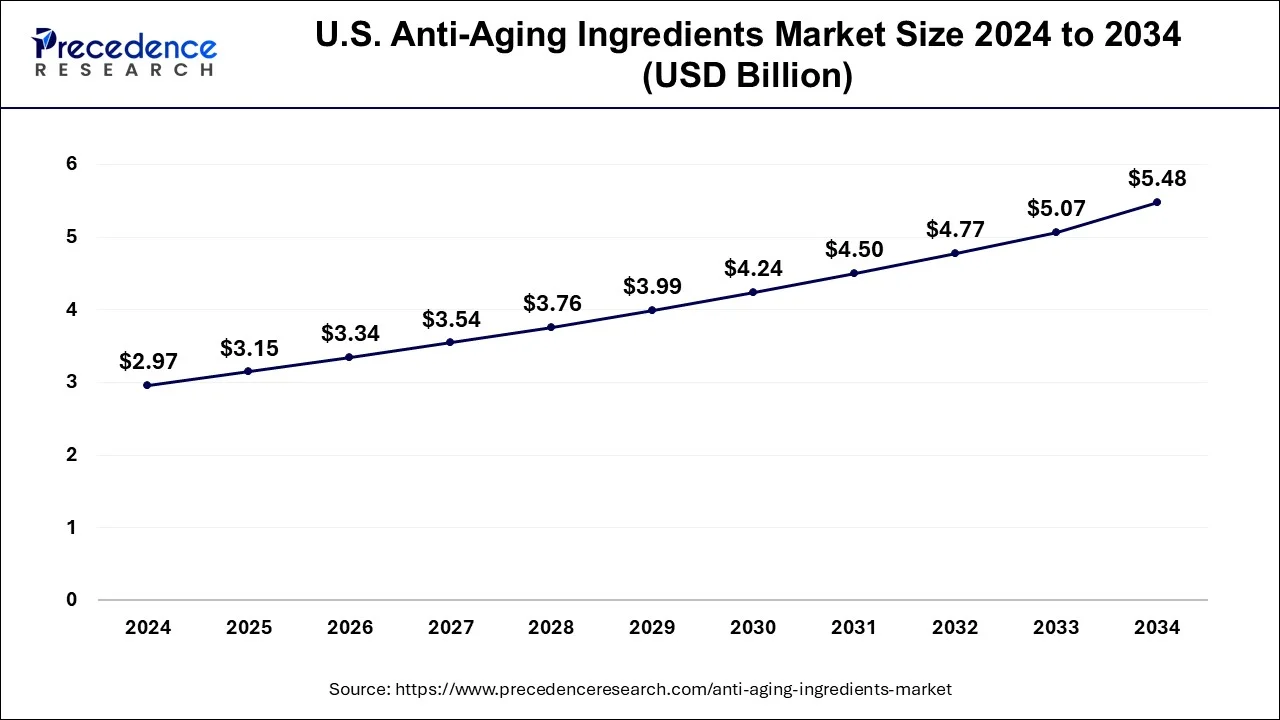
The U.S. anti-aging ingredients market size is evaluated at USD 3.34 billion in 2026 and is projected to be worth around USD 5.82 billion by 2035, growing at a CAGR of 6.33% from 2026 to 2035.
What Factors Make North America the Leader in the Anti-Aging Ingredients Market?
North America dominated the global anti-aging ingredients market in 2025. The dominance of the region is noticed due to the rising awareness regarding anti-aging and its benefits. There has been a high adoption of skincare products, particularly anti-aging products, as the population is experiencing signs of aging due to increasing pollution, stress, and unhealthy lifestyles. In the States, skincare is a treatment approach; when the skin is already damaged, people start opting for anti-aging products to treat it. Apart from the United States, Canada also has the biggest skincare and cosmetic industry. Additionally, the American population has adopted skin-tightening and cellulite-reducing treatments and products significantly.
Why Is Asia Pacific Expected to Witness the Fastest Growth in the Anti-Aging Ingredients Market?
Asia Pacific is anticipated to witness the fastest growth in the anti-aging ingredients market during the forecasted years. The growth of the region is observed due to Japan and South Korea having the largest skincare revenue per capita. The rapidly growing population in countries such as Japan, South Korea, China, and Singapore is encouraging growth. Asian skin care products are cost-effective as they feature sleek and minimalist packaging, unlike Western beauty brands. The priority is on the quality of the product and not the packaging. Korean skincare is more towards a preventative approach.
Anti-Aging Ingredients Market Companies
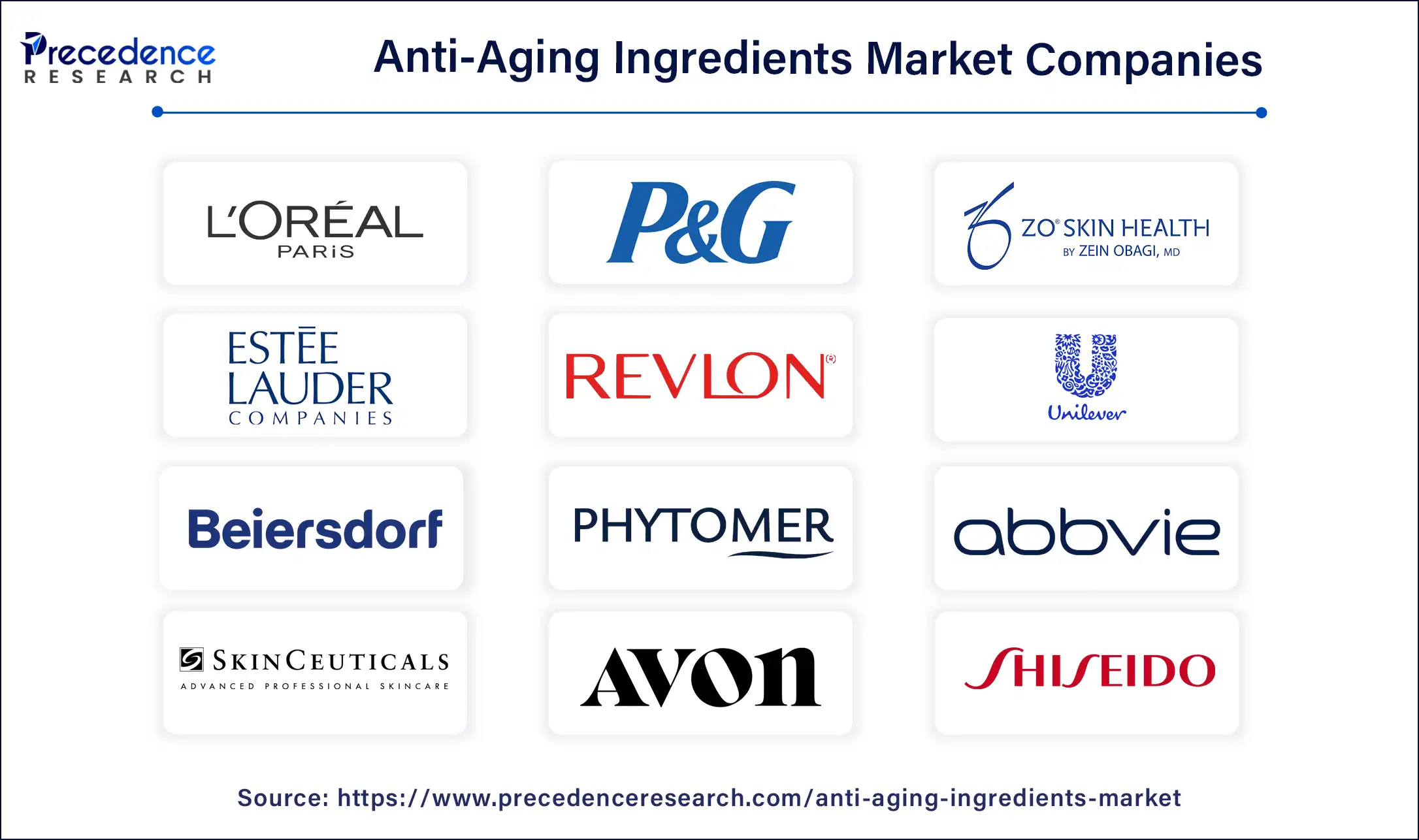
- L'Oréal Paris
- Procter & Gamble
- ZO Skin Health, Inc.
- Estée Lauder Companies, Inc.
- Revlon, Inc
- Unilever Plc
- Beiersdorf
- PHYTOMER
- AbbVie
- SkinCeuticals
- Avon Products
- Shiseido
- Unilver
- Olay
- La Roche-Posay
Latest Announcements by Industry Leaders
- In December 2024, General Manager Angela Hildebrand of SkinCeuticals said, “At SkinCeuticals, our transformative technology is designed to address a wide range of skincare concerns, empowering consumers with the confidence to feel their best," she further added, "As we look ahead to 2025, we're excited to continue setting the bar for advanced skincare innovation that meet the evolving needs of both our consumer and physician partners." Said the General Manager Angela Hildebrand.
Recent Developments
- In February 2025, BASF announced the expansion of its bioactive ingredient portfolio with the introduction of a new plant-derived peptide complex aimed at enhancing skin firmness and elasticity. This development aligns with the growing consumer demand for effective natural anti-aging solutions
- In March 2025, Shiseido unveiled a new line of anti-aging products incorporating fermented botanical extracts, emphasizing the company's commitment to combining traditional ingredients with modern scientific research to address skin aging concerns.
- Also in March 2025, Estée Lauder Companies launched a personalized skincare platform utilizing AI-driven skin analysis to recommend products containing specific anti-aging ingredients tailored to individual skin profiles, reflecting the industry's move towards customized beauty solutions.
- In August 2024, Neutrogena, a dermatologist-recommended skincare brand, launched the Visible Repair range with an innovative solution for early signs of aging. The aim is to address the growing skin aging concerns faced by Indian consumers. This product shows results in 7 days. It contains a combination of retinol and other powerful anti-aging ingredients that produce 48% more collagen.
- In December 2024, SkinCeuticals, the #1 medical skincare brand in the U.S. and leader in antioxidant technology, launched their annual exclusive skincare kits, which have clinically proven formulas to address a variety of skincare needs, from combating signs of aging to targeting discoloration and boosting hydration. The holiday kit includes SkinCeuticals Face and Eye Power Pair Set, SkinCeuticals The Gold Standard Kit, and SkinCeuticals Winter Skin Essential Set, which offers ultimate nourishment and anti-aging benefits.
Segments Covered in the Report
By Ingredient Type
- Antioxidants (Vitamin C, E, and A)
- Peptides
- Moisturizers
- Exfoliators
By Product Category
- Serum and Essences
- Moisturizer and Lotions
- Facial Cleaners and Exfoliators
- Masques and packs
- Supplements
By Target Group
- Women
- Men
- Unisex
- Sensitive skin
By Application
- Facial Care
- Skin Care
- Hair Care
- Body Care
- Cosmetics
By Region
- North America
- Asia Pacific
- Europe
- Latin America
- Middle East and Africa
For inquiries regarding discounts, bulk purchases, or customization requests, please contact us at sales@precedenceresearch.com
Frequently Asked Questions





Ask For Sample
No cookie-cutter, only authentic analysis – take the 1st step to become a Precedence Research client
 Get a Sample




 sales@precedenceresearch.com
 Schedule a Meeting
