



Apoptosis Assays Market Size, Companies, Share, Patient Volume, Treatment Adoption Rates, Pricing Analysis, Regulatory Landscape, Competitive Positioning, and Demand Forecast
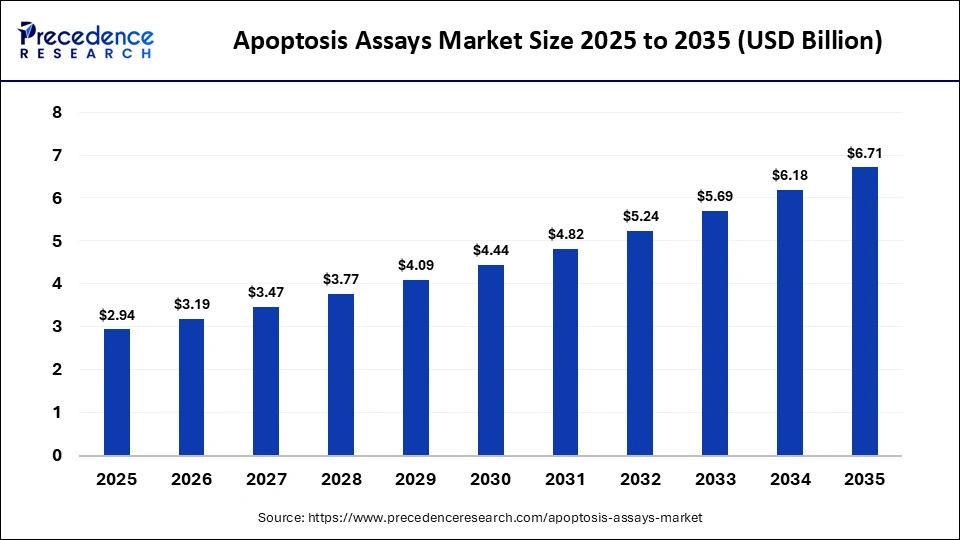
Rohan Patil, a Healthcare Industry Expert, highlights that the apoptosis assays market has reached USD 3.19 billion in 2026 and is on track to reach USD 6.71 billion by 2035, advancing at a CAGR of 8.90%. Key apoptosis assays market companies shaping the market include Thermo Fisher Scientific Inc, Merck KGaA, Bio-Rad Laboratories, Inc., Becton, Dickinson and Company, Danaher Corporation, Promega Corporation, while major growth segments span By Product, By Assay Type.
Source: https://www.precedenceresearch.com/apoptosis-assays-market
 Get a Sample
 Table Of Content


What is the Apoptosis Assays Market Size in 2026?
The global apoptosis assays market size was calculated at USD 2.94 billion in 2025 and is predicted to increase from USD 3.19 billion in 2026 to approximately USD 6.71 billion by 2035, expanding at a CAGR of 8.90% from 2026 to 2035. The robust R&D pipelines, novel product innovations, strategic acquisitions among biopharmaceutical players, and emerging business opportunities raise the demand for apoptosis assays.
Key Takeaways
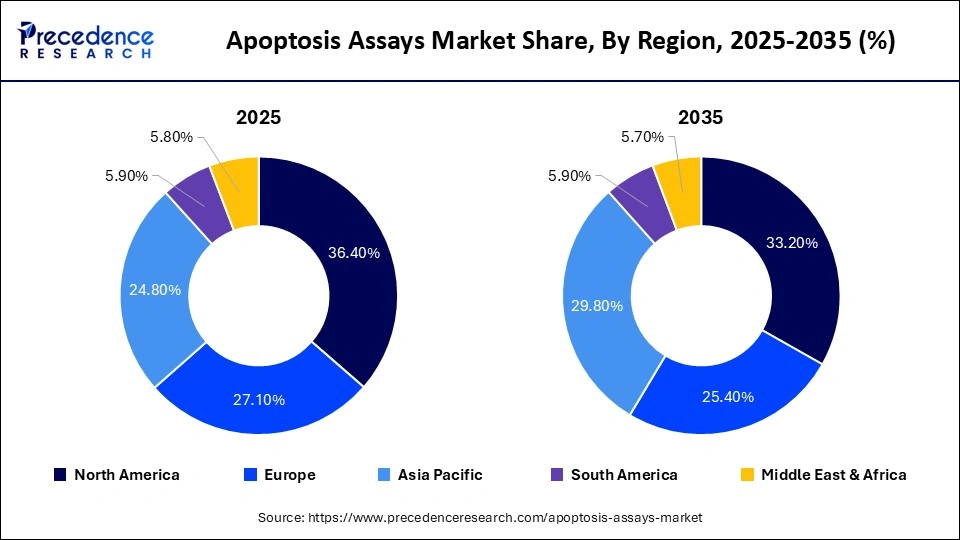
- North America dominated the apoptosis assays market in 2025, with a market share of approximately 36.4%.
- Asia-Pacific is expected to grow at the fastest CAGR in the market during the forecast period.
- By product, the kits and reagents segment held a dominant position in the market with a share of 39.4% in 2025.
- By product, the software and analysis tools segment in the market is expected to grow at the fastest CAGR of 9.4% during the forecast period.
- By assay type, the caspase activity assays segment led the global market with a share of 24.7% in 2025.
- By technology, the flow cytometry segment registered its dominance over the global market with a share of 30.8% in 2025.
- By technology, the high content screening segment is expected to grow with the highest CAGR of 9.6% in the market during the studied years.
- By end user, the pharmaceutical and biotechnology companies segment held the largest revenue share of 38.7% in the market in 2025.
- By end user, the contract research and contract development organizations segment is expected to expand rapidly in the market with a CAGR of 8.9% in the coming years.
Apoptosis Assays: Expanding R&D Product Portfolios
The apoptosis assays market comprises products, platforms, and services used to detect, quantify, and analyze programmed cell death across research, drug discovery, toxicology, and clinical study settings. These assays help evaluate cellular responses through biomarkers such as caspase activation, DNA fragmentation, membrane changes, and mitochondrial dysfunction. Market demand is driven by rising cancer research, biologics development, cell-based studies, precision medicine, and increasing use of high-sensitivity analytical tools in pharmaceutical, biotechnology, and academic laboratories worldwide.
How AI is Impacting the Apoptosis Assays Market?
Artificial intelligence is revolutionizing the development of immunoassays, clinical diagnostics, precision medicine, real-time health monitoring, and drug discovery. It brings precision and accuracy in assay performance, detection of diseases, and tailoring personalized treatment plans based on cell functioning inside the human body. AI reduces the costs and improves pricing strategies of reagents, products, and kits used in apoptosis assays and other clinical workflows. AI is expanding the apoptosis assays and business development strategies of global pharmaceutical and biotechnology companies and clinical research organizations.
Apoptosis Assays Market Trends
- Rising Demand for the Production of Biologics and Targeted Therapies: Pharmaceutical and biotechnology companies are conducting comprehensive research and developing novel biologics and therapeutic drugs. The clinical research organizations are delivering promising diagnostic and therapeutic services. This biopharmaceutical development also involves conducting apoptosis assays, which help researchers analyze individuals' cellular responses to treatments. They also enable healthcare professionals to tailor personalized treatment plans to patients based on their cellular functioning.
- Expanding End Users and Targeted Customers: The potential suppliers and end users across the apoptosis assays industry, and related services and products, are pharmaceutical companies, biotechnology companies, contract research organizations, academic research institutes, and biopharmaceutical developers. They provide and adopt essential laboratory products, such as reagents, assay performance kits, and enzymes, and offer services, including outsourcing, research, production, quality control, and regulatory compliance. They aim to ensure the safety and effectiveness of products before they enter the market.
Market Scope
| Report Coverage | Details |
| Market Size in 2025 | USD 2.94 Billion |
| Market Size in 2026 | USD 3.19 Billion |
| Market Size by 2035 | USD 6.71 Billion |
| Market Growth Rate from 2026 to 2035 | CAGR of 8.90% |
| Dominating Region | North America |
| Fastest Growing Region | Asia-Pacific |
| Base Year | 2025 |
| Forecast Period | 2026 to 2035 |
| Segments Covered | Product, Assay Type, Technology, End User, and Region |
| Regions Covered | North America, Europe, Asia-Pacific, Latin America, and Middle East & Africa |
Market Dynamics
Drivers
Revolution of Modern Clinical Practices and Businesses
Leading companies involved in apoptosis assays, like Thermo Fisher Scientific Inc., Bio-Rad Laboratories, and many others, are setting strategies for pricing and business development. They have achieved remarkable revenue in past years through strong sales of laboratory products and services, diagnostic kits and reagents, consumables, and digital tools. Biopharmaceutical companies rely on outsourcing to deliver promising diagnostic and therapeutic solutions. Clinical research ensures regulatory compliance and transparency in the research conduct.
Restraint
Safety, Pricing, and Effectiveness Concerns of Laboratory Products
Laboratories depend on different kinds of products provided by leading pharmaceutical and biotechnology companies to deliver promising results of tests. They prioritize to ensure the safety protocols of hazardous chemicals, reaction enzymes, assay kits, reagents, antibodies, and many other biochemicals. Good laboratory practices (GLP) aim to protect laboratory workers, researchers, staff, and other professionals while performing routine tasks. Advanced technologies and tools are adopted by manufacturing firms that help them to bring cost-effectiveness in pricing and promote global expansion of their products and services.
Opportunity
Adoption in Cancer Research and Oncology Therapeutics
Emerging trends in the oncology sector include apoptosis assays, multiplexing capabilities, precision oncology, high-throughput screening, and 3D cell culture models. 3D cell culture models and organoids are used to test drug efficacy over traditional 2D models. Apoptosis assays are used to characterize tumor responses to therapies, which help professionals recommend personalized treatments.
Segmental Insights
Product Insights
Apoptosis Assays Market Share, By Product, 2025-2035 (%)
| Product | 2025 | 2035 |
| Kits and Reagents | 39.4% | 35.8% |
| Instruments | 24.6% | 23.1% |
| Consumables and Accessories | 17.3% | 16.4% |
| Assay Services | 10.2% | 13.9% |
| Software and Analysis Tools | 8.5% | 10.8% |
The Kits and Reagents Segment Dominated the Market with 39.4% Share in 2025
The kits and reagents segment dominated the apoptosis assays market in 2025, with a revenue share of approximately 39.4%, owing to their immense role in the detection of biological markers, multiplexing, and routine laboratory projects. They provide a standardized workflow for researchers and help them target specific cellular changes. They are pivotal to detect and quantify morphological and biochemical stages of programmed cell death.
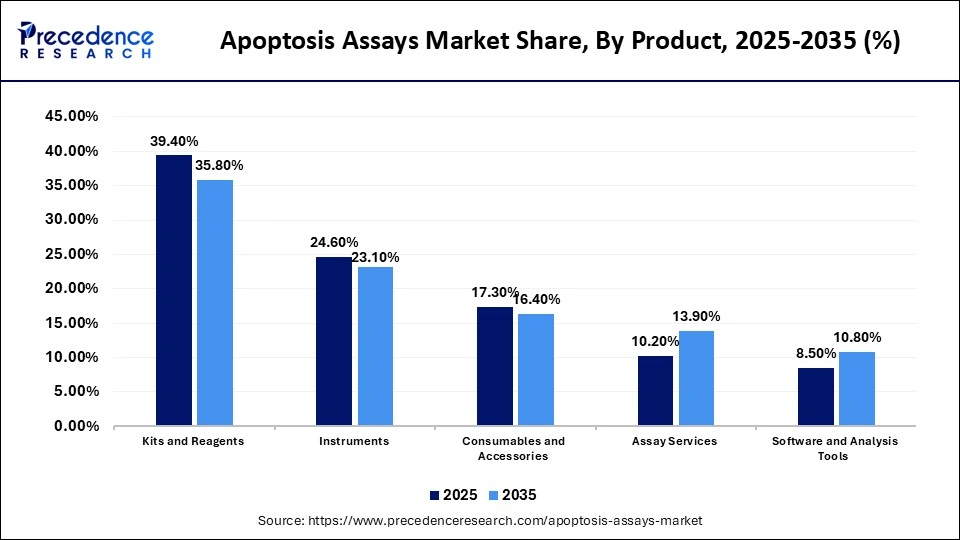
The software and analysis tools segment is expected to show the fastest growth with a CAGR of 9.4% over the forecast period, due to their features to automatically count apoptotic cells and identify specific fluorescent signals from markers. They convert raw data from apoptosis assays into quantifiable results. They identify morphological changes through AI-driven tools and contribute to simple cell counting.
Assay Type Insights
The Caspase Activity Assays Segment Led the Market with 24.7% Share in 2025
The caspase activity assays segment dominated the market in 2025 with a revenue share of approximately 24.7%, owing to their key roles in the confirmation of apoptosis, identification of pathways, temporal monitoring, and drug potency screening. They are widely used for high-throughput drug discovery. They also evaluate the pro-apoptotic effectiveness of anti-cancer therapies.
Apoptosis Assays Market Share, By Assay Type, 2025-2035 (%)
| Assay Type | 2025 | 2035 |
| Caspase Activity Assays | 24.7% | 23.1% |
| DNA Fragmentation Assays | 18.2% | 16.4% |
| Membrane Asymmetry Assays | 16.5% | 15.3% |
| Mitochondrial Membrane Potential Assays | 14.8% | 15.9% |
| Cell Permeability Assays | 11.6% | 11.2% |
| Cytochrome C Release Assays | 7.9% | 8.6% |
| Others | 6.3% | 9.5% |
Technology Insights
The Flow Cytometry Segment Held the Largest Market Share 30.8% in 2025
The flow cytometry segment held the largest revenue share of 30.8% in the apoptosis assays market in 2025, owing to consistent results at varying flow rates and high-quality resolution for the detection of small particles. This technique requires easy maintenance and automatic cleaning cycles. It allows researchers to achieve accurate and absolute cell counts.
Apoptosis Assays Market Share, By Technology, 2025-2035 (%)
| Technology | 2025 | 2035 |
| Flow Cytometry | 30.8% | 28.4% |
| Fluorescence Microscopy | 18.4% | 16.9% |
| Plate Reader Based Assays | 20.6% | 18.8% |
| High Content Screening | 12.3% | 16.2% |
| PCR and NGS Based Analysis | 9.7% | 11.7% |
| Spectrophotometry | 8.2% | 8.0% |
The high content screening segment is expected to gain the highest market share with a CAGR of 9.6% between 2026 and 2035 due to its significance as a powerful platform to detect and quantify the complex and sequential stages of programmed cell death. This technique monitors several apoptotic markers in a single experiment. It combines automated fluorescence microscopy with quantitative image analysis.
End User Insights
The Pharmaceutical and Biotechnology Companies Segment Dominated the Market with 38.7% Share in 2025
The pharmaceutical and biotechnology companies segment contributed the biggest revenue share of 38.7% in the apoptosis assays market in 2025, owing to their major contribution in drug discovery and development, safety and toxicology assessment, and quality control for biologics. They drive technological innovations across automation, AI, miniaturization, and multiplexing. Pharmaceutical firms are shifting towards outsourcing to CROs for standardized screening of apoptosis.
Apoptosis Assays Market Share, By End User, 2025-2035 (%)
| End User | 2025 | 2035 |
| Pharmaceutical and Biotechnology Companies | 38.7% | 36.4% |
| Academic and Research Institutes | 29.4% | 25.8% |
| Contract Research and Contract Development Organizations | 16.2% | 19.3% |
| Hospitals and Diagnostic Laboratories | 9.1% | 10.1% |
| Government and Forensic Laboratories | 6.6% | 8.4% |
The contract research and contract development organizations segment is expected to witness the fastest growth in the market with a CAGR of 8.9% over the forecast period, due to their integrated support, clinical supply material testing, and stability and bioavailability assessment. They provide access to advanced techniques, which resolve challenges associated with costs. They ensure a strict regulatory compliance of all assay data with regulatory standards for regulatory submissions.
Regional Insights
North America Apoptosis Assays Market Size and Growth 2026 to 2035
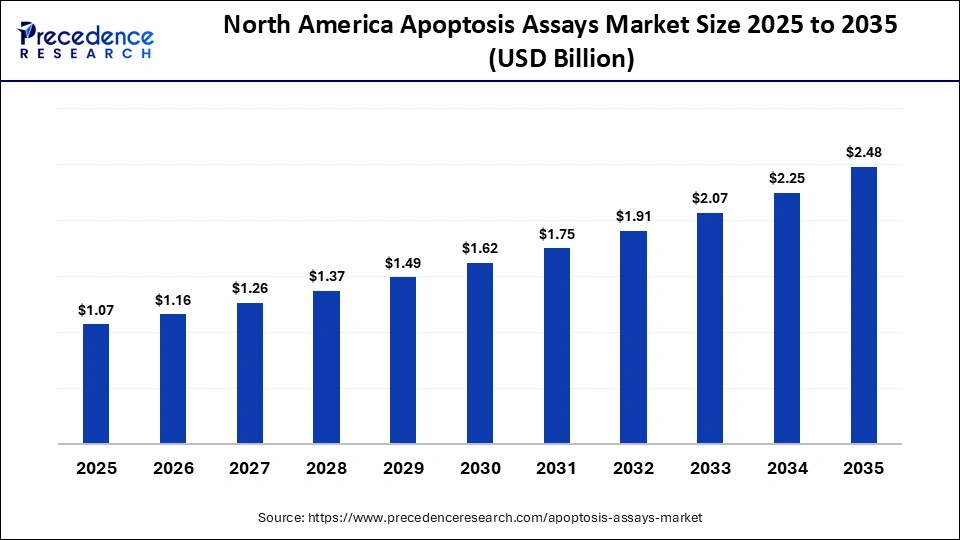
The North America apoptosis assays market size is estimated at USD 1.07 billion in 2025 and is projected to reach approximately USD 2.48 billion by 2035, with a 8.77% CAGR from 2026 to 2035.
How North America Dominated the Apoptosis Assays Market?
North America held a major market share of approximately 36.4% in 2025, owing to robust research funding, pharmaceutical and biotechnology activities, and a supportive regulatory environment. The North American industry for apoptosis assays has experienced new high-throughput product launches. The government prioritized improved safety and security for biological research. The National Institutes of Health (NIH) provided robust funding for specialty research. This region witnesses the rising demand for 3D cell culture models and multiplexed assays to enhance R&D in oncology and neurodegenerative diseases.
U.S. Apoptosis Assays Market Size and Growth 2026 to 2035
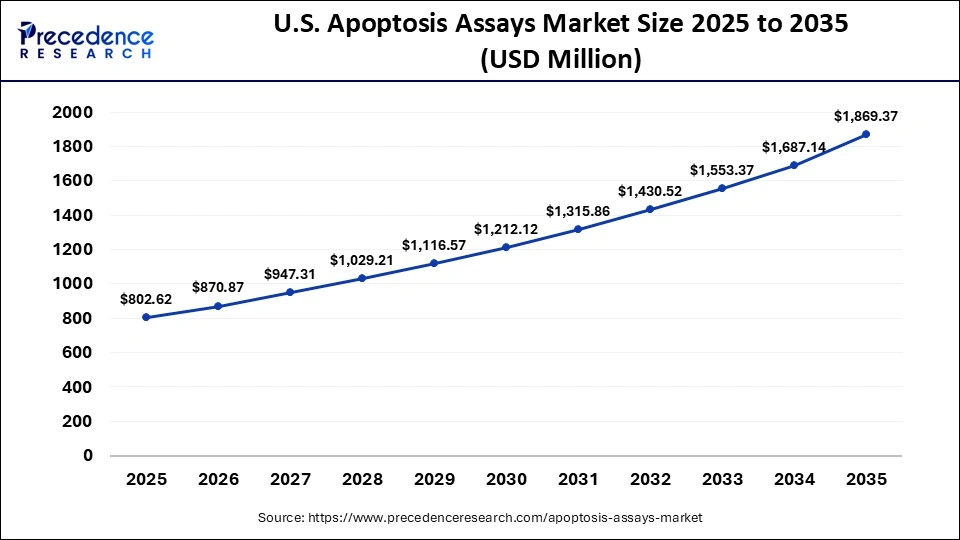
The U.S. apoptosis assays market size is calculated at USD 802.62 million in 2025 and is expected to reach nearly USD 1,869.37 million in 2035, accelerating at a strong CAGR of 8.82% between 2026 and 2035.
U.S. Market Analysis
The U.S. witnesses significant R&D investments in the biopharmaceutical sector and technological advancements in assay platforms. The federal funding aims to provide regulatory support and promote cell-based R&D for drug development. Leading companies in the apoptosis assays industry have launched new technologies to meet research and development needs.
How is Asia-Pacific Growing in the Apoptosis Assays Market?
Asia-Pacific is expected to experience the fastest growth during the predicted timeframe, due to the increasing number of contract research organizations (CROs) and the development of patient-centric therapies. Government programs and strategic initiatives aim to boost research in biotechnology and life sciences. Governments have provided funding to support cancer research and drug discovery. The expanded precision medicine trends have driven demand for cellular pathway analysis tools.
India Market Trends
India experiences growth in outsourcing and CRO activity, a shift towards personalized medicine, and the expansion of domestic pharmaceutical manufacturing. India's National Research Foundation (NRF) aims to support academic-industry collaboration and life science research. The BioE3 policy was launched to boost high-performance biomanufacturing for the economy, environment, and employment.
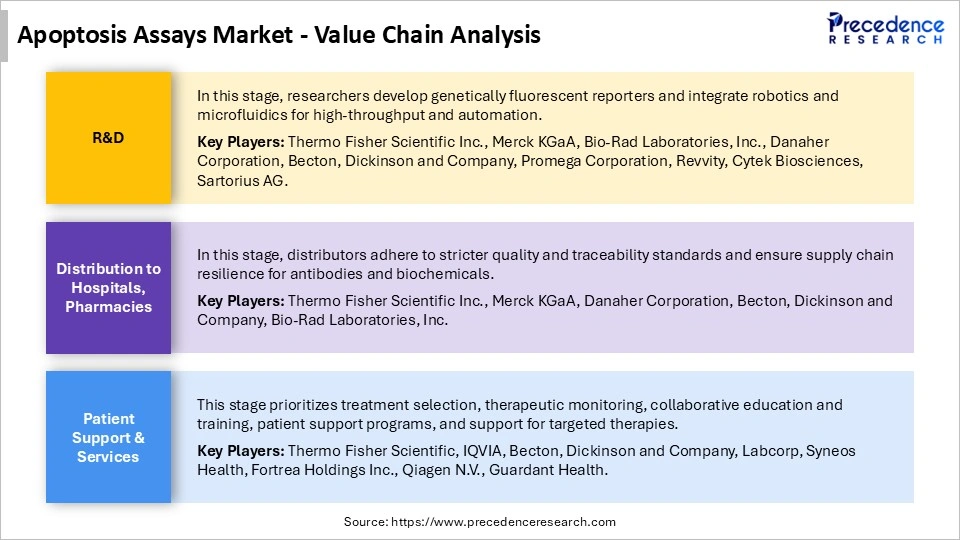
Apoptosis Assays Market Value Chain Analysis
Apoptosis Assays Market Companies
- Thermo Fisher Scientific Inc.
- Merck KGaA
- Bio Rad Laboratories, Inc.
- Becton, Dickinson and Company
- Danaher Corporation
- Promega Corporation
- Agilent Technologies, Inc.
- Revvity, Inc.
- Bio Techne Corporation
- Roche Holding AG
- Sartorius AG
- Abcam plc
- Miltenyi Biotec
- Takara Bio Inc.
- Enzo Biochem, Inc.
Recent Developments
- In October 2025, Thermo Fisher Scientific Inc. presented its new accelerator drug development solutions to scale in biopharmaceutical manufacturing and help boost efficiency. The company also collaborated with OpenAI and OSDPredict, a new digital toolbox that helps predict formulation behavior in small-molecule development.(Source: https://manufacturingchemist.com)
- In May 2025, Merck KGaA, Germany, and Darmstadt announced positive results from their Phase 3 MANEUVER clinical trial assessing first-in-class anti-CEACAMS ADC precemtabart tocentecan (M1940) for patients with colorectal cancer. This new clinical data witnessed the company's dedication to advancing innovative therapies for a broad range of diseases.(Source: https://www.emdgroup.com)
Segments Covered in the Report
By Product
- Kits and Reagents
- Instruments
- Consumables and Accessories
- Assay Services
- Software and Analysis Tools
By Assay Type
- Caspase Activity Assays
- DNA Fragmentation Assays
- Membrane Asymmetry Assays
- Mitochondrial Membrane Potential Assays
- Cell Permeability Assays
- Cytochrome C Release Assays
- Others
By Technology
- Flow Cytometry
- Fluorescence Microscopy
- Plate Reader-Based Assays
- High Content Screening
- PCR and NGS-Based Analysis
- Spectrophotometry
By End User
- Pharmaceutical and Biotechnology Companies
- Academic and Research Institutes
- Contract Research and Contract Development Organizations
- Hospitals and Diagnostic Laboratories
- Government and Forensic Laboratories
By Region
- North America
- Latin America
- Europe
- Asia-pacific
- Middle and East Africa
For inquiries regarding discounts, bulk purchases, or customization requests, please contact us at sales@precedenceresearch.com
Frequently Asked Questions
Tags





Ask For Sample
No cookie-cutter, only authentic analysis – take the 1st step to become a Precedence Research client
 Get a Sample




 sales@precedenceresearch.com
 Schedule a Meeting
