



Automotive Digital Instrument Cluster Market Size, Companies, Share, Vehicle Production Volume, Sales Performance, Export & Import Analysis, Technology Adoption, Competitive Positioning, and Demand Trends
Automotive Digital Instrument Cluster Market (By Type: LCD Display, LED Display, OLED Display, Projection Display; By Vehicle Type: Passenger Vehicles, Light Commercial Vehicles, Heavy Commercial Vehicles; By Technology: Analog Dashboard, Digital Dashboard, Hybrid Dashboard; By End Use: Private Use, Fleet Management, Ride Sharing) - Global Industry Analysis, Size, Trends, Leading Companies, Regional Outlook, and Forecast 2026 to 2035
Source: https://www.precedenceresearch.com/automotive-digital-instrument-cluster-market
 Get a Sample
 Table Of Content


What is the Automotive Digital Instrument Cluster Market Size in 2026?
The global automotive digital instrument cluster market size accounted for USD 7.50 billion in 2025 and is predicted to increase from USD 8.16 billion in 2026 to approximately USD 17.51 billion by 2035, expanding at a CAGR of 8.85% from 2026 to 2035. The rapid expansion of the market is due to increasing demand for enhanced vehicle aesthetics, functionality, and the proliferation of luxury vehicles with vehicle digitization.
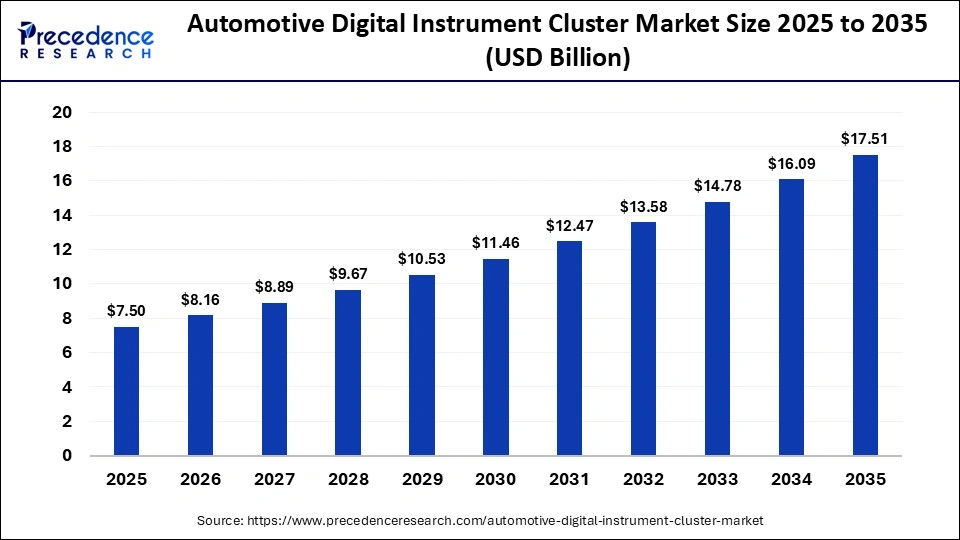
Key Takeaways
- North America dominated the automotive digital instrument cluster market in 2025.
- Europe is expected to grow at the fastest CAGR in the market during the forecast period.
- By type, the LCD display segment held a dominant position in the market in 2025.
- By type, the OLED display segment is expected to grow at the fastest CAGR in the market during the forecast period.
- By vehicle type, the passenger vehicles segment held a dominant position in the market in 2025.
- By vehicle type, the light commercial vehicles segment is expected to grow at the fastest CAGR in the market during the forecast period.
- By technology, the digital dashboard segment held a dominant position in the market in 2025.
- By technology, the hybrid dashboard segment is expected to grow at the fastest CAGR in the market during the forecast period.
- By end-use, the private use segment held a dominant position in the market in 2025.
- By end-use, the fleet management segment is expected to grow at the fastest CAGR in the market during the forecast period.
Market Overview
An instrument cluster is the system placed in front of the driver and is one of the most important components of any vehicle. It includes a speedometer, tachometer, odometer, temperature gauge, fuel gauge, and displays other critical information. It keeps the driver informed about the vehicle's status, performance, and potential issues.
The automotive digital instrument cluster market is growing rapidly as vehicle manufacturers seek advanced, connected, and customer-centric technologies. Digital clusters offer real-time vehicle data, customized displays, and unified integration with navigation and driver assistance features. Rising customer demands for aesthetic display with technological advancements are boosting the market. The adoption is further driven by increased focus on safety, fuel efficiency, lightweight vehicle design, and sustainability.
Impact of AI on the Automotive Digital Instrument Cluster Market
Artificial intelligence is reshaping the market by enabling smarter driver displays, more instinctive and highly personalized. AI algorithms perform predictive analysis, which enables real-time vehicle data, driving patterns, and the surrounding environment, thereby enhancing driving safety and convenience. Integration with advanced driver-assistance systems (ADAS), voice recognition, and gesture control allows clusters to adjust to the driving behavior.
AI helps in detecting fatigue or distraction and road conditions, improving overall safety. AI-assisted integration of navigation, infotainment, and over-the-air updates, instrument clusters are being reshaped as intelligent control centers. As automakers shift towards connected and autonomous vehicles, AI-assisted digital cockpits are becoming a key part of modern driving experiences and central to human-machine interaction, accelerating the growth of the market.
Automotive Digital Instrument Cluster Market Trends
- Fully digital instrument clusters provide clearer visuals, real-time data, and enhanced human-machine interaction, thereby vehicles are rapidly shifting from traditional analog dashboards to digital instrument clusters.
- Integration of advanced technologies such as AI, augmented reality, and advanced driver assistance systems (ADAS) delivers predicted alerts, navigation overlaps, and smarter driver support.
- Increasing demand by consumers for tailored dashboards according to their preferences, having adjustable layouts, themes, and display settings.
- Expansion of digital displays to the mainstream vehicle segment, and not limited to premium cars, since they are cost-effective.
- Digital cockpit development with energy-efficient displays and eco-friendly materials for broader sustainability goals.
Market Scope
| Report Coverage | Details |
| Market Size in 2025 | USD 7.50 Billion |
| Market Size in 2026 | USD 8.16 Billion |
| Market Size by 2035 | USD 17.51 Billion |
| Market Growth Rate from 2026 to 2035 | CAGR of 8.85% |
| Dominating Region | North America |
| Fastest Growing Region | Europe |
| Base Year | 2025 |
| Forecast Period | 2026 to 2035 |
| Segments Covered | Type, Vehicle Type, Technology, End Use, and Region |
| Regions Covered | North America, Europe, Asia-Pacific, Latin America, and Middle East & Africa |
Segment Insights
Type Insights
How Did the LCD Display Segment Lead the Market?
The LCD display segment led the automotive digital instrument cluster market in 2025. The market is driven by its affordability, reliability, and wide availability. They offer a strong balance of performance, cost, and practicality for manufacturers. Its properties, such as clear visibility, stable performance in different driving conditions, and flexible screen sizing for different vehicle models, make it a preferred choice for cluster manufacturing. LCD-based clusters are typically favored in vehicles where cost optimization is a priority. Their energy efficiency and durability drive their adoption by manufacturers for mid-range and mass-market vehicles.
The OLED display segment is expected to grow at the fastest CAGR in the automotive digital instrument cluster market over the forecast period. It offers a more advanced and visually appealing aesthetic display experience than traditional display technologies. Its self-emissive pixels deliver deeper blacks, higher contrast, and vibrant colors, enhancing visibility in different lighting conditions. OLED panels enable the formation of curved, ultra-thin, lighter, and flexible, enabling manufacturers to design curved and seamless cockpits. OLEDs are now more accessible due to falling production costs and advanced manufacturing technologies. To deliver next-generation digital experiences and tailored displays, automakers are highly adopting OLED displays, boosting segment growth.
Vehicle Type Insights
How did the Passenger Vehicles Segment Dominate the Market in 2025?
The passenger vehicles segment dominated the automotive digital instrument cluster market in 2025. The market is driven by increasing demand for advanced technology features, such as smarter, safer, and more connected driving experiences. Since passenger vehicles are sold in larger volumes, they dominate the automotive market. Due to increased demand for aesthetic and customized displays, automakers are increasingly equipping passenger vehicles with advanced digital displays and interactive dashboards. Integration of sophisticated technologies provides real-time data, enhancing comfort, convenience, and visual appearance. From Sedans and SUVs to sports cars and luxury vehicles, digital instrument clusters are now equipped in all these vehicles.
The light commercial vehicles segment is expected to grow at the fastest CAGR in the automotive digital instrument cluster market over the forecast period, due to the demand for enhanced fleet management, real-time diagnostics, and safety. The transportation and logistics industry is growing rapidly and becoming more data-driven and efficiency-focused. They rely heavily on real-time data, such as fuel consumption, maintenance status, navigation, and driver behavior analytics, enabling fleet operators to optimize operations and reduce costs. Digital instrument clusters enable delivering clear, integrated data directly to drivers and fleet management systems. Rising awareness of safety, strict emission regulations, and the adoption of smarter monitoring systems are driving rapid growth across the segment.
Technology Insights
How did the Digital Dashboard Segment Dominate the Automotive Digital Instrument Cluster Market?
The digital dashboard segment dominated the market in 2025, driven by increased adoption by automakers, since they deliver enhanced safety, improve visual clarity, and support connected and software defined vehicle designs. They offer greater functionality, flexibility, dynamism, and real-time information. Due to integration with navigation, infotainment, advanced driver assistance systems, and vehicle diagnostics, they are a central control interface in modern vehicles. With increasing consumer demands for customized dashboards and more interactive in-car experiences, digital dashboards are dominating the market.
The hybrid dashboard segment is expected to grow at the fastest CAGR over the forecast period. For critical information like speed and RPM, many drivers still prefer the clarity and comfort of analog gauges alongside the convenience and connectivity of digital displays. The hybrid approach allows automakers to deliver both physical dials with customizable digital screens. They allow integration of advanced features directly into the dashboards and are popular in mid-range vehicles, without increasing costs. Their growth is fueled by consumer demand for features that deliver aesthetics with modern technology.
End-Use Insights
What made the Private Use Segment Dominate the Automotive Digital Instrument Cluster Market?
The private use segment dominated the market in 2025, since personal vehicles are being used in large volumes. Most vehicles on the road are owned and driven by individual customers. This creates the demand for modern, technology-rich driving experiences and aesthetic displays. With rising disposable incomes, consumers are adopting digital features in everyday driving experiences. Consumers also seek convenience and enhanced safety with real-time data and integrated vehicle systems, driving the market of digital instrument clusters.
The fleet management segment is expected to grow at the highest CAGR during the forecast period. The segment is driven by the companies that demand real-time data to operate their transportation activities more efficiently. This segment emphasizes fuel usage, vehicle health, route performance, and driver behavior to reduce costs and improve productivity. Advanced diagnostics, tracking, and performance monitoring directly within the vehicle are supported by the digital instrument clusters.
Regional Insights
What Factors Have Driven the Dominance of North America in the Market?
North America dominated the global automotive digital instrument cluster market in 2025. The market in the region has a strong demand for advanced vehicle technology. Countries like the U.S. and Canada have adopted premium features such as digital dashboards and advanced driver-assistance technologies. There is increased demand for instrument clusters with the rising adoption of electric and luxury vehicles equipped with digital dashboards. The region hosts a large number of automakers and technology firms. These players are highly invested in research and development of digital cockpits to meet the demands of their consumers. The region has strong safety and regulatory standards, boosting the adoption of digital instrument clusters for advanced monitoring and driver information systems. Strong consumer spending and high vehicle penetration drive the rapid adoption of next-generation in-vehicle display technologies.
U.S. Automotive Digital Instrument Clusters Market Trends
The U.S. automotive digital instrument cluster market is experiencing rising demand for luxury and electric vehicles with large and high-resolution digital instrument clusters, providing real-time data with navigation, battery range, and vehicle diagnostics. The automakers are increasingly integrating digital clusters with ADAS features, with safety alerts and driver monitoring data. The country is focusing on connected and software-defined vehicles. Drivers increasingly prefer customized dashboards that enable tailored layouts, themes, and displayed information. The presence of leading automakers and automotive technology companies drives innovation in the market.
What makes Europe the Fastest Growing Region in the Automotive Digital Instrument Cluster Market?
Europe automotive instrument cluster market is expected to grow at a significant CAGR from 2026 to 2035, driven by strong technological leadership and demand for luxury vehicles. The region hosts well-known automakers such as BMW, Mercedes-Benz, Audi, and Volkswagen. These automakers highly invest in advanced digital instrument clusters for brand differentiation. Due to strict emissions regulations and sustainability goals, the region is adopting electric and hybrid vehicles equipped with digital instrument clusters. Consumers in the region highly prefer modern, premium, technology-rich, and aesthetic vehicles. Rapid advances in connected and autonomous vehicle systems are fueling market growth across the region.
Germany's Automotive Digital Instrument Cluster Market
The region's market is growing rapidly, driven by strong innovation and digital transformation across the country's automotive ecosystem. A strong push toward vehicle digitalization is accelerating the adoption of advanced digital instrument clusters. Rising government investments in the digitization projects further boost innovation and product development. The shift of consumers towards electric and hybrid vehicles demands advanced displays that show battery range, charging status, and energy usage. Strict safety regulations and integration of ADAS and connected vehicle technologies are increasing the need for clusters that enable real-time alerts, navigation data, and driver-assistance information. These factors are shaping Germany's automotive digital instrument market.
Automotive Digital Instrument Cluster Market Value Chain Analysis
- Raw Material Sourcing (Steel, Plastics, Electronics)
Sourcing through global suppliers, along with a long-term agreement to maintain the quality of the raw materials. It includes optic glass, display substrates, semiconductor ICs, microcontrollers, flexible printed circuit boards, engineering polymers for housing, backlight, and touch interface materials.
Key Companies: Corning Inc., LG Display, Samsung Display, TSMC, and Foxcom.
- Component Manufacturing (Engines, Transmissions, etc.)
Assembly of LCD/OLED panels, GPUs, embedded processors, and digital controllers; development of cluster software, UI graphics, and driver information systems; integration of sensors, warning systems, and connectivity modules. Technologies used include human-machine interface (HIM) software, automotive SoCs, and GPU-based graphics processing.
Key Companies: Bosch, Continental AG, Denso Corporation, Visteon Corporation, and Marelli Holdings.
- Vehicle Assembly and Integration
Instrument clusters are installed into dashboards, electronic control units are connected to the vehicle CAN bus and sensor networks, and software is calibrated. Systems integrated include navigation systems, ADAS warnings, driver monitoring systems, and vehicle diagnostics.
Key Companies: Toyota Motor Corporation, Volkswagen Group, BMW Group, Hyundai Motor Company, and Ford Motor Company.
- Testing and Quality Control
Environmental testing, such as heat, vibration, and humidity, displays readability and brightness validation, functional testing, such as warnings, speed accuracy, and software stability, electromagnetic compatibility testing, and lifecycle reliability simulations. The standards applied include ISO, UNECE, functional safety certification (ASIL levels), and electronic reliability and durability testing.
Key Companies: TUV Rheinland, UL Solutions, SGS SA, Intertek Group, and Bureau Veritas.
- Aftermarket Services and Spare Parts
Replacement of faulty displays, processors, or software modules, software updates and recalibration, diagnostics using specialized automotive tools, and retrofit upgrades for older versions; warranty support.
Key Companies: Tesla Inc, Valeo, Aptiv, Harman International, Panasonic Automotive Systems.
Automotive Digital Instrument Cluster Market Companies
- Bosch
- Continental AG
- Denso Corporation
- Marelli
- Aptiv PLC
- Panasonic Automotive
- Harman International
- LG Electronics Vehicle Solutions
- Hyundai Mobis
- JP Minda Group
- Nippon Seiki Co., Ltd.
- Pricol Limited
- Robert Bosch GmbH
- Simco Ltd.
- Valid Manufacturing Ltd.
- Visteon Corporation
Recent Developments
- In November 2024, at EICMA 2024, Bosch displayed its TFT connect platform, which enables voice control directly through the motorcycle and through a smartphone with Siri or Google Assistant.(Source: https://www.autocarpro.in)
- In May 2024, Toyota Motor Europe detailed that the Yaris Cross SUV offers a customizable 12.3-inch digital driver display across higher-grade models with access to connectivity, information, and entertainment.(Source: https://media.toyota.co.uk)
Segments Covered in the Report
By Type
- LCD Display
- LED Display
- OLED Display
- Projection Display
By Vehicle Type
- Passenger Vehicles
- Light Commercial Vehicles
- Heavy Commercial Vehicles
By Technology
- Analog Dashboard
- Digital Dashboard
- Hybrid Dashboard
By End Use
- Private Use
- Fleet Management
- Ride Sharing
By Region
- North America
- Asia Pacific
- Europe
- Latin America
- Middle East and Africa
For inquiries regarding discounts, bulk purchases, or customization requests, please contact us at sales@precedenceresearch.com
Frequently Asked Questions





Ask For Sample
No cookie-cutter, only authentic analysis – take the 1st step to become a Precedence Research client
 Get a Sample




 sales@precedenceresearch.com
 Schedule a Meeting
