



Automotive Piston Market Size, Companies, Share, Vehicle Production Volume, Sales Performance, Export & Import Analysis, Technology Adoption, Competitive Positioning, and Demand Trends
Automotive Piston Market (By Component Type: Piston, Piston Rings, Piston Pins; By Vehicle Type: Passenger Vehicles, Commercial Vehicles, TwoWheelers/Others; By Material Type: Aluminum Pistons, Steel Pistons, Cast Iron/Others; By Engine/Fuel Type: Gasoline, Diesel, Hybrid/Alternate Fuels) - Global Industry Analysis, Size, Trends, Leading Companies, Regional Outlook, and Forecast 2026 to 2035
Source: https://www.precedenceresearch.com/automotive-piston-market
 Get a Sample
 Table Of Content


What is the Automotive Piston Market Size in 2026?
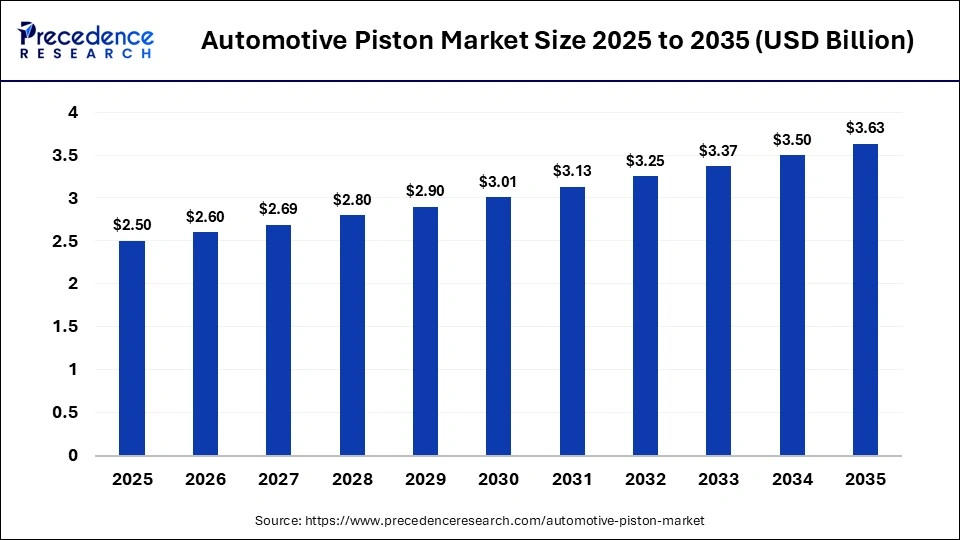
The global automotive piston market size accounted for USD 2.50 billion in 2025 and is predicted to increase from USD 2.60 billion in 2026 to approximately USD 3.63 billion by 2035, expanding at a CAGR of 3.80% from 2026 to 2035. Market growth is driven by rising global vehicle production, regulatory emission targets, lightweight material adoption, and innovation in engine design.
Key Takeaways
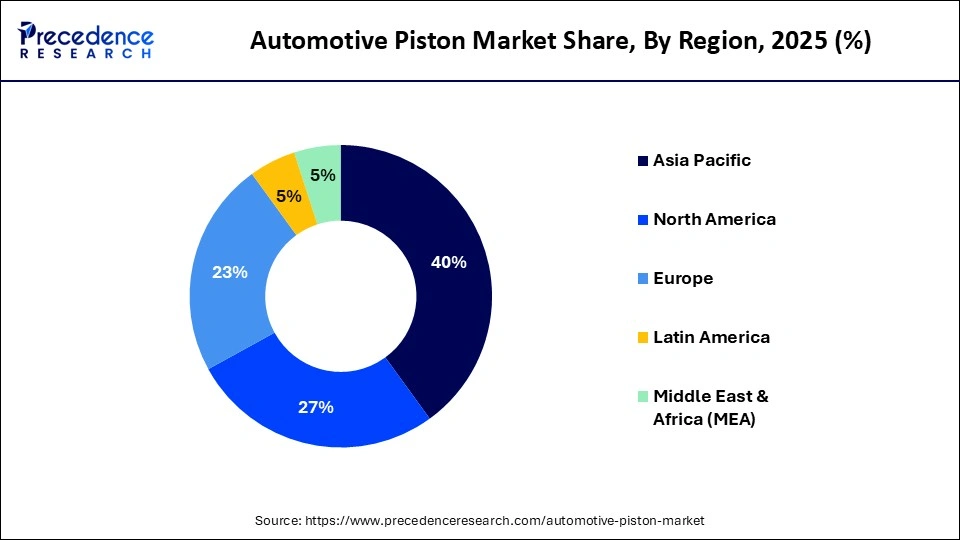
- Asia-Pacific dominated the global automotive piston market with a share of approximately 40% in 2025 and is expected to grow at the fastest CAGR of 4.5% in the market during the forecast period.
- By competent type, the piston segment held a dominant position in the market with a share of approximately 49% in 2025.
- By component type, the piston pins segment is expected to grow with the highest CAGR of 3.4% in the market during the studied years.
- By vehicle type, the passenger vehicles segment dominated the market with a share of approximately 60% in 2025.
- By vehicle type, the commercial vehicles segment is expected to expand rapidly with a CAGR of 3.5% in the coming years.
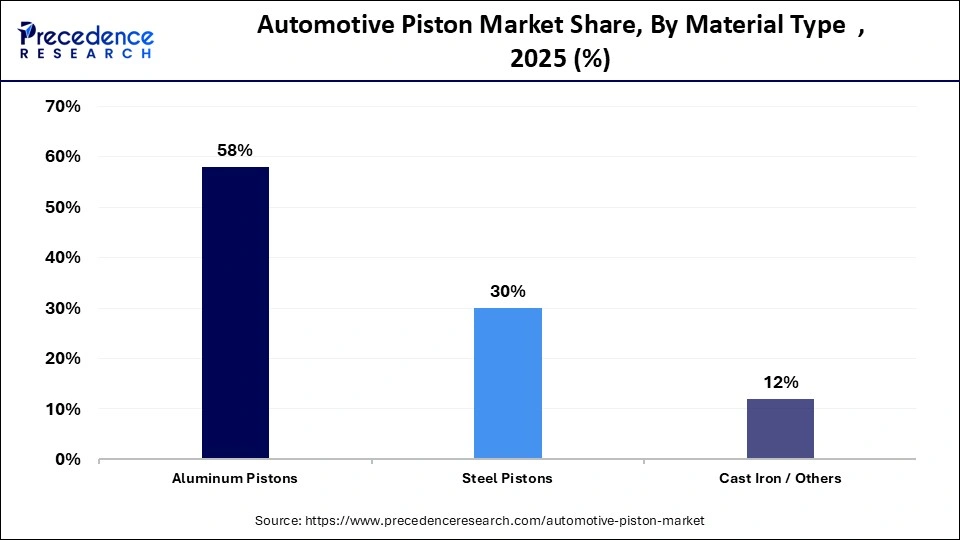
- By material type, the aluminum pistons segment accounted for a considerable revenue share of approximately 58% in the market in 2025 and is expected to grow with the highest CAGR of 3.6% in the market during the studied years.
- By engine/fuel type, the gasoline segment led the global market with a share of approximately 45% in 2025.
- By engine/fuel type, the hybrid/alternative fuels segment is expected to gain the highest market share with a CAGR of 3.8% between 2026 and 2035.
Automotive Piston: Engine Efficiency and Performance
The automotive piston market consists of components used in internal combustion engines to convert combustion pressure into mechanical motion. Pistons, piston rings, and piston pins are critical for engine performance, fuel efficiency, and emission control in passenger and commercial vehicles. Product development strategies are being redesigned due to the increase in demand for lightweight and high-strength materials. With the rise of EVs, we still produce hybrid and ICE cars, which allows us to maintain a high demand in the world.
What is the Role of AI in the Automotive Pistons?
The application of artificial intelligence (AI) is changing the piston design by means of sophisticated simulation and predictive modelling. AI tools are optimized to be used in improving the efficiency of the piston geometry, thermal resistance, and composition of materials. AI and machine learning (ML) algorithms can analyze vast amounts of data and predict potential defects in pistons caused by overheating, excessive wear, or mechanical failure, enabling real-time updates. AI is also used in smart manufacturing systems to detect defects and achieve accuracy in machining. Another benefit of predictive analytics is the maintenance, forecasting, and product lifecycle management.
Automotive Piston Market Trends
- EV-Specific Rubber Friction Materials: To be more efficient and eliminate a lot of energy wastage, the hybrid engines need sophisticated low-friction coatings on the pistons.
- Demand for Lightweight Pistons: Lightweight pistons made of aluminium alloys are used more to increase fuel economy and engine responsiveness, enabling them, among other parts, to meet the latest exhaust emission standards.
- Strict Environmental Policies: Pistons are generally developed with less oil consumption, and better combustion efficiency is also offered with emission norms.
- Increasing Use of Gasoline Direct Injection Engine: Gasoline direct injection engines are preferable used to spray fuel directly into the combustion chamber at high pressure, boosting fuel efficiency, increasing torque, and enhancing power.
Market Scope
| Report Coverage | Details |
| Market Size in 2025 | USD 2.50 Billion |
| Market Size in 2026 | USD 2.60 Billion |
| Market Size by 2035 | USD 3.63 Billion |
| Market Growth Rate from 2026 to 2035 | CAGR of 3.80% |
| Dominating Region | North America |
| Fastest Growing Region | Asia Pacific |
| Base Year | 2025 |
| Forecast Period | 2026 to 2035 |
| Segments Covered | Component Type, Component Type, Material Type, Engine/Fuel Type, and Region |
| Regions Covered | North America, Europe, Asia-Pacific, Latin America, and Middle East & Africa |
Segmental Insights
Component Type Insights
What Made the Piston Segment Dominate the Automotive Piston Market?
The piston segment dominated the market with a share of approximately 49% in 2025, since it is the most moving part in internal combustion engines. Any engine that is based on combustion demands several pistons, which have an immediate high-volume requirement. The efficiency and durability of pistons are continuously improved through new technologies of lightweight alloys and coatings. The rising manufacturing of passenger vehicles across the world adds more strength to the segment leadership. This is also because replacement demand in engine overhauls also propels the segment's growth.
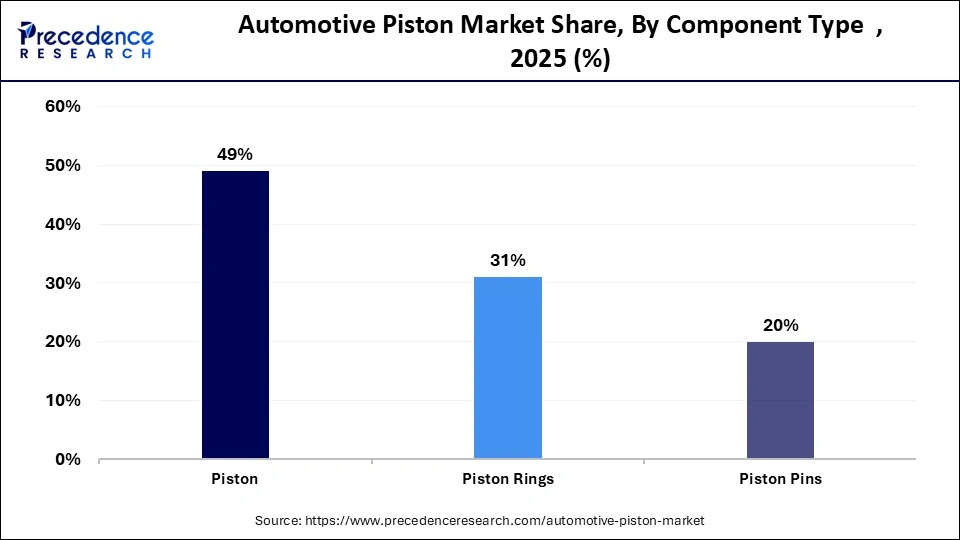
The piston pins segment is expected to show the fastest growth with a CAGR of 3.4% over the forecast period because of the increase in engine performance optimization needs. All these pins join the piston to the connecting rod and are required to bear high mechanical stress. The use of lightweight and high-strength materials is also increasing, and this is enhancing innovation in this segment. Demand is further facilitated by increased production of hybrid engines, which demand hardy and lightweight components. The growth of segments is increasing faster through precision engineering gains.
Vehicle Type Insights
Which Vehicle Type Segment Dominated the Automotive Piston Market?
The passenger vehicles segment held the largest market share of approximately 60% in 2025 because it is highly produced across the globe. Increasing urbanization and mobility among individuals require further sales of vehicles. The high emission standards promote the use of modern technologies. Demand is also supported by regular servicing of engines and replacement. The production of hybrid passenger cars also helps in the long-term increase.
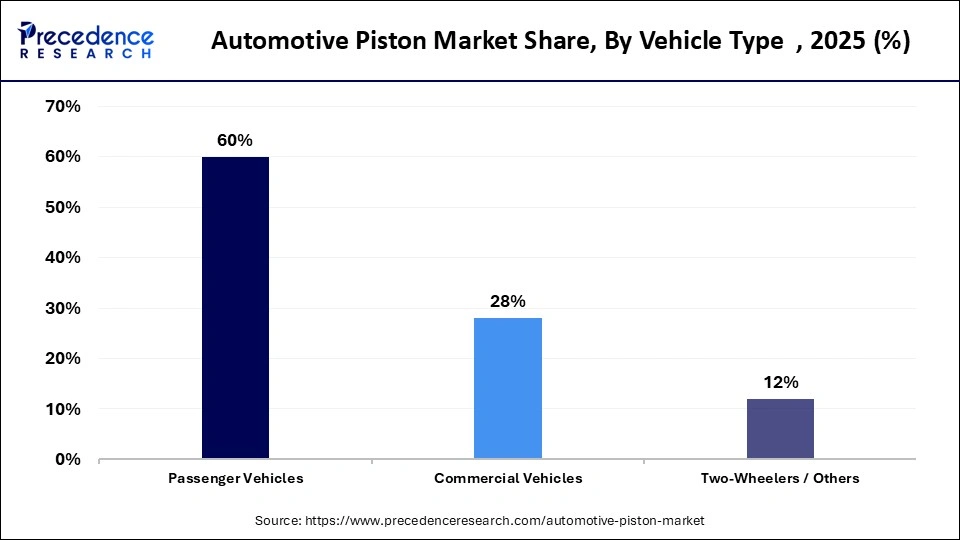
The commercial vehicles segment is expected to gain the highest market share with a CAGR of 3.5% between 2026 and 2035, driven by the growth of the logistics, construction, and industrial sectors. Durability and high-performance pistons that can work with extreme loads are needed in heavy-duty engines. The growth of freight transportation and e-commerce operations drives the demand for vehicles. Building infrastructure development projects also encourages the production of commercial vehicles. Advanced piston is also increasing with fleet modernization efforts.
Material Type Insights
How the Aluminum Pistons Segment Dominated the Automotive Piston Market?
The aluminum pistons segment contributed the biggest market share of approximately 58% and is expected to expand rapidly in the market with a CAGR of 3.6% in the coming years, which has lightweight qualities and good thermal conductivity. They enhance fuel efficiency by decreasing the weight of the engines and improving heat dissipation. They can be used in hybrid and commercial applications because of increased longevity. Cost-effectiveness and ease of production also contribute to the usage by the majority. They are gaining momentum because of the growing pressure to have down-sized but powerful engines. Alloys of aluminum are also sufficient in terms of strength to work in most passenger cars. Segment leadership is ensured by continuous investments in alloy composition.
Engine/Fuel Type Insights
Why the Gasoline Segment Dominated the Automotive Piston Market?
The gasoline segment accounted for the highest market share of approximately 45% in 2025, due to high production volumes of cars powered by gasoline. The technological growth is working towards the enhancement of the efficiency of combustion and minimizing emissions. Developing economies are still heavily dependent on gasoline cars. In the mature markets, replacement demand further supports the segment.
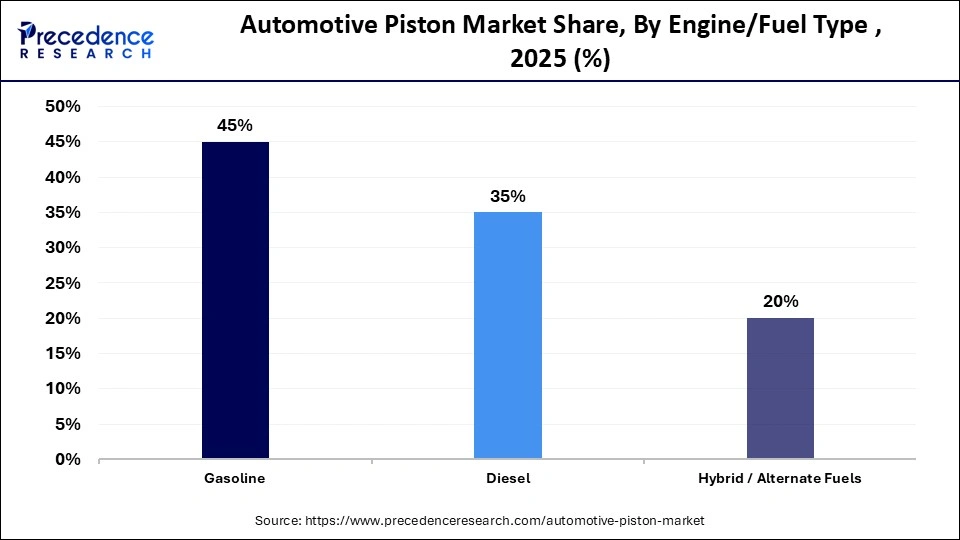
The hybrid/alternate fuels segment is expected to grow with the highest CAGR of 3.8% in the market during the studied years because of the rising trend of electrification. Hybrids have not yet deployed internal combustion engines, thus necessitating optimum pistons that are used during intermittent cycles of operation. The adoption of hybrid vehicles is being boosted by incentives provided by the government to encourage cleaner mobility. CNG engines are also alternative fuel engines that lead to the growth of segments. Ongoing innovation in low-friction and lightweight piston designs helps in growth.
Regional Insights
Asia Pacific Automotive Piston Market Size and Growth 2026 to 2035
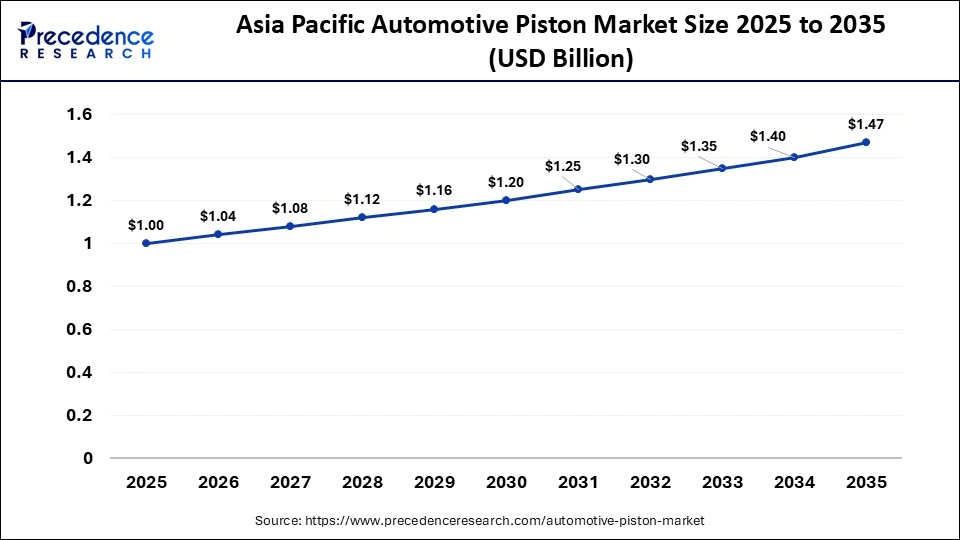
The Asia Pacific automotive piston market size is expected to be worth USD 1.47 billion by 2035, increasing from USD 1.00 billion by 2025, growing at a CAGR of 3.93% from 2026 to 2035.
Why Asia Pacific Dominated the Automotive Piston Market?
Asia-Pacific held a major market share of approximately 40% and is expected to be the fastest-growing with a CAGR of 4.5% in the market. This can be attributed to the fact that it has a big automotive manufacturing base. The markets are growing due to rapid urbanization, increasing disposable incomes, and high vehicle demand. The region enjoys economic production factors and large supply chains. More adoption of hybrid cars will boost the demand for pistons even more. The government policies that favor local motor-industry production drive the growth. Increasing exports of vehicles and components maintain long term market dominance.
Country-Level Analysis
China dominates the market in Asia-Pacific since it is the biggest automobile manufacturer in the world. India is also a growing market with the rising passenger and commercial vehicle sales. Japan has a stable demand, which is motivated by high automotive engineering and hybrid leadership. South Korea has a high contribution to the exports of OEM and innovation. Thailand and Indonesia are Southeast Asian countries that are becoming production centers. In general, the diversification at the country level guarantees the superiority and high growth rate of the Asia Pacific.
How is North America Reporting its Notable Growth in the Automotive Piston Market?
North America is expected to grow at a considerable CAGR in the upcoming period, due to technological advancements and the growth of hybrid cars. The increasing demand for SUVs and light trucks is favorable for the consumption of pistons. The existence of high emphasis on fuel efficiency and emission cut promote the development of high-tech piston materials. The availability of larger automotive OEMs enhances local production. The market for engine overhauls is also an after-market, which is one reason why the market grows steadily. Investments in automation and research and development contribute to competitiveness.
Country-Level Analysis
On the country level, the U.S. is the leading regional growth, because of the high level of vehicle ownership and good manufacturing capacity. Canada also makes a consistent contribution with the growing level of commercial vehicle production and exports. Mexico is a strategic manufacturing center for supply chains in North America. Further growth in the use of hybrid vehicles also increases the demand for pistons in the area. Effective relationships between the OEM and suppliers ensure the stability of supply. All these factors are favorable to the long-term market development of North America.
What are the Advancements in the Automotive Piston Market in Europe?
Europe is expected to have significant growth in the market. This growth is driven by stringent environmental regulations and a shift towards sustainable automotive practices. The European Union also has a strong focus on reducing carbon emissions, which is boosting demand for lightweight and efficient components, including piston pins. Countries such as Germany, France, and the UK are leading players.
Germany Trends
The country's market landscape is marked by a strong emphasis on research and development, with companies heavily investing in advanced manufacturing techniques in order to enhance product performance and sustainability.
What are the Key Trends in the Automotive Piston Market in Latin America?
Latin America is expected to have significant growth throughout the forecast period, driven by increasing vehicle production and a growing middle-class population. The increasing demand for high-performance and cost-effective components is further fueling market growth, supported by favorable government policies and investments in infrastructure. Countries like Brazil and Mexico are leading players, with significant contributions being made from local manufacturers and international companies.
Brazil Trends
The country's market landscape is characterized by a mix of established companies and emerging players, all competing for market share. As the automotive industry continues to evolve, the demand for innovative piston pin solutions is expected to rise.
How is the Middle East and Africa Region Growing in the Automotive Piston Market?
The Middle East and Africa region is witnessing significant growth in the market, driven by increasing vehicle ownership and infrastructure development. Other factors, such as rising disposable incomes and urbanization, are also contributing to the demand for vehicles, thereby boosting the need for piston pins. Countries like South Africa and the UAE are leading players.
Saudi Arabia Trends
The region's market landscape is still in its developing stages, with opportunities for both local and international companies to enter the market. As the automotive sector continues to grow in this region, the demand for high-quality piston pins is expected to increase.
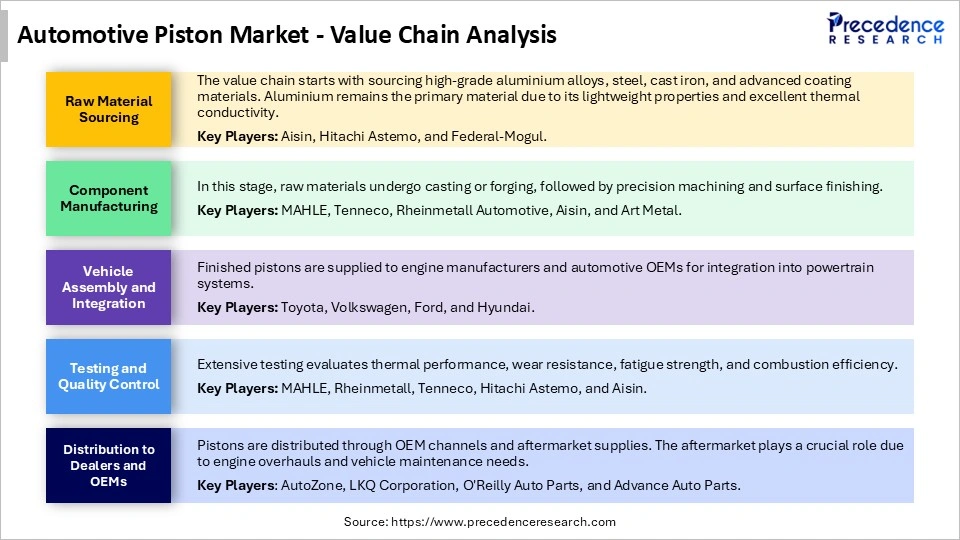
Automotive Piston Market Value Chain Analysis
Automotive Piston Market Companies
- MAHLE GmbH
- Tenneco Inc.
- Aisin Seiki Co., Ltd
- Hitachi Astemo, Ltd.
- Toyota Industries Corporation
- Rheinmetall AG (KSPG / Kolbenschmidt)
- Shriram Pistons and Rings Ltd.
- India Pistons Limited
- Capricorn Automotive Ltd.
- CPCarrillo, Inc.
- Arias Pistons
- Ross Racing Pistons
- Piston Automotive LLC
- ElringKlinger AG
- Sogefi S.p.A.
Recent Developments
- In March 2025, Cummins announced the launch of its first gasoline engine, B6.7 Octane engine, that can pump out over 1,000 lb-ft of stump-pulling power. The engines were launched to be used in pickup trucks, school buses, step vans, delivery vehicles, and service trucks.(Source: https://www.theautopian.com)
- In March 2025, Volvo Trucks announced the launch of its new VNR truck containing Volvo D13 VGT engine. The engine comprises improved seven-wave piston to optimize air and fuel mixture control, improve the combustion process, lower the overall temperature, and reduce NOx output.
- In December 2024, Shriram Pistons and Rings Ltd. (SPRL) announced the acquisition of TGPEL Precision Engineering Ltd. to strengthen its position in the manufacturing of high-precision injection-molded components, as part of its long-term strategy to diversify its product portfolio beyond internal combustion engines. (Source: https://www.autocarpro.in)
Segments Covered in the Report
By Component Type
- Piston
- Piston Rings
- Piston Pins
By Vehicle Type
- Passenger Vehicles
- Commercial Vehicles
- TwoWheelers/Others
By Material Type
- Aluminum Pistons
- Steel Pistons
- Cast Iron/Others
By Engine/Fuel Type
- Gasoline
- Diesel
- Hybrid/Alternate Fuels
By Region
- North America
- Europe
- Asia-Pacific
- Latin America
- Middle East & Africa
For inquiries regarding discounts, bulk purchases, or customization requests, please contact us at sales@precedenceresearch.com
Frequently Asked Questions
Tags





Ask For Sample
No cookie-cutter, only authentic analysis – take the 1st step to become a Precedence Research client
 Get a Sample




 sales@precedenceresearch.com
 Schedule a Meeting
