



Cold and Flu Supplements Market Size, Key Companies, Company Market Share, Patient Volume, Treatment Adoption Rates, Pricing Analysis, Regulatory Landscape, Competitive Positioning, and Demand Forecast
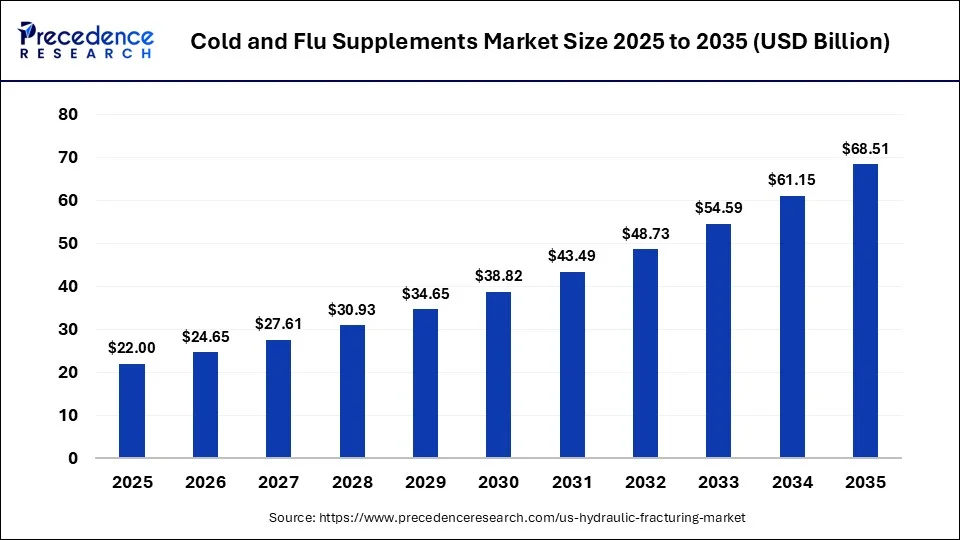
The cold and flu supplements market was valued at USD 24.65 billion in 2026, expanding at a CAGR of 12.03% by 2035. The market is driven by rising consumer focus on immune health, increasing demand for natural remedies, and growing use of supplements for seasonal cold and flu symptom support. Key trends include adoption of botanical ingredients, combination formulations, gummies, powders, and convenient liquid formats. Growing preventive healthcare awareness, e-commerce penetration, and demand for evidence-backed immune-support products are expected to create new opportunities for manufacturers through 2035.
Source: https://www.precedenceresearch.com/cold-and-flu-supplements-market
 Get a Sample
 Table Of Content


Cold and Flu Supplements Market Size, Demand, and Trends Analys is 2035
The cold and flu supplements market is forecasted to expand from USD 24.65 billion in 2026 to USD 68.51 billion by 2035, growing at a CAGR of 12.03% from 2026 to 2035. The cold and flu supplements market is being driven by preventive health awareness, seasonal respiratory demand, rising interest in vitamins, minerals, botanical ingredients, and convenient dosage formats. The market is evolving toward herbal and combination formulations, premium products, powders, gummies, and digitally enabled distribution, while competitive differentiation increasingly depends on evidence-backed ingredients, trusted brands, formulation innovation, and omnichannel reach.
 Key Takeaways
- The global cold and flu supplements market was estimated at approximately USD 24.65 billion in 2026.
- The United States accounted for approximately USD 6.91 billion of the broader cold and flu supplements market in 2025.
- China and India were estimated at approximately USD 2.96 billion and USD 2.03 billion, respectively, in 2025 under the broader market definition.
- North America represented approximately 35.2% of global market revenue in 2025.
- Herbal and botanical supplements are estimated to grow at approximately 13.8% CAGR, making them one of the fastest-growing product pools.
- Powder formulations are expanding at approximately 13.6% CAGR, supported by drink-mix formats and multifunctional immunity products.
- The broader vitamins and supplements sector recorded approximately 70 announced or completed M&A deals in YTD 2025, compared with 59 in the comparable prior-year period.
- Supplements represented approximately 53.9% of sector deal volume, while strategic buyers accounted for approximately 85% of transactions in YTD 2025.
Preventive Immunity, Seasonal Respiratory Demand and Premium Botanical Formulations Are Expanding the Market
The global cold and flu supplements market is estimated at approximately USD 24.65 billion in 2026, with available market estimates placing the market within a broad USD 13.22 billion range, reflecting differences in whether adjacent immune-health and respiratory supplements are included. Using the broader market definition, the market is projected to reach approximately USD 68.51 billion by 2035, implying an estimated 12.03% CAGR.
The market is being reshaped by preventive health behavior, seasonal respiratory illness cycles, increasing consumer interest in vitamins and minerals, botanical formulations, convenient dosage forms, and online purchasing. Herbal and botanical supplements are analysis estimates to grow at approximately 13.8% CAGR, ahead of several conventional categories, while powder formats are expanding at roughly 13.6% CAGR.
Importantly, the market is not equivalent to the broader respiratory OTC-drug market. Supplements generally occupy a preventive, wellness-support, and symptom-support position, creating a regulatory and evidence environment distinct from pharmaceutical cold and influenza treatments
Key Coverage
2026 global market estimate: ~USD 24.65 billion
2035 projected market: ~USD 68.51 billion
Forecast CAGR: ~12.03%
North America share: ~35.2%
Asia Pacific 2025 value: ~USD 6.7 billion
Fastest-growth product pool: herbal or botanical formulations
Fastest-growth form: powders
Core demand pools: immunity support, seasonal prevention, early-symptom support and natural-health positioning
Market Size - A Large Seasonal Market With Double-Digit Expansion Under the Broad Market Definition
Key Coverage
- 2021-2025 historical market reconstruction
- 2025 base-year revenue
- 2026-2035 forecast
- CAGR and incremental revenue opportunity
- Regional and country-level forecasts
- Base/upside/downside scenarios
- Seasonal demand normalization
- Volume and value decomposition
Segmentation Analys is - Vitamins Remain Foundational While Botanical and Combination Formulations Capture Incremental Growth
Product demand spans vitamin-based, mineral-based, herbal or botanical-based, and combination or other formulations, with tablets, capsules, liquids, and powders forming the principal dosage formats. Tablets remain a major format because of low manufacturing complexity, dosing convenience, and pharmacy compatibility, while powders are benefiting from drink-mix formats and multifunctional immunity products.
Vitamin C and zinc remain foundational ingredients, but the competitive opportunity is shifting toward multi-ingredient formulations combining vitamins, minerals, elderberry, echinacea, probiotics, and other botanical ingredients. Scientific evidence is not uniform across ingredients: oral zinc may shorten cold duration when used early, while vitamin C generally provides only modest reductions in duration and severity; evidence for echinacea and elderberry varies by preparation and study.
Key Coverage
- Product-type revenue and share
- Vitamin C, zinc and multinutrient formulations
- Elderberry, echinacea and botanical formulations
- Combination-product growth
- Tablets vs capsules vs liquids vs powders
- Adult vs pediatric positioning
- Preventive vs early-symptom use
- Segment CAGR and growth contribution
Market Dynamics - Preventive Health is Expanding the Addressable Consumer Pool, but Evidence and Claim Discipline Remain Critical
Demand is being supported by heightened health awareness, recurring seasonal respiratory infections, consumer willingness to self-manage minor illnesses, and growing interest in natural and plant-based products. At the same time, product claims face an important evidence constraint: zinc has relatively stronger evidence for shortening cold duration when taken early, whereas vitamin C does not generally prevent colds in the general population and echinacea evidence remains mixed.
This creates a strategic divide between science-led formulations and products competing primarily through brand trust, ingredient familiarity, taste, convenience, and natural positioning.
Key Coverage
- Preventive-health adoption
- Seasonal respiratory cycles
- Consumer wellness spending
- Ingredient efficacy and evidence
- Regulatory claim constraints
- Natural-product demand
- Premiumization
- E-commerce-led access
Tentative Leading Company Universe - 22 Companies With Direct or Strategic Exposure
| Company | Headquarters | Market Position | Core Strength | Major Applications/Segments |
| Haleon | U.K. | Global consumer-health leader | VMS & respiratory health | Cold/flu, immunity |
| Nestlé | Switzerland | Global nutrition platform | Premium VMS | Vitamins, immunity |
| Church & Dwight | U.S. | Consumer-health challenger | Gummy/supplement brands | Immune & respiratory |
| Schwabe Group | Germany | Botanical specialist | Herbal extracts | Respiratory health |
| Boiron | France | Natural-health specialist | Homeopathic/natural products | Cold/flu |
| NOW Foods | U.S. | Broad supplement specialist | Vitamins & botanicals | Immune support |
| PharmaCare / Sambucol | Australia/U.S. | Botanical specialist | Elderberry | Cold/flu |
| Gaia Herbs | U.S. | Botanical specialist | Herbal formulations | Immune/respiratory |
| Naturelo | U.S. | DTC supplement specialist | Clean-label supplements | Immune health |
| Pharmavite | U.S. | VMS specialist | Mass-market vitamins | Vitamin/mineral |
| Nature's Way | U.S. | Natural supplement specialist | Herbal & VMS | Immune support |
| Blackmores | Australia | Regional VMS leader | Vitamins/minerals | Immune health |
| Himalaya Wellness | India | Herbal-health specialist | Botanical formulations | Respiratory/immune |
| Dabur | India | Ayurveda/health platform | Herbal nutrition | Immune/respiratory |
| Amway | U.S. | Direct-selling supplement platform | VMS | Wellness/immune |
| Herbalife | U.S. | Global nutrition platform | Supplements | General wellness |
| Otsuka Pharmaceutical | Japan | Nutrition/pharma group | Functional health | Supplements |
| A.Vogel / Bioforce | Switzerland | Herbal specialist | Plant-based products | Cold/flu |
| Life Extension | U.S. | Premium supplement specialist | Science-led VMS | Immune support |
| Thorne | U.S. | Premium supplement specialist | Clinician-oriented VMS | Immune health |
| Viva Naturals | Canada | DTC supplement player | Natural supplements | Immunity |
| Nature's Bounty / major VMS portfolio | U.S. | Mass-market VMS | Vitamins & minerals | Immune support |
Which Competitive Capabilities Are Reshaping the Cold and Flu Supplements Market?
The competitive landscape is increasingly shaped by a combination of brand strength, formulation breadth, botanical and clinically supported ingredients, delivery-format innovation, manufacturing scale, and omnichannel distribution rather than by SKU count alone. Across the broader vitamins and supplements sector, strategic buyers accounted for approximately 80% of M&A activity in YTD 2025, while supplements represented 53.9% of sector deal volume, indicating sustained strategic interest in differentiated consumer-health portfolios. Competitive intensity is also supported by a fragmented company universe spanning multinational consumer-health groups, pharmaceutical companies, specialist herbal brands, direct-to-consumer players, and regional supplement manufacturers.
Our analysis indicates that competitive advantage is becoming increasingly capability-driven. Large players benefit from established retail distribution, marketing budgets, regulatory infrastructure, and portfolio scale, while specialist companies can differentiate through botanical expertise, clinically substantiated formulations, clean-label positioning, immune-health specialization, and premium delivery formats such as gummies, powders, and liquids. Our assessment is that this creates a two-speed competitive structure: scaled companies are positioned to capture broad consumer demand efficiently, whereas focused brands can gain share where consumers place greater value on efficacy claims, ingredient transparency, personalization or natural formulations.
In our view, the most significant strategic implication is that portfolio breadth alone is unlikely to determine competitive positioning. Companies able to combine proprietary or clinically supported ingredients with trusted brands, differentiated formats and efficient distribution can create stronger barriers to substitution and potentially support premium pricing. At the same time, manufacturing integration and access to DTC and digital channels are becoming increasingly important as companies seek greater control over product development, consumer data and speed-to-market. This competitive evolution creates opportunities for specialists in botanical science, immune-health formulations and personalized supplementation, while increasing pressure on undifferentiated private-label and commodity-oriented products.
Which Strategic Developments and M&A Moves Are Reshaping the Competitive Structure of the Cold and Flu Supplements Market?
M&A and strategic activity across the broader vitamins, minerals and supplements ecosystem have accelerated around brand acquisition, botanical ingredients, contract manufacturing, personalization and omnichannel distribution. Sector transaction volume reached approximately 70 announced or completed deals in YTD 2025, versus 59 in the comparable prior-year period, while strategic buyers accounted for approximately 85% of transactions. Supplements represented 53.9% of sector deal volume, highlighting continued appetite for acquiring established consumer-health brands and differentiated formulations. Average sector M&A valuation reached approximately 10.7x EV/EBITDA during 2024-YTD 2025, indicating that recognizable brands, functional ingredients, and scalable distribution continue to command strategic premiums.
Our analysis indicates that M&A in cold and flu supplements is increasingly being driven by capability acquisition rather than simple market consolidation. Buyers are seeking access to proprietary botanical ingredients, clinically supported formulations, established DTC communities, manufacturing capacity, and international distribution. Recent transactions illustrate this shift: a major Indian consumer-products group agreed to acquire an established organic health-and-wellness platform with 100+ products, relationships with more than 12,000 farmers and distribution across 48+ countries, while a nutraceuticals manufacturer acquired a botanical-ingredient developer to expand its proprietary, clinically researched ingredient portfolio.
In our view, the most significant implication is that future competitive advantage will increasingly depend on controlling differentiated ingredients and scalable routes to market, rather than simply expanding the number of cold-and-flu SKUs. The emergence of personalized nutrition and vertically integrated supplement platforms reinforces this direction: one recent transaction created a 51:49 nutraceutical joint venture combining formulation, manufacturing, marketing and distribution capabilities, while another acquisition strategy integrated biometric data, personalized nutrition recommendations and supplement manufacturing. We expect strategic buyers to remain particularly interested in botanical science, immune-health formulations, gummy or powder delivery formats, clinically substantiated ingredients, DTC brands and contract manufacturing capabilities.
Which Companies Have the Capabilities to Capture the Next Wave of Growth in Cold and Flu Supplements?
The competitive universe spans multinational consumer-health companies, pharmaceutical and nutraceutical manufacturers, specialist herbal brands, direct-to-consumer businesses, and regional supplement players, creating substantial variation in scale, product breadth and strategic capabilities. Within the broader vitamin supplements sector, strategic buyers represented approximately 80% of M&A activity in YTD 2025, while supplements accounted for 53.9% of sector deal volume, demonstrating continued corporate interest in acquiring brands, formulations, ingredients and manufacturing capabilities. This activity indicates that competitive positioning is increasingly linked to the ability to combine consumer reach with differentiated product and formulation assets.
Our analysis indicates that leading companies are differentiating through distinct capability combinations rather than competing on product count alone. Large-scale players typically possess advantages in brand recognition, retail distribution, regulatory infrastructure, manufacturing scale and marketing reach, while specialist competitors can compete through botanical expertise, clinically supported ingredients, immune-health specialization, clean-label formulations and premium delivery formats. Our assessment is that this creates meaningful competitive segmentation, with different companies occupying distinct positions across mass-market accessibility, premium wellness, natural/herbal products, science-led supplementation and digitally enabled personalization.
In our view, the most significant strategic implication is that companies seeking share gains will need to strengthen the specific capabilities that match their target consumer and channel strategy. A broad portfolio can support cross-selling and distribution efficiency, but differentiated ingredients, evidence-backed claims, distinctive formats and direct consumer relationships can provide stronger avenues for premiumization and customer retention. From our assessment, this creates opportunities for both scaled incumbents seeking portfolio expansion and specialist players seeking partnerships, acquisitions, or geographic expansion.
Which Companies Are Capturing the Largest Share of the Cold and Flu Supplements Market, and Where is Competitive Power Shifting?
The cold and flu supplements market remains structurally fragmented across multinational consumer-health companies, pharmaceutical and nutraceutical manufacturers, specialist herbal brands, and regional players, with competitive concentration varying significantly by product type, geography, and distribution channel. The broader vitamins and supplements sector provides an important indicator of this structure: supplements represented approximately 53.9% of sector M&A deal volume in YTD 2025, while strategic buyers accounted for around 80% of transactions, reflecting continued investment in brands, formulations, ingredients, and market access. This environment suggests that market share is increasingly influenced not only by existing sales scale but also by portfolio expansion and access to differentiated capabilities.
Our analysis indicates that competitive ranking in cold and flu supplements is best understood through multiple dimensions rather than revenue alone. Companies with broad retail distribution and high brand recognition can capture significant consumer volumes, while specialist players may hold stronger positions in herbal remedies, clinically supported ingredients, premium formulations, or specific geographic markets. Our assessment is that this creates a market in which a company's apparent global scale may not fully reflect its competitive strength within high-growth niches. Product-level penetration, channel reach, geographic concentration, and formulation differentiation therefore become critical to understanding where actual competitive power resides.
In our view, the most significant implication is that future share shifts are likely to emerge at the intersection of scale and specialization. Large players can leverage manufacturing, marketing and distribution advantages to expand rapidly, while focused competitors can defend or build share through differentiated ingredients, natural positioning, innovative delivery formats and stronger consumer engagement. From our assessment, the most relevant competitive opportunities therefore lie in identifying underpenetrated product categories, high-growth geographies, premium price tiers and specialist consumer segments where incumbent scale does not automatically translate into dominance.
Segments Covered in the Report
By Product Type
- Vitamins & Minerals
- Herbal & Botanical Supplements
- Zinc Supplements
- Vitamin C Supplements
- Vitamin D Supplements
- Multivitamin & Immune-Support Supplements
- Probiotics & Synbiotics
- Combination Formulations
- Other Supplements
By Form
- Tablets & Capsules
- Gummies
- Powders
- Effervescent Tablets
- Lozenges
- Syrups & Liquids
- Softgels
- Chewables
- Other Forms
By Ingredient / Active Component
- Vitamin C
- Vitamin D
- Zinc
- Elderberry
- Echinacea
- Garlic
- Ginger
- Propolis
- Andrographis
- Other Botanical Ingredients
By Application / Health Benefit
- Cold Prevention
- Flu Prevention
- Symptom Relief
- Immune-System Support
- Respiratory Health
- Recovery Support
By Consumer Demographics
- Adults
- Children
- Seniors
- Pregnant / Lactating Women
- Pediatric / Family
By Distribution Channel
- Pharmacies & Drugstores
- Supermarkets & Hypermarkets
- Specialty Health Stores
- Clinics & Healthcare Providers
- E-commerce
- Direct-to-Consumer
- Other Retail Channels
By Price Range
- Economy
- Mid-Range
- Premium
- Super-Premium
By Geography
- North America
- U.S.
- Canada
- Europe
- Germany
- U.K.
- France
- Italy
- Spain
- Rest of Europe
- Asia Pacific
- China
- Japan
- India
- South Korea
- Australia
- Rest of Asia Pacific
- Latin America
- Middle East & Africa
For inquiries regarding discounts, bulk purchases, or customization requests, please contact us at sales@precedenceresearch.com
Frequently Asked Questions





Ask For Sample
No cookie-cutter, only authentic analysis – take the 1st step to become a Precedence Research client
 Get a Sample
.webp)



 sales@precedenceresearch.com
 Schedule a Meeting
