



Cold Seal Adhesive Market Size, Companies, Share, Production Capacity, Raw Material Pricing, Export & Import Analysis, Manufacturing Cost, Competitive Positioning, and Demand Forecast
Cold Seal Adhesive Market (By Type: Natural Rubber Latex Based, Synthetic Polymer Based, Water-based, Solvent-based; By Application: Food & Beverage Packaging, Healthcare & Medical Packaging, Industrial Packaging, Others; By Material Compatibility: Paper & Board, Polypropylene (PP), Polyethylene (PE), Polyethylene Terephthalate (PET), Others) - Global Industry Analysis, Size, Trends, Leading Companies, Regional Outlook, and Forecast 2026 to 2035
Source: https://www.precedenceresearch.com/cold-seal-adhesive-market
 Get a Sample
 Table Of Content


What is the Cold Seal Adhesive Market Size in 2026?
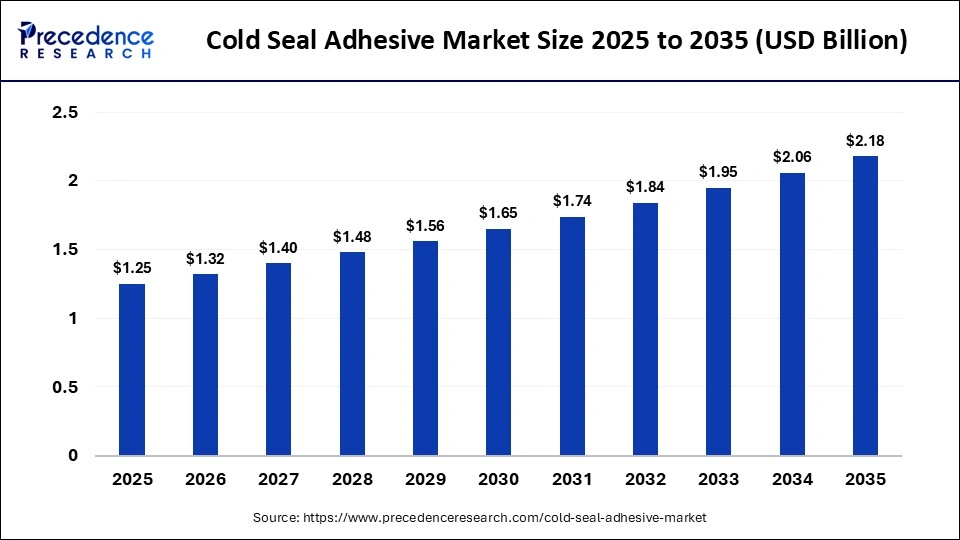
The global cold seal adhesive market size accounted for USD 1.25 billion in 2025 and is predicted to increase from USD 1.32 billion in 2026 to approximately USD 2.18 billion by 2035, expanding at a CAGR of 5.70% from 2026 to 2035. Increasing e-commerce activities, the need to reduce excess packaging waste, and the rising demand for packaged food are key factors driving the market.
Key Takeaways
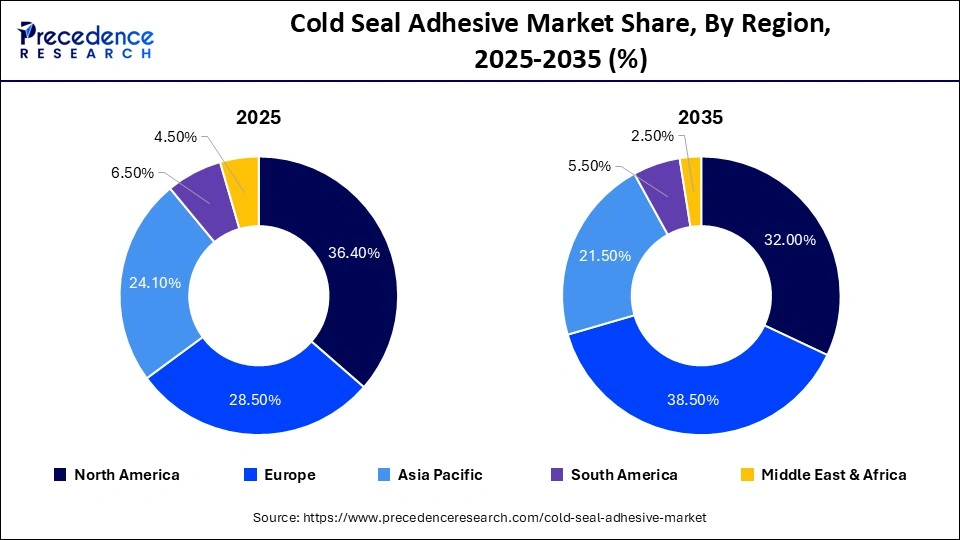
- Europe led the cold seal adhesive market in 2025 with approximately 36.4% share.
- Asia Pacific is the second-largest shareholder, holding around 28.5% share in 2025, and is expected to experience the fastest growth in the coming years.
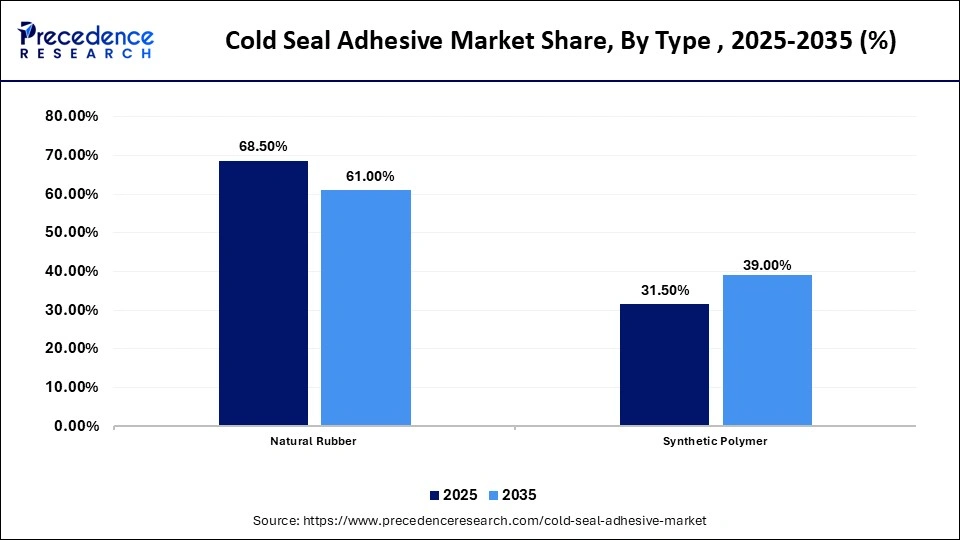
- By type, the natural rubber segment dominated the market with a share of 68.5% in 2025.
- By type, the synthetic polymer segment is the second-largest shareholder in 2025 and is expected to register the fastest growth over the forecast period.
- By application, the food & beverage segment dominated the market with a 72.0% share in 2025.
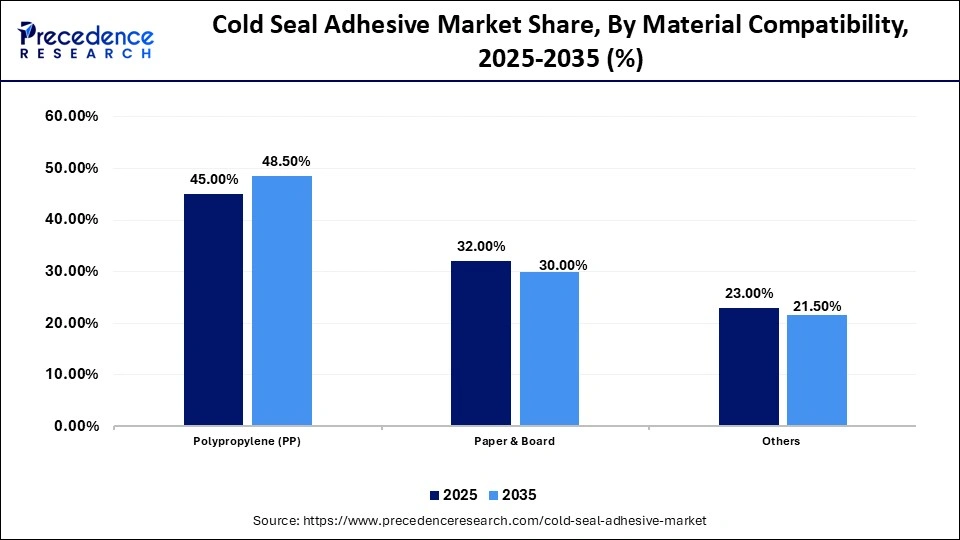
- By material compatibility, the polypropylene (PP) segment dominated the market with a 45.0% share in 2025.
Market Overview
Cold seal adhesives are water-based formulations used for sealing heat-sensitive products. They are widely applied in packaging for baked goods, confectionery, candy, and cereal bars, nutritional and protein bars, frozen dessert & ice cream, specialty snacks, and pharmaceutical items. In addition, cold seal adhesives cause less product damage and reduce streaking. These adhesives also result in fewer leaks and are expected to extend the lifespan of cutting knives and seal jaws, as no heating is required, further boosting their adoption.
Impact of Artificial Intelligence on the Cold Seal Adhesive Market
Artificial intelligence is transforming packaging technologies, including cold seal adhesive applications. AI predicts performance characteristics and optimizes formulations with high speed and accuracy, shrinking development cycles from months to days and cutting experiments. In packaging operations, AI enhances shipment tracking, counterfeit detection, material sorting, and waste separation using automated inspection systems. It is also used to improve shelf-life prediction, contamination detection, and material selection based on product-specific needs. Combined with nanotechnology, AI enables the development of biodegradable, intelligent packaging materials with environmental benefits and intrinsic antibacterial properties, advancing both performance and sustainability in the cold seal adhesive segment.
Major Market Trends
- Sustainability and Eco-Friendly Packaging: Companies are reducing environmental impact through energy-efficient packaging and recyclable materials. Cold seal supports a circular economy by enabling the use of recycled content, easier separation of components after use, and minimizing excess packaging waste.
- Growth of E-commerce: The rise in e-commerce activities, which is significantly driving the market. As online shopping expands, the need for efficient, secure, and reliable packaging solutions continues to increase across industries.
- Rising Demand for Food and Medical Packaging: Increasing demand for food and medical packaging is boosting the adoption of cold seal adhesives. These adhesives ensure safe, efficient, and sustainable packaging while improving protection for heat-sensitive products such as chocolates and pharmaceuticals.
Market Scope
| Report Coverage | Details |
| Market Size in 2025 | USD 1.25 Billion |
| Market Size in 2026 | USD 1.32 Billion |
| Market Size by 2035 | USD 2.18 Billion |
| Market Growth Rate from 2026 to 2035 | CAGR of 5.70% |
| Dominating Region | Europe |
| Fastest Growing Region | Asia-Pacific |
| Base Year | 2025 |
| Forecast Period | 2026 to 2035 |
| Segments Covered | Type, Application, Material Compatibility, and Region |
| Regions Covered | North America, Europe, Asia-Pacific, Latin America, and Middle East & Africa |
Market Dynamics
Drivers
Demand for Product Integrity and Flexible Packaging
The cold seal adhesive market is driven by the need to preserve the integrity of sensitive products, along with rising demand for flexible packaging. Growth in packaged food and pharmaceutical consumption, along with a shift toward solvent-free and water-based adhesives, further supports market expansion.
Restraint
Limited Compatibility and Lower Bond Strength
Limited material compatibility remains a key restraint, requiring the use of a specialized adhesive. Additionally, bond strength may be comparatively lower, especially in high-stress environments, which can restrict its applications across certain packaging conditions.
Opportunity
Advancement in Adhesive Formulations
Advancements in adhesive formulations create immense opportunities in the market. Advanced formulations facilitate the creation of packaging products that exhibit superior performance traits, such as increased adhesion strength and reduced curing durations.
Segment Insights
Type Insights
Cold Seal Adhesive Market Share, By Type , 2025-2035 (%)
| Type | 2025 | 2035 |
| Natural Rubber | 68.5% | 61.0% |
| Synthetic Polymer | 31.5% | 39.0% |
The Natural Rubber Latex-Based Segment Dominated the Market With a 68.5% Share in 2025
The natural rubber latex-based segment led the cold seal adhesive market with the largest share of approximately 68.5% in 2025. This is mainly due to its excellent initial tack and cost-effectiveness for high-speed confectionery production lines. With over a century of proven reliability, natural rubber latex continues to demonstrate consistent performance. Its widespread use in medical devices and food packaging, owing to compliance with established safety and quality standards, further strengthens its market position.
The synthetic polymer based (latex-free) segment accounted for 31.5% share of the market in 2025 and is expected to grow at the fastest rate over the forecast period. This is because of the increasing demand for allergen-free adhesives in medical and premium food applications. These synthetic adhesive formulations exhibit lower odor, reduced foaming tendency in the liquid state, and superior mechanical stability. They can form strong bonds at room temperature while allowing reels to be wound without blocking and stored for extended periods, supporting their broader adoption across high-performance packaging lines.
The water-based segment held a significant share of the market in 2025 and is expected to grow at a notable rate during the projection period. This is due to its ability to enhance overall sustainability and boost production efficiencies. Furthermore, it facilitates the incorporation of more transparent film into packaging designs, thereby improving aesthetics and allowing consumers to see the product before purchase. This approach also contributes to a reduction in adhesive usage and coating weight, leading to decreased plastic thickness without compromising performance.
The solvent-based segment is growing because these adhesives are becoming popular for their remarkable adaptability. During the manufacturing process, the adhesive is mixed with a solvent solution, which evaporates post-application, leaving a highly durable and moisture-resistant bond. These adhesives provide exceptional initial tack and holding strength, and they function reliably under both extreme heat and cold conditions. Moreover, they demonstrate excellent resistance to moisture and humidity. Consequently, sectors such as automotive, construction, and appliances are progressively depending on coil-applied, solvent-based laminating adhesives for their outstanding performance in high-speed production settings.
Application Insights
Cold Seal Adhesive Market Share, By Application, 2025-2035 (%)
| Application | 2025 | 2035 |
| Food & Beverage | 72.0% | 75.5% |
| Healthcare | 15.4% | 16.5% |
| Others | 12.6% | 8.0% |
The Food & Beverage Packaging Segment Led the Market With a 72.0% Share in 2025
The food & beverage packaging segment led the cold seal adhesive market while holding approximately 72.0% share in 2025, driven by the suitability of cold seal adhesives for packaging heat-sensitive items like chocolate bars and granola. These adhesives provide strong, instant bonding without heat, ensuring fast, efficient sealing of high-speed production lines. Their compatibility with flexible packaging, safety for direct food contact, and ability to maintain freshness and hygiene make them highly preferred in the industry. Additionally, the segment's dominance is further reinforced by the growing demand for packaged and convenience foods.
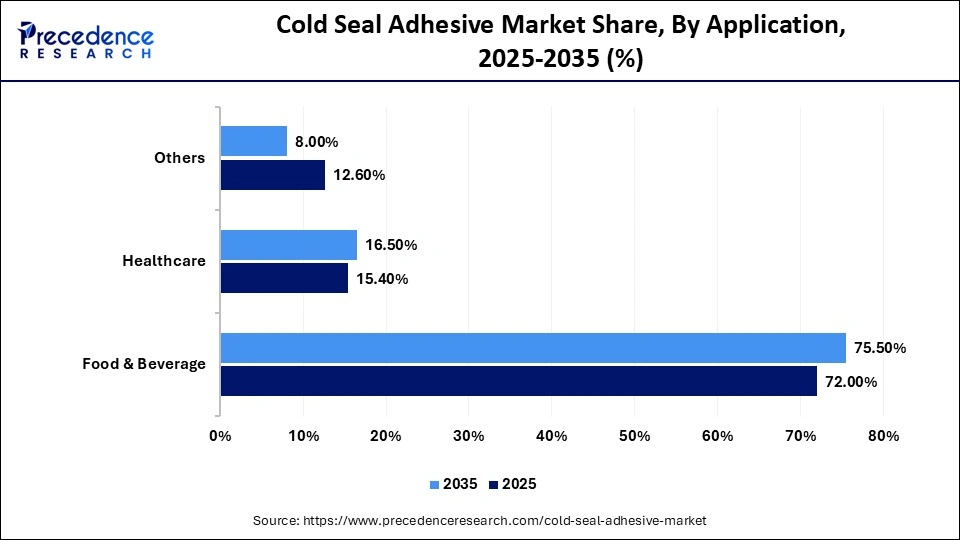
The healthcare & medical packaging segment captured nearly 15.4% market share in 2025, supported by the growing use of cold seal adhesives in instant seal medical pouches, where heat sealing could damage sensitive contents. Heat, moisture, and component sensitive products benefit from low temperature sealing, while wound dressings and paper-based medical packaging gain easier assembly without content damage. Cold seal adhesives enable secure sealing without heat, preserving the integrity of temperature-sensitive medical products and devices. Additionally, the increasing demand for safe, sterile, and tamper evident packaging solutions drives segmental growth.
The industrial packaging segment is expected to grow at a significant rate over the forecast period due to the increasing need for efficient and high-speed packaging solutions in manufacturing and logistics. Cold seal adhesives enable quick, reliable sealing without heat, reducing energy consumption and improving operational efficiency. Additionally, the rising demand for durable and secure packaging for industrial goods during storage and transportation is further driving adoption in this segment.
Material Compatibility Insights
Cold Seal Adhesive Market Share, By Material Compatibility, 2025-2035 (%)
| Material Compatibility | 2025 | 2035 |
| Polypropylene (PP) | 45.0% | 48.5% |
| Paper & Board | 32.0% | 30.0% |
| Others | 23.0% | 21.5% |
The Polypropylene (PP) Segment Dominated the Market With 45.0% Share in 2025
The polypropylene (PP) segment dominated the cold seal adhesive market in 2025, accounting for nearly 45.0% share. This leadership is driven by its role as the standard substrate for flexible snack packaging, thanks to its excellent moisture barrier properties. Polypropylene is a popular choice because of its strength, durability, moisture resistance, and relatively low cost, providing a cost-effective adhesive solution without compromising performance. It is also resistant to high temperatures, water, and chemicals, making it suitable for a wide range of environments and applications.
The paper & board segment held nearly 32.0% share in 2025. This is because of the increased adoption of recyclable, plastic-free, and PFAS-free (100% fluorine-free) structures incorporating moisture barrier (MVTR) and oxygen barrier (OTR) coatings. In addition, heat-sealable barrier layers help keep perishables fresh and maintain sensitive contents in near-factory condition, further supporting the shift toward paper-based packaging solutions.
The polyethylene (PE) segment is expected to grow at a significant rate in the coming years due to its outstanding adhesion and elastic properties. PE is highly adaptable to forces caused by temperature fluctuations and mechanical stress, while offering high tensile strength. In addition, it is lightweight, flexible, chemically and corrosion resistant, and inexpensive to manufacture, making it a cost-effective and versatile material choice across diverse packaging applications.
The polyethylene terephthalate (PET) segment is gaining momentum as brands increasingly focus on improving package recyclability. PET offers strong resistance to microbiological attack and does not react with food or biodegrade, ensuring product safety and stability. Moreover, ongoing developments in high-performance gas barrier layers and ultraviolet (UV) light protection are expected to further increase PET's adoption, as these innovations help extend the shelf life of packaged products and support more sustainable, long-lasting packaging solutions.
Regional Insights
Europe Cold Seal Adhesive Market Size and Growth 2026 to 2035
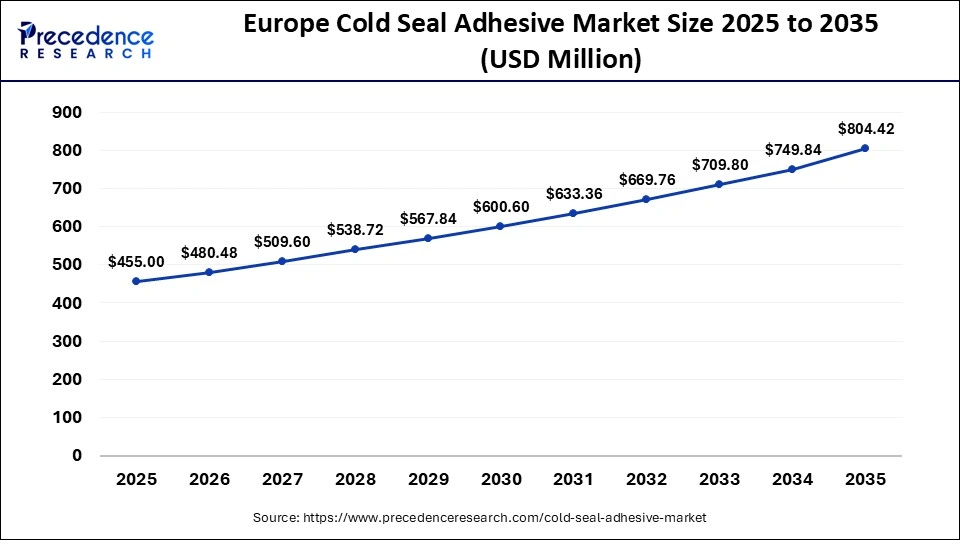
The Europe cold seal adhesive market size has grown strongly in recent years. It will grow from USD 455.00 million in 2025 to USD 804.42 million in 2035, expanding at a compound annual growth rate (CAGR) of 5.86% between 2026 and 2035.
What Made Europe the Dominant Region in the Cold Seal Adhesive Market?
Europe dominated the cold seal adhesive market with a 36.4% share in 2025, supported by its position as the largest hub for advanced confectionery manufacturing and strict safety standards surrounding packaging. Stringent regulations are accelerating the shift toward sustainable packaging and driving greater adoption of cold seal adhesives in the food and beverage sector. In addition, the region's advanced manufacturing capabilities and highly skilled workforce enhance its competitiveness in the global market. Rising safety requirements and the push for biodegradable packaging are further boosting the use of cold seal adhesives across food, pharmaceutical, and hygiene product applications.
UK Market Analysis
The UK is the major contributor to the European cold seal adhesive market, driven by robust demand from the processed food and pharmaceutical industries. The transition toward ready-to-eat meals and convenient snacking options has heightened the need for cold seal packaging that guarantees freshness and ease of use. Prominent firms such as Bondrite Adhesives Ltd and AdCo (UK) Limited are contributing to the growth of the market's revenue.
Asia Pacific: The Fastest-Growing Region
Asia Pacific is the second-largest shareholder, holding around 28.5% share of the market in 2025, and is expected to grow at the fastest rate over the forecast period, driven by rising consumption of packaged snacks. The regional market growth is further supported by increasing industrialization, rapid urbanization, and a booming packaging sector. The market's landscape is becoming dynamic, with a strong focus on cost-effective, high-performance products designed to serve diverse applications across multiple industries.
China Market Analysis
The market in China is expanding, driven by swift urbanization, an increase in packaged food consumption, and a burgeoning middle class. Government initiatives that encourage green packaging and foster domestic innovation are also advancing the market, especially in the areas of flexible packaging and single-use applications. Firms such as Hubei Huitian New Materials Co., Ltd. and Beijing Comens New Materials Co., Ltd. are playing a fundamental role in influencing the market.
How is the Opportunistic Rise of North America in the Cold Seal Adhesive Market?
North America captured approximately 24.1% share of the market in 2025 and is expected to grow at a notable rate, driven by increasing demand for cold seal adhesives from the packaging industry, particularly in food and pharmaceutical applications, where product safety, convenience, and shelf-life extension are critical. Regulatory support for sustainable, eco-friendly packaging solutions is further accelerating market expansion as converters and brand owners transition toward low-impact, recyclable adhesive systems. In addition, the region is characterized by early adoption of advanced packaging technologies and relatively high disposable incomes, which collectively support rapid uptake of high-performance, value-added cold seal adhesive solutions across multiple end-use segments.
U.S. Market Analysis
The U.S. leads the North American cold seal adhesive market, driven by a robust, technology-focused competitive landscape. Key players such as Bostik US, Henkel Corporation, and H.B. Fuller are advancing innovative formulations to boost performance and meet diverse customer needs. Demand is rising rapidly in confectionery, pharmaceutical, and ready-to-eat food packaging, where fast throughput, product integrity, and sustainable flexible formats are essential, firmly positioning the U.S. as the region's primary growth engine.
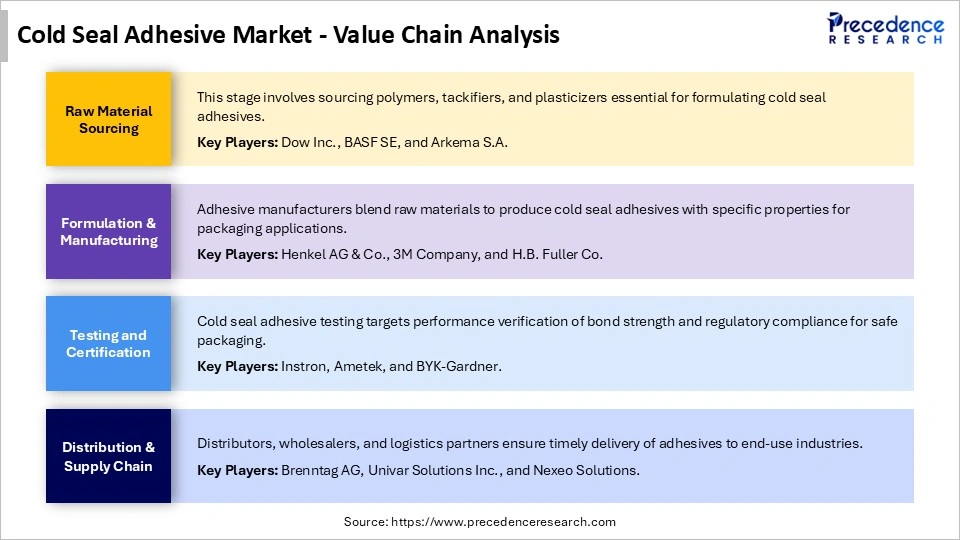
Cold Seal Adhesive Market Supply Chain Analysis
Cold Seal Adhesive Market Companies
- Henkel AG & Co. KGaA
- H.B. Fuller Company
- Arkema (Bostik)
- Dow Inc.
- Sika AG
- 3M Company
- Coim Group
- DIC Corporation
- Ashland Inc.
- Mitsui Chemicals, Inc.
- Toyo Ink SC Holdings Co., Ltd.
- Avery Dennison Corporation
- Paramelt B.V.
- Ube Corporation
- Hitech Album
Recent Developments
- In February 2026, Henkel introduced an innovative cold seal solution engineered for barrier-coated paper packaging, closing a key technology gap in the industry's transition from plastic to paper substrates. The new adhesive system supported high-speed production of recyclable paper structures tailored for heat-sensitive snacks and confectionery.(Source: https://eponline.com)
- In March 2026, Astara Capital Partners backed the merger of Garlock Flexibles with C-P Flexible Packaging, strengthening its position in the growing cold seal adhesion packaging market. The firm structured a continuation vehicle for Garlock while supporting the acquisition, creating a scaled platform with expanded cold seal capabilities aligned with rising demand for flexible, heat-sensitive packaging solutions.(Source: https://www.morningstar.com)
Segment Covered in the Report
By Type
- Natural Rubber Latex Based
- Synthetic Polymer Based (Latex-free)
- Water-based
- Solvent-based
By Application
- Food & Beverage Packaging (Confectionery, Snacks, Bakery)
- Healthcare & Medical Packaging (Bandages, Surgical Gloves)
- Industrial Packaging
- Others (Envelopes, Protective Post)
By Material Compatibility
- Paper & Board
- Polypropylene (PP)
- Polyethylene (PE)
- Polyethylene Terephthalate (PET)
- Others
By Region
- North America
- Latin America
- Europe
- Asia-pacific
- Middle and East Africa
For inquiries regarding discounts, bulk purchases, or customization requests, please contact us at sales@precedenceresearch.com
Frequently Asked Questions
Tags





Ask For Sample
No cookie-cutter, only authentic analysis – take the 1st step to become a Precedence Research client
 Get a Sample




 sales@precedenceresearch.com
 Schedule a Meeting
