



Computer Aided Design in Electrical and Electronics Market Trends, Companies, Revenue / Sales Performance, Subscriber Growth, Pricing Strategies, Cloud Adoption, Infrastructure Expansion, Competitive Landscape, and Industry Outlook
Computer Aided Design in Electrical and Electronics Market (By Software Type: 3D CAD Software, 2D CAD Software; By Deployment Mode: On-premise, Cloud-based; By Application Area: PCB Design, Integrated Circuit (IC) Design, Cable Harness Design, Control Systems Design; By End-Use Industry: Consumer Electronics, Automotive, Aerospace & Defense, Telecommunications, Industrial Automation) - Global Industry Analysis, Size, Trends, Leading Companies, Regional Outlook, and Forecast 2026 to 2035
Source: https://www.precedenceresearch.com/computer-aided-design-in-electrical-and-electronics-market
 Get a Sample
 Table Of Content


What is the Computer Aided Design in Electrical and Electronics Market Size in 2026?
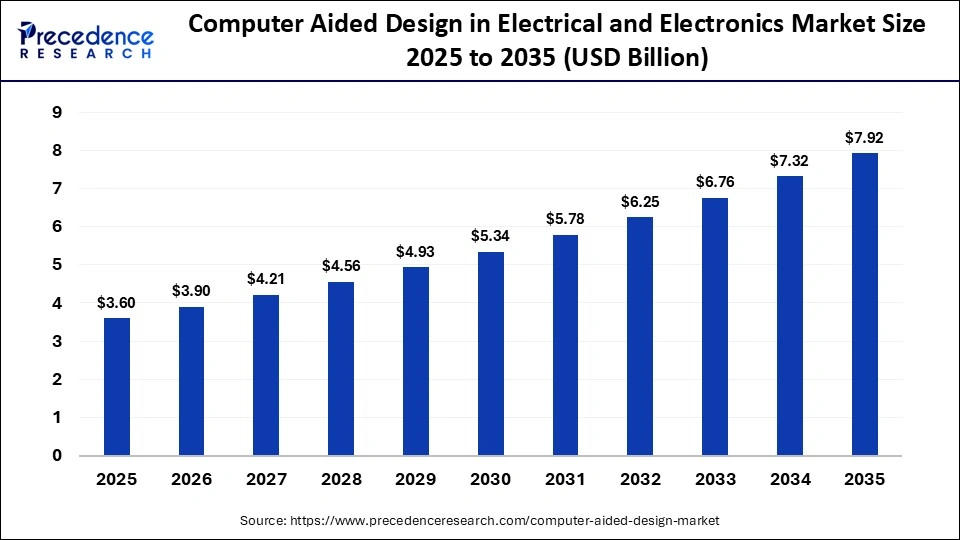
The global computer aided design in electrical and electronics market size was calculated at USD 3.60 billion in 2025 and is predicted to increase from USD 3.90 billion in 2026 to approximately USD 7.92 billion by 2035, expanding at a CAGR of 8.20% from 2026 to 2035.This market is growing due to rising demand for advanced circuit design, miniaturized electronic devices, and faster product development cycles.
Key Takeaways
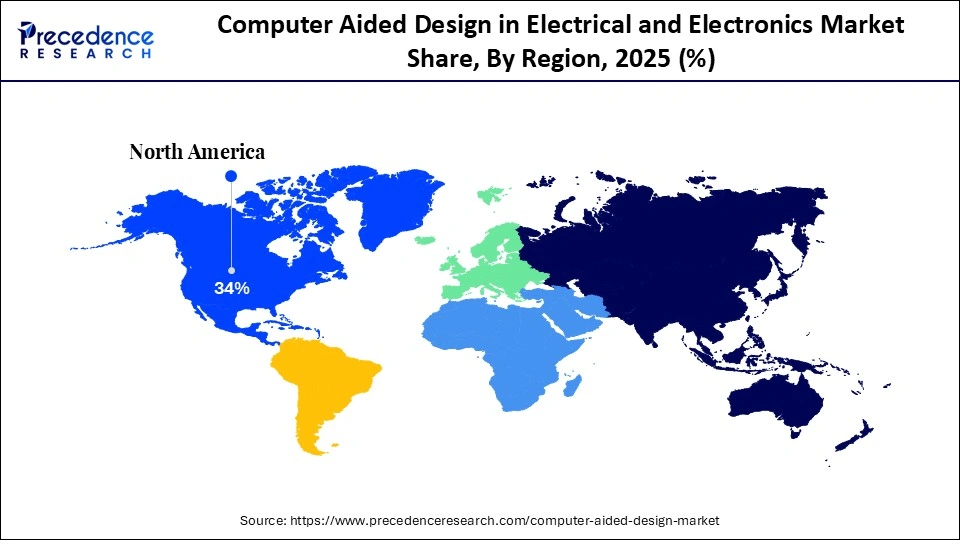
- North America dominated the market with a 34% share in 2025.
- Asia Pacific is expected to grow at a CAGR of 8.8% between 2026 and 2035.
- By software type, the 3D CAD software segment held the biggest market share of 56% in 2025.
- By software type, the 2D CAD software segment is expected to expand at the fastest CAGR of 7.2% between 2026 and 2035.
- By deployment mode, the on-premise segment contributed to the highest market share of 60% in 2025.
- By deployment mode, the cloud-based segment is expected to grow at a strong CAGR of 7.4% between 2026 and 2035.
- By application area, the PCB design segment held a major market share of 38% in 2025.
- By application area, the IC design segment is expected to expand at the fastest CAGR of 7.5% from 2026 to 2035.
- By end-use industry, the consumer electronics segment held the biggest market share of 35% in 2025.
- By end-use industry, the automotive segment is expected to grow at a CAGR of 7.6% between 2026 and 2035.
How is the Computer Aided Design in Electrical and Electronics Market Evolving?
The market has been experiencing significant growth due to the complexity of electronic system integration, PCB development, and circuit design. Increasing demand for smart devices, electric vehicles, consumer electronics, and industrial automation is propelling the use of sophisticated CAD tools for precise simulation and quicker product development. Long-term market growth is also being supported by manufacturers investing in advanced design software because of the trend toward high performance and miniaturized components.
Future Market Overview
- AI-driven optimization tools: Automation in design validation and layout optimization presents strong growth potential.
- Cloud-native subscription models: Flexible SaaS-based CAD solutions can attract startups and SMEs.
- Multidisciplinary co-design platforms: Integrated systems combining electronics, mechanical, and software design offer expansion opportunities.
- Digital twin & PLM integration: Linking CAD with digital twins and lifecycle management can enhance real-time product feedback.
- Advanced training solutions: Growing complexity creates demand for certification programs and digital learning tools.
- Low-code CAD extensions: User-friendly tools for non-specialists can broaden market reach.
- Real-time simulation feedback: Interactive simulation during design stages can significantly reduce errors.
- Sustainability-focused design features: Tools that evaluate environmental impact during product design will gain importance.
How Does Computer-Aided Design Improve ROI for Electrical & Electronics Companies?
CAD significantly improves return on investment for electrical and electronics companies by reducing product development time, minimizing design errors, and lowering prototyping costs. With the aid of sophisticated simulations and automated validation tools, engineers can identify problems early on and avoid costly rework and material waste. Cloud-based collaboration increases team productivity while reducing infrastructure costs even more. Faster time to market also helps businesses seize revenue opportunities earlier, boosting overall profitability and competitiveness in the electronics and electrical industry.
Government Initiatives Supporting the Computer Aided Design in Electrical and Electronics Market
| Government initiatives | Country | How it Supports the Market |
| Make in India | India | Encourages domestic electronics manufacturing, increasing demand for advanced CAD tools in PCB and circuit design. |
| Production-linked incentive (PLI) scheme | India | Provides financial incentives to electronics manufacturers, driving the adoption of high-end ECAD/MCAD software for product development |
| Digital India | India | Promotes digital infrastructure and smart technologies, indirectly boosting the use of cloud-based CAD platforms |
| CHIPS and science act | United States | Expands semiconductor manufacturing, increasing the need for advanced design and simulation software. |
| Horizon europe | European union | Funds R&D in advanced electronics and engineering technologies, supporting innovation in CAD-based product design. |
| Made in China 2025 | China | Focuses on high-tech manufacturing and electronics self-reliance, strengthening demand for sophisticated CAD solutions. |
How is AI Transforming the Computer Aided Design in Electrical and Electronics Market?
Artificial intelligence is significantly revolutionizing the market for computer aided design in electrical and electronics by enabling automated design optimization, error detection, and predictive simulation. Engineers can cut down on design time, increase accuracy, and optimize circuit layouts for increased performance and energy efficiency with the aid of AI-powered tools. Additionally, machine learning algorithms facilitate real-time testing and quicker prototyping, which enables businesses to reduce development costs and accelerate product innovation. Overall, AI enhances efficiency, accelerates product development, and drives innovation across the electrical and electronics design ecosystem.
Major Market Trends
- AI-enabled design automation: AI-powered layout optimization, rule checking, and predictive error detection speed up circuit and PCB design processes.
- Rise of cloud-based CAD platforms: Cloud deployment is increasing due to remote collaboration, scalability, and lower infrastructure costs.
- ECAD–MCAD integration: seamless integration between electronic and mechanical design tools is improving product development efficiency.
- Advanced simulation capabilities: engineers are using high-level simulation for signal integrity, thermal analysis, and EMI validation before prototyping.
- Growing demand for high-speed designs: 5G, IoT, and high-frequency applications are pushing demand for more advanced modeling tools.
- Reusable design libraries: pre-built component libraries and IP blocks are reducing development time and design errors.
- Collaboration & data management tools: Built-in version control and team collaboration features are becoming essential for global engineering teams.
- Support for compact & smart devices: CAD tools are evolving to support miniaturized, multi-functional electronic products.
- Compliance & standards of integration: software now includes built-in regulatory checks to ensure industry compliance.
Market Scope
| Report Coverage | Details |
| Market Size in 2025 | USD 3.60 Billion |
| Market Size in 2026 | USD 3.90 Billion |
| Market Size by 2035 | USD 7.92 Billion |
| Market Growth Rate from 2026 to 2035 | CAGR of 8.20% |
| Dominating Region | North America |
| Fastest Growing Region | Asia Pacific |
| Base Year | 2025 |
| Forecast Period | 2026 to 2035 |
| Segments Covered | Software Type, Deployment Mode, Application Area, End-Use Industry, and region |
| Regions Covered | North America, Europe, Asia-Pacific, Latin America, and Middle East & Africa |
Segment insights
Software Type insights
What Made 3D CAD Software the Dominant Segment in the Market?
The 3D CAD software segment dominated the computer aided design in electrical and electronics market with a 56% share in 2025. This is because it provides improved product simulation for electrical and electronics design, accurate modeling, and sophisticated visualization. For increased precision, quicker prototyping, and fewer design errors, businesses favor 3D CAD software. It also facilitates real-time testing before production and the integration of complex components. Its market position was further reinforced by the large enterprises' high adoption rate.
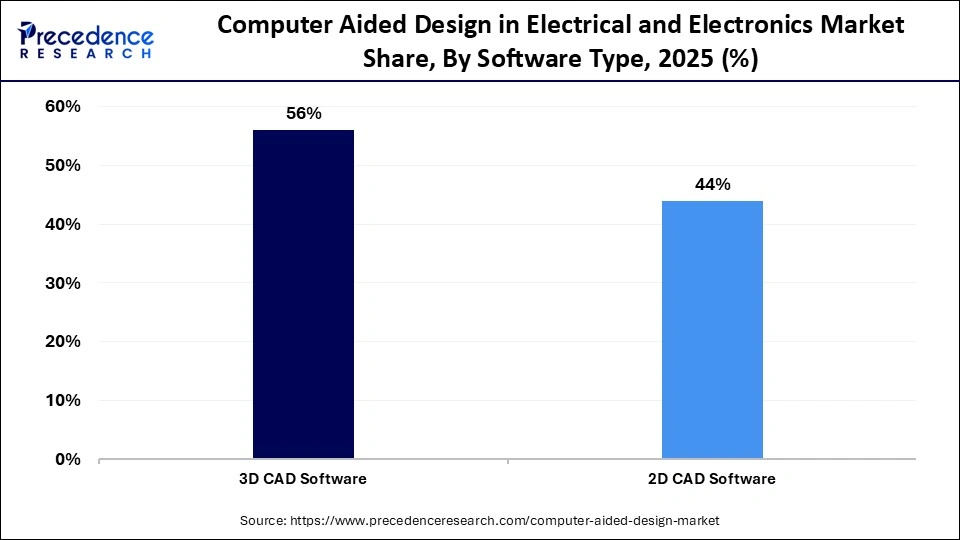
The 2D CAD software segment is expected to grow at a CAGR of 7.2% in the coming years, since it is affordable and popular for simple circuit designs, documentation, and basic drafting. A growing number of small and medium-sized businesses are using 2D solutions to meet their cost-effective design needs. Compared to 3D tools, 2D software requires less money for training. Its growth is being supported by the increasing demand for straightforward schematic designs.
Deployment Mode insights
Why Did the On-Premise Segment Dominate the Market?
The on-premise segment dominated the computer aided design in electrical and electronics market with a 60% market share in 2025 because sensitive electronics projects require better control over design files and increased data security. For safe internal cooperation, large businesses favor on-site systems. Additionally, it guarantees consistent performance independent of internet connectivity. Businesses that handle private product information depend heavily on this deployment.
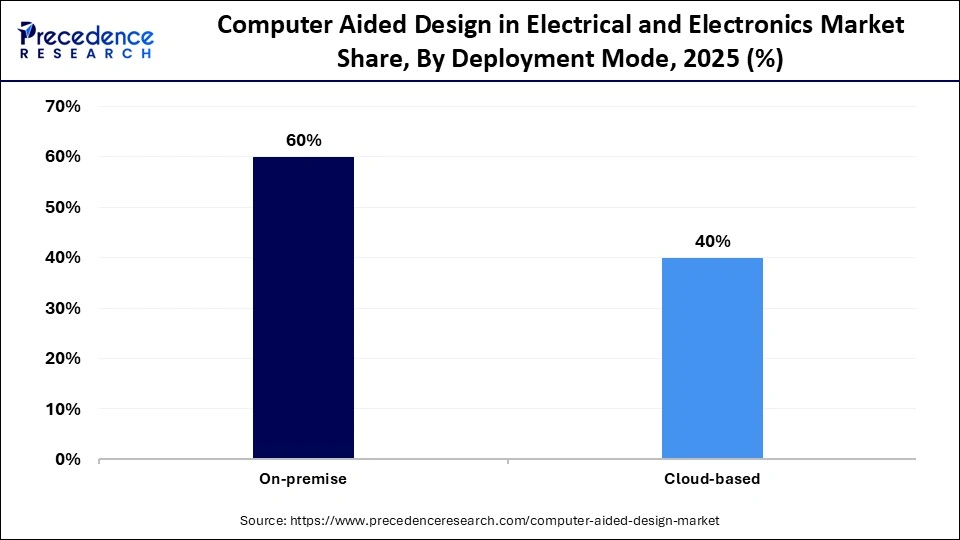
The cloud-based segment is expected to grow at the fastest CAGR of 7.4% in the coming years due to its lower upfront costs, real-time collaboration, and remote access capabilities. Adoption of cloud-based software is accelerated by remote engineering workflows and ongoing digital transformation initiatives. Cloud solutions also offer scalable storage and simplified software updates, while the rising demand for flexible work arrangements further boosts their popularity.
Application Area insights
Why Did the PCB Design Segment Dominate the Market?
The PCB design segment dominated the computer aided design in electrical and electronics market with a 38% share in 2025. The segment's dominance is attributed to the growing need for sophisticated circuit integration and small electronic devices. Both consumer electronics and industrial applications make extensive use of PCB design tools. They lessen manufacturing errors and increase layout efficiency. Its dominance is further reinforced by the increasing complexity of electronic products.
The IC design segment is expected to grow at the fastest CAGR of 7.5% in the coming years due to the increasing complexity and miniaturization of electronic circuits in devices like smartphones, wearables, electric vehicles, and industrial electronics. CAD tools enable precise layout, simulation, and optimization of PCBs, reducing design errors and accelerating product development. Additionally, rising demand for high-performance, reliable, and compact electronic components drives manufacturers to adopt advanced CAD solutions, further boosting growth in this segment.
End-Use Industry insights
What Made Consumer Electronics the Dominant Segment in the Market?
The consumer electronics segment dominated the computer aided design in electrical and electronics market with a 35% share in 2025. This is because of the high demand for smart devices, laptops, wearables, and smartphones. Rapid product innovation necessitates ongoing design advancements using CAD. CAD tools help manufacturers accelerate development, ensure design accuracy, and reduce prototyping costs, making them essential for meeting fast-paced product cycles. Additionally, the demand for high-performance, miniaturized components and complex PCB layouts in consumer electronics further reinforces the segment's market dominance.
The automotive segment is expected to grow at the fastest CAGR of 7.6% in the coming years due to the increasing integration of advanced electronics, electric powertrains, and autonomous driving systems in modern vehicles. CAD tools enable precise design and simulation of complex circuits, wiring harnesses, and PCB layouts, reducing errors and speeding up development cycles. Rising demand for electric vehicles, connected cars, and smart automotive components further drives adoption, making the automotive industry a key growth driver in the market.
Regional Insights
North America Computer Aided Design in Electrical and Electronics Market Size and Growth 2026 to 2035
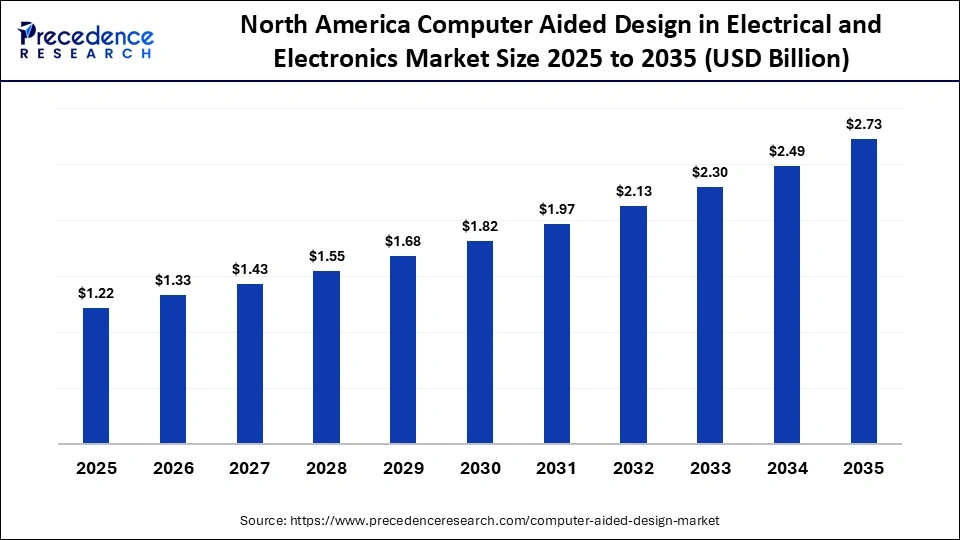
The North America computer aided design in electrical and electronics market size is estimated at USD 1.22 billion in 2025 and is projected to reach approximately USD 2.73 billion by 2035, with a 8.39% CAGR from 2026 to 2035.
Why Did North America Dominate the Computer Aided Design in Electrical and Electronics Market?
North America dominated the computer aided design in electrical and electronics market with a major share of 34% in 2025. This is mainly due to widespread use of CAD technology, presence of leading CAD software suppliers, and significant investment in electronics innovation. Key industry players are well represented in the area. The region benefits from high AI adoption, extensive R&D investments, and early digital transformation, enabling rapid integration of AI-powered CAD tools. Additionally, robust infrastructure, skilled engineering talent, and supportive regulatory and technology frameworks accelerate the deployment of sophisticated CAD solutions.
U.S. Computer Aided Design in Electrical and Electronics Market Size and Growth 2026 to 2035
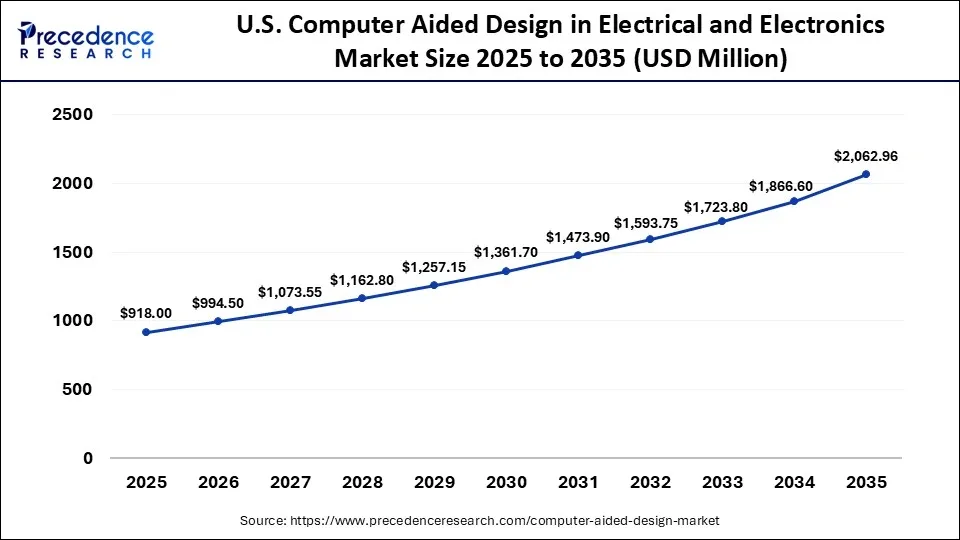
The U.S. computer aided design in electrical and electronics market size is calculated at USD 918.00 million in 2025 and is expected to reach nearly USD 2,062.96 million in 2035, accelerating at a strong CAGR of 8.43% between 2026 and 2035.
U.S. Computer Aided Design in Electrical and Electronics Market Analysis
The U.S. leads the North American market due to its robust technology infrastructure, presence of top CAD software providers, and significant investments in electronics innovation. Continuous adoption and advancement of CAD tools are supported by strong R&D initiatives. Demand is fueled by large enterprises in consumer electronics, aerospace, and semiconductor industries, while government support for domestic chip production further drives market growth.
How is the Opportunistic Rise of Asia Pacific in the Market?
Asia Pacific is expected to grow at the fastest CAGR of 8.8% in the coming years because of the rapid industrialization, expansion of electronics manufacturing, and increased investments in semiconductor and PCB production. Strong demand from emerging economies, along with rising production of consumer electronics and automotive electronics, is accelerating market growth. The expansion of regional manufacturing hubs further boosts development and strengthens the region's position in the market.
India Computer Aided Design in Electrical and Electronics Market Analysis
The market in India is expanding due to growing investments in consumer and automotive electronics and rising production of PCBs. The adoption of CAD software is driven by rapid digitalization and the rising exports of electronic goods. Government initiatives supporting innovative semiconductor design and fabrication strengthen the ecosystem, while growing industrialization and technological advancements further accelerate market opportunities.
Operating in the Market Companies
- Cadence design systems
- Synopsys
- Siemens EDA
- Altium
- Autodesk
- Zuken
- Ansys
- Keysight technologies
- Dassault systèmes
Recent Developments
- In February 2026, Cadence Design Systems announced it had completed its €2.7 billion acquisition of Hexagon's design and engineering business. This acquisition aims to enhance Cadence's physical AI capabilities by integrating advanced structural analysis and multiphysics technologies. The combined technologies will allow for enhanced simulation of complex, high-fidelity electromechanical systems.(Source: Https://theaiinsider.Tech)
- In February 2026, Cadence announced ChipStack, the industry's first agentic AI super-agent for chip design. This tool is designed to boost productivity by up to 10x by automating complex design and verification workflows using natural language prompts. (Source: Https://www.Forbes.Com)
- In January 2026, Altium & IPC (global electronics association) announced the launch of the first joint PCB design certifications to standardize professional skills. The initiative integrates industry-standard manufacturing criteria directly into the software training curriculum. This program aims to bridge the talent gap by ensuring designers are proficient in both CAD tools and global compliance.(Source: Https://www.Electronics.Org)
- In September 2025, YURA added an AI chatbot-based design support to its CADvizor wiring harness CAD solution, enhancing efficiency and accelerating automation of complex designs.(Source: https://www.digitalengineering247.com)
- In September 2024, WSCAD launched ELECTRIX AI, the world's first AI-powered electrical CAD solution, cutting design time by up to 99% with smart error-checking, intuitive guidance, and rapid handling of complex tasks(Source: https://www.wscad.com)
Segments covered in the report
By Software Type
- 3D CAD Software
- 2D CAD Software
By Deployment Mode
- On-premise
- Cloud-based
By Application Area
- PCB Design
- Integrated Circuit (IC) Design
- Cable Harness Design
- Control Systems Design
By End-Use Industry
- Consumer Electronics
- Automotive
- Aerospace & Defense
- Telecommunications
- Industrial Automation
By Region
- North America
- Europe
- Asia-Pacific
- Latin America
- Middle East & Africa
For inquiries regarding discounts, bulk purchases, or customization requests, please contact us at sales@precedenceresearch.com
Frequently Asked Questions





Ask For Sample
No cookie-cutter, only authentic analysis – take the 1st step to become a Precedence Research client
 Get a Sample




 sales@precedenceresearch.com
 Schedule a Meeting
