



Electric Vehicle (EV) Charging Station Market Size, Key Companies, Company Market Share, Vehicle Production Volume, Sales Performance, Export & Import Analysis, Technology Adoption, Competitive Positioning, and Demand Trends
The global electric vehicle (EV) charging station market is experiencing rapid growth as electric vehicle adoption accelerates worldwide and governments invest heavily in charging infrastructure. The market is driven by increasing demand for fast, reliable, and accessible charging solutions, along with advancements in smart charging, AI-powered energy management, and renewable energy integration. As public and private charging networks continue to expand, companies are focusing on ultra-fast charging technologies, improved user experience, and efficient infrastructure to support the global transition toward sustainable transportation.
Source: https://www.precedenceresearch.com/electric-vehicle-charging-station-market
 Get a Sample
 Table Of Content


What Is Driving the Growth of the Electric Vehicle (EV) Charging Station Market?
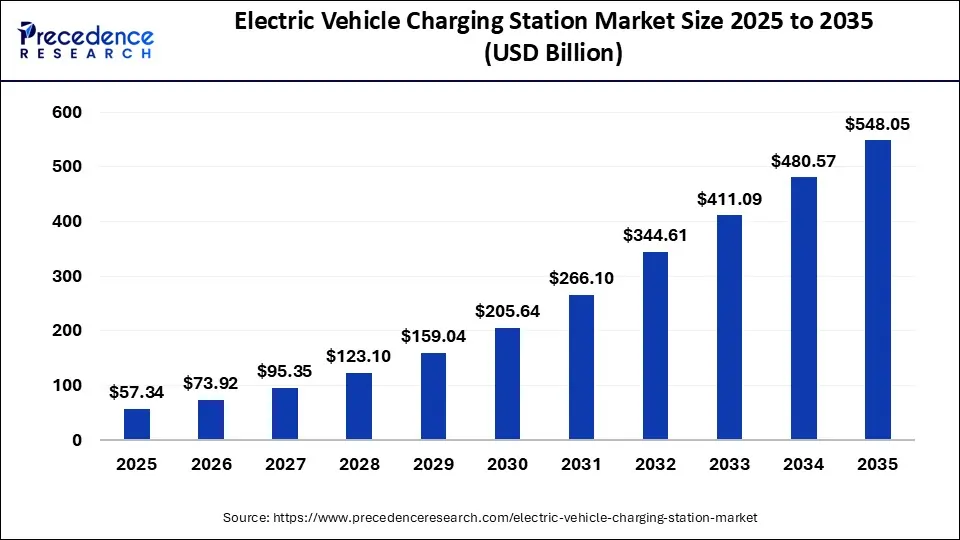
The global electric vehicle (EV) charging station market size was USD 73.92 billion in 2026 and is expected to grow from USD 73.92 billion in 2026 to nearly USD 548.05 billion by 2035, registering a robust CAGR of 25.32% from 2026 to 2035. Growth is being driven by rising electric vehicle adoption, government-backed infrastructure initiatives, and increasing demand for fast, accessible charging solutions.
As the market matures, the focus is shifting from simply expanding charging networks to improving reliability, charging speed, and user convenience. Companies that combine infrastructure growth with smart charging capabilities and efficient operations are likely to gain a competitive advantage in the evolving electric mobility landscape.
Electric Vehicle Charging Station Market Key Takeaway
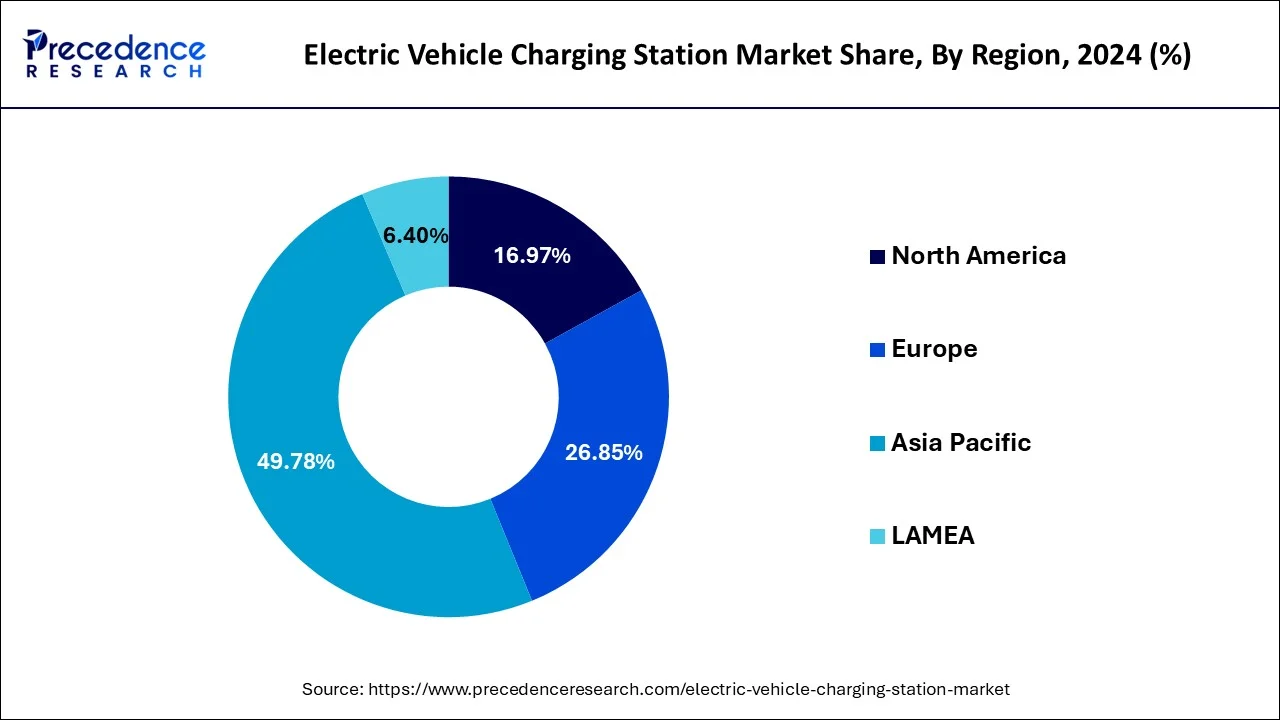
- Asia Pacific dominated the EV charging station market with the largest market share of 49.78% in 2025.
- By level of charging, the level 2 segment has held the biggest market share of 66.24% in 2025.
- By level of charging, the level 3 charging station segment is expected to grow at the fastest rate in the market from 2025 to 2035.
- By charging station type, the wireless charging segment is set to experience the fastest rate of market growth from 2026 to 2035.
- By mode of charging, the plug-in charging segment accounted for the highest market share of 86% in 2025.
- By end user, the residential segment captured the maximum market share of 65% in 2025.
- By application, the public chargers segment recorded more than 85% of market share in 2025.
Market Overview
The increasing levels of carbon emissions and hazardous pollutants from the conventional transportation system have accelerated the global transition towards electric vehicles (EVs). The transition has spurred significantly more demand for EV charging stations in both the residential and commercial markets. The merging of the auto and charging infrastructure industries and the introduction of subscription charging models are other positive developments for market growth. Currently, the market is dominated by commercial charging stations rather than residential charging solutions. With the growing use of EVs, public and commercial charging infrastructure is projected to grow rapidly.
Some of the key drivers of the market are the government initiatives to promote the adoption of EVs and investments in charging infrastructure. Furthermore, fast charging solutions are increasingly required, and the wide adoption of electric vehicles by shared mobility and fleet operators is also driving market growth.
Impact of Artificial Intelligence on the EV Charging Station Market
Artificial intelligence is revolutionizing the EV charging station market. It helps with energy management and makes charging operations better. Artificial intelligence-powered systems look at how much charging is needed, the condition of the grid, and what users do to give power smartly and reduce costs. This helps charging stations be used more and reduces wasted energy and grid congestion.
Artificial intelligence is also making maintenance easier by finding problems before they happen, which reduces downtime and makes services more reliable. Machine learning algorithms help people who run the charging stations guess how much charging will be needed and pick the places to put new stations. Also, artificial intelligence helps with charging solutions that make it easy to use renewable energy sources, which makes the charging infrastructure more sustainable.
Market Trends
- Expansion of Ultra-Fast Charging Networks: Key market companies are investing heavily in ultra-fast DC charging systems. These systems charge vehicles really fast. People want to be able to charge their vehicles easily, especially when they are traveling long distances. This is making companies invest more in high-power charging infrastructure around the world.
- Integration of Renewable Energy: More charging stations are using solar power and battery energy storage systems. This helps the environment, reduces the need for the grid, and supports sustainability goals.
- Growth of Smart and Connected Charging Solutions: The market is seeing charging stations that use the internet and artificial intelligence. These stations can be monitored in a time-managed way from far away and balance the load dynamically. Smart charging technologies make operations more efficient. Give users a better experience.
Electric Vehicle Charging Stations Market Data and Statistics
- By 2025, Beijing, China alone will have 7,00,000 electric vehicle chargers. The policy, Urban Management Development Plan for Beijing is expected to promote the installation of electric vehicle charging stations in the city.
- The Tokyo Metropolitan Government exceeded the subsidy for apartment EV charging station installation up to $12,600. Tokyo plans to offer EV charging stations at every construction of building with 20% of parking space.
Market Report Coverage and Key Metrics
| Report Highlights | Details |
| Market Size in 2025 | USD 57.34 Billion |
| Market Size in 2026 | USD 73.92 Billion |
| Market Size by 2035 | USD 548.05 Billion |
| Growth Rate from 2026 to 2035 | CAGR of 25.32% |
| Largest Market | Asia Pacific |
| Base Year | 2025 |
| Forecast Period | 2026 to 2035 |
| Segments Covered | Level of Charging, Charging Station Type, Power Output, Vehicle Type, Installation Type, Connector Type, Application, Mounting Type, Charging Service, End User, and Region |
| Regions Covered | North America, Europe, Asia-Pacific, Latin America, and Middle East & Africa |
EV Charging Station Market Dynamics
Driver
Rising Adoption of Electric Vehicles Worldwide
More people are buying electric vehicles all over the world. This is driving the demand for EV charging infrastructure. Governments are helping by giving incentives, setting targets to reduce emissions, and making rules that support the adoption of vehicles. As more people buy vehicles, the need for charging networks that are easy to use and reliable keeps growing.
Restraint
High Installation and Infrastructure Development Costs
Building electric vehicle charging stations is expensive. It costs a lot of money to buy equipment, upgrade the grid, buy land, and maintain the stations. High installation costs can limit how many charging stations can be built in places that do not have a lot of money. These financial challenges can slow down the growth of charging infrastructure and make it hard for the market to grow quickly.
Opportunity
Expansion of Public and Highway Charging Infrastructure
Investing in public charging networks and highway charging corridors is a big opportunity for companies in the market. More people are traveling distances in electric vehicles, which means there is a need for charging stations that can charge vehicles quickly and are in good locations. Partnerships between governments, utilities, and private companies are expected to help deploy infrastructure around the world.
Experts Opinion
The electric vehicle (EV) charging station market holds strong growth potential, driven by the rapid global transition toward electric mobility, supportive government policies, and expanding EV adoption across both developed and emerging economies. Our industry expert highlights that investments in fast-charging and ultra-fast charging infrastructure are accelerating as consumers demand reduced charging time and improved accessibility. The integration of smart charging systems, AI-based load management, and grid optimization technologies is playing a key role in enhancing operational efficiency and supporting large-scale deployment.
Our industry expert believes the market is poised for sustained expansion as EV penetration continues to rise and charging infrastructure becomes a critical component of urban and highway development planning. Opportunities are expected to grow significantly in public charging networks, residential charging solutions, and fleet electrification segments, particularly with the rise of electric buses, taxis, and logistics vehicles. The expert also emphasizes that advancements in vehicle-to-grid (V2G) technology, renewable energy integration, and subscription-based charging models will further reshape the industry landscape.
Segmental Insights
Level of Charging Insights
How does the Level 2 Segment Dominate the Electric Vehicle (EV) Charging Station Market in 2025?
The level 2 segment dominated the market in 2025, owing to the importance of level 2 charging as the backbone of workplace, home, and light commercial EV infrastructure. It introduces power electronics, cloud connectivity, precise energy measurement, and embedded firmware. It is a tuned system that ensures every charge is efficient, safe, and dependable.
The level 3 segment is expected to grow at the fastest CAGR in the market during the forecast period due to the newest addition of level 3 charging to electric mobility, which is also known as fast or DC charging. Level 3 charging stations deliver 50 kW and 350 kW of power and are the fastest on the market today.
Charging Station Type Insights
What made AC Charging the Dominant Segment in the Electric Vehicle (EV) Charging Station Market in 2025?
The AC Charging segment dominated the market in 2025, owing to its flexibility of installation at home or in workplaces. The AC charging stations allow EV owners to charge their electric vehicles during work hours or overnight. The AC chargers, in combination with DC leakage current sensors, are crucial to ensure the efficiency and safety of the charging process.
The DC Charging segment is estimated to grow at the fastest rate in the market during the predicted timeframe due to the importance of regulation and the performance of energy meters. This regulation protects end-users from discrepancies in energy billing. The key role of DC meters in a direct current charger of an EV lies in integration, protection, display of information, and monitoring.
Vehicle Type Insights
How did the Passenger Cars Segment Dominate the Electric Vehicle (EV) Charging Station Market in 2025?
The passenger cars segment dominated the market in 2025, owing to its largest consumer base for charging operators. High daily usage of these cars provides a steady flow of transactions. The passenger vehicle chargers are installed by retailers, hotels, and restaurants to attract high-spending customers.
The battery electric vehicle segment is anticipated to grow at the fastest rate in the market during the upcoming period due to the direct influence of batteries on driving range, vehicle performance, and overall user experience. A battery is considered the heart of electric vehicles because they power these green machines.
Installation Type Insights
Which Segment by Installation Type Dominated the Electric Vehicle (EV) Charging Station Market in 2025?
The fixed segment dominated the market in 2025, owing to structural durability, maximum safety, and higher power delivery compared to portable or plug-in models. It brings enhanced electrical safety through built-in protection and continuous load management. It shows superior power and performance due to higher amperage and faster charging speeds and enables DC fast charging.
The portable segment is predicted to grow at a rapid rate in the market during the studied period due to the freedom to charge anywhere with an outlet and backup for a home charging system. A portable installation removes range anxiety and is significantly faster than basic chargers.
Connector Type Insights
Why did the CCS Segment Dominate the Electric Vehicle (EV) Charging Station Market in 2025?
The CCS segment held a dominant position in the market in 2025. The Combined Charging System (CCS) is crucial in meeting the growing demand for reliable and fast electric vehicle charging. A rigorous CCS testing helps manufacturers to ensure the compliance of their charging stations with the global safety and interoperability standards.
Application Insights
Which Segment Dominated the Electric Vehicle (EV) Charging Station Market in 2025?
The private segment led the global market in 2025. This growth is driven by the installation of private charging infrastructure at multi-dwelling units, standalone homes, or dedicated corporate fleet depots. Private EV charging stations deliver long-term property value appreciation, ultimate daily convenience, and maximum cost savings.
The public segment is expected to grow with the highest CAGR in the market during the studied years. This expansion is driven by the deployment and integration of charging stations based on local community needs. Public charging stations, at-home EV charging, and workplace charging stations raise the daily useful range of all electric vehicles.
Mounting Type Insights
How did the wall-mount segment dominate the Electric Vehicle (EV) Charging Station Market in 2025?
The wall mount segment registered its dominance over the global market in 2025. Wall mounting is considered one of the most common installation approaches for workplace charging points, home chargers, and certain commercial and semi-public applications. This approach is widely applicable to AC EV chargers.
The pedestal mount segment is expected to expand rapidly in the market in the coming years. It has a specific design, installation requirements, ideal use cases, and cost. It also delivers electricity to charge electric vehicles. The pedestal chargers are mounted on a vertical column or post and are freestanding charging stations.
End User Insights
Which Residential EV Charging Stations Segment Led the Electric Vehicle (EV) Charging Station Market in 2025?
The residential EV charging stations segment dominated the global market in 2025. They offer economic and cost advantages such as the lowest electricity rates, off-peak charging discounts, and long-term battery savings. They also offer convenience and time efficiency through eliminated waiting times and smart app automation.
The stations segment is expected to witness the fastest growth in the market over the forecast period. The dedicated charging stations are crucial in enabling the wide acceptance of electric vehicles. They contribute to the development of accessible and robust charging infrastructure.
EV Charging Station Market Regional Analysis
How Big is the Asia Pacific Electric Vehicle (EV) Charging Station Market?
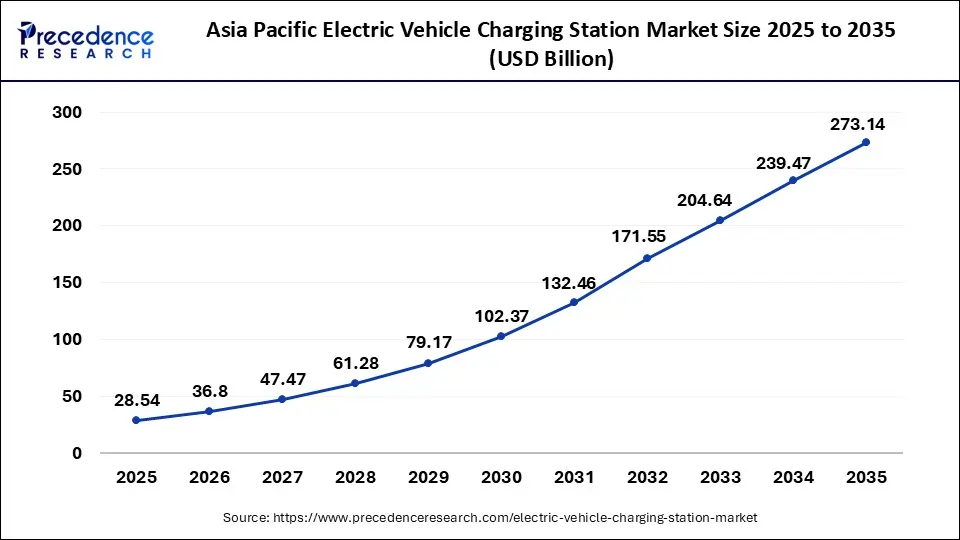
According to an expert of Precedence Research, the Asia Pacific electric vehicle (EV) charging station market size was estimated at USD 28.54 billion in 2025 and is predicted to surpass USD 273.14 billion by 2035, rising at a CAGR of 25.34% from 2026 to 2035.
How does Asia Pacific dominate the Electric Vehicle (EV) Charging Station Market in 2025?
Asia Pacific dominated the market in 2025, owing to rising urbanization paired with smart city initiatives, government policies, and accelerated deployment of DC fast-charging networks. The government policies are shifting toward targeted public-private infrastructure and smart-grid integration. This regional growth is also propelled by public-private partnerships focused on grid stability, national policies, fast-charging, direct subsidies, and battery networks. The operators are moving toward rapid charging stations, and DC fast charging remains the fastest-growing area.
How can the Electric Vehicle (EV) Charging Station Market Contribute to the Growth of India?
India experiences rapid network expansion along urban hubs and national highways and surging domestic EV adoption. Indian industry is growing due to the largest volume of EV sales, easier infrastructure rollout, lower charging power requirements, and use for deliveries and daily commuting.
What is the Potential of the Electric Vehicle (EV) Charging Station Market in North America?
North America is expected to grow at the fastest CAGR in the market during the forecast period due to rapid scaling of regional charging networks, massive federal funding, and automotive standardization. Several states and municipal governments are either investing or subsidizing the development of EV charging infrastructure. Research suggests that there will be millions of electric vehicles on the road in the U.S. by 2030. Also, the number of charge points will climb over the same period.
How is the Expansive Reach of the Electric Vehicle (EV) Charging Station Market in the U.S.?
The U.S. is advancing in the market through multi-port fast-charging stations, public and private investments, and surging real-world charging demand. With the rising adoption of electric vehicles in the U.S., the need for public charging infrastructure is also growing.
Why is Europe considered a significantly growing region in the Electric Vehicle (EV) Charging Station Market?
Europe is expected to grow at a significant rate in the market during the studied period due to high-power capacity and network optimization, stringent EU mandates, and the transition to DC fast charging. In October 2025, the European Commission reported that Bulgaria launched a national EV charging network at railway stations. One of the national initiatives aims to establish a network of charging stations for electric vehicles.
What is the Key Role of the Electric Vehicle (EV) Charging Station Market in Germany?
Germany is growing and expanding in the market due to surging commercial fleet electrification, government regulatory frameworks, and the expansion of high-capacity public infrastructure. Germany's 2026 EV incentive program supports socially targeted EV uptake. The German federal government launched a new electric vehicle incentive program, which is designed to boost the transition to climate-friendly mobility.
Which Major Growth Factors Drive the Notable Growth of the Electric Vehicle (EV) Charging Station Market in Latin America?
Latin America is expected to grow at a notable rate in the market during the predicted timeframe, driven by fleet electrification across corporate delivery networks, logistics firms, and public transport operators. Latin America is positioned as an emerging global market in the energy transition of transportation. This growth is led by the expansion of charging infrastructure, significant advances in electrified vehicle sales, the development of new technologies, and the implementation of public policies.
How can the Electric Vehicle (EV) Charging Station Market Expand in Brazil?
Brazil is transitioning toward high-power commercial fleet demands, government regulatory reforms, and a rapid surge in vehicle adoption and local manufacturing. Brazil is advancing the physical and regulatory infrastructure needed to support the rapid adoption of electric vehicles.
How does the Electric Vehicle (EV) Charging Station Market Majorly Impact the Significant Growth of MEA?
MEA is expected to grow significantly in the market in the coming years, propelled by massive state funding to reduce fossil fuel reliance and a shift of commercial fleet operators to electric mobility. Africa is leading by providing affordable and cleaner transportation, along with the rising adoption of electric vehicles. Electric vehicles are raising demands for software, electricity, charging services, batteries, insurance products, maintenance jobs, data analytics, and new financing models.
What is the Major Footprint of Saudi Arabia in the Electric Vehicle (EV) Charging Station Market?
Saudi Arabia is transforming due to supportive real estate regulations, government funding under Vision 2030, and the rise of local EV manufacturing and fleets. This country is driven by the ambitious Vision 2030 that places economic diversification and environmental sustainability at the heart of its priorities.
Market Competitive Landscape: Leading Companies and Strategies
The electric vehicle charging station market is highly competitive and rapidly evolving, with a mix of global energy companies, automotive manufacturers, and specialized charging infrastructure providers. Leading players such as Tesla, ChargePoint, ABB, Siemens, and EVgo dominate the market through continuous investments in fast-charging technologies, network expansion, and smart charging solutions.
These companies are focusing on enhancing charging speed, interoperability, and user experience while expanding their global footprint across residential, commercial, and public charging networks. To strengthen their market position, key players are actively engaging in strategic partnerships, mergers and acquisitions, and collaborations with utilities, automakers, and governments.
Leading Global Demand for EV Charging Stations in 2025
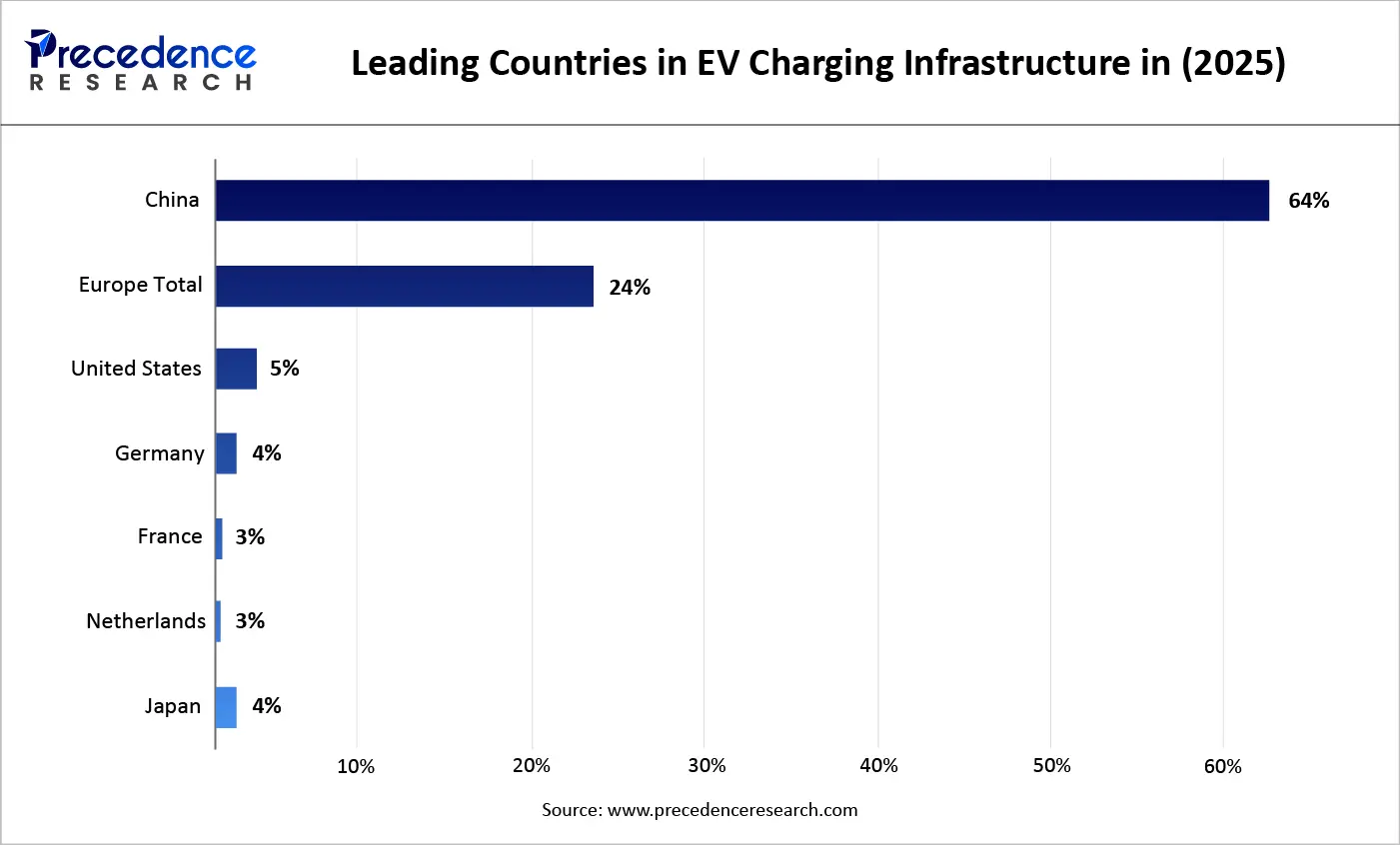
As electric vehicles transition from niche to mainstream, the distribution of charging infrastructure highlights where demand is most intense. In 2025, China stands out as the dominant market, with over 2.5 million public charging points, reflecting massive EV adoption supported by strong government policies and investment. Europe's combined network of approximately 900,000+ stations underscores coordinated regional efforts to electrify transport, with Germany, France, and the Netherlands leading in deployment. The United States has also expanded its public charging footprint to around 150,000+ stations, driven by federal and state infrastructure programs. Japan's growing network of 70,000+ charging points mirrors rising consumer interest in electric mobility. These trends indicate robust global demand for EV charging infrastructure as countries accelerate decarbonization and support broader EV adoption.
Top EV Charging Products- 2025
| Country | Company | Product | Description |
| USA | Tesla | Supercharger V3 | Tesla's proprietary fast-charging network offers up to 250 kW charging speeds, enabling rapid charging for Tesla vehicles. The supercharger network is a cornerstone of Tesla's strategy to alleviate. |
| Germany | Siemens | Versicharge | Siemens offers the Versicharge line, providing both AC and DC charging solutions suitable for residential, commercial, and public applications, emphasizing smart connectivity and energy efficiency. |
| Netherlands | EvBox | Elvi residential charger | EVBox specializes in scalable charging solutions, with the EM designed for home use and the toniq modular catering to high-traffic commercial locations. supporting fast charging capabilities. |
| U.K. | BP Plus | Rapid Ultra-fast charges | BP Pulse operates a network of rapid and ultra-fast charges across the UK, aiming to provide convenient charging options and support the country's transition to electric mobility |
| France | TotalEnergies | High-power changing | Total Energy is expanding its EV charging infrastructure with high-power stations across Europe, focusing on integrating renewable energy sources and enhancing user experience. |
Electric Vehicle (EV) Charging Station Market Companies
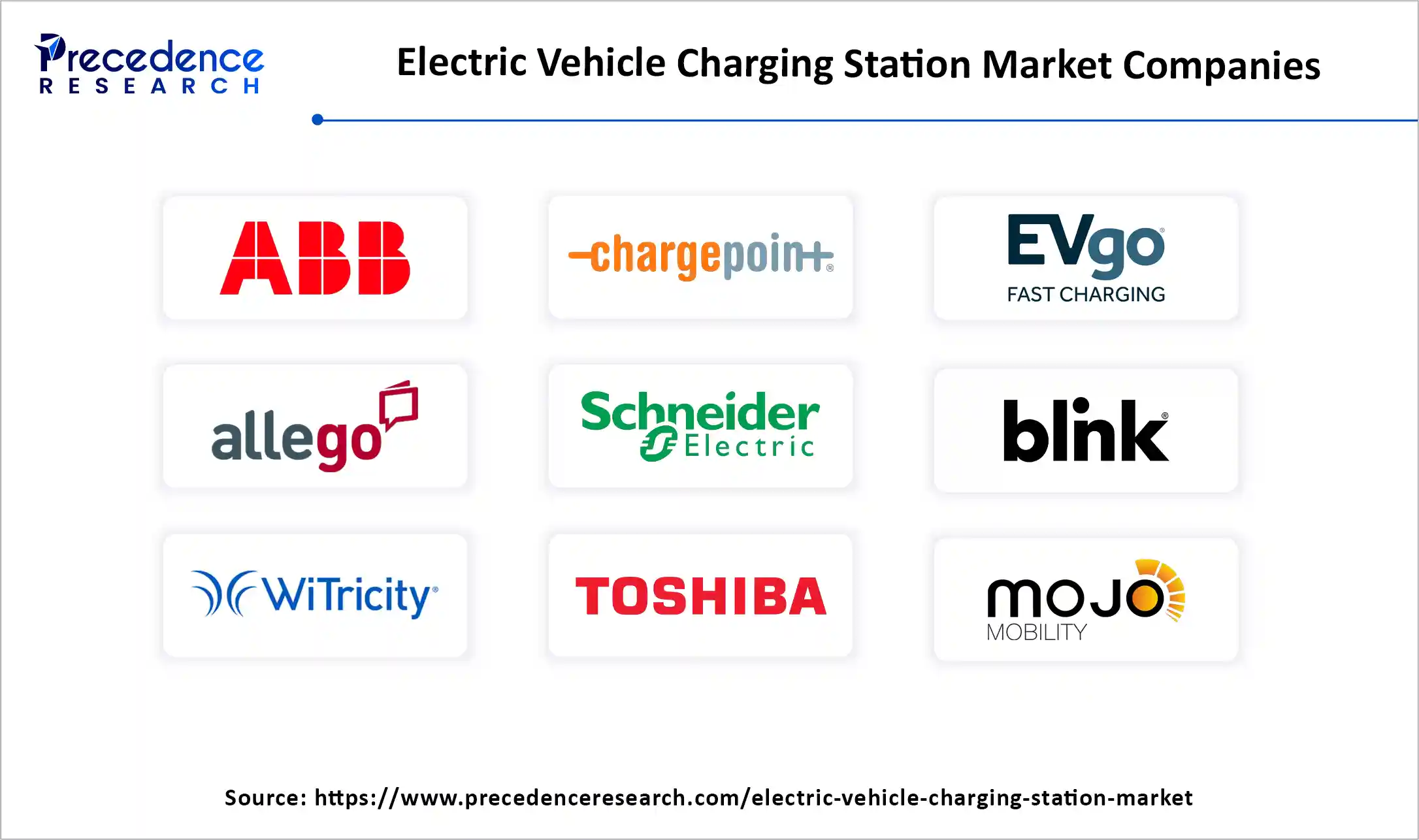
- EVgo Services LLC: Offers networked public fast charging for electric vehicles (EVs) across the United States.
Allego: Provides a range of charging solutions for electric and hybrid vehicles, including fast chargers for urban, residential, and commercial use. - Schneider Electric: Delivers smart charging solutions and energy management systems designed for a sustainable energy ecosystem, including EV infrastructure.
- Blink Charging Co: Offers EV charging equipment and services, including Level 2 and DC fast chargers for residential and commercial applications.
- WiTricity Corporation: Specializes in wireless power transfer technology for electric vehicles, enabling convenient and efficient charging without physical connectors.
- Toshiba Corporation: Engages in developing battery technology and energy management systems, also providing advanced charging solutions for electric vehicles.
- AeroVironment, Inc: Delivers electric vehicle charging solutions, focusing on home charging stations and public charging infrastructure.
- Mojo Mobility, Inc: Innovates in wireless charging solutions for electric vehicles and other devices, offering convenience and reducing the need for cables.
Other Major Companies
- ABB Ltd.
- ChargePoint, Inc.
- General Electric
- Robert Bosch GmbH
- Chargemaster plc.
- Evatran Group
- HellaKGaAHueck& Co.
- Siemens AG
- Leviton Manufacturing Co., Inc.
- Efacec
- Alfen N.V.
- Denso Corporation
- Elix Wireless
- Tesla Inc.
- ClipperCreek
- Engie
- Infineon Technologies AG
- Qualcomm Technologies, Inc.
Recent Developments in the EV Charging Station Market (2025–2026)
- In May 2026, the Indian government announced a plan to establish up to 714 new electric vehicle charging stations under a central scheme, with an investment of approximately ₹500 crore. This initiative aims to enhance the EV charging infrastructure across the country, promoting the adoption of electric vehicles and supporting the transition to a greener transportation system. (Source: https://www.thebatterymagazine.com/)
- In May 2026, Tata Power is expanding its electric vehicle charging network along the Delhi-Mumbai Expressway, aiming to enhance EV infrastructure in India. The initiative includes multiple high-speed charging stations to support electric vehicle users and promote sustainable travel across this critical route, facilitating convenient and efficient charging options. (Source: https://www.thebatterymagazine.com/)
- In July 2025, Ballenoil launched its own EV charging network. The company plans to install 42 charging points and charging infrastructure, focusing on delivering over 150kW of power. The focus is on charging vehicles in just 10-20 minutes. (Source: https://www.mobilityplaza.org)
Segments Covered in the Report
By Level of Charging
- Level 1
- Level 2
- Level 3
By Charging Station Type
- AC Charging
- DC Charging
- Wireless Charging
By Power Output
- <11KW
- 11KW-50KW
- >50KW
By Vehicle Type
- Passenger Cars
- Battery Electric Vehicle (BEV)
- Plug-in Hybrid Vehicle(PHEV)
- Heavy Commercial Vehicles
- Light Commercial Vehicles
- Two-wheelers & Scooters
By Installation Type
- Fixed
- Portable
- Residential
- Commercial
By Connector Type
- Normal Charging
- Type 2
- CCS
- CHAdeMO
- Tesla SC
- GB/T
By Application
- Private
- Public
By Mounting Type
- Wall Mount
- Pedestal Mount
- Ceiling Mount
By Charging Service
- EV Charging Service
- Battery Swapping Service
By End User
- Commercial EV Charging Stations
- Commercial Public EV Charging Stations
- On-Road Charging
- Parking Spaces
- Destination Chargers
- Commercial Private EV Charging Stations
- Fleet Charging
- Captive Charging
- Commercial Public EV Charging Stations
- Residential EV Charging Stations
By Region
- North America
- Europe
- Asia-Pacific
- Latin America
- Middle East and Africa
For inquiries regarding discounts, bulk purchases, or customization requests, please contact us at sales@precedenceresearch.com
Frequently Asked Questions





Ask For Sample
No cookie-cutter, only authentic analysis – take the 1st step to become a Precedence Research client
 Get a Sample




 sales@precedenceresearch.com
 Schedule a Meeting
