



EMC Testing Market Trends, Companies, Revenue / Sales Performance, Subscriber Growth, Pricing Strategies, Cloud Adoption, Infrastructure Expansion, Competitive Landscape, and Industry Outlook
EMC Testing Market (By Offering: Services, Hardware and Software; By Test Type: Emissions Testing, Immunity Testing, Electrostatic Discharge (ESD) Testing, Conducted Immunity Testing, Conducted Emissions Testing, RF Testing; By Service Type: Testing Services, Inspection Services, Certification Services; By Application/End-Use Industry: Consumer Electronics and Appliances, Automotive, IT and Telecommunications, Aerospace and Defense, Medical Devices, Industrial Equipment; By Testing Stage: Pre-Compliance Testing, Compliance Testing, Post-Compliance/Certification Testing) - Global Industry Analysis, Size, Trends, Leading Companies, Regional Outlook, and Forecast 2026 to 2035
Source: https://www.precedenceresearch.com/emc-testing-market
 Get a Sample
 Table Of Content


What is the EMC Testing Market Size in 2026?
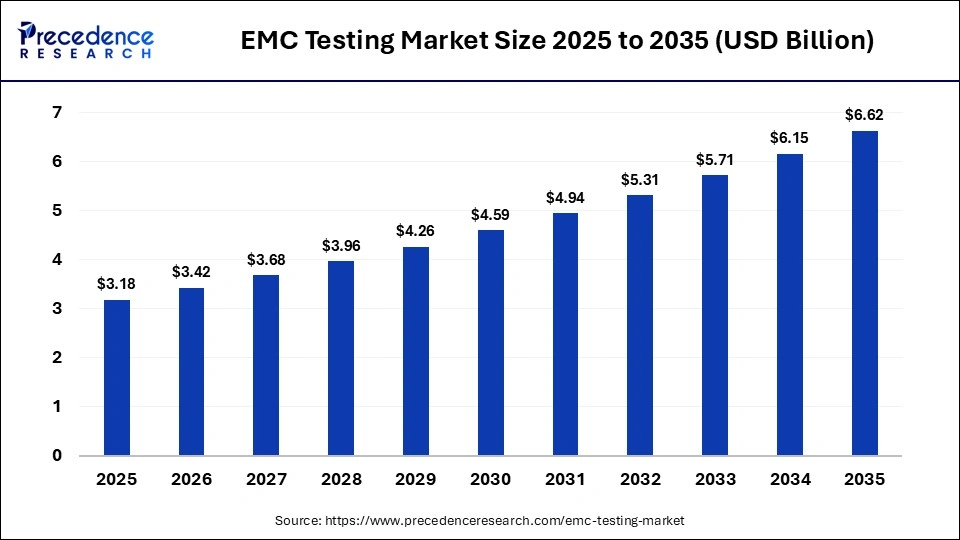
The global EMC testing market size accounted for USD 3.18 billion in 2025 and is predicted to increase from USD 3.42 billion in 2026 to approximately USD 6.62 billion by 2035, expanding at a CAGR of 7.60% from 2026 to 2035. The EMC testing industry represents one of the most significant parts of today's electronics landscape, assuring that every modern and complex object, from electric vehicles to IoT sensors to 5G infrastructure, works smoothly and without causing electromagnetic interference in accordance with stringent international standards.
Key Takeaways
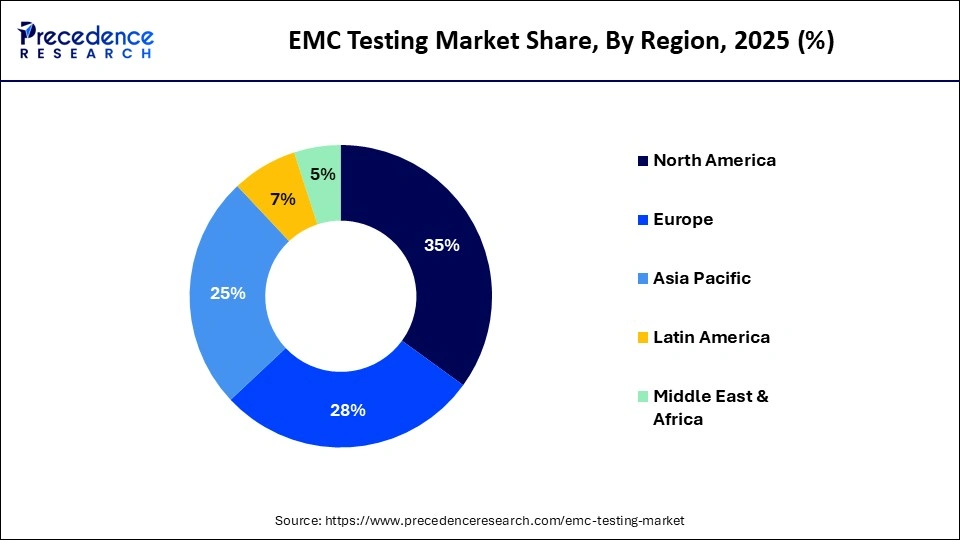
- North America held the largest revenue share of 35% in the EMC testing market in 2025.
- Asia-Pacific is expected to grow at the fastest CAGR of 8% in the market during the forecast period.
- By offering, the services segment accounted for a considerable revenue share of 60% in the market in 2025 and is expected to grow at the fastest CAGR of 6% in the market between 2026 and 2035.
- By test type, the emissions testing segment accounted for a considerable revenue share of 40% in the market in 2025.
- By test type, the immunity testing segment is expected to grow at the fastest CAGR of 6.2% in the market between 2026 and 2035.
- By service type, the testing services segment accounted for the highest revenue share of 50% in the EMC testing market in 2025.
- By service type, the certification services segment is expected to expand rapidly in the market with a CAGR of 6.4% in the coming years.
- By application/end-use industry, the consumer electronics and appliances segment held a major revenue share of 40% in the market in 2025.
- By application/end-use industry, the automotive segment is expected to grow with the highest CAGR of 6.8% in the market during the studied years.
- By testing stage, the pre-compliance testing segment accounted for the highest market share of 40% in 2025.
- By testing stage, the post-compliance/certification testing segment is expected to show the fastest growth with a CAGR of 6.5% over the forecast period.
What is the EMC Testing Market?
Electromagnetic compatibility (EMC) testing refers to the process of evaluating electronic and electrical devices to ensure they operate correctly in their electromagnetic environment without causing or suffering from electromagnetic interference (EMI). EMC testing verifies that products meet regulatory standards related to emissions and immunity before entering the market. It is widely used in industries such as consumer electronics, automotive, aerospace, telecommunications, and healthcare to ensure product safety, reliability, and compliance with international regulations.
Impact of AI in the EMC Testing Market
Artificial intelligence (AI) is gradually changing the way EMC tests are performed and can be considered more robust. The traditional way of conducting EMC tests included many hours of manual signal inspection and repeated measurements in a shielded environment. AI-enabled analytics today can crunch through large volumes of interference data to identify patterns that are likely the most difficult for human engineers to spot. Machine learning algorithms can spot emission sources or segment noise profiles, and even predict potential compatibility challenges during the design stage.
This technology reduces testing processes with trial and error and speeds up product certification. Amid accelerating complexity in electronic industries, such as in electric vehicles, Internet of Things (IoT) devices, and 5G infrastructure, AI is quietly transforming EMC testing from traditional compliance to a more intelligent and predictive engineering exercise.
Trends Influencing the EMC Testing Market
- Growing Connected Electronics and IoT Devices: A wave of connected devices ranging from smart thermostats to industrial IoT sensors has transformed the electromagnetic landscape. Given that each device has specific emissions and the possibility of interference, manufacturers focus on EMC validation earlier in the design cycle to make sure it can function properly in increasingly congested wireless environments.
- Electrification of the Automotive Sector: Electric vehicles have completely transformed the criteria for EMC. This adds a level of complexity, such as high-voltage batteries, power inverters, radar sensors, and infotainment systems, that exist in an electronic setup. Therefore, automakers are putting large sums of time into EMC tests to minimize potential signal conflicts that could threaten vehicle safety.
- Recent Advances in 5G and Emerging Wireless Technologies: The arrival of 5G infrastructure, in addition to early developments in the realm of 6G, has increased competition over frequency spectrum operations. Today, devices operate over a broader range of bands at higher frequencies; as a consequence, advanced EMC testing arrangements can detect nuanced interferences that previous frameworks were unable to detect.
Market Scope
| Report Coverage | Details |
| Market Size in 2025 | USD 3.18 Billion |
| Market Size in 2026 | USD 3.42 Billion |
| Market Size by 2035 | USD 6.62 Billion |
| Market Growth Rate from 2026 to 2035 | CAGR of 7.60% |
| Dominating Region | North America |
| Fastest Growing Region | Asia Pacific |
| Base Year | 2025 |
| Forecast Period | 2026 to 2035 |
| Segments Covered | Offering, Test Type, Service Type, Application/End-Use Industry, Testing Stage, and Region |
| Regions Covered | North America, Europe, Asia-Pacific, Latin America, and Middle East & Africa |
Segmental Insights
Offering Insights
Which Offering Segment Dominated the EMC Testing Market?
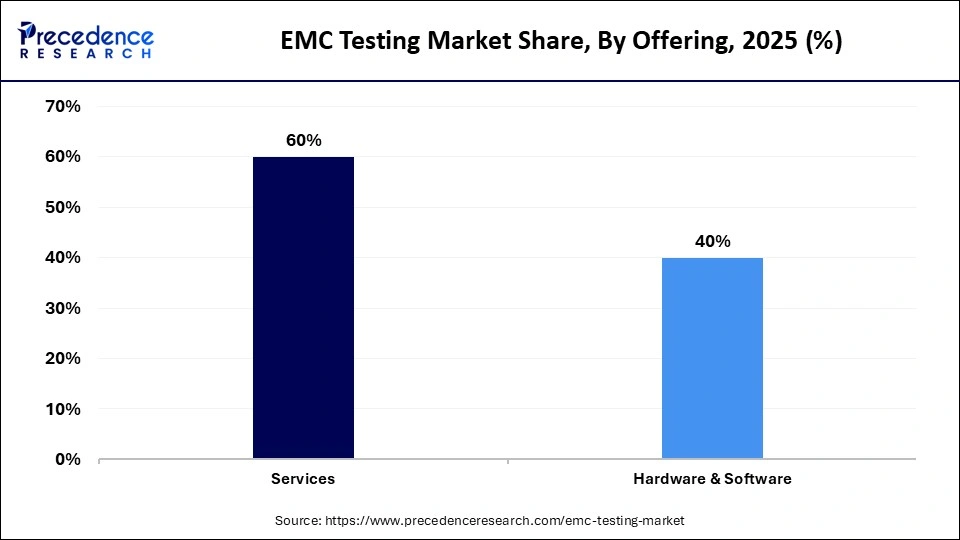
The services segment held a dominant revenue share of 60% in the market in 2025 and is expected to show the fastest growth with a CAGR of 6% over the forecast period, as manufacturers increasingly rely on specialized laboratories to meet complex electromagnetic compliance standards.
When it comes to building such internal EMC facilities, this will demand a very substantial investment in anechoic chambers, precision antennas, and very high-quality measuring equipment, so companies tend to outsource the test work. The proliferation of connected electronic products, electric vehicles, and wireless communication products is expected to drive up demand for third-party validation.
Test Type Insights
How the Emissions Testing Segment Dominated the EMC Testing Market?
The emissions testing segment dominated the market with a share of 40% in 2025. From this, an emissions assessment is essential in establishing whether electronic devices do not introduce EMI, which could disturb nearby systems. Around the world, for a long time now, regulations have maintained strict thresholds for electronic products before their market introduction. So as devices had developed into smaller and more compact shapes, the monitoring of electromagnetic emissions became more important.
The immunity testing segment is expected to gain the highest market share with a CAGR of 6.2% between 2026 and 2035, as electronics are also exposed to external EMI. Modern devices, from medical devices to sensors in self-driving cars, have to continue working even while in complex electromagnetic environments. In these fast-paced wireless communication networks and interdependent technologies, immunity testing will probably take on increasing importance as the industry is pursuing a uniform hardware-level performance in the electromagnetic environment.
Service Type Insights
What Made the Testing Services Segment Dominate in the EMC Testing Market?
The testing services segment held the largest revenue share of 50% in the market in 2025, as specialized EMC laboratories are critical for validating electromagnetic function, which they supply, complete with shielded chambers, antennas, and proper devices for precise measurement of these properties. Due to high capital investments and regulatory certifications needed to establish internal testing facilities, many manufacturers turned to outside providers. The influx of electronic devices into the global markets has brought the growth of demand from professional testing services.
The certification services segment is expected to witness the fastest growth in the market with a CAGR of 6.4% over the forecast period, as international regulatory compliance becomes increasingly strict, and this is expected to propel market share. Certification that verifies EMC for electronic products is required before they can be sold internationally.
With manufacturers entering new geographies, certification standards are expected to become more intensive. This increasing need for formal documentation and regulatory accreditation will drive demand for certification services, particularly among companies introducing connected devices, smart appliances, and advanced communication technologies.
Application/End-Use Industry Insights
How the Consumer Electronics and Appliances Segment Dominate the EMC Testing Market?
The consumer electronics and appliances segment contributed the biggest revenue share of 40% in the market in 2025, largely due to the annual influx of electronic devices into global markets. Devices such as smartphones, laptops, televisions, smart home gadgets, and kitchen appliances all need EMC verification before being released. The ongoing cycle of product development, together with shorter lifespans of products, results in an unprecedented demand for tests.
The automotive segment is expected to expand rapidly in the market with a CAGR of 6.8% in the coming years, due to fast-paced innovations that convert vehicles into complex electronic platforms. Today, many cars have a multitude of electronic control units, alongside radar sensors, infotainment systems, and advanced driver assistance technologies. Electric vehicles compound the electromagnetic problems as well due to high-voltage power electronics embedded within them. Manufacturers will probably increase their investments in EMC testing services to support the safe operation of vehicles free of electromagnetic interference in the automobile's interconnected vehicle systems.
Testing Stage Insights
Which Testing Stage Segment Led the EMC Testing Market?
The pre-compliance testing segment led the global market with a share of 40% in 2025, driven by the needs of producers to identify electromagnetic issues in the early stages of product development. With this, engineering via the implementation of testing earlier, emissions, or interference problems might be identified before the final certification steps. Not only does such an actionable approach help reduce cost-prohibitive design work, but it also reduces time-to-market. It allowed firms to optimize their circuit layouts, shielding configurations, and signal paths before formal regulatory evaluations.
The post-compliance/certification testing segment is expected to grow with the highest CAGR of 6.5% in the market during the studied years, as regulatory entities around the globe increasingly expand the range of requirements and regulate the standards for electromagnetic emission. Products must go through formal validation in accredited laboratories before their commercial release can be approved. Firms that expand their product launches globally are likely to have higher demand for compliance certifications of known global standards.
Regional Insights
North America EMC Testing Market Size and Growth 2026 to 2035
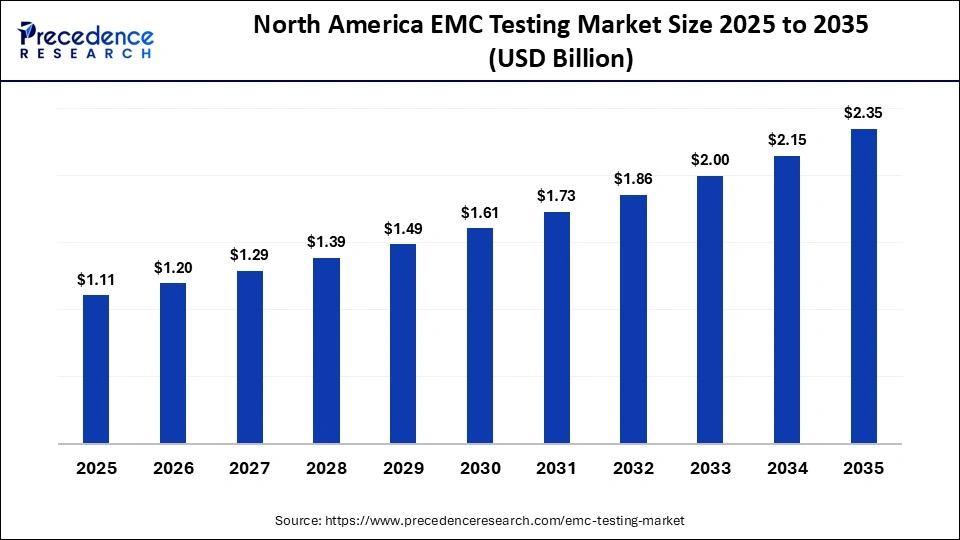
The North America EMC testing market size is estimated at USD 1.11 billion in 2025 and is projected to reach approximately USD 2.35 billion by 2035, with a 7.79% CAGR from 2026 to 2035.
Why North America Dominated the EMC Testing Market?
North America held a major revenue share of 35% in the market in 2025, due to the presence of a strong electronics manufacturing system and rigorous electronics regulation. In some vital areas such as aerospace, telecommunications, defense, and automotive electronics, it is only natural that compliance testing happens before a product goes on the floor. Moreover, the region has access to a large network of accredited laboratories and high-tech measuring equipment. A growing number of connected devices, alongside improvements in 5G infrastructure and complex electronics systems, has led to continued demand for EMC validation throughout the technological and industrial sectors.
U.S. EMC Testing Market Size and Growth 2026 to 2035
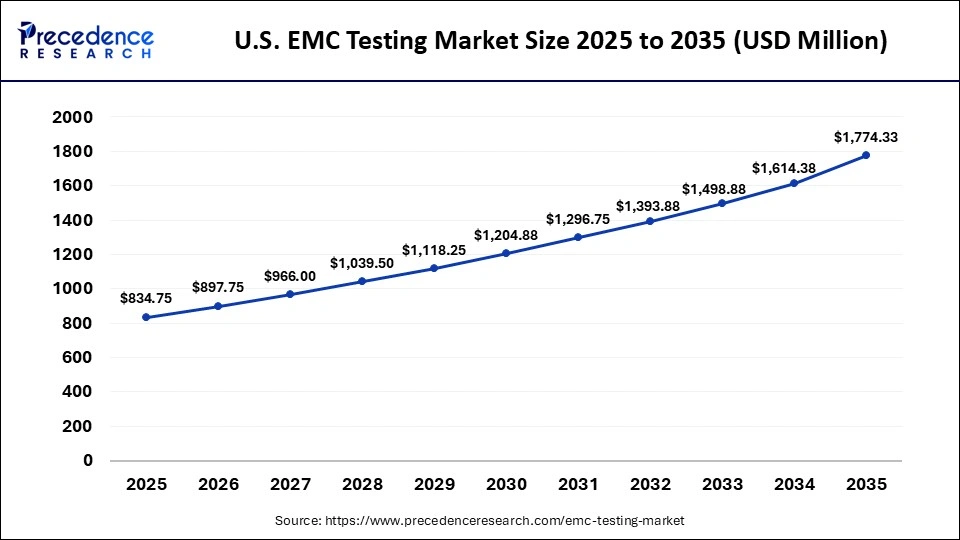
The U.S. EMC testingmarket size is calculated at USD 834.75 million in 2025 and is expected to reach nearly USD 1,774.33 million in 2035, accelerating at a strong CAGR of 7.83% between 2026 and 2035.
U.S. Market Trends
The U.S. leads the market in North America, combining its advanced electronics sector with laws governing EMI. Government bodies have stringent compliance requirements that require the full testing of electronic products before they can be sold. The country is served by many accredited EMC laboratories and state-of-the-art manufacturers of test equipment. In addition, rapid innovations in aerospace systems, medical electronics, telecommunications infrastructure, and semiconductor technology have enhanced the U.S.'s dominance in EMC testing efforts.
Why is Asia Pacific Experiencing the Fastest Growth in the EMC Testing Market?
Asia-Pacific is expected to experience the fastest growth with a CAGR of 8% during the predicted timeframe, due to its burgeoning electronics manufacturing sector. It has become a significant hub for the production of consumer electronic products, fabrication of semiconductors, and manufacture of automotive electronic components.
With the further integration and development of smaller parts coming online, verification of EMC will probably be further demanded. Moreover, expanding investment in intelligent systems like electric mobility systems and advanced communication systems is believed to increase demand for EMC testing services in numerous sectors.
China Market Trends
China is expected to be the fastest-growing country in the Asia-Pacific, owing to its rapidly developing electronics manufacturing ecosystem. It is also the world's leading maker of consumer electronics, telecommunications equipment, and electric vehicles, all of which include vigorous electromagnetic compatibility tests. Also, domestic semiconductor manufacturing is poised to surge, and communication technology is quickly advancing, which is bound to create new demand for comprehensive testing services.
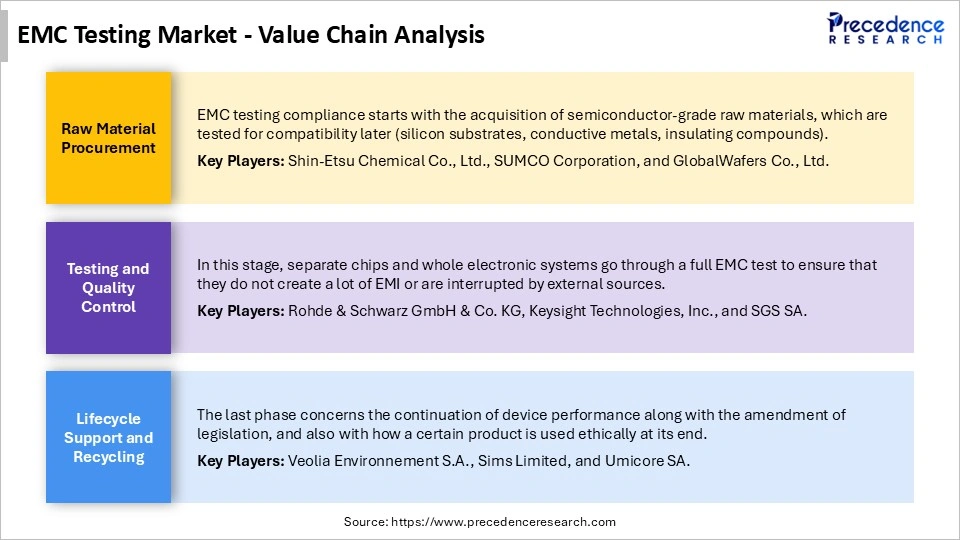
EMC Testing Market Supply Chain Analysis
EMC Testing Market Companies
- SGS S.A.
- Intertek Group plc
- Bureau Veritas
- Eurofins Scientific
- TUV Rheinland
- TUV SUD
- UL Solution
- Keysight Technologies
- Rohde & Schwarz
- Anritsu Corporation
- DEKRA SE
- Applus+ Laboratories
- Element Materials Technology
- NTS (National Technical Systems)
- CSA Group
Recent Developments
- In March 2026, Rohde & Schwarz GmbH & Co. KG planned to unveil state-of-the-art solutions for EMC testing and measurement at the EMV 2026 exhibition in Cologne. These innovations to overcome emerging issues such as AI-supported electronics, expanded frequency bandwidths, and electrified systems, which require more advanced validation of EMC, are designed to help tackle these challenges. (Source: https://www.rohde-schwarz.com)
- In March 2026, Fiem Industries commissioned an EMI and EMC testing laboratory at its R&D-Electronics Innovation Centre and corporate office in Gurugram, India. The facility aims to support the company's development of automotive lighting electronics for two-wheelers and passenger vehicles, as lighting systems increasingly incorporate LED technology.(Source: https://www.autocarpro.in)
Segments Covered in the Report
By Offering
- Services
- Hardware and Software
By Test Type
- Emissions Testing
- Immunity Testing
- Electrostatic Discharge (ESD) Testing
- Conducted Immunity Testing
- Conducted Emissions Testing
- RF Testing
By Service Type
- Testing Services
- Inspection Services
- Certification Services
By Application/End-Use Industry
- Consumer Electronics and Appliances
- Automotive
- IT and Telecommunications
- Aerospace and Defense
- Medical Devices
- Industrial Equipment
By Testing Stage
- Pre-Compliance Testing
- Compliance Testing
- Post-Compliance/Certification Testing
By Region
- North America
- Latin America
- Europe
- Asia-pacific
- Middle and East Africa
For inquiries regarding discounts, bulk purchases, or customization requests, please contact us at sales@precedenceresearch.com
Frequently Asked Questions
Tags





Ask For Sample
No cookie-cutter, only authentic analysis – take the 1st step to become a Precedence Research client
 Get a Sample




 sales@precedenceresearch.com
 Schedule a Meeting
