



Healthcare Business Collaboration Tools Market Size, Key Companies, Company Product Portfolio, Hospital Procurement Trends, Manufacturing Capacity, Sales Performance, Regulatory Approvals, Company Market Share, and Forecast
Healthcare Business Collaboration Tools Market (By Type: Conferencing Software, Communication and Coordination Software; By Facility Size: Small and Medium Facilities, Large Facilities; By Deployment: Cloud, On-Premises) - Global Industry Analysis, Size, Trends, Leading Companies, Regional Outlook, and Forecast 2026 to 2035
Source: https://www.precedenceresearch.com/healthcare-business-collaboration-tools-market
 Get a Sample
 Table Of Content


What is the Healthcare Business Collaboration Tools Market Size?
The global healthcare business collaboration toolsmarket size is calculated at USD 40.15 billion in 2025 and is predicted to increase from USD 49.56 billion in 2026 to approximately USD 311.26 billion by 2035, expanding at a CAGR of 22.73% from 2026 to 2035. The growth in the healthcare business collaboration tools market is because of factors such as increased demand for remote business services and healthcare services, increased use of digital technologies, and the demand for patient care management.
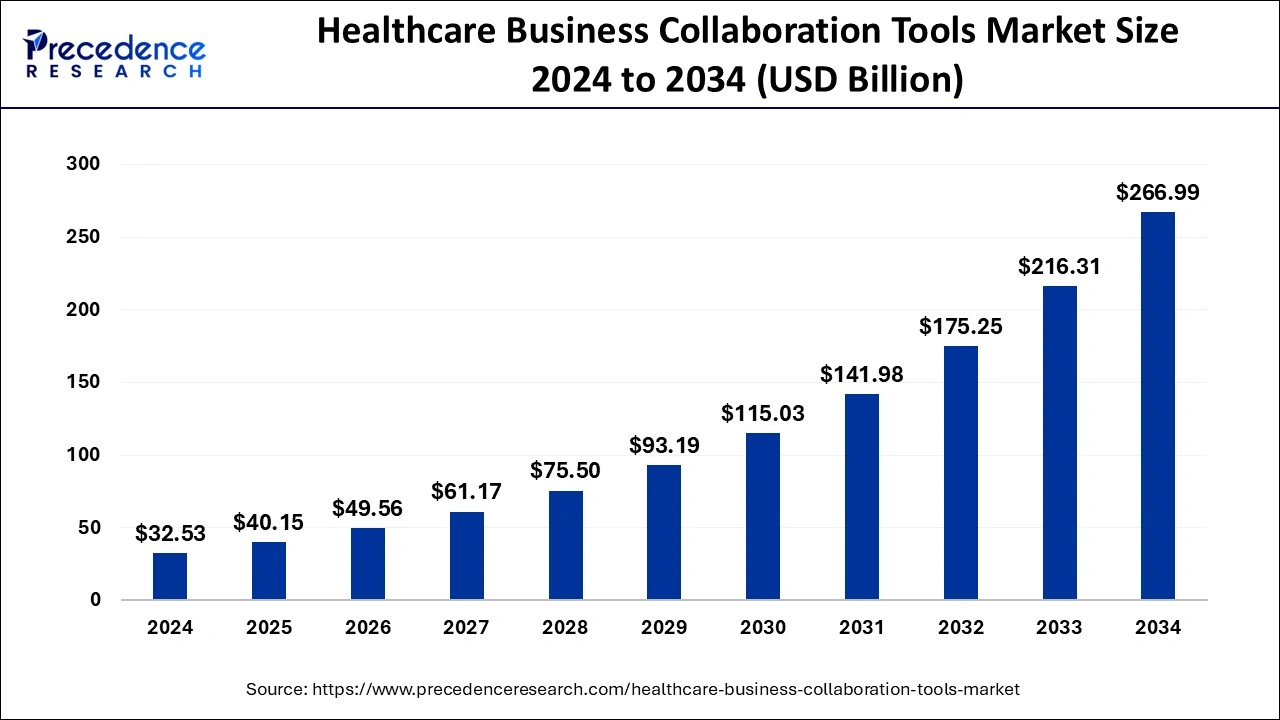
Healthcare Business Collaboration Tools Market Key Takeaways
- Europe dominated the global market with the largest market share of 33% in 2025.
- North America is anticipated to witness the fastest growth in the market during the forecasted years.
- The communication and coordination software segment noted the largest market share in 2025.
- By type, the conferencing software segment is projected to witness the fastest growth during the forecast period.
- By facility size, the large facilities segment contributed the highest market share in 2025.
- By facility size, the small and medium facilities segment is expected to grow at the fastest CAGR during the forecast period.
- By deployment, the on-premises segment has captured the biggest market share in 2025.
- By deployment, the cloud segment is projected to witness the fastest growth in the market during the forecast period.
What is the Healthcare Business Collaboration Tool?
Healthcare business collaboration tools are digital platforms that aid healthcare providers and administrative teams in communicating, coordinating, and managing workflows. In the healthcare industry, it is used to support communication between healthcare providers, facilitate patient flow, and cooperate while sharing information. They also improve care and reduce time spent on tasks and paperwork, while also keeping the patient information safe. Effective tools of communication allow healthcare teams to communicate effectively, especially in critical and sensitive areas.
Furthermore, the use of healthcare business collaboration tools market solutions also rose after the pandemic, because of proper communication and cooperation between the healthcare workforces. Telehealth and remote patient monitoring systems have increased the need for safe and real-time communication platforms allowing clinicians to collaborate across geographical locations.
Artificial Intelligence (AI) Integration in the Healthcare Business Collaboration Tools Market
Artificial intelligence and machine learning are integrated into the healthcare business collaboration tools market systems that offer capabilities to predict the patient's outcome, self-scheduling appointments, and natural language processing. Such AI-integrated components improve workflow and support data-driven decision-making. AI-enabled chatbots to improve the level of interaction with patients. The application of AI, especially machine learning, complements these tools, which contribute to predicting resources and improving customer engagement through solutions based on artificial intelligence.
- In October 2024, Microsoft announced new AI tools within its Microsoft Cloud for Healthcare to boost healthcare workflows and empower healthcare workers. These tools include AI models in Azure AI Studio, developed with partners Providence, a healthcare provider, and Paige.ai, an AI company focusing on medical imaging, to integrate and analyze clinical data for enhanced outcomes.
Healthcare Business Collaboration Tools Market Growth Factor
- Digital healthcare adoption: Digital solutions like electronic records increase as well as improve the uses of telemedicine thus increasing the efficiency of patient care delivery.
- Improved patient care: Adopting collaboration tools in healthcare means that the providers are more knowledgeable about their patients, they make fewer mistakes, and the patient's outcomes are better because of the enhanced flow of information.
- Operational efficiency: The use of collaboration enhances the organization's productivity, lessens operational difficulties, and increases the impact of health systems for patients and clients to give adequate care.
Market Outlook
- Industry Growth Overview: Digital transformation improves adoption. Telehealth demand rises. The use of AI increases the efficiency of coordination, and it facilitates linked healthcare processes around the world.
- Sustainability Trends: Paper is expected to be used less, and travel is likely to be done with digital tools. Cloud solutions facilitate effective processes to facilitate greener healthcare practices around the world.
- Major investors: Sequoia Capital, Accel Partners, Tiger Global, Mayfield, and HealthQuad are the sources of funding that encourage innovation in healthcare collaboration technologies across the world.
Market Scope
| Report Coverage | Details |
| Market Size by 2035 | USD 311.26 Billion |
| Market Size in 2025 | USD 40.15 Billion |
| Market Size in 2026 | USD 49.56 Billion |
| Market Growth Rate from 2026 to 2035 | CAGR of 22.73% |
| Largest Market | Europe |
| Base Year | 2025 |
| Forecast Period | 2026 to 2035 |
| Segments Covered | Type, Facility Size, Deployment, and Regions |
| Regions Covered | North America, Europe, Asia-Pacific, Latin America, and Middle East & Africa |
Market Dynamics
Driver
Increase in telemedicine and remote healthcare services
As the use of telemedicine rises, the collaboration tools improve with a specific focus on patient interactions and remote medical consultation. Such tools are file sharing, video calling, and various self-diagnostic options, which allow telemedicine to render healthcare business collaboration tools market services. The shift towards the approval and use of telemedicine services across the world means that collaboration solutions are a massive opportunity. The advancements in the use of telecommunication in the provision of healthcare services have been primarily responsible for the increasing demand for these tools. Telemedicine relies on effective communication systems to put patients in touch with the healthcare givers for consultation, diagnosis, and treatment.
- In June 2024, Mitel Networks Corp. launched the Virtual Care Collaboration Service (VCCS), a healthcare collaboration solution in the European markets, including France, Belgium, Netherlands, Italy, UK, and Switzerland for both out and in-patient care.
Restraint
Cost constraints
The use of sophisticated communication and cooperation tools in healthcare organizations entails initial major capital costs such as IT infrastructures and licenses, as well as human capital costs. These costs could be a huge restraint to smaller clinics and rural hospitals that do not have adequate funds to invest. A significant number of healthcare organizations experience financial challenges that do not allow the implementation of solutions to support the healthcare business collaboration tools market. This high initial investment for integration and the subsequent recurring cost of maintenance and support pose a problem to providers.
Opportunity
Innovation in healthcare collaboration tools
The healthcare business collaboration tools market is considered to have a high degree of modernization due to the increase in the acceptance of digital technologies or tools for communication and the rising adoption of several strategies by market players to develop healthcare business collaboration tools. The trend of mergers and acquisitions (M&A) continues to shape the business environment as companies look forward to partnerships and acquisitions to improve market presence.
- In March 2022, Fraser Health cooperated with Calian, the Microsoft Gold Certified Partner. This partnership platform is a central hub, boosting patient communication, streamlined scheduling, seamless data exchange, and improved physician collaboration.
Segment Insights
Type Insights
The communication & coordination software segment noted the largest share of the healthcare business collaboration tools market in 2025. There is increased adoption of new technologies within the healthcare industries, such as rolling out software that enhances instant messaging and task assignments. These tools provide solutions for rapid information exchange, care team collaboration, appointment scheduling, and patient engagement, eventually leading to enhanced clinical outcomes and improved patient experiences. Such software platforms create a safe for caregivers to share crucial patient data within a short period. The need for effective communication and coordination solutions has surged as healthcare evolves towards value-based care models and telehealth services.
- In November 2024, Minds and Assembly collaborated with BOLDSCIENCE, a medical communications agency, to improve its fully integrated healthcare communications and commercialization platform for biotech, medical device, pharma, and digital health clients.
The conferencing software segment is projected to witness the fastest growth in the healthcare business collaboration tools market during the forecast period. These tools enable credential and real-time communication between healthcare professionals across geographical regions. Telecommunication platforms focus on applications such as telemedicine, remote consultations, and virtual meetings as consumer adoption of conferencing software grows throughout the healthcare sector. These tools are important for healthcare organizations to maintain operational continuity and deliver quality care in remote or hybrid care delivery models due to features such as support for video, voice, and chat and tools such as screen and document sharing, hence driving the growth of the segment. Expanded functionality, such as the live display of screens and the simultaneous editing of documents, makes medical conversation and decision-making with healthcare teams more effective.
Facility Size Insights
By facility size, the large facilities segment contributed the dominant share of the healthcare business collaboration tools market in 2025. These organizations treat a high patient load and are thus characterized by extended care teams that require frequent and timely communication to support workflow and deliver good patient care. They require efficient and stable collaboration solutions that can be widely applicable to handle almost any aspect of healthcare operations efficiently. Scheduling, patient management, and case management of large numbers of patients are the key things for which collaboration tools can be beneficial and for which waiting time needs to be optimized. Also, large organizations have the financial capabilities to invest in thorough collaboration solutions.
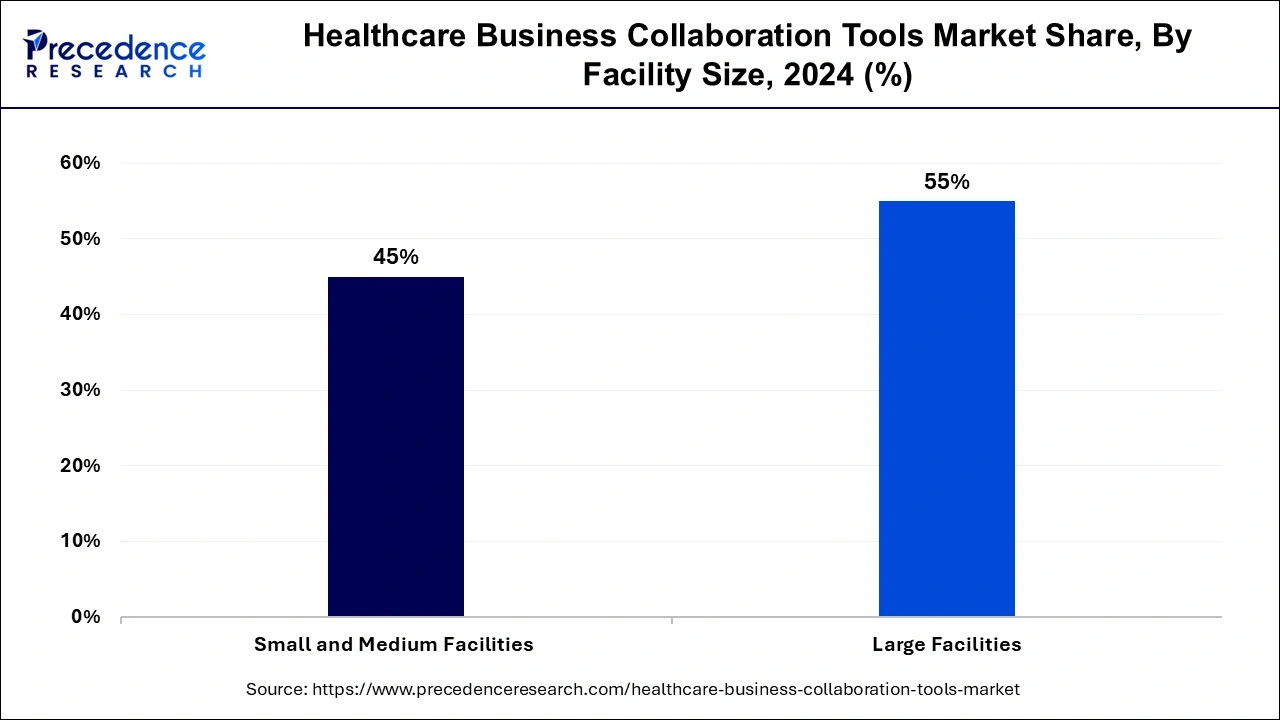
The small and medium facilities segment is projected to witness the fastest growth in the healthcare business collaboration tools market during the forecast period. The anticipated growth is driven by adaptability, cost-effective cloud-based solutions, the urgent need for telehealth and remote care, scalability, recognition of competitive advantages, commitment to quality patient care, and the necessity of regulatory compliance. Business collaboration tools have been adopted in small and medium-sized healthcare facilities as the operational demands of the organizations in patient care and communication require improvements, especially in small teams. Collaboration tools tailored for small and medium-sized setups are intended for ease of use, rapid deployment, and cost-effectiveness.
Deployment Insights
The on-premises segment has contributed the largest share of the healthcare business collaboration tools market in 2025. On-premises software has better flexibility along with better integration and customization facilities and can protect data that includes sensitive information. On-premises deployment, preferred for its localized control and customization options, permits healthcare institutions to host collaboration tools within their physical infrastructure. On-premises solutions in software provide better interface compatibility and configurability, as well as better security and control over data and information, especially for compliance with standard industrial regulations.
The cloud segment is projected to witness the fastest growth in the healthcare business collaboration tools market during the forecast period. Accessibility and efficiency are boosted by data access from any location that has web connectivity through cloud solutions. With the ever-continuing need for resourceful, agile, and cheap methods of communication, cloud-based systems are becoming more and more used in the healthcare sector. Cloud deployment standardizes the use of collaboration tools, with flexibility for healthcare providers to use these tools at remote locations. This growth trend has put great pressure on the advancement and implementation of collaboration solutions tailored for the healthcare sector with an emphasis on real-time communication, information sharing, or enhanced clinical processes.
- In June 2024, Cognizant released the first set of healthcare age language model (LLM) solutions for Google Cloud generative AI (genAI) technology, including the company's Vertex AI platform and Gemini models to redesign healthcare administrative tasks and experience.
Regional Insights
What is the Europe Healthcare Business Collaboration Tools Market Size?
The Europe healthcare business collaboration tools market size was evaluated at USD 16.35 billion in 2026 and is projected to be worth around USD 102.72 billion by 2035, growing at a CAGR of 22.55% from 2026 to 2036.
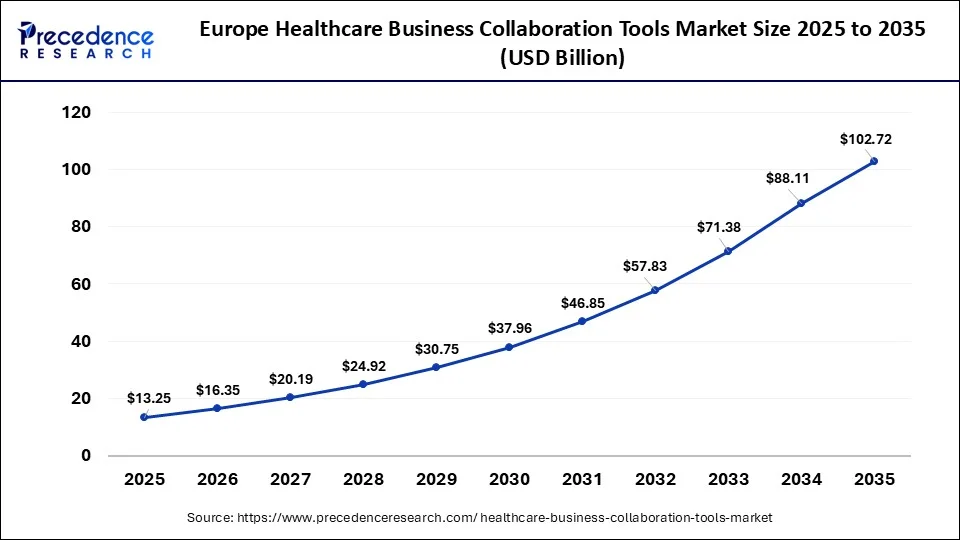
Europe accounted for the largest share of the healthcare business collaboration tools market in 2025. European countries are experiencing integration of advanced technologies, and healthcare providers and emerging healthcare needs require the optimization of patient care. Southern European countries are catching up with the digital health trend, focusing on improving collaboration tools for both healthcare providers and patients. France is rapidly embracing telemedicine, particularly in rural areas where access to healthcare professionals is limited, driving the need for digital collaboration tools. Healthcare collaboration tools are increasingly incorporating AI for scheduling, administrative tasks, patient triage, and automated data analysis, improving efficiency.
Germany Healthcare Business Collaboration Tools Market Trends
The cloud adoption and digital transformation in Germany are quick. Germany is the leader with great emphasis on data privacy compliance. Cloud collaboration tools are used to replace the outdated systems. Interoperability enhances the continuous flow of patient records. The need for sophisticated conferencing systems sustains healthcare coordination.
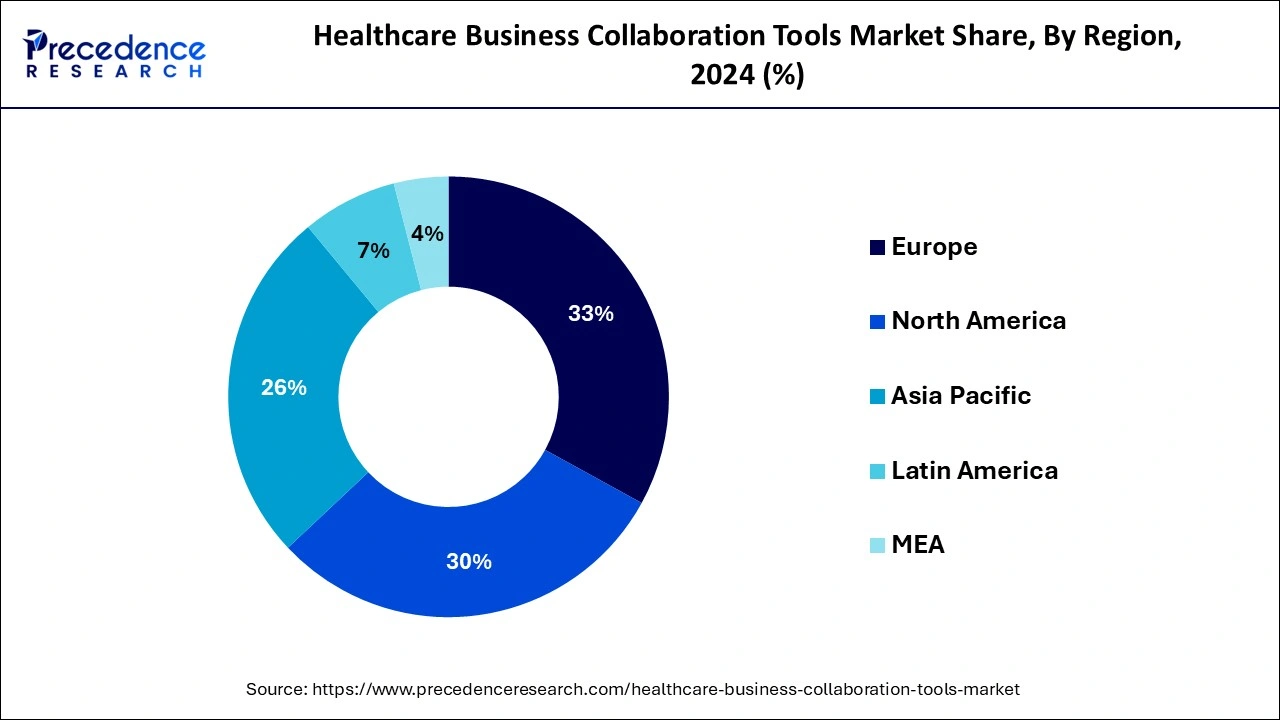
North America is anticipated to witness the fastest growth in the healthcare business collaboration tools market during the forecasted years. North America's developed healthcare system, as well as high technological adoption, contribute to this significant share. These bodies are adopters of collaboration tools to streamline workflows, improve patient care, and encourage medical research and innovation.
The North American government pays special attention to the integration with digital health, where telemedicine services and electronic health records (HER) are successfully introduced along with a favorable collaboration environment. In addition, the area has some rigorous regulations of data privacy, like HIPAA in the United States, that permit the safe use and exchange of patient data.
U.S. Healthcare Business Collaboration Tools Market Trends
U.S. develops with the great digital health and AI incorporation. The U.S. is on top of ambient intelligence tools, which mitigate the workload of clinicians. Online care systems grow exceptionally quickly. The demand for secure messaging increases. Interoperability enhances real-time teamwork in healthcare.
Healthcare Business Collaboration Tools Market Companies
- Microsoft: Offers Cloud for Healthcare, which combines Teams, Azure, and Dynamics. Allows secure collaboration, virtual care, and AI-powered documentation with Copilot.
- Google: Provides AI-based Workspace and Cloud Healthcare API. Promotes real-time documentation, analytics, and patient engagement in healthcare ecosystems.
- IBM: Provides Watsonx AI HIPAA-compliant cloud. Allows safe data sharing, analytics, and consulting to update healthcare collaboration systems throughout the world.
Other Major Key Players
- FreshBooks
- CONTUS TECH
- Tvisha Technologies Pvt Ltd.
- Zoho Corporation Pvt. Ltd.
- Wrike, Inc.
- 500apps.com
- BrainCert
Announcements by Industry Leaders
- In April 2024, Philips announced their collaboration with SmartQare, a company that focuses on health and wearables, to improve and domicile the process of care monitoring in and out of hospitals. This collaboration incorporates SmartQare's advanced patient monitoring technology with Philips' extensive healthcare solutions, aiming to improve the efficiency and accuracy of continuous monitoring.
Recent Developments
- In October 2025, Verily partnered with UCHealth, the University of Colorado Anschutz, and RefinedScience to enhance data usage and healthcare delivery. The collaboration aims to advance precision medicine through AI and digital tools, aggregating biomedical data for research and developing AI/ML models in areas like oncology and neuroscience. (Source: https://www.businesswire.com)
- In April 2025, the Cleveland Clinic and AKASA partnered to implement generative AI tools for efficient medical coding. The collaboration will enhance mid-revenue cycle processes at the Cleveland Clinic's U.S. locations, improving documentation and coding accuracy.
(Source: https://newsroom.clevelandclinic.org) - In June 2024, Keragon Inc. of healthcare automation software unveiled the out of stealth, the first no-code workflow automation platform built specifically for the U.S. healthcare sector.
- In February 2024, Oracle expanded its partnership with ObvioHealth, the digital clinical trial organization, to amplify the life science segment globally. The long-term partnership targets Synching ObvioHealth's digital trial services with Oracle's numerous health information management platforms to offer effective trial solutions and improve patient monitoring on a global scale.
- In August 2023, HCA Healthcare, Inc., a leading healthcare company in the United States, and Google Cloud revealed a new partnership to utilize generative AI to advance workflows on time-consuming tasks, such as clinical documentation, so physicians and nurses can focus on patient care.
Segments Covered in the Report
By Type
- Conferencing Software
- Communication and Coordination Software
By Facility Size
- Small and Medium Facilities
- Large Facilities
By Deployment
- Cloud
- On-Premises
By Geography
- North America
- Asia Pacific
- Europe
- Latin America
- Middle East and Africa
For inquiries regarding discounts, bulk purchases, or customization requests, please contact us at sales@precedenceresearch.com
Frequently Asked Questions





Ask For Sample
No cookie-cutter, only authentic analysis – take the 1st step to become a Precedence Research client
 Get a Sample
.webp)



 sales@precedenceresearch.com
 Schedule a Meeting
