



High Throughput Screening (HTS) Market Size, Companies, Share, Patient Volume, Treatment Adoption Rates, Pricing Analysis, Regulatory Landscape, Competitive Positioning, and Demand Forecast
High Throughput Screening (HTS) Market (By Products and Services: Consumables, Instruments, Services, Software; By Technology: Cell-based Assays, Lab-on-a-chip Technology (LOC), Label-free Technology, Ultra-High Throughput Screening; By Application: Drug Discovery Programs, Chemical Biology Programs, Biochemical Screening, Cell & Organ-based Screening; By End Use: Pharmaceutical & Biopharmaceutical Companies, Academic & Research Institutes, Contract Research Organizations (CROs), Others) - Global Industry Analysis, Size, Trends, Leading Companies, Regional Outlook, and Forecast 2026 to 2035
Source: https://www.precedenceresearch.com/high-throughput-screening-market
 Get a Sample
 Table Of Content


What is High Throughput Screening (HTS) Market Size in 2026?
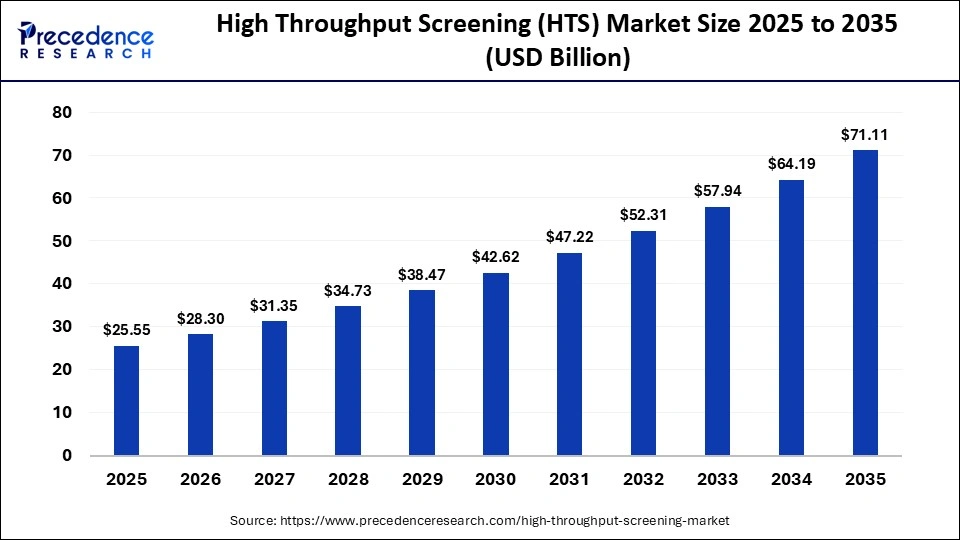
The global high throughput screening (HTS) market size was calculated at USD 25.55 billion in 2025 and is predicted to increase from USD 28.30 billion in 2026 to approximately USD 71.11 billion by 2035, expanding at a CAGR of 10.78% from 2026 to 2035. The growth of this market is driven by the increasing adoption of high-throughput screening technologies in the pharmaceutical, biotechnology, and chemical industries, as they enable faster and more efficient drug discovery and development.
Key Takeaways
- North America dominated the market with the largest share of 52% in 2025.
- Asia Pacific is expected to grow at the fastest CAGR during the forecast period.
- By product and services, the consumables segment dominated the market with the largest CAGR in 2025.
- By product and services, the services segment is expected to grow at the fastest CAGR during the forecast period.
- By technology, the cell-based assay technology segment dominated the market with the largest share in 2025.
- By technology, the lab-on-a-chip (LOC) technology segment is predicted to grow at the fastest CAGR during the forecast period.
- By end use, the pharmaceutical & biopharmaceutical companies segment dominated the market with the highest share in 2025.
- By end use, the academic & research institutes segment is expected to grow at the fastest CAGR during the forecast period.
- By application, the drug discovery programs segment dominated the market with the highest share in 2025.
- By application, the biochemical screening segment is expected to grow at the fastest CAGR during the forecast period.
Market Overview
The high throughput screening (HTS) market refers to the global industry focused on technology instruments, reagents, and software used to rapidly test and analyze thousands of millions of chemicals or biological compounds simultaneously. HTS plays a critical role in drug discovery and life sciences research as it helps scientists quickly identify potential drug candidates, biological targets, and toxic effects during the early stage of research. Due to its speed, efficiency, and ability to process a large volume of samples, HTS is increasingly being applied in fields such as stem cell research, toxicology, and other biomedical studies.
The growing use of HTS across research areas has significantly contributed to the expansion of the market. Additionally, the rise of open innovation and collaborative research models is further supporting market growth. Pharmaceutical and biotechnology companies are increasingly partnering with academic institutions, research organizations, and technology providers to access advanced screening technologies and innovative research approaches.
How are Technological Advancements Influencing the High Throughput Screening (HTS) Market?
Advanced technologies play a crucial role in transforming the high throughput screening (HTS) market by improving the efficiency of drug discovery. One of the most significant developments is the integration of artificial intelligence and machine learning, which enables researchers to analyze massive data sets generated by the HTS platform with greater speed and accuracy. Companies such as Schrodinger in silicon medicine and Thermo Fisher Scientific are actively applying AI to optimize compound libraries, predict molecular interactions, and improve assay design. These AI-driven predictive analytics and pattern recognition help with identifying promising drug candidates faster.
In addition, advances in robotics automation, miniaturization, and cloud-based platforms have significantly enhanced screening speed and reproducibility while reducing manual intervention and human error. The integration of AI with automated laboratory systems also supports real-time monitoring, scalable workflows, and better collaboration across global research teams.
What are the Major Trends in the High Throughput Screening (HTS) Market?
- Product innovations and launches: Key players operating in the market are increasingly focusing on introducing new laboratory solutions to support research and drug discovery. Also, many companies have developed advanced instruments such as multimode plate readers that allow scientists to analyze biological and chemical samples using different detection methods on a single platform. For instance, in February 2026, QIAGEN introduced QIAsprint Connect, a benchtop automation system, which simplify high throughput sample preparation in research labs.
- Growing burden of chronic diseases: The increasing prevalence of chronic diseases has also strengthened demand for high-throughput screening technologies. Conditions such as cancer, diabetes, and cardiovascular diseases require continuous research to identify new therapeutic targets and drug candidates. These HTS systems Help identify potential treatments that act on specific biological pathways involved in long term diseases.
- Expansion of research and manufacturing facilities: Pharmaceutical and biotechnology companies are expanding their research and manufacturing infrastructure to support drug development activities. For instance, in February 2026, Revvit Y introduced several discovery platforms, including the Opera Phoenix OptiQ high content screening systems designed to accelerate screening and data analysis workflows in research laboratories.
- Strategic partnerships: Collaborations between pharmaceutical companies and technology providers are becoming more common in the HTS ecosystem. Such partnerships help integrate automation and advanced screening technologies into the drug discovery workflow.
Market Scope
| Report Coverage | Details |
| Market Size in 2025 | USD 25.55 Billion |
| Market Size in 2026 | USD 28.30 Billion |
| Market Size by 2035 | USD 71.11 Billion |
| Market Growth Rate from 2026 to 2035 | CAGR of 10.78% |
| Dominating Region | North America |
| Fastest Growing Region | Asia Pacific |
| Base Year | 2025 |
| Forecast Period | 2026 to 2035 |
| Segments Covered | Product and Services, Technology, End Use, Application, and region |
| Regions Covered | North America, Europe, Asia-Pacific, Latin America, and Middle East & Africa |
Segment Analysis
Product and Services Insights
Why Did the Consumables Segment Dominate the High Throughput Screening (HTS) Market?
The consumables segment dominated the market with the highest share in 2025. The dominance of this segment is largely driven by the regular and repeated use of consumables such as assay kits, reagents, microplates, and detection substrates during screening. These components are essential for enabling automated screening of thousands of chemical and biological compounds within a short time frame. Beyond drug discovery, consumables are also widely used in applications such as toxicology studies, stem cell research, and biomarker identification, which has further expanded their demand across research laboratories.
The services segment is expected to grow at the fastest CAGR in the upcoming period. The growth of the segment is driven by the increasing complexity in screening workflows, which has encouraged many pharmaceutical and biotechnology companies to rely on specialized service providers for asset development, target validation, data analysis, and automation support. Services now extend far beyond routine testing and include target profiling, assay optimization, compound library screening, and advanced data interpretation.
Technology Insights
What Made Cell-Based Assay the Leading Segment in the High Throughput Screening (HTS) Market?
The cell-based assay segment led the market with the highest share in 2025 because these assays are widely used for their ability to provide biologically relevant information about how compounds interact with living cells. Unlike traditional biochemical assays, they focus on isolated molecular target cell-based systems, which allow researchers to observe multicellular responses simultaneously, including toxicity signaling pathways and metabolic changes. The increasing shift from conventional 2D cell cultures to 3D cell models has further enhanced the relevance of these assays in drug discovery and enables researchers to generate more accurate and predictive screening outcomes.
The lab-on-a-chip (LOC) segment is projected to grow at the fastest CAGR during the forecast period, as it reduces reagent use, decreases sample volume requirements, and lowers overall costs. LOC systems integrate microfluidics, miniaturized sensors, and automated detection techniques within compact platforms, allowing rapid analysis of biological samples using very small volumes of reagents. In 2025, several research groups and technology developers introduced advanced microfluidic-based screening systems capable of performing thousands of rapid measurements from minimal biological samples, demonstrating the potential of LOC platforms for next-generation diagnostic and personalized medicine.
End Use Insights
Why Did the Pharmaceutical and Biopharmaceutical Companies Segment Dominate the Market?
The pharmaceutical & biopharmaceutical companies segment dominated the market with the highest market share in 2025. This dominance is largely linked to the intense competition within the drug development landscape, where companies are constantly striving to identify new therapeutic candidates more quickly and efficiently. As a result, many organizations are expanding their research pipelines and increasing reliance on outsourced research and development services, which has increased the demand for HTS technologies. Pharmaceutical and biotechnological companies also invest heavily in research and development activities aimed at identifying new therapeutic candidates.
Also, the global burden of chronic diseases, including CVD, metabolic conditions like cancer, neurological disorders, and immune-related diseases are further accelerated need for novel drug molecules. High-throughput screening plays a critical role in the early stage by enabling researchers to evaluate thousands of compounds rapidly, making it an essential tool for pharmaceutical innovation and contributing significantly to the growth of the segment.
The academic & research institutes segment is projected to expand at the fastest rate during the forecast period. Growth in this segment is strongly supported by increasing collaborations between academic institutions and industry partners. These partnerships allow institutions to share infrastructure, technical expertise, and research resources while also supporting the training of future scientists and laboratory professionals. The HTS technologies are used to explore new biological targets, identify promising therapeutic compounds, and investigate complex cellular pathways. The ability of HTS platforms to generate large volumes of biological data efficiently makes them valuable to academic research.
Application Insights
How Does the Drug Discovery Programs Segment Dominate the High Throughput Screening (HTS) Market?
The drug discovery programs segment dominated the market with the largest share in 2025. This is because HTS enables rapid testing of thousands of compounds, accelerating the identification of potential drug candidates. Its integration with advanced automation and data analytics allows pharmaceutical companies to streamline lead identification and optimization efficiently. Additionally, the growing focus on developing new therapies across therapeutic areas sustains high demand for HTS in drug discovery pipelines.
The biochemical screening segment is expected to grow at the fastest CAGR during the forecast period. This is primarily due to its ability to rapidly evaluate enzyme activities, receptor-ligand interactions, and other molecular targets with high precision. Advances in assay technologies and detection methods have enhanced the sensitivity and reliability of biochemical assays, making them ideal for large-scale compound testing. Additionally, the increasing demand for early-stage drug discovery and target validation drives the adoption of biochemical screening in HTS workflows.
Regional Insights
North America High Throughput Screening (HTS) Market Size and Growth 2026 to 2035
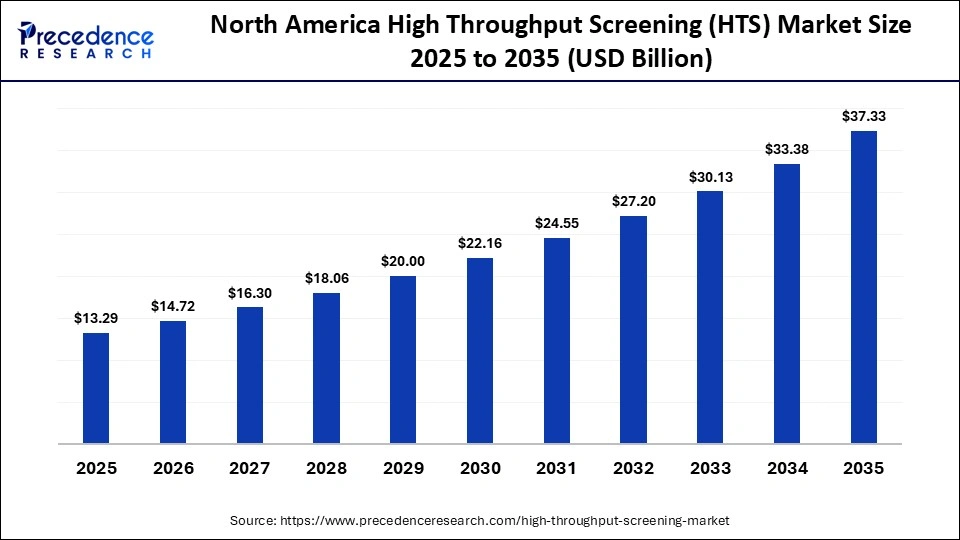
The North America high throughput screening (HTS) market size is estimated at USD 13.29 billion in 2025 and is projected to reach approximately USD 37.33 billion by 2035, with a 10.88% CAGR from 2026 to 2035
What Made North America the Leading Region in the Market?
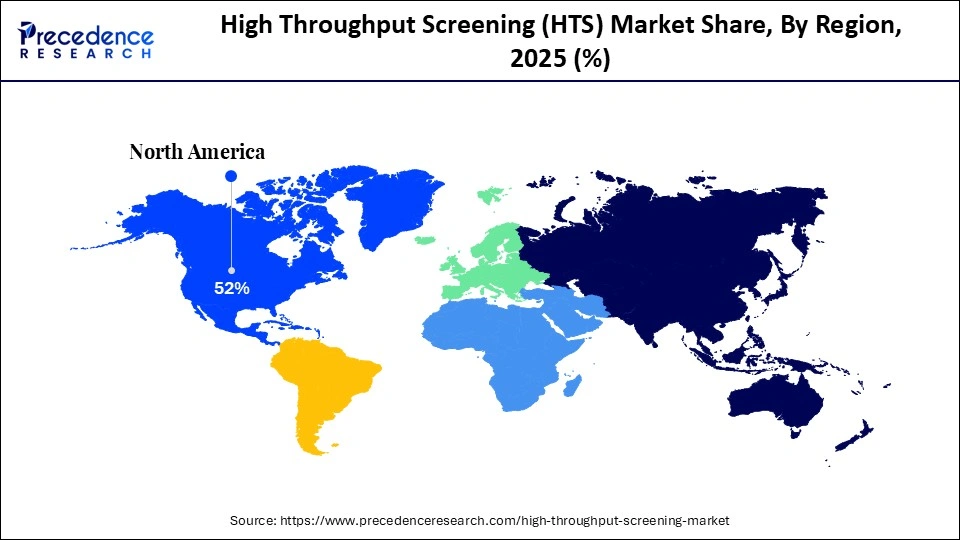
North America led the high throughput screening (HTS) market while capturing the largest share of 52% in 2025. The region's dominant position is supported by its robust pharmaceutical and biotechnological sectors, advanced research infrastructure, and continuous investment in drug discovery. There is a growing prevalence of chronic diseases, which requires the development of new therapeutic solutions. The increasing need to accelerate the identification of potential drug candidates has encouraged the adoption of advanced screening technologies across the region.
Presence of major life science companies such as Thermo Fisher Scientific, Perkin Elmer and Agilent Technologies continue to support technological innovation in automated screening platforms. Moreover, strong collaboration between industry players and academic institutions further promotes the adoption of high throughput screening technologies.
U.S. High Throughput Screening (HTS) Market Size and Growth 2026 to 2035
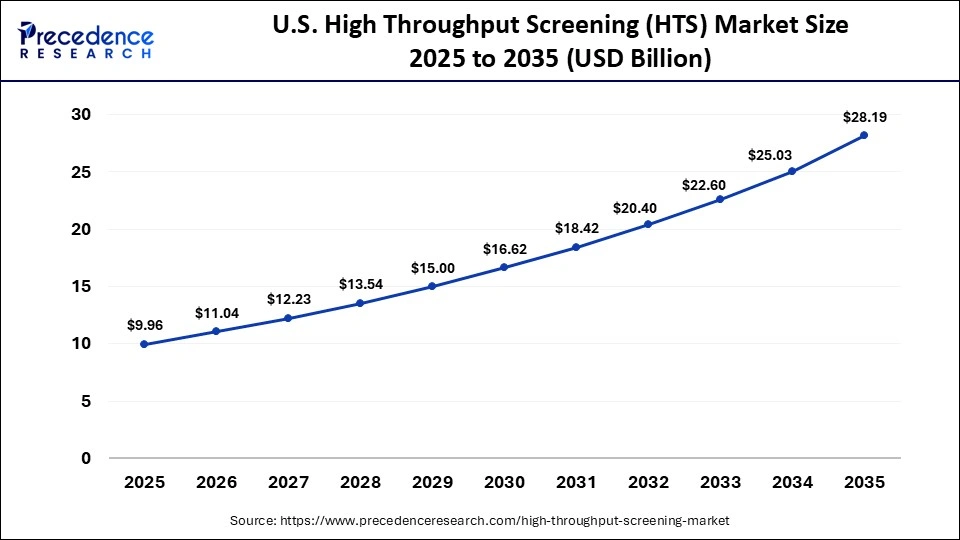
The U.S. high throughput screening (HTS) market size is calculated at USD 9.96 billion in 2025 and is expected to reach nearly USD 28.19 billion in 2035, accelerating at a strong CAGR of 10.96% between 2026 to 2035.
U.S. Market Analysis
The U.S. leads the North American high throughput screening (HTS) market, driven by high research and development spending, a robust biotechnology ecosystem, and the rising prevalence of chronic diseases that demand new therapeutic solutions. Pharmaceutical companies and research institutions are increasingly adopting HTS technologies to accelerate early-stage drug discovery and compound screening. The presence of leading industry players, such as Thermo Fisher Scientific, supports advancements in automated and miniaturized screening platforms, while recent innovations, such as the iQue 3 high-throughput screening cytometers introduced by Sartorius in July 2025, are helping researchers improve workflow efficiency and accelerate drug discovery and cell therapy research.
How is the Opportunistic Rise of Asia Pacific in the High Throughput Screening (HTS) Market?
Asia Pacific is expected to grow at the fastest rate in the market during the forecast period, driven by the rapid expansion of the pharmaceutical and biotechnology industries across the region. Increasing cases of chronic diseases have intensified the need for more efficient drug discovery processes, prompting both public and private organizations to increase investments in research and development. Countries such as China, Japan, and India are emerging as key contributors to the market due to their expanding biotechnology hubs and supportive government initiatives aimed at encouraging scientific innovation.
China Market Analysis
China is expanding rapidly in high throughput screening (HTS) market, supported by significant investments in biotechnology and pharmaceutical research by the government. Initiatives such as Made in China 2025 and funding programs led by the National Natural Science Foundation of China have strengthened the country's innovation ecosystem and encouraged the development of advanced drug discovery technologies. The rapid growth of biopharmaceutical clusters and contract research organizations (CROs), which are increasingly adopting HTS platforms, further supports market expansion. Major domestic companies, such as WuXi AppTec, are enhancing their screening capabilities to serve global pharmaceutical partners, enabling Chinese research institutions and biotech firms to accelerate drug discovery programs and strengthen China's position in the market.
India Market Analysis
India is experiencing steady growth in the high throughput screening (HTS) market, driven by the rapid expansion of the country's pharmaceutical and biotechnology sectors. Increasing R&D investments and the need to accelerate early-stage drug discovery are boosting adoption of HTS technologies. Government initiatives and funding programs led by organizations such as the Department of Biotechnology and the Biotechnology Industry Research Assistance Council are promoting innovation and strengthening the life sciences research ecosystem. India has also become a key hub for outsourced drug discovery services, with contract research organizations like Syngene International supporting global pharmaceutical companies in compound screening and assay development. Major cities such as Bengaluru and Hyderabad are further enhancing HTS capabilities, supporting the growth of drug discovery research across the country.
Europe: A Notably Growing Region
Europe is expected to grow at a notable rate in the market, supported by growing collaborations between research institutions, biotechnology companies, and pharmaceutical firms aimed at advancing screening technologies. These partnerships strengthen research capabilities and increase the demand for high throughput screening platforms across drug discovery programs. Within the region, the UK is a major player in the market, as pharmaceutical companies and research laboratories in the country are increasingly adopting high throughput screening technologies to accelerate drug discoveries while reducing development costs.
High Throughput Screening (HTS) Market Companies
- Agilent Technologies, Inc.
- Danaher Corporation
- Thermo Fisher Scientific Inc.
- PerkinElmer Inc.
- Bio-Rad Laboratories, Inc.
- Aurora Biomed Inc.
- Tecan Trading AG
- Promega Corporation
- Charles River Laboratories.
- Creative Biolabs.
Recent Developments
- On February 15, 2025, Thermo Fisher Scientific introduced a new high-throughput screening platform with AI-driven data analysis and label-free detection capabilities designed to accelerate drug discovery workflows and improve assay sensitivity for pharmaceutical research laboratories.
- On March 3, 2025, Perkin Elmer launched a next-generation microplate-based screening system incorporating microfluidic technology and real-time genomic assay monitoring to enhance screening precision while reducing reagent consumption in high-throughput screening experiments.
- On May 21, 2025, Wuxi Biology introduced its upgraded HTS platform 2.0, a fully automated screening system designed to support hit identification and accelerate drug development across multiple biological targets. The platform integrates automated workflows and a large molecule library to improve efficiency and reproducibility in large-scale screening campaigns.
- On June 30, 2025, Sartorius introduced the IQUE 5 high throughput screening cytometer, designed for rapid cellular screening applications. The system supports up to 27 detection channels, 96- and 384-well formats, and continues 24-hour operation, improving productivity and drug discovery and cell therapy research.
Segments Covered in the Report
By Products and Services
- Consumables
- Reagents & Assay Kits
- Laboratory Equipment
- Instruments
- Liquid Handling Systems
- Detection Systems
- Other Instruments
- Services
- Software
By Technology
- Cell-based Assays
- Fluorometric Imaging Plate Reader Assays
- Reporter-based Assays
- 3D - Cell Cultures
- 2D - Cell Cultures
- Reporter-based Assays
- Perfusion Cell Culture
- Lab-on-a-chip Technology (LOC)
- Label-free Technology
- Ultra-High Throughput Screening
By Application
- Drug Discovery Programs
- Chemical Biology Programs
- Biochemical Screening
- Cell & Organ-based Screening
By End Use
- Pharmaceutical & Biopharmaceutical Companies
- Academic & Research Institutes
- Contract Research Organizations (CROs)
- Others
By Region
- North America
- Latin America
- Europe
- Asia-pacific
- Middle and East Africa
For inquiries regarding discounts, bulk purchases, or customization requests, please contact us at sales@precedenceresearch.com
Frequently Asked Questions





Ask For Sample
No cookie-cutter, only authentic analysis – take the 1st step to become a Precedence Research client
 Get a Sample
.webp)



 sales@precedenceresearch.com
 Schedule a Meeting
