



Homogenizers Market Trends, Companies, Revenue / Sales Performance, Production Capacity, Equipment Utilization, Pricing Analysis, Distribution Performance, Competitive Landscape, and Demand Forecast
Homogenizers Market (By Type: High-Pressure Homogenizers, Ultrasonic Homogenizers, Mechanical Homogenizers, Inline Homogenizers; By Application: Food and Beverage, Pharmaceutical, Cosmetics and Personal Care; Chemical, Biotechnology; By Mode of Operation: Batch Homogenizers, Continuous Homogenizers) - Global Industry Analysis, Size, Trends, Leading Companies, Regional Outlook, and Forecast 2026 to 2035
Source: https://www.precedenceresearch.com/homogenizers-market
 Get a Sample
 Table Of Content


What is the Homogenizers Market Size?
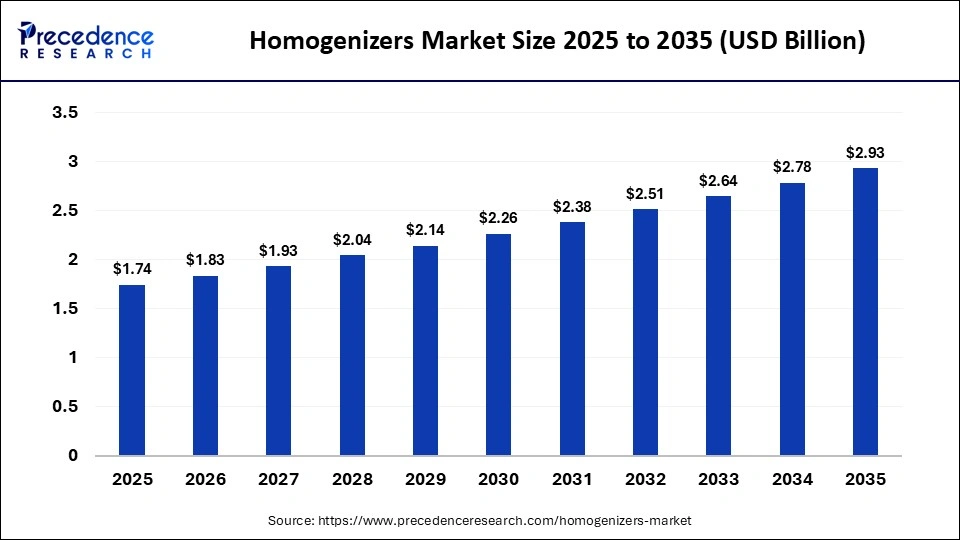
The global homogenizers market size accounted for USD 1.74 billion in 2025 and is predicted to increase from USD 1.83 billion in 2026 to approximately USD 2.93 billion by 2035, expanding at a CAGR of 5.36% from 2026 to 2035. The market is driven by rising demand for uniform and stable formulations across food and beverages, pharmaceuticals, and biotechnology industries.
Market Highlights
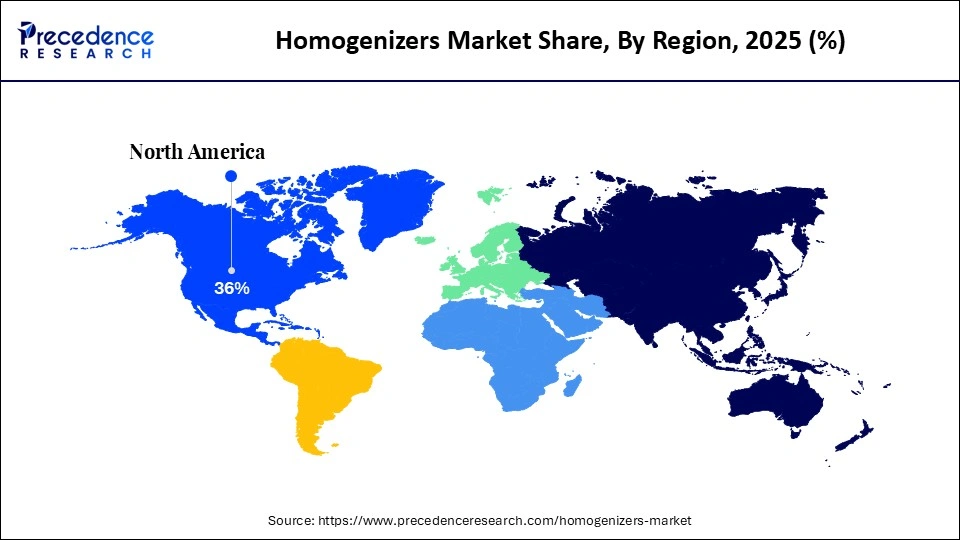
- North America dominated the market with the largest market share of 36% in 2025.
- Asia-Pacific is expected to host the fastest-growing market in the coming years.
- By type, the high-pressure homogenizers segment contributed the biggest revenue share of the homogenizers market in 2025.
- By type, the ultrasonic homogenizers segment is expected to show the fastest growth over the forecast period.
- By application, the food & beverages segment accounted for the highest revenue share of the market in 2025.
- By application, the biotechnology segment is expected to gain the highest share of the market between 2026 and 2035.
- By mode of operation, the batch homogenizers segment led the global market in 2025.
- By mode of operation, the continuous homogenizers segment is expected to witness the fastest growth in the market in the coming years.
Homogenizers: Precision Processing Powering Modern Manufacturing
The market is experiencing robust growth due to increasing preference for consistency, particle size reduction, and product stability by manufacturers. These systems are essential in the emulsification and dispersion processes and cell disruption in various industries. The scope of application is increasing due to investments in biopharmaceutical production and advanced food processing. High-pressure and ultrasonic homogenizers are becoming efficient and able to be scaled as their technologies are being enhanced.
What is the Role of AI in the Homogenizers Market?
Artificial intelligence (AI) is being used in homogenization systems for argument and dispensation for real-time parameters. AI-powered sensors and data analytics are used to control pressure, temperature, and subdivision size for the distribution of energy in a more detailed way. The maintenance of machine learning (ML) has proven to be a cost-driven objective for reducing the cost of operations and downtime structures. An increasing adoption of ML concepts has forged improvement in the legibility of processes, along with enhancing the quality of the produced products.
Homogenizers Market Trends
- AI-based Process Control: They measure pressure and real-time temperature and particle size information that is used to automatically modify processing parameters. This reduces batch-to-batch variation and enhances the quality of goods in the food, pharmaceutical, and biotechnology applications. Another way that predictive analytics helps is to minimize downtimes and the lifespan of the equipment.
- Biopharmaceutical and Cell Disruption: Homogenizers make a big leap in biopharmaceutical preparation to lyse cells, isolate proteins, and produce vaccines. The growing demand for biologics and advanced therapies potentiates the need for homogenizers based on high pressures and microfluidizers. This type of system is effective in cell disruption, and they do not affect product integrity.
- Increased Clean-Label and Functional Foods Demand: The move towards clean-label and even plant-based and functional food goods is creating the necessity to create sophisticated homogenization technologies. Homogenizers can give the desired texture, stability, and bioavailability with no chemical additives. Food manufacturers are resorting to the process of homogenization to satisfy the demand for consumers to have natural and high-quality products. This has been exceptionally true in dairy substitutes and nutraceutical drinks.
- Design of Energy-Saving and Sustainable Equipment: Equipment manufacturers are equally striving to come up with energy-saving homogenizers to reduce the cost of operations, in addition to the environmental impact. This is driven by sustainability objectives and pressures created by regulatory forces are compelling the adoption of the eco-friendly nature of processing equipment.
Market Scope
| Report Coverage | Details |
| Market Size in 2025 | USD 1.74 Billion |
| Market Size in 2026 | USD 1.83 Billion |
| Market Size by 2035 | USD 2.93 Billion |
| Market Growth Rate from 2026 to 2035 | CAGR of 5.36% |
| Dominating Region | North America |
| Fastest Growing Region | Asia Pacific |
| Base Year | 2025 |
| Forecast Period | 2026 to 2035 |
| Segments Covered | Type, Application, Mode of Operation, and Region |
| Regions Covered | North America, Europe, Asia-Pacific, Latin America, and Middle East & Africa |
Segmental Insights
Type Insights
Which Type Segment Dominated the Homogenizers Market?
The high-pressure homogenizers segment held a dominant position in the market in 2025, because it is applicable in various markets, including food, pharmaceutical, and chemical processing sectors. These systems are effective in the reduction of particles and the emulsification of a uniform size with high pressure. They can process large quantities of data; therefore, they can be used in industrial-scale production. Manufacturers have been attracted to the use of pressure homogenizers due to reliability and regulatory compliance. There is constant improvement in technology to increase energy efficiency and process control.
The ultrasonic homogenizers segment is expected to grow at the fastest CAGR in the market between 2026 and 2035, driven by its proficiency in cell disruption and nano-emulsification. High-frequency ultrasonic waves are employed in these systems to contribute to a precise and uniform homogenization. Demand is growing due to the increasing use in biotechnology and laboratory-scale uses. They have a performance advantage due to their appropriateness for heat-sensitive materials. The development of probe material and power control is encouraging wider use.
Application Insights
Which Application Segment Led the Homogenizers Market?
The food & beverages segment led the market in 2025, due to the need for constant texture and stable emulsions. Homogenizers are increasingly used in dairy, beverages, sauces, and vegetable-based products. The increasing demand for functional and fortified foods is enhancing the demands in processing. Safety laws on food are encouraging the integration of sophisticated homogenization technology. Manufacturers are concerned with the efficient homogenization of shelf life and sensory quality.
The biotechnology segment is expected to expand rapidly in the market in the coming years, due to the rising demand for biologics and cell-based studies. Homogenizers are important in the lysis of cells, the extraction of proteins, and the production of vaccines. An increase in biopharmaceutical production is enhancing the use of equipment. Scalability and accuracy are prominent needs based on technological innovation. The market growth is supported by the expansion of research laboratories and bioprocessing plants.
Mode of Operation Insights
How the Batch Homogenizers Segment Dominated the Homogenizers Market?
The batch homogenizers segment accounted for the highest revenue share in the market in 2025, because they are flexible in dealing with production volumes that are small to medium. They are commonly utilized in laboratories and pilot plant production lines. These systems provide the ability to have more control over the processing parameters of specialized formulations. Manufacturers prefer batch operations to product development and testing. The fact that they are cost-effective allows them to be adopted in various industries.
The continuous homogenizers segment is expected to witness the fastest growth in the market over the forecast period, owing to the growing demand for high automation and high throughput. These systems enable continuous production, which enhances the efficiency in the operations and uniformity. Large food and pharmaceutical companies are embracing continuous processes to cut the processing time. Scalability and reliability are improved by integration with automated control systems. Increasing focus on industrial efficiency is enhancing adoption.
Regional Insights
How Big is the North America Homogenizers Market Size?
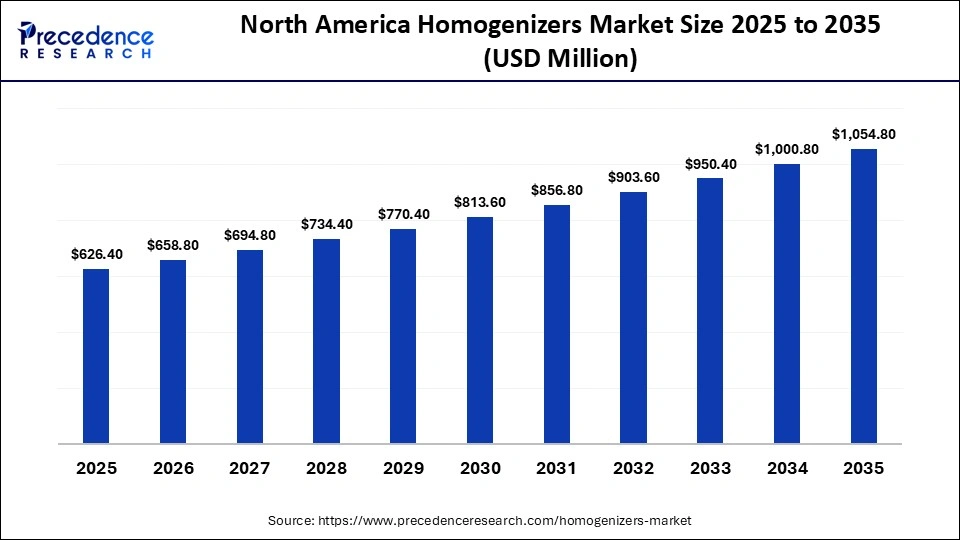
The North America homogenizers market size is estimated at USD 626.40 million in 2025 and is projected to reach approximately USD 1,054.80 million by 2035, with a 5.35% CAGR from 2026 to 2035.
Why North America Dominated the Homogenizers Market?
North America dominated the market in 2025, driven by the burgeoning food & beverages, pharmaceutical, and biotechnology industries. The region enjoys progressive manufacturing facilities and the timely introduction of automated processing technology. Tough food safety and pharmaceutical quality regulations are pushing the use of high-performance homogenizers. Market growth is being reinforced by increased investment in the manufacturing of biopharmaceuticals and the creation of vaccines. The increasing trend in consumption of clean-label and functional food products is increasing the adoption of homogenizers. Stable market leadership is ensured through continuous technological innovation by the regional equipment manufacturers.
What is the Size of the U.S. Homogenizers Market?
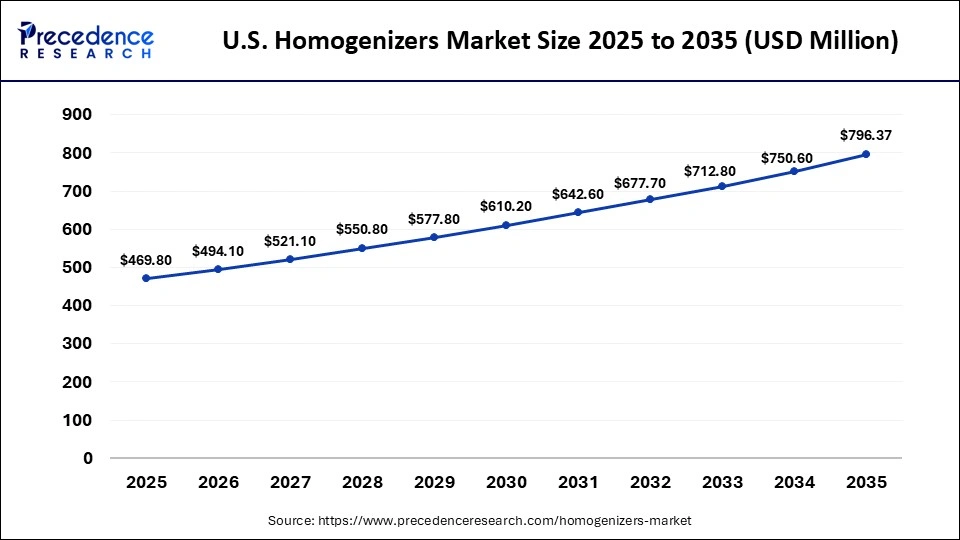
The U.S. homogenizers market size is calculated at USD 469.80 million in 2025 and is expected to reach nearly USD 796.37 million in 2035, accelerating at a strong CAGR of 5.42% between 2026 and 2035.
U.S. Country Level Analysis
The U.S. dominates the market in North America as a result of a high level of food and beverage production and the biopharmaceutical industry. Large homogenization systems are used by major pharmaceutical companies and CMOs in the U.S. in large-scale production. Canada is also experiencing stable growth because of the growth in dairy and nutraceutical sectors. The support offered by the government to modern manufacturing is motivating the improvement of equipment in processing plants. Mexico is becoming a manufacturing hub in processed foods and drinks. Modernization of processing infrastructure is being facilitated by increasing foreign investments.
How is Asia-Pacific Growing in the Homogenizers Market?
Asia-Pacific is expected to be the fastest-growing region in the market during the predicted timeframe, on account of blistering industrialization and growth of food processing sector. The tendency towards population growth and urbanization is gaining pressure on packaged and processed food products. The increase in biotechnology and pharmaceutical production is hastening the use of equipment.
Governments are making investments in healthcare facilities and the production of drugs within the country. The growing attention to the export-quality food and pharmaceutical products is preconditioning the widespread request of the high-technology homogenization. Regional growth is being reinforced by the manufacturing that is cost-effective and increased R&D activity.
Country Level Analysis
China is the first one to have large-scale food processing and biopharmaceutical manufacturing facilities. Government support and the manufacturing of domestic equipment is enhancing access to technology. India is having a robust growth because of the growing dairy, beverage, and biotechnology industries.
Will Europe Grow in the Homogenizers Market?
Europe is expected to grow at a notable CAGR in the foreseeable future as the continent reflects a dynamic nature which is manifested in its diverse economic forms and geographical settings and cultural customs. Each country has varied opportunities and challenges to its businesses and investors depending on its business environment. Germany has the best interests in engineering and in production of technological advancement because the industrial base of the country makes it the first country to be referred to.
The French and Italian markets are international centers of high-end products and fashion design. Nordic countries comprising of Sweden and Finland are successful because of their technology and sustainability that establish global benchmarks of renewable energy and innovation. The European Union is a large single market that enhances trade and investment operations within the member states.
Country Analysis
The UK creates a favorable business environment due to its strong financial services sector that has not been brought down by Brexit. The Eastern European countries, specifically Poland and Hungary, offer the best growth opportunities to investors due to their affordability of labor costs and superior infrastructure development.
The Southern region of Europe offers Spain and Greece with their unique tourist attractions and agricultural practices, but the economic stability status of the two countries varies. The European business environment is a mixture of the old markets and the new developing economies, which compels businesses to adapt their activities to the details of the local circumstances and the market changes.
What is the Landscape of the Homogenizers Market in Latin America?
Latin America is expected to grow at a notable CAGR in the foreseeable future. The demand for homogenizers has grown significantly from the pharmaceutical sector to manufacture suspensions and emulsions for injectables. Government investments aimed at strengthening the chemicals industry across Brazil and Argentina further increase the application of homogenizers. Moreover, the growing adoption of packaged foods among people further contributes to industrial growth.
Brazil Market Analysis
The rising demand for homogenizers from the food industry to manufacture sauces and dressings has boosted the market expansion. Biotechnology companies are heavily deploying homogenizers to develop a wide range of vaccines. Also, the surging demand for industrial coatings and the growing adoption of body lotion by women drive the market expansion.
What are the Driving Factors of the Homogenizers Market in the Middle East and Africa?
The Middle East and Africa region is considered to be a significantly growing area, due to the increasing use of ultrasonic homogenizers in chemical companies to manufacture specialized suspensions. In addition, the surging focus of the global dairy companies to open new centers in Saudi Arabia and the UAE has increased the demand for homogenizers. Government initiatives aimed at strengthening the biopharmaceutical industry also add to the market growth.
UAE Market Analysis
The growing demand for specialized lubricants and high-quality adhesives from oil and gas companies increases the application of mechanical homogenizers. Also, the increasing use of high-quality skincare items among elite consumers has emphasized the need for skincare brands to deploy advanced homogenizers in their production units. In addition, the rapid growth of the chemical industry, along with the increasing sales of inline homogenizers, boosts the market growth.
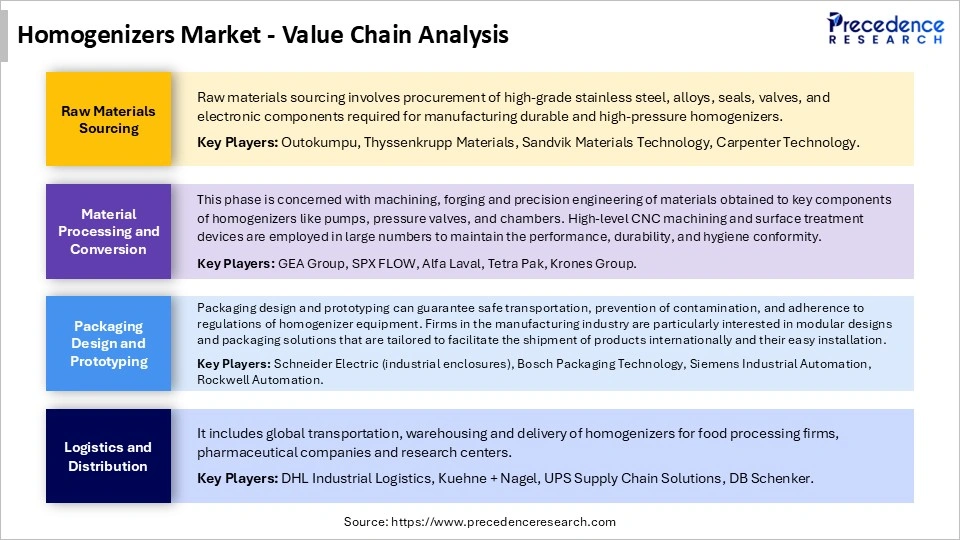
Homogenizers Market Value Chain Analysis
Competitive Landscape
The homogenizers market is characterized by a dynamic competitive landscape that consists of established brands and the proliferation of startups. The fragmented nature of the market allows for a diverse range of products and services for specific consumers. The top companies dealing in this industry comprise players such as SPX Flow, GEA Group, and Alfa Laval. These brands are making significant investments to strengthen their product portfolio. GEA Group generally focuses on innovation related to process technology, while SPX Flow is engaged in manufacturing eco-friendly items to enhance sustainability and energy efficiency in its homogenizers. Brands like Alfa Laval (SE) are engaged in expanding their businesses in emerging nations to strengthen their global outreach.
The issues associated with high energy consumption and regulatory hurdles have created problems among the market leaders. Leading brands have started using eco-friendly materials for the manufacturing of upcoming products. In addition, the integration of real-time quality control sensors in homogenizers will drive opportunities in the future.
Who are the Major Players in the Global Homogenizers Market?
The major players in the homogenizers market include GEA Group, SPX Flow, Inc., Krones AG, Sonic Corporation, Avestin Inc., Bertoli s.r.l., FrymaKoruma GmbH, Microfluidics International Corporation, Silverson Machines Inc., FBF Italia S.r.l., NETZSCH Group, PHD Technology International LLC, Alfa Laval AB, BEE International Inc., Ekato Holding GmbH, Shanghai Donghua High Pressure Homogenizer Factory, Omni International, Inc., Scilogex, LLC, WAB Group, and ATS Engineering Inc.
Recent Developments
- In May 2025, SPX FLOW launched its latest APV homogenizer system which offers advanced operational power together with additional functions while maintaining its compact system design. The system improves operational efficiency and delivers high performance reliability through its operation in a compact system design.
- In February 2025, Tetra Pak introduced its dual function homogenizer which operates with low energy requirements for better food processing efficiency. The equipment provides two functions because it can both homogenize and pasteurize materials while preserving product quality and delivering substantial energy efficiency benefits.
- In May 2024, Tetra Pak expanded its homogenizer range by introducing the Circle Green which operates as a sustainable model that reduces both energy and water usage. The new equipment enables the company to fulfill its environmental goals while improving efficiency of dairy and beverage processing operations which meet the rising need for eco-friendly solutions.
Segments Covered in the Report
By Type
- High-Pressure Homogenizers
- Ultrasonic Homogenizers
- Mechanical Homogenizers
- Inline Homogenizers
By Application
- Food and Beverage
- Pharmaceutical
- Cosmetics and Personal Care
- Chemical
- Biotechnology
By Mode of Operation
- Batch Homogenizers
- Continuous Homogenizers
By Region
- North America
- Europe
- Asia-Pacific
- Latin America
- Middle East & Africa
For inquiries regarding discounts, bulk purchases, or customization requests, please contact us at sales@precedenceresearch.com
Frequently Asked Questions
Tags





Ask For Sample
No cookie-cutter, only authentic analysis – take the 1st step to become a Precedence Research client
 Get a Sample




 sales@precedenceresearch.com
 Schedule a Meeting
